

Civil Engineering Courses and Diplomas: Topics, Skills and Career Routes
Introduction
Civil engineering is the backbone of modern society. From roads and bridges to skyscrapers and water systems, civil engineers design, build, and maintain the infrastructure that keeps the world running. If you’re considering a civil engineering course or diploma, understanding what it covers is key to choosing the right pathway.
What Is a Civil Engineering Course or Diploma?
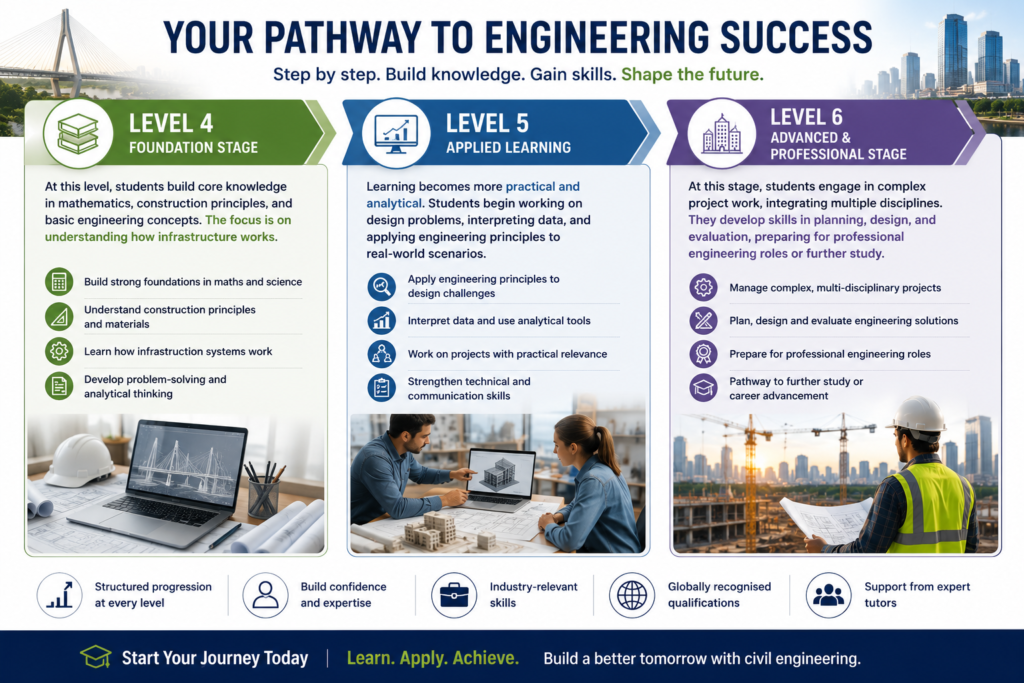
A civil engineering course or diploma is designed to equip students with the technical knowledge and practical skills needed to work in the construction and infrastructure sector. These programmes range from introductory (foundation or Level 4) to advanced (Level 6 or degree-equivalent), allowing learners to progress step by step.
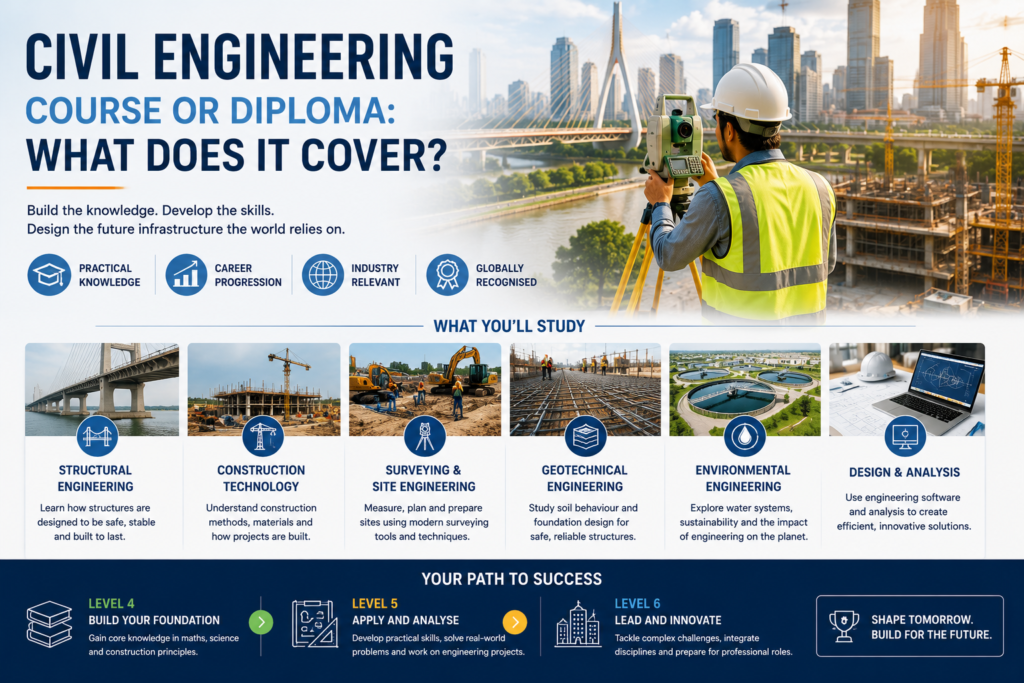
They combine theoretical learning with real-world application, preparing students for roles in design, construction, project management, and engineering consultancy.
Core Subjects You’ll Study
1. Engineering Mathematics and Science
Every civil engineering journey begins with a strong intellectual foundation. At this stage, mathematics and physics are not just subjects, they become the language through which engineers understand the world. Students learn to interpret forces, predict motion, and analyse how materials behave under different conditions. These principles form the backbone of all engineering decisions, enabling learners to move from abstract theory to practical understanding with confidence.
2. Structural Engineering
As knowledge deepens, students begin to explore how the built environment stands strong against the forces of nature. Structural engineering introduces the art and science of designing buildings, bridges, and infrastructure that are both safe and resilient. Learners engage with concepts such as stress, strain, and load distribution, gaining insight into how structures maintain stability under pressure. It is here that engineering precision meets real-world responsibility.
3. Construction Technology
Understanding design is only part of the story, bringing it to life is where engineering truly takes shape. Construction technology immerses students in the practical side of the discipline, exploring materials, methods, and on-site operations. From foundations to finishing, learners discover how projects are planned, managed, and executed. This stage bridges the critical gap between theory and application, turning ideas into tangible structures.
4. Geotechnical Engineering
Beneath every structure lies a complex and often unpredictable foundation, the ground itself. Geotechnical engineering focuses on understanding soil behaviour and ground conditions, revealing how they influence the safety and longevity of structures. Students learn how to design foundations that respond to these conditions, ensuring stability even in challenging environments. It’s a subject that highlights the importance of what lies unseen beneath every project.
5. Environmental Engineering
In today’s world, engineering is not just about building, it’s about building responsibly. Environmental engineering encourages students to consider the broader impact of their work, from water management and waste systems to sustainability and environmental protection. Learners gain an understanding of how engineering solutions can support both human needs and the health of the planet, shaping a more sustainable future.
How Learning Progresses
Practical Skills You’ll Gain
As you progress through your engineering journey, you’ll gain far more than just theoretical knowledge, you’ll develop the practical skills that define real-world engineers. You’ll learn how to bring ideas to life through technical drawing and CAD, transforming concepts into precise, professional designs used across the industry.
Along the way, you’ll sharpen your ability to think critically and solve complex problems, approaching challenges with confidence and analytical clarity. Your learning will also focus on planning and delivering projects effectively, equipping you with the organisational and management skills needed to take ideas from concept through to completion.
You’ll build a deep understanding of how engineering and construction processes work in practice, giving you the insight to see how designs become functional, real-world solutions. At the same time, you’ll develop a strong awareness of safety standards and regulations, ensuring that everything you create meets professional and industry expectations.
Your Future in Civil Engineering Starts Here
A civil engineering diploma doesn’t just give you a qualification, it opens the door to a dynamic and rewarding career in one of the world’s most essential industries. As your skills grow, so do your opportunities.

You could find yourself working as a Civil Engineering Technician, supporting the design and development of vital infrastructure, or stepping onto site as a Site Engineer, helping bring major construction projects to life. If design is your passion, a role as a Structural Design Assistant allows you to contribute to safe, innovative structures that shape the built environment.
For those who enjoy coordination and leadership, careers such as Construction Project Coordinator offer the chance to manage timelines, resources, and teams, keeping projects moving efficiently from concept to completion. You may also progress into roles like Infrastructure Engineer, working on large-scale systems that power cities and communities.
And this is only the beginning. Your diploma can also act as a powerful stepping stone toward a full engineering degree or even postgraduate study, unlocking higher-level roles and long-term career progression.
Is a Civil Engineering Diploma Right for You?
If you’re interested in how the built environment is created and want a career that combines technical knowledge with real-world impact, civil engineering is an excellent choice. A diploma offers a flexible and practical route into the industry, with clear progression opportunities.
A civil engineering course or diploma provides far more than just classroom knowledge, it builds the foundation for a career shaping the world around us. From understanding core engineering principles to tackling complex infrastructure challenges, each stage of study prepares you for increasing levels of responsibility and expertise.
Interested in our Civil Engineering Courses?
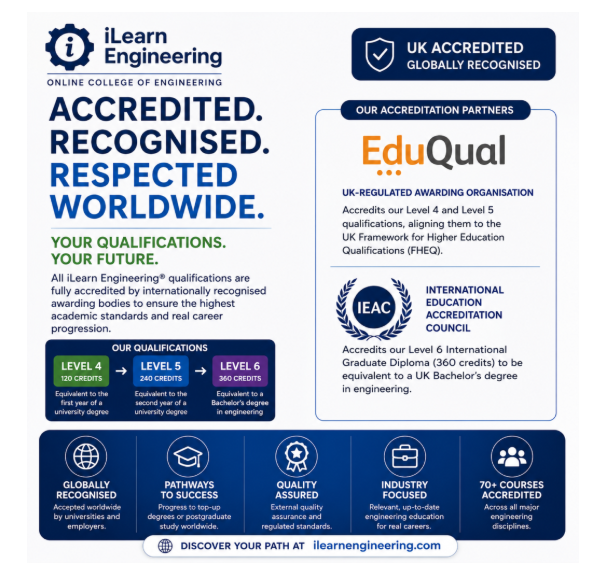
At iLearn Engineering®, we offer a diverse range of online accredited Civil Engineering courses and qualifications to cater to different academic and career goals. Our civil courses are available in varying credit values and levels, ranging from 40 credit Engineering Diplomas to a Bachelor’s equivalent 360 credit International Graduate Diploma.
Get started today
Explore our range of Civil Engineering courses and diplomas
Recent Posts
Types of Aircraft Drag Explained: Induced, Profile and Interference Drag
Types of Aircraft Drag Explained: Induced, Profile and Interference Drag An aircraft experiences several forms of aerodynamic drag at the same time. Some result from generating lift, some arise as air flows over the aircraft’s surfaces, and others are created when airflow around neighbouring components interacts. For a conventional aircraft in subsonic flight, total drag […]
Induced Drag Explained: Why Flying Slower Can Increase Drag
Induced Drag Explained: Why Flying Slower Can Increase Drag Why can an aircraft experience more drag when it flies more slowly? We usually associate greater speed with greater air resistance, but a wing must also generate enough lift to support the aircraft. Induced drag is the drag associated with producing lift on a finite-span wing. […]
Laminar vs Turbulent Boundary Layers: Why Airflow Separates from Aircraft Wings
Laminar vs Turbulent Boundary Layers: Why Airflow Separates from Aircraft Wings Airflow around an aircraft wing is often shown as smooth streamlines passing neatly over the aerofoil. In reality, the thin layer of air immediately next to the wing surface behaves very differently from the undisturbed airflow further away. This region is called the boundary […]