

Why a Headwind Reduces Take-Off Distance: The Airspeed–Groundspeed Derivation
Aeroplanes normally take off into wind because the wing must reach a required airspeed to produce lift, whereas the runway distance is travelled at groundspeed. A headwind contributes to the airspeed before the aircraft has covered any runway. It therefore reduces the groundspeed required at lift-off and, usually, the ground run.
Airspeed is not groundspeed
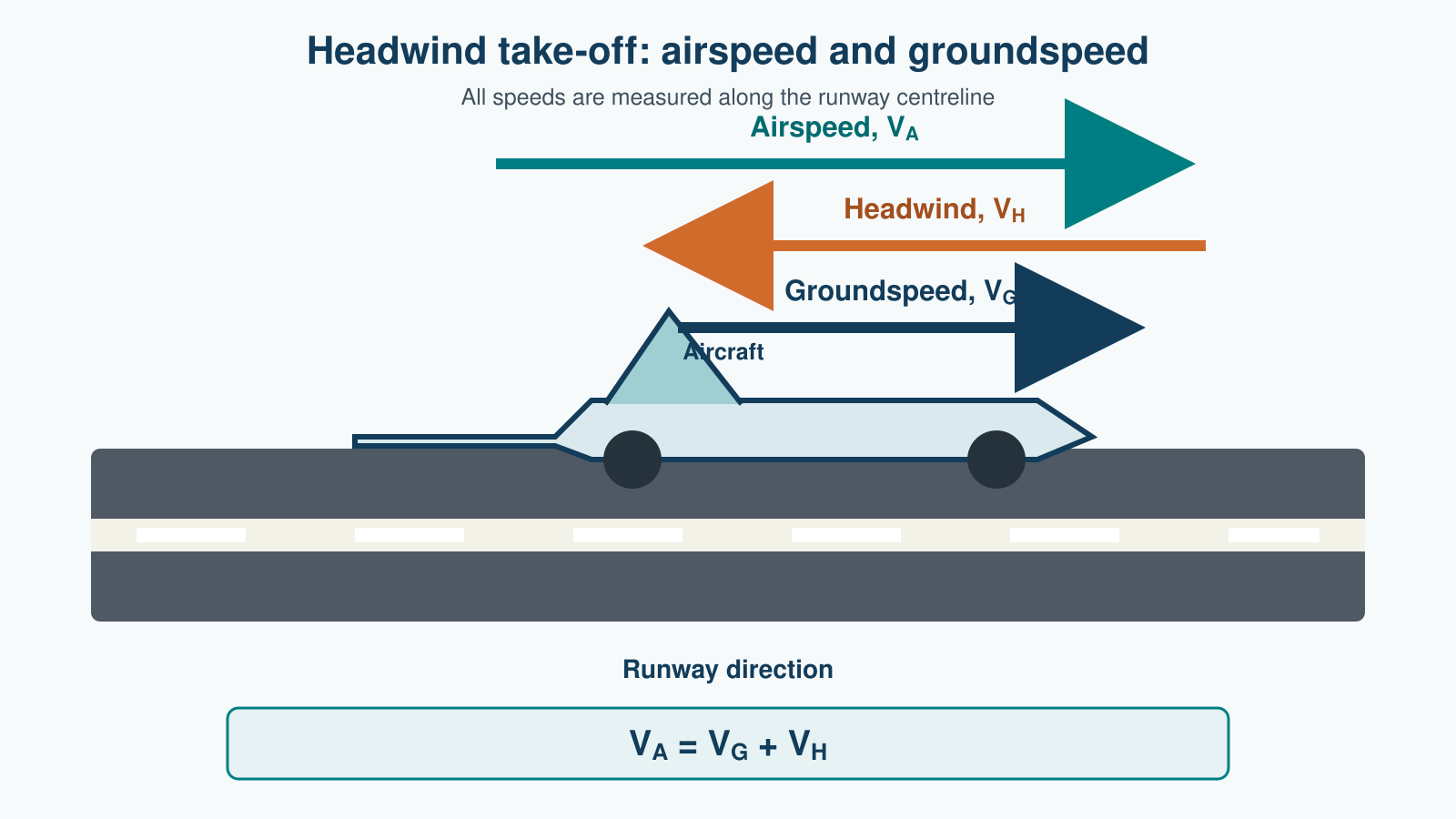
Let positive motion be along the take-off direction. The aircraft airspeed, VA, is its velocity relative to the surrounding air; groundspeed, VG, is its velocity relative to the runway. If the runway has a steady headwind component VH, the one-dimensional velocity relation is:
This is a vector relation written for the particular case in which the wind is directly along the runway. A crosswind must first be resolved into its runway component. The Federal Aviation Administration (FAA) similarly treats take-off performance as dependent on the relevant wind component, not merely the reported wind speed.
Start with the lift requirement
Near lift-off, the wing must generate sufficient lift to support the aircraft weight. The basic lift equation is:
Here, L is lift, ρ is air density, S is wing planform area and CL is lift coefficient. Setting lift equal to weight at the idealised lift-off condition gives a characteristic stall speed:
Aircraft performance data specify the applicable lift-off or rotation target speed for the aircraft and conditions concerned. It can be represented generally as:
Where k is an approved safety and configuration factor, rather than a universal constant. Crucially, VLO is an airspeed. NASA’s lift equation shows why: lift depends on velocity relative to the air, squared—not velocity relative to the ground.
Deriving lift-off groundspeed in a headwind
At lift-off, set airspeed VA equal to the required lift-off speed VLO in the velocity relation:
Rearranging gives:
The aircraft has not become capable of flying at a lower airspeed. It still needs VLO through the air. It simply reaches that airspeed while moving more slowly over the runway.
For a tailwind component VT, the simple corresponding relation is:
A tailwind therefore increases the groundspeed needed before lift-off. This is why tailwind take-offs require particular care and must only be made in accordance with the aircraft’s approved performance data and operating limitations.
From groundspeed to ground run
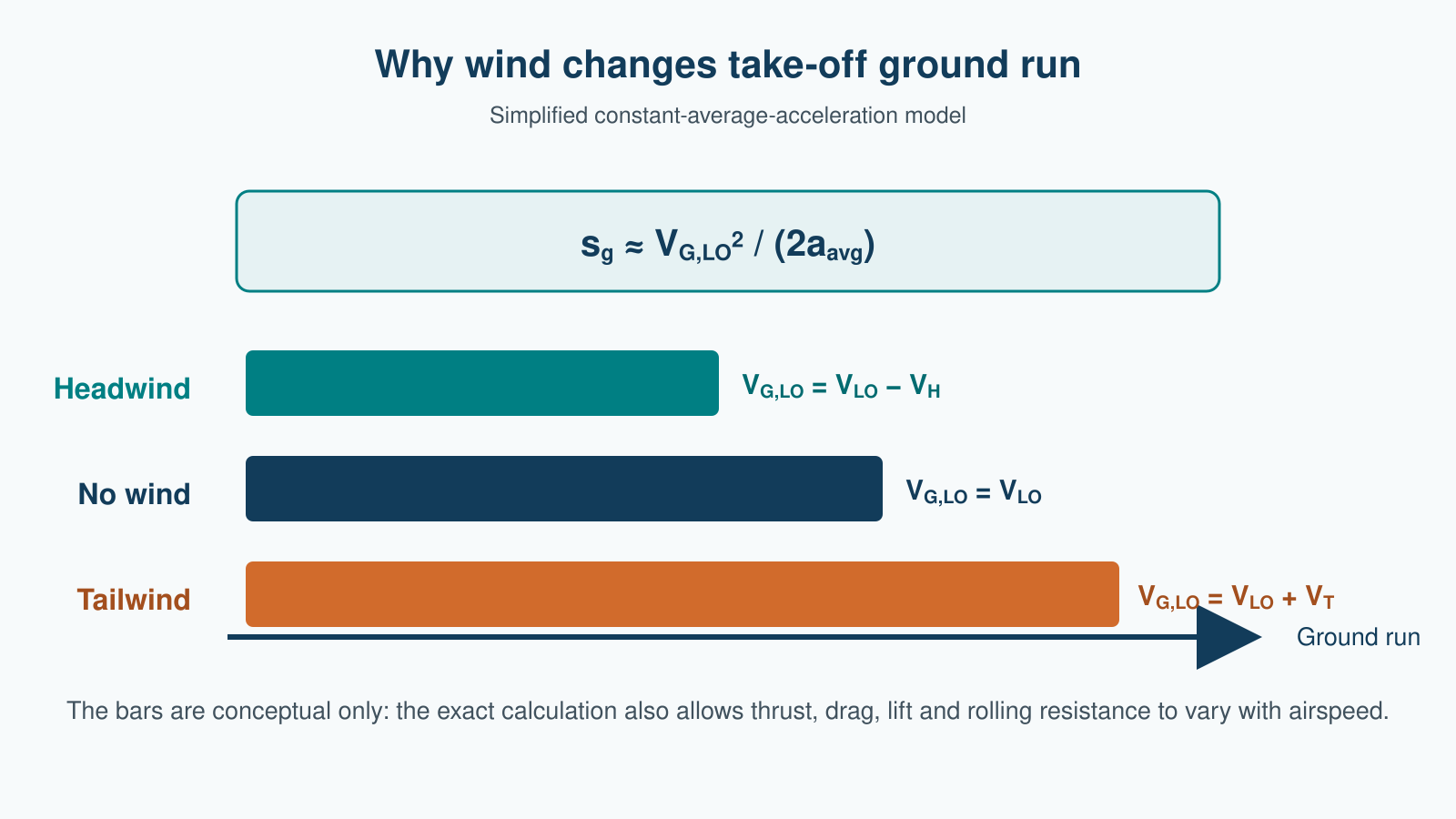
Suppose, initially, that acceleration along the runway is approximated by a constant average value aavg. The constant-acceleration relation gives:
Where sg is ground-run distance. Substitution for a headwind gives:
For a tailwind:
Illustrative comparison
Assume an aircraft requires a lift-off airspeed of 60 m s−1 and has a simplified average acceleration of 2.5 m s−2. With no wind:
With a 10 m s−1 headwind component, the lift-off groundspeed becomes 50 m s−1:
With a 10 m s−1 tailwind component, the lift-off groundspeed becomes 70 m s−1:
This is an illustrative engineering model, not a dispatch or flight-planning calculation. In reality, the acceleration is not constant and an approved aircraft performance method is required.
The fuller flight-mechanics derivation
The notes’ ground-run method can retain the changing forces rather than hiding them inside aavg. Along a level runway, the net accelerating force is:
Where T is thrust, D is aerodynamic drag, μ is rolling-resistance coefficient, W is weight and L is lift. Newton’s second law gives:
For a steady, runway-aligned headwind, airspeed equals groundspeed plus headwind component. The rates of change of airspeed and groundspeed are equal. Since distance increment equals groundspeed multiplied by time increment, the ground run becomes:
This expression is more revealing than the simple square-law model. A headwind lowers the upper limit of the integration, but it also changes the airspeed at every point in the run. That affects lift, drag and tyre loading. Consequently, the exact benefit cannot be found safely by applying one universal percentage correction.
What this derivation does—and does not—tell us
The equations explain the physics, but they do not replace certified aircraft data. Thrust available, runway slope, runway surface, temperature, pressure altitude, aircraft mass, configuration, obstacle clearance and wind variability all affect take-off performance. The FAA advises pilots to use the aircraft’s Pilot’s Operating Handbook or Airplane Flight Manual for the approved take-off conditions and distances.
For students of flight mechanics, however, the result is a useful design insight: take-off distance is controlled not by the lift-off airspeed alone, but by the way airspeed, groundspeed and acceleration interact throughout the ground run.
Develop your flight-mechanics knowledge
The Diploma in Principles of Flight is the closest focused route for studying lift, drag, stability, control and aircraft performance in greater depth. For a broader aerospace-engineering pathway, explore the Higher International Certificate in Aerospace Engineering, the Higher International Diploma in Aerospace Engineering and the International Graduate Diploma in Aerospace Engineering.
Frequently asked questions
Does a headwind reduce the airspeed needed for take-off?
No. The required lift-off airspeed is set by the aircraft’s aerodynamic and operational requirements. A headwind reduces the groundspeed needed to achieve that airspeed.
Why is the wind effect on take-off distance not linear?
In the constant-acceleration approximation, distance depends on the square of lift-off groundspeed. In the fuller model, aerodynamic forces also vary with airspeed, so the relationship is more complex still.
Can these equations be used to calculate a real take-off?
No. They are educational derivations. Real-world performance planning must use the approved data, procedures and limitations for the specific aircraft.