

Types of Aircraft Drag Explained: Induced, Profile and Interference Drag
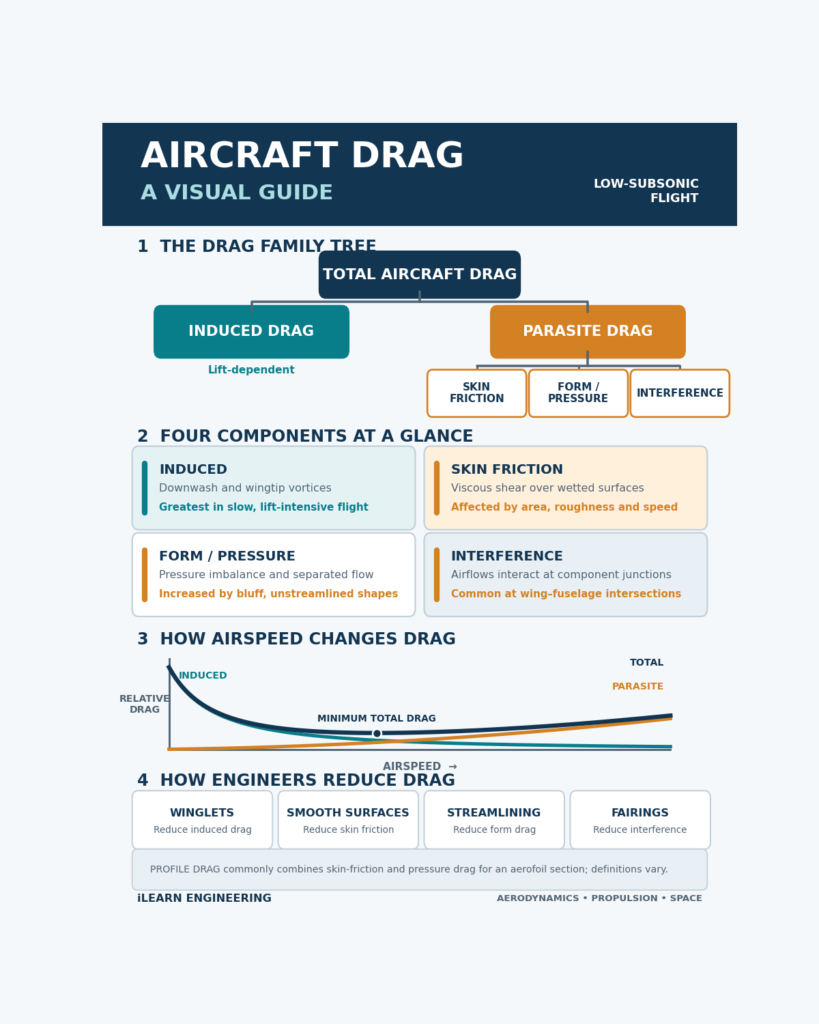
An aircraft experiences several forms of aerodynamic drag at the same time. Some result from generating lift, some arise as air flows over the aircraft’s surfaces, and others are created when airflow around neighbouring components interacts.
For a conventional aircraft in subsonic flight, total drag can be divided broadly into two main groups:
- induced drag, which is associated with generating lift; and
- parasite drag, which includes skin-friction, form and interference drag.
This simplified classification helps engineers identify where drag originates and which design changes might reduce it. At higher speeds, additional effects such as wave drag must also be considered.
What is aerodynamic drag?
Drag is an aerodynamic force that opposes an aircraft’s motion relative to the air. It is produced by the interaction between the aircraft and the airflow around it. Every exposed part of an aircraft can contribute to drag, including its wings, fuselage, engines, landing gear, aerials and control surfaces. [1]
The drag equation is:
D = ½ × ρ × V² × S × Cᴅ
Where:
- D = drag force, in newtons.
- ρ = air density, in kg/m³.
- V = velocity relative to the air, in m/s.
- S = reference area, in m².
- Cᴅ = drag coefficient, which is dimensionless.
The drag coefficient represents the combined influence of factors including shape, inclination, surface condition, viscosity and compressibility. The reference area must always be stated because different choices of area produce different coefficient values for the same physical drag force. [2]
A simplified classification of aircraft drag
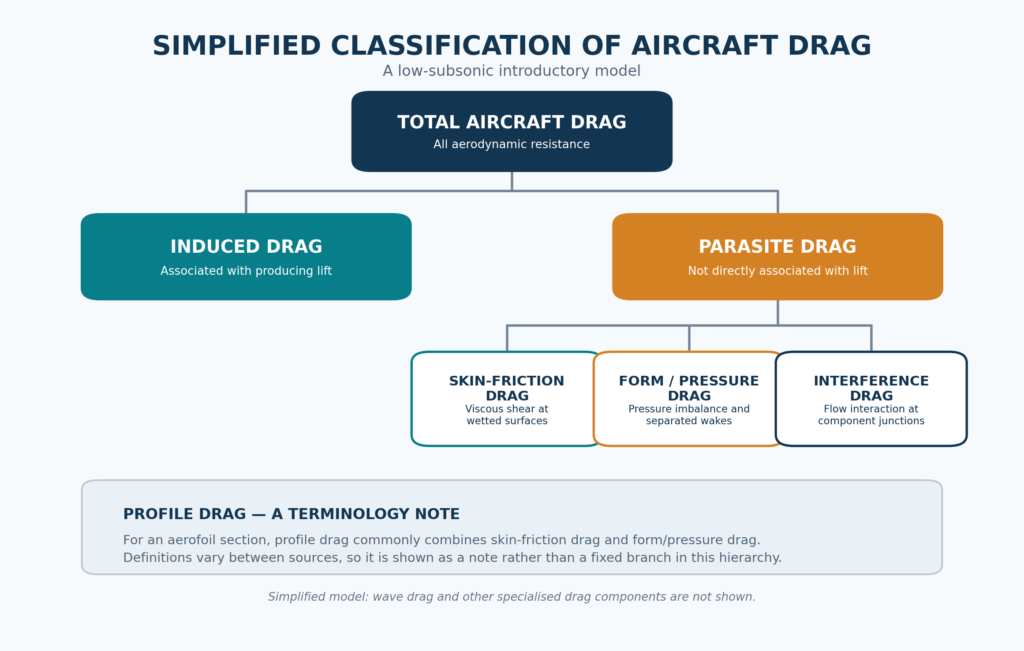
For introductory analysis at low subsonic speeds, total aircraft drag can be organised as follows:
- Total drag
- Induced drag
- Parasite drag
- Skin-friction drag
- Form or pressure drag
- Interference drag
Some textbooks introduce profile drag as an additional grouping. Profile drag commonly refers to the drag associated with an aerofoil section, usually combining its skin-friction and pressure drag. However, terminology varies between sources, so engineers should check how a particular text or dataset defines the term.
The simplified classification is useful, but it is not an exhaustive list. Real aircraft can also experience wave drag, trim drag, cooling drag, leakage drag and drag from gaps, protuberances or deployed systems.
What is induced drag?
Induced drag is the drag associated with producing lift on a finite-span wing.
A lifting wing creates a pressure difference between its upper and lower surfaces. Near the wing tips, air moves from the higher-pressure region beneath the wing towards the lower-pressure region above it. This contributes to a trailing vortex system and downwash behind the wing.
Downwash changes the local airflow direction. The aerodynamic force produced by the wing is therefore inclined slightly rearwards, creating a drag component. NASA describes induced drag as drag caused by the three-dimensional flow around a finite lifting wing. [3]
The induced drag coefficient can be represented as:
Cᴅᵢ = Cₗ² / (π × AR × e)
Where:
- Cᴅᵢ = induced drag coefficient.
- Cₗ = lift coefficient.
- AR = wing aspect ratio.
- e = span-efficiency factor.
- π ≈ 3.1416.
Induced drag becomes particularly important when an aircraft must generate a high lift coefficient. This commonly occurs during slower flight, take-off, landing or manoeuvring.
For the same required lift, air density and wing configuration, induced drag decreases approximately with the square of airspeed. A reduction in airspeed therefore does not necessarily mean that every form of drag decreases.
Increasing wingspan can reduce induced drag because it increases aspect ratio and changes the distribution of lift across the wing. This is one reason gliders use long, slender wings. Winglets can also modify the wingtip flow, although their overall benefit depends on how they are integrated into the complete aircraft.
The relationship between wing geometry, induced drag and structural requirements is explored further in Why There Is No Perfect Aerofoil.
What is parasite drag?
Parasite drag is the broad name given to drag that is not directly associated with producing lift.
It arises from moving the aircraft’s surfaces and components through the air. In a simplified classification, parasite drag consists mainly of:
- skin-friction drag;
- form or pressure drag; and
- interference drag.
Parasite drag generally becomes more important as airspeed increases. If density, reference area and drag coefficient remain constant, the drag equation shows that drag force increases with velocity squared.
Doubling the airspeed would therefore produce four times the drag under those restricted assumptions. In practice, the drag coefficient can also change with Reynolds number, Mach number, angle of attack and aircraft configuration.
Skin-friction drag
Skin-friction drag results from viscous shear stresses acting between the airflow and an aircraft’s surface.
Air touching a solid surface is brought effectively to rest relative to that surface. This is called the no-slip condition. Moving away from the surface, airflow velocity increases until it reaches the freestream value. The region in which this velocity change occurs is the boundary layer.
The velocity difference within the boundary layer produces shear stress. When that shear stress is integrated across the aircraft’s wetted area, it produces skin-friction drag.
Several factors influence skin friction:
- the aircraft’s wetted area;
- surface roughness and waviness;
- gaps, joints and protruding fasteners;
- contamination by dirt, insects, ice or damaged coatings;
- air viscosity;
- Reynolds number; and
- whether the boundary layer is laminar or turbulent.
A laminar boundary layer generally produces less skin-friction drag than a turbulent boundary layer. However, turbulent boundary layers contain more mixing and can resist adverse pressure gradients more effectively, allowing the flow to remain attached for longer.
This creates an important design compromise. Preserving laminar flow may reduce friction, but delaying separation can sometimes be more valuable. The relationship is explained in Laminar vs Turbulent Boundary Layers: Why Airflow Separates from Aircraft Wings.
Form or pressure drag
Form drag, also called pressure drag, results from pressure differences acting around an object.
As air flows around a body, its velocity and pressure change. If the airflow remains attached and pressure is recovered effectively towards the rear, pressure drag can be relatively low. If the flow separates, it leaves a broader wake with lower pressure behind the body.
The imbalance between the pressure acting on the front and rear of the body creates a rearward force.
Shape therefore has a major influence on form drag. A streamlined body encourages the airflow to remain attached and allows pressure to recover gradually. A bluff body causes earlier separation and produces a larger wake.
NASA’s comparisons of shapes tested under similar low-speed conditions show that streamlined forms can have substantially lower drag coefficients than bluff forms. The comparison is meaningful only when the same reference area and compatible flow conditions are used. [4]
Examples of aircraft features that can contribute to form drag include:
- a bluff fuselage or poorly shaped fairing;
- exposed landing gear;
- external aerials and sensors;
- wheels, struts and undercarriage doors;
- external stores; and
- abrupt changes in cross-section.
Reducing frontal area can help, but frontal area alone does not determine form drag. The complete pressure distribution and the size of the separated wake also matter.
Interference drag
Interference drag occurs when the flow around one aircraft component interacts with the flow around another.
A wing and fuselage tested separately each produce their own pressure distributions and boundary layers. When they are joined, those flows interact. The drag of the assembled configuration can therefore be greater than the sum of the components considered in isolation.
Common locations include:
- wing–fuselage junctions;
- tailplane–fuselage junctions;
- engine-pylon and wing junctions;
- nacelles positioned close to the fuselage;
- landing-gear struts and their attachment points; and
- external stores mounted close to wings or the fuselage.
At a junction, pressure gradients and boundary layers can combine to produce complex three-dimensional flow. This may thicken the boundary layer, create local vortices or cause earlier separation.
Interference drag cannot always be estimated by adding the isolated drag coefficients of the individual components. Their relative positions and shapes affect the resulting flow field. NASA research into aircraft engine installation, for example, treats interference drag as a configuration-dependent effect that must be considered when evaluating engine location. [5]
Engineers commonly reduce interference drag using carefully shaped fairings and fillets. These provide a more gradual transition between intersecting surfaces and can reduce abrupt changes in airflow direction.
Wind-tunnel testing and computational fluid dynamics are particularly useful because interference effects depend on the complete geometry rather than one component alone.
What does profile drag mean?
The term profile drag requires care because it is not applied consistently in every source.
For an aerofoil or wing section, profile drag usually describes the drag that remains apart from induced drag. It commonly includes:
- skin-friction drag; and
- pressure drag caused by the aerofoil’s shape and boundary-layer behaviour.
In this sense:
Profile drag = skin-friction drag + pressure drag
For a finite aircraft wing, induced drag must then be added separately. Interference effects involving the fuselage, nacelles or other components are also normally considered outside the isolated aerofoil-section profile drag.
Some sources use profile drag more broadly or treat it as closely related to zero-lift drag. When comparing aerodynamic data, the stated definition and reference area are therefore more important than the label alone.
How the drag components compare
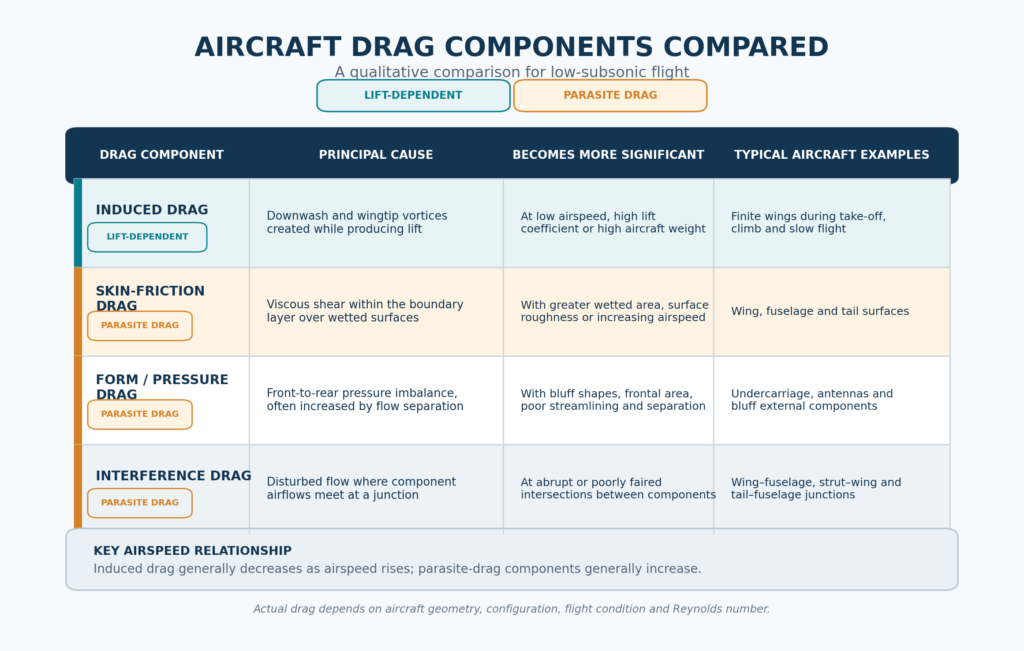
| Drag component | Main cause | Common aircraft locations | Typical reduction approaches |
|---|---|---|---|
| Induced drag | Three-dimensional flow associated with producing lift | Finite wings and wing tips | Higher aspect ratio, suitable lift distribution and carefully integrated wingtip devices |
| Skin-friction drag | Viscous shear stress within the boundary layer | All wetted aircraft surfaces | Smooth, clean surfaces and appropriate boundary-layer design |
| Form or pressure drag | Pressure imbalance and separated wakes | Fuselage, landing gear, stores and bluff components | Streamlining, gradual area changes and separation control |
| Interference drag | Interaction between flows around neighbouring components | Wing–fuselage, pylon–wing and tail junctions | Fairings, fillets and optimised component positioning |
The table provides a useful starting point, but the components are not completely independent.
A fairing added to reduce interference drag increases wetted area and can therefore increase skin-friction drag. A longer wing may reduce induced drag but add structural mass and surface area. A turbulent boundary layer increases skin friction but may delay separation and reduce pressure drag.
Aircraft design is therefore an optimisation problem involving total drag rather than the isolated minimisation of one component.
Which type of drag dominates?
The dominant drag component changes with the aircraft and its operating condition.
Slow flight
During slow flight, the wing must usually operate at a higher lift coefficient to produce the required lift. Induced drag therefore becomes more significant.
Cruise
At a suitable cruise condition, induced and parasite drag may both make important contributions. Designers seek an efficient balance rather than eliminating either component completely.
High-speed flight
As airspeed increases, parasite drag becomes increasingly important. Near the speed of sound, compressibility effects and shock waves can introduce substantial wave drag. NASA identifies wave drag as an additional component when shock waves form on an object. [6]
Configured flight
Extending landing gear, flaps or other devices changes the aircraft’s shape and exposed area. This can increase pressure, interference and skin-friction drag. High-lift devices may also change the lift distribution and induced drag.
Why drag classification matters
Classifying drag helps engineers connect an observed performance problem with its likely aerodynamic cause.
If drag is high during slow, lift-intensive flight, the wing’s aspect ratio and lift distribution may deserve attention. If cruise drag is affected by surface contamination, skin friction may be important. A large separated wake suggests pressure drag, while unexpected drag after combining otherwise efficient components may indicate interference.
The classification also prevents misleading design decisions. Smoothing a surface will not directly remove induced drag. Increasing wingspan will not eliminate pressure drag from exposed landing gear. Adding a fairing may reduce junction losses but increase wetted area.
The correct question is therefore not simply, “How can drag be reduced?” It is:
Which drag component is being produced, what causes it, and what trade-offs will result from changing the design?
For a wider introduction to lift, drag, thrust and weight, read The Four Fundamental Forces that Enable Aircraft to Fly.
Develop your knowledge of aircraft aerodynamics
Understanding the types of aircraft drag provides a foundation for analysing aircraft performance, aerodynamic efficiency and wing design.
The Diploma in Aerodynamics from iLearn Engineering® is a 40-credit Level 6 course covering aerodynamic forces and moments, aerofoils and wings, boundary-layer behaviour, compressible flow and high-speed aerodynamics.
Learners seeking a broader aerospace route can also explore the Higher International Certificate in Aerospace Engineering, Higher International Diploma in Aerospace Engineering and International Graduate Diploma in Aerospace Engineering.
Explore the Diploma in Aerodynamics to view its course content and study options.
Frequently asked questions
What are the two main types of aircraft drag?
For a simplified low-speed analysis, total aircraft drag is divided into induced drag and parasite drag. Parasite drag can then be divided into skin-friction, form or pressure, and interference drag.
Is profile drag the same as parasite drag?
Not always. Profile drag commonly refers to the skin-friction and pressure drag of an aerofoil section. Parasite drag is a broader aircraft-level grouping that can also include interference drag. Definitions vary, so the terminology used by a particular source should be checked.
Is induced drag a form of parasite drag?
No. Induced drag is associated with producing lift on a finite wing. Parasite drag includes drag components that are not directly caused by lift production.
What is the difference between form drag and interference drag?
Form drag results from the pressure distribution and separated wake around a body. Interference drag is the additional drag created when the flows around neighbouring components interact.
Does all aircraft drag increase with airspeed?
No. Under constant-lift conditions, induced drag decreases as airspeed increases. Parasite drag generally increases with airspeed, although the exact relationship depends on changes in drag coefficient and flow conditions.
Is wave drag included in parasite drag?
Classification conventions vary. Wave drag is commonly treated as a separate compressibility-related component because it is produced by shock waves in transonic and supersonic flow. The simplified induced-versus-parasite model is therefore most useful for introductory low-subsonic analysis.
References
- NASA Glenn Research Center — Drag
- NASA Glenn Research Center — Drag Equation
- NASA Glenn Research Center — Induced Drag Coefficient
- NASA Glenn Research Center — Shape Effects on Drag
- NASA Technical Reports Server — Interference Drag Associated with Engine Locations for Multidisciplinary Design Optimization
- NASA Glenn Research Center — Factors That Affect Drag
Interested in our Aerospace Engineering Courses?
At iLearn Engineering®, we offer a diverse range of online accredited aerospace engineering courses and qualifications to cater to different academic and career goals. Our aerospace courses are available in varying credit values and levels, ranging from 40 credit Engineering Diplomas to a Bachelor’s equivalent 360 credit International Graduate Diploma.
All Aerospace Engineering Courses
All Aerospace Engineering Diploma Courses can be seen here.
Short Aerospace Courses (40 Credits)
- Diploma in Aerospace Engineering
- Diploma in Aircraft Design
- Diploma in Principles of Flight
- Diploma in Aerospace Structures
- Diploma in Aerodynamics
- Diploma in Aerodynamics, Propulsion and Space
First Year of Undergraduate (Level 4 – 120 Credits)
Higher International Certificate in Aerospace Engineering
Years One and Two of Undergraduate (Level 5 – 240 Credits)
Higher International Diploma in Aerospace Engineering
International Graduate Diploma (Level 6 – 360 Credits)
International Graduate Diploma in Aerospace Engineering
Complete Engineering Course Catalogue (all courses)
Alternatively, you can view all our online engineering courses here.
Recent Posts
Induced Drag Explained: Why Flying Slower Can Increase Drag
Induced Drag Explained: Why Flying Slower Can Increase Drag Why can an aircraft experience more drag when it flies more slowly? We usually associate greater speed with greater air resistance, but a wing must also generate enough lift to support the aircraft. Induced drag is the drag associated with producing lift on a finite-span wing. […]
Laminar vs Turbulent Boundary Layers: Why Airflow Separates from Aircraft Wings
Laminar vs Turbulent Boundary Layers: Why Airflow Separates from Aircraft Wings Airflow around an aircraft wing is often shown as smooth streamlines passing neatly over the aerofoil. In reality, the thin layer of air immediately next to the wing surface behaves very differently from the undisturbed airflow further away. This region is called the boundary […]
Why There Is No Perfect Aerofoil: The Design Trade-Offs Behind Every Aircraft Wing
Why There Is No Perfect Aerofoil: The Design Trade-Offs Behind Every Aircraft Wing If a designer could create a perfect aerofoil, it would produce very high lift with almost no drag, remain stable at every angle of attack, fit a lightweight structure inside the wing and work equally well at low and high speed. No […]