

Laminar vs Turbulent Boundary Layers: Why Airflow Separates from Aircraft Wings
Airflow around an aircraft wing is often shown as smooth streamlines passing neatly over the aerofoil. In reality, the thin layer of air immediately next to the wing surface behaves very differently from the undisturbed airflow further away.
This region is called the boundary layer. It influences skin-friction drag, lift, stall behaviour, heat transfer and the point at which airflow separates from the wing.
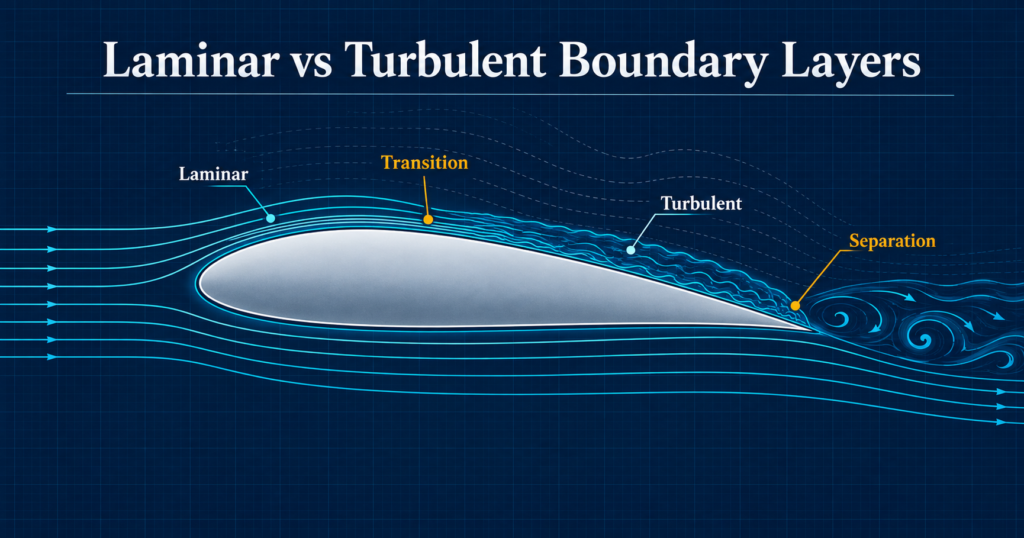
The key distinction is between laminar and turbulent boundary layers. Laminar flow has lower skin-friction drag, but it can separate more readily. Turbulent flow produces more skin friction, yet its greater mixing can help it remain attached to the wing for longer. Aircraft designers must balance these competing effects.
What is a boundary layer?
Air has viscosity, meaning that it resists sliding motion between adjacent layers of fluid. As air passes over an aerofoil, the air molecules immediately next to the surface are slowed to effectively zero velocity relative to the wing. This is known as the no-slip condition.
Moving away from the wing surface, the airflow speed gradually increases until it reaches the undisturbed freestream velocity.
The thin region between zero velocity at the surface and the freestream velocity is the boundary layer.
NASA describes the boundary layer as the region close to a surface where velocity changes from zero at the wall to the freestream value. This behaviour is fundamental to aerodynamic drag, wing stall and high-speed heat transfer. [1]
Why the boundary layer matters on an aerofoil
The airflow outside the boundary layer can often be approximated as smooth and largely unaffected by viscosity. Inside the boundary layer, however, viscosity and shear stress are significant.
This affects aircraft performance in several ways:
- friction between the air and wing surface creates skin-friction drag;
- the boundary layer alters the effective shape seen by the external airflow;
- a thicker boundary layer can make pressure recovery more difficult;
- loss of boundary-layer energy can lead to flow separation; and
- separation can reduce lift, increase drag and contribute to stall.
The boundary layer is therefore small in physical size but large in aerodynamic importance.
Laminar boundary layers
A laminar boundary layer has an orderly flow structure. The air moves in relatively smooth layers, with limited mixing between them.
Laminar flow generally produces lower skin-friction drag than turbulent flow. This is attractive because reducing drag can improve cruise efficiency, range and fuel economy.
However, the low mixing in a laminar boundary layer means that the slower-moving air near the surface has relatively little momentum. When the flow encounters a rising pressure, it can struggle to continue moving downstream against that pressure increase.
This makes laminar flow more vulnerable to separation.
Some aircraft and specialist aerofoils are designed to maintain laminar flow over as much of the surface as practical. Doing so requires careful control of aerofoil shape, surface smoothness, contamination and manufacturing tolerances.
Turbulent boundary layers
A turbulent boundary layer contains irregular fluctuations and mixing. It is not simply “messy” airflow; it has a recognisable average flow direction, but with many small-scale velocity variations within it.
That mixing brings higher-momentum air from further away from the surface closer to the wing. As a result, the near-wall region has more energy available to resist an adverse pressure gradient.
The trade-off is increased skin-friction drag.
A turbulent boundary layer can therefore be less efficient in one sense, because it creates more friction, but more resilient in another because it can remain attached to the aerofoil for longer.
This is why designers do not always aim to preserve laminar flow at all costs. In some flight conditions, delaying separation is more valuable than achieving the lowest possible skin-friction drag.
Transition: from laminar to turbulent flow
The change from laminar to turbulent flow is called transition.
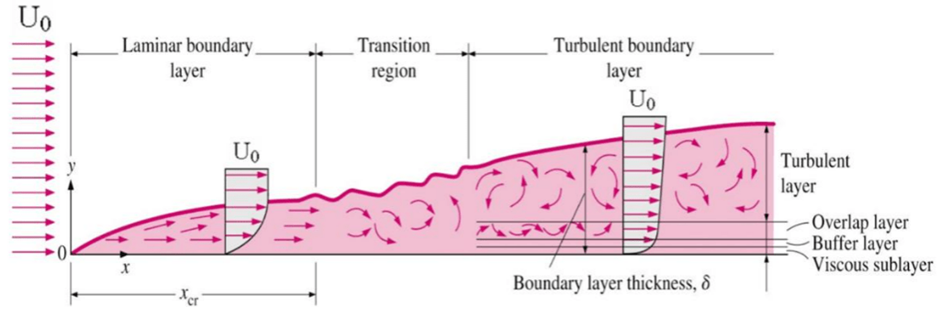
Transition does not occur at one universal Reynolds number. It depends on several factors, including:
- aerofoil shape;
- surface roughness;
- leading-edge contamination, such as insects, dirt or ice;
- freestream turbulence;
- pressure gradient;
- airspeed;
- air density; and
- the characteristic length being considered.
Reynolds number helps engineers compare the relative importance of inertial and viscous effects:
Reₓ = ρVx / μ
Where:
- Reₓ is Reynolds number at a distance x from the leading edge;
- ρ is air density;
- V is freestream velocity;
- x is distance from the leading edge; and
- μ is dynamic viscosity.
A higher Reynolds number often makes transition more likely, but it should not be used as a fixed switch between laminar and turbulent flow. The real transition location must be investigated for the relevant aerofoil and operating conditions.
What is an adverse pressure gradient?
An adverse pressure gradient occurs when the static pressure rises in the direction of the airflow.
On the upper surface of a wing, air commonly accelerates near the leading edge, where pressure falls. Further downstream, the flow must slow down and recover pressure as it approaches the trailing edge.
This recovery region produces an adverse pressure gradient.
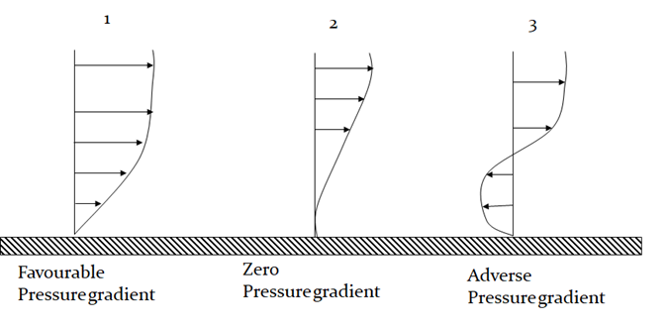
The boundary layer must continue moving downstream despite the increasing pressure. If it has enough momentum, the airflow remains attached to the aerofoil surface. If it does not, the flow close to the surface slows, stops and can reverse direction.
That is boundary-layer separation.
Why airflow separates from a wing
Flow separation occurs when the boundary layer can no longer overcome the adverse pressure gradient.
After separation, the airflow no longer follows the intended aerofoil contour. Instead, it forms a region of recirculating flow, eddies and a thicker wake behind the wing.
The consequences are significant:
- lift is reduced or becomes less predictable;
- pressure drag increases;
- buffeting may occur;
- control-surface effectiveness can reduce; and
- at high angle of attack, the wing can stall.
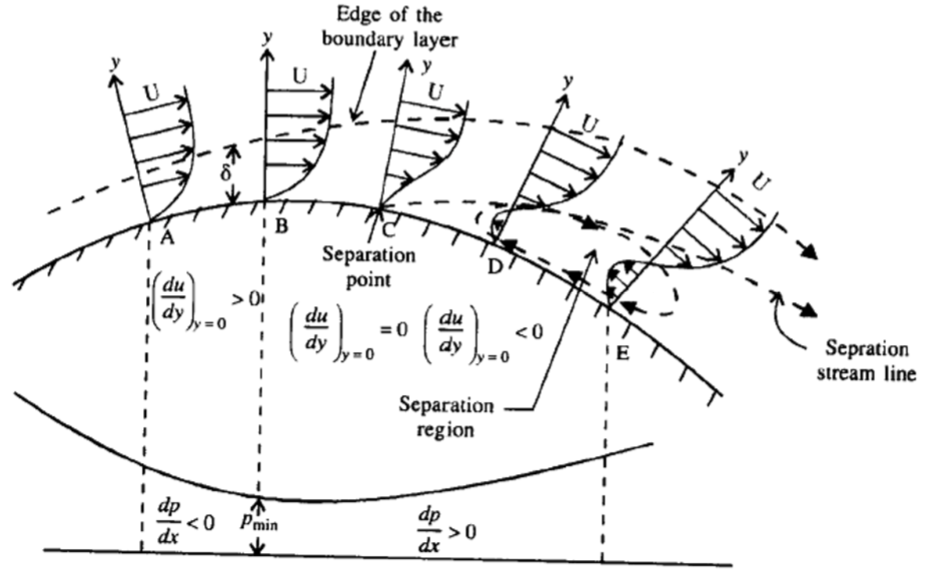
NASA notes that separated boundary-layer flow creates an effective shape that can be very different from the physical shape of the wing, and that this mechanism is responsible for wing stall at high angle of attack. [1]
A stall is therefore primarily an angle-of-attack condition. Low speed makes it more likely because an aircraft must increase angle of attack to generate the lift required to support its weight.
Surface roughness and contamination
A smooth wing surface helps preserve the intended boundary-layer behaviour. Roughness, damage, gaps, insects, rain, frost or ice can disturb the boundary layer and cause earlier transition from laminar to turbulent flow.
This can increase drag and, depending on the location and severity, promote earlier separation.
Ice contamination is especially serious because it changes both the aerofoil shape and the boundary-layer behaviour. Even a relatively small accumulation near the leading edge can alter the pressure distribution, reduce maximum lift and increase stall speed.
This is one reason aircraft require strict inspection and de-icing procedures before flight in icing conditions.
A practical design compromise
Consider two possible aerofoils for a low-speed aircraft.
The first is designed to maintain laminar flow for a long distance over the upper surface. It may offer low skin-friction drag when it is clean and operated at its intended condition. However, it may be sensitive to roughness and may separate earlier when operating outside its preferred range.
The second aerofoil transitions to a turbulent boundary layer earlier. It may have slightly higher skin-friction drag in cruise, but it can tolerate a stronger adverse pressure gradient and may retain attached flow for longer.
Neither aerofoil is automatically better. The appropriate choice depends on the aircraft’s mission, expected operating conditions, surface quality, safety margins and performance requirements.
This is the same wider design principle that applies to all aerofoil decisions: the most suitable solution is the one that best meets the complete aircraft requirement.
How engineers investigate boundary layers
Boundary-layer behaviour is studied through wind-tunnel tests, flight tests and increasingly sophisticated analysis methods.
Engineers may use:
- pressure taps to measure pressure distribution along an aerofoil;
- surface-flow visualisation to reveal attachment and separation;
- tufts, smoke or oil-film methods to show flow direction;
- pressure rakes to investigate the wake; and
- force balances to measure the resulting lift, drag and moments.
For a detailed explanation of how pressure measurements support aerodynamic testing, read How Wind Tunnels Use Pressure Measurements to Test Aircraft Aerodynamics.
Boundary layers and aircraft performance
Boundary layers link several core aerodynamic ideas.
They explain why a wing experiences skin-friction drag, why a smooth surface matters, why pressure recovery must be controlled and why increasing angle of attack eventually leads to stall.
They also show why aerodynamic design involves compromise. Laminar flow can reduce friction drag, while turbulent flow can delay separation. A designer must decide which characteristic is most valuable for the aircraft’s intended operating conditions.
For a broader introduction to the forces and moments acting on an aircraft, see What Really Keeps an Aircraft Flying?.
Develop your aerodynamics knowledge
The Diploma in Aerodynamics at iLearn Engineering® is a 40-credit Level 6 course covering aerofoils and wings, aerodynamic forces and moments, boundary-layer behaviour, flow separation and high-speed aerodynamics.
Learners seeking a broader aerospace pathway can also explore the Higher International Certificate in Aerospace Engineering, Higher International Diploma in Aerospace Engineering and International Graduate Diploma in Aerospace Engineering.
Frequently asked questions
Is laminar flow always better than turbulent flow?
No. Laminar flow generally produces lower skin-friction drag, but a turbulent boundary layer can resist separation more effectively. The preferred behaviour depends on the aerofoil and operating condition.
What causes airflow to separate from a wing?
Flow separates when the boundary layer does not have enough momentum to continue downstream against an adverse pressure gradient. High angle of attack, surface roughness and unsuitable aerofoil geometry can all make separation more likely.
Does turbulent flow cause stall?
Turbulence does not automatically cause stall. In fact, a turbulent boundary layer can delay separation. A stall occurs when the wing exceeds the conditions in which attached flow can be maintained, most commonly by exceeding its critical angle of attack.
References
[1] NASA Glenn Research Center: Boundary Layer
Interested in our Aerospace Engineering Courses?
At iLearn Engineering®, we offer a diverse range of online accredited aerospace engineering courses and qualifications to cater to different academic and career goals. Our aerospace courses are available in varying credit values and levels, ranging from 40 credit Engineering Diplomas to a Bachelor’s equivalent 360 credit International Graduate Diploma.
All Aerospace Engineering Courses
All Aerospace Engineering Diploma Courses can be seen here.
Short Aerospace Courses (40 Credits)
- Diploma in Aerospace Engineering
- Diploma in Aircraft Design
- Diploma in Principles of Flight
- Diploma in Aerospace Structures
- Diploma in Aerodynamics
- Diploma in Aerodynamics, Propulsion and Space
First Year of Undergraduate (Level 4 – 120 Credits)
Higher International Certificate in Aerospace Engineering
Years One and Two of Undergraduate (Level 5 – 240 Credits)
Higher International Diploma in Aerospace Engineering
International Graduate Diploma (Level 6 – 360 Credits)
International Graduate Diploma in Aerospace Engineering
Complete Engineering Course Catalogue (all courses)
Alternatively, you can view all our online engineering courses here.
Recent Posts
Why There Is No Perfect Aerofoil: The Design Trade-Offs Behind Every Aircraft Wing
Why There Is No Perfect Aerofoil: The Design Trade-Offs Behind Every Aircraft Wing If a designer could create a perfect aerofoil, it would produce very high lift with almost no drag, remain stable at every angle of attack, fit a lightweight structure inside the wing and work equally well at low and high speed. No […]
How Aerofoils Generate Lift: A Beginner’s Guide to Angle of Attack, Camber and Pressure Distribution
How Aerofoils Generate Lift: A Beginner’s Guide to Angle of Attack, Camber and Pressure Distribution An aerofoil does not create lift simply because its upper surface is curved. Lift is produced because the aerofoil meets the airflow at a suitable angle and shape, causing a pressure distribution that results in an aerodynamic force. For aircraft […]
Why Aircraft Engine Intakes Use Diffusers: Slowing Air to Recover Pressure
Why Aircraft Engine Intakes Use Diffusers: Slowing Air to Recover Pressure An aircraft engine needs a large, steady supply of air at its compressor face. That may sound simple, but the air approaching an aircraft is moving quickly, often with changes in direction, velocity and pressure caused by the aircraft’s shape and flight condition. An […]