

How to Calculate Aircraft Take-Off Ground Run: A Flight Mechanics Tutorial
An aircraft does not become airborne simply because its engines are producing thrust. During the take-off ground run, thrust must overcome aerodynamic drag and rolling resistance. On a sloping runway, it must also overcome a component of the aircraft’s weight.
This tutorial derives a useful ground-run equation from Newton’s second law. It is an engineering model for understanding aircraft performance, not a substitute for approved Aircraft Flight Manual or Pilot’s Operating Handbook data.
What is the take-off ground run?
The ground run is the distance travelled from brake release to lift-off. It is only one part of total take-off distance; the airborne distance needed to clear a specified obstacle is calculated separately.
As the aircraft accelerates, its wings progressively generate more lift. This reduces the load carried by the wheels and therefore reduces rolling resistance. At lift-off, the available lift is sufficient for the aircraft to leave the runway.
For an overview of take-off speeds and phases, including rotation and lift-off speed, see Breaking Down Take-Off: Critical Flight Parameters.
Step 1: Draw the free-body diagram
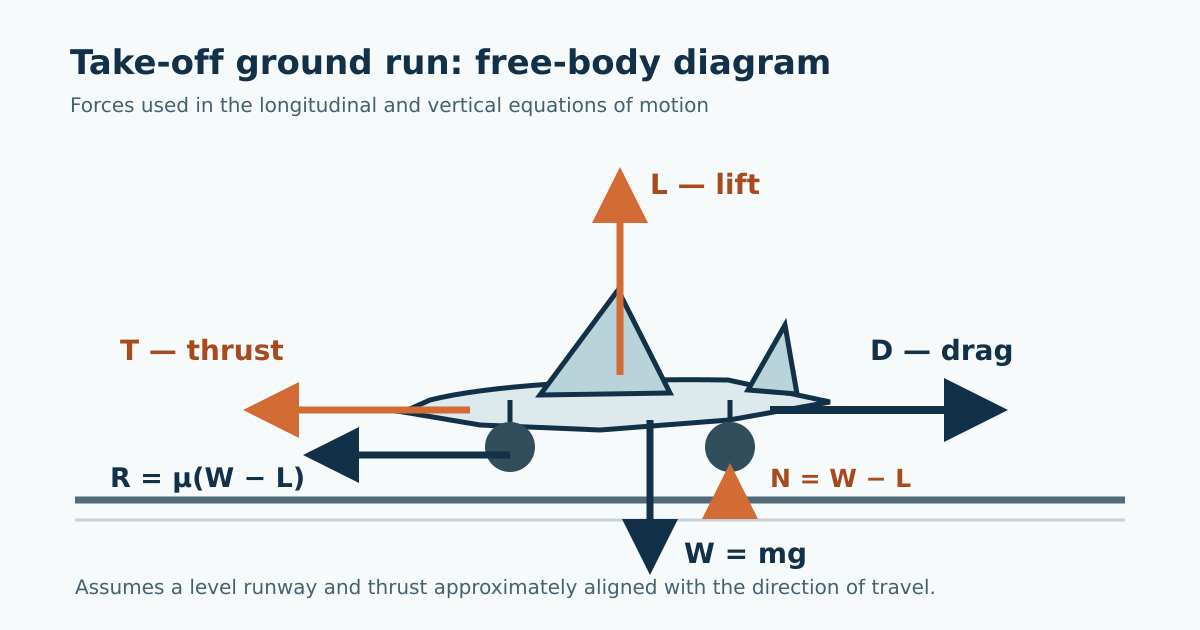
Start with an aircraft on a level runway and take the forward direction as positive. The important forces are:
- T — thrust, acting forward;
- D — aerodynamic drag, acting opposite to motion;
- R — rolling resistance at the tyres;
- W — weight, equal to mg, acting vertically downward;
- L — aerodynamic lift, acting vertically upward; and
- N — normal reaction from the runway, acting vertically upward.
Step 2: Write the vertical force balance
During the ground run, the aircraft remains in contact with the runway. There is no significant vertical acceleration, so the vertical forces balance:
Therefore:
As lift increases, the normal reaction N falls. The wheels carry less of the aircraft’s weight.
Step 3: Express rolling resistance
Rolling resistance can be modelled as the coefficient of rolling resistance multiplied by the normal reaction:
Substituting N = W − L gives:
Where μ is the coefficient of rolling resistance. This shows why rolling resistance is not perfectly constant during a take-off run. At low speed, lift is small and the wheels carry almost all the aircraft weight. Near lift-off, lift is much greater and rolling resistance is lower.
Step 4: Apply Newton’s second law along the runway
Newton’s second law states that the resultant force equals mass multiplied by acceleration:
For the level-runway ground run:
Substituting the rolling-resistance expression gives the fundamental take-off ground-run equation:
This states that acceleration depends on the force remaining after thrust has overcome drag and rolling resistance.
Step 5: Allow for changing lift and drag
Lift and drag both vary approximately with the square of airspeed:
Where:
- ρ is air density;
- V is airspeed;
- S is wing reference area;
- CL is lift coefficient; and
- CD is drag coefficient.
Substituting these terms into the force equation gives:
This is more realistic than assuming fixed acceleration because aerodynamic lift and drag rise as the aircraft accelerates.
Step 6: Convert acceleration into distance
Acceleration is the rate of change of velocity with time:
However, the quantity required is runway distance, s. Using:
The ground-run equation becomes:
Rearranging:
The ground-run distance from rest to lift-off speed VLO is therefore:
This integral recognises that drag, lift, rolling resistance and potentially thrust change during acceleration.
A simpler constant-acceleration approximation
For an introductory estimate, assume the net accelerating force is approximately constant:
Using the standard kinematic relationship:
If the aircraft starts from rest, U = 0, so:
This approximation is useful for showing trends, but it is not a full aircraft-performance calculation. In reality, drag increases with speed, lift reduces rolling resistance, and available thrust may change as airspeed increases.
Worked example: estimating a ground run
Consider a simplified aircraft model operating from a level, dry runway in still air:
- Mass, m = 6,000 kg
- Weight, W = 6,000 × 9.81 = 58,860 N
- Wing area, S = 30 m2
- Air density, ρ = 1.225 kg/m3
- Take-off thrust, T = 26,000 N
- Rolling-resistance coefficient, μ = 0.02
- Ground-run lift coefficient, CL = 0.70
- Drag coefficient, CD = 0.040
- Lift-off speed, VLO = 60 m/s
First, combine the speed-dependent drag and rolling-resistance terms:
Substituting the values:
The ground-run integral becomes:
Solving gives:
In this deliberately simplified example, the aircraft requires approximately 451 m of ground roll to reach its assumed lift-off speed.
The result does not include rotation, obstacle clearance, wind, runway contamination, engine-transient behaviour, certification margins or the detailed aerodynamic data used in approved performance manuals.
What makes the ground run longer?
Higher aircraft mass
A heavier aircraft increases both W and m. More force is needed to accelerate it, and a higher lift-off speed may also be required.
Higher temperature or altitude
Lower air density reduces lift at a given true airspeed. The aircraft must accelerate to a higher true airspeed to generate the required lift, while engine or propeller performance may also be reduced.
Higher drag
High-lift devices can reduce lift-off speed, but they also alter drag. Engineers must balance the lift benefit against the drag penalty.
A poor runway surface
A higher value of μ increases rolling resistance. Soft, rough or contaminated surfaces can therefore have a substantial effect on acceleration.
Extending the model for runway slope
For an uphill runway with slope angle θ, part of the aircraft’s weight acts down the slope:
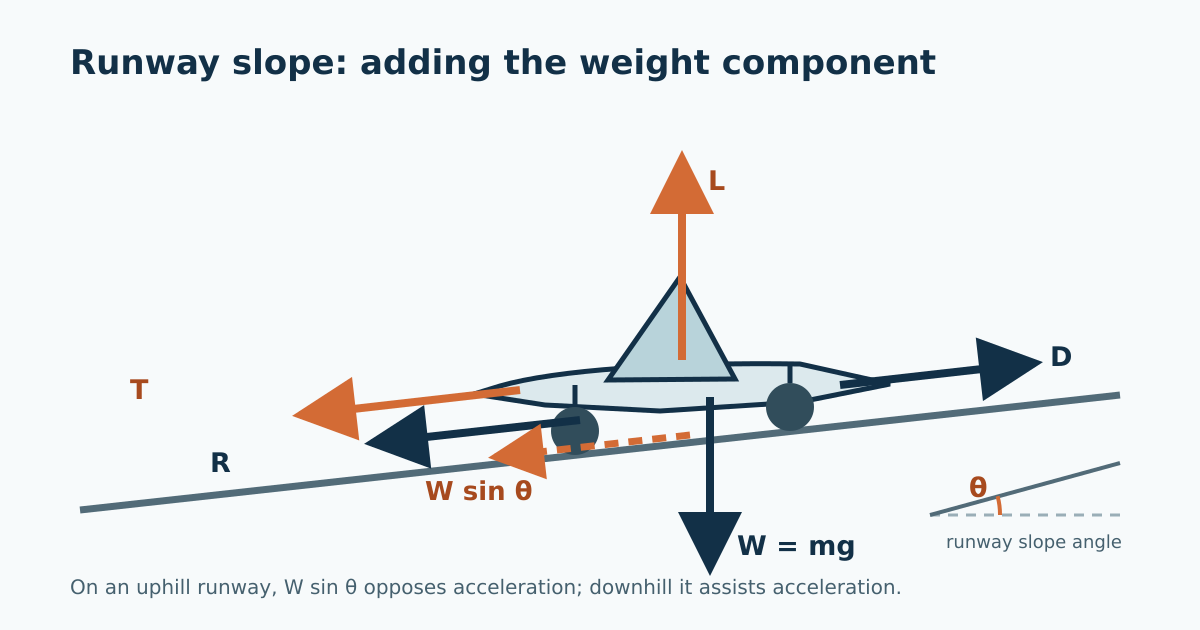
The longitudinal equation becomes:
An uphill slope therefore reduces acceleration and increases ground-run distance. On a downhill runway, the weight component acts in the direction of travel and assists acceleration.
Study Flight Mechanics with iLearn Engineering®
The Diploma in Principles of Flight is a 40-credit EduQual Level 4 qualification covering flight mechanics, aerodynamics and aircraft performance.
For a broader aerospace engineering route, learners can progress through:
- Higher International Certificate in Aerospace Engineering — EduQual Level 4, 120 credits;
- Higher International Diploma in Aerospace Engineering — EduQual Level 5, 240 credits in total; and
- International Graduate Diploma in Aerospace Engineering — Level 6, 360 credits in total.
These routes combine Flight Mechanics with the wider engineering mathematics, science, aerospace structures and specialist aerospace knowledge needed for progressively more advanced study.
References
Interested in our Aerospace Engineering Courses?
At iLearn Engineering®, we offer a diverse range of online accredited aerospace engineering courses and qualifications to cater to different academic and career goals. Our aerospace courses are available in varying credit values and levels, ranging from 40 credit Engineering Diplomas to a Bachelor’s equivalent 360 credit International Graduate Diploma.
All Aerospace Engineering Courses
All Aerospace Engineering Diploma Courses can be seen here.
Short Aerospace Courses (40 Credits)
- Diploma in Aerospace Engineering
- Diploma in Aircraft Design
- Diploma in Principles of Flight
- Diploma in Aerospace Structures
- Diploma in Aerodynamics
- Diploma in Aerodynamics, Propulsion and Space
First Year of Undergraduate (Level 4 – 120 Credits)
Higher International Certificate in Aerospace Engineering
Years One and Two of Undergraduate (Level 5 – 240 Credits)
Higher International Diploma in Aerospace Engineering
International Graduate Diploma (Level 6 – 360 Credits)
International Graduate Diploma in Aerospace Engineering
Complete Engineering Course Catalogue (all courses)
Alternatively, you can view all our online engineering courses here.
Recent Posts
Why a Headwind Reduces Take-Off Distance: The Airspeed–Groundspeed Derivation
Why a Headwind Reduces Take-Off Distance: The Airspeed–Groundspeed Derivation Aeroplanes normally take off into wind because the wing must reach a required airspeed to produce lift, whereas the runway distance is travelled at groundspeed. A headwind contributes to the airspeed before the aircraft has covered any runway. It therefore reduces the groundspeed required at lift-off […]
Types of Aircraft Drag Explained: Induced, Profile and Interference Drag
Types of Aircraft Drag Explained: Induced, Profile and Interference Drag An aircraft experiences several forms of aerodynamic drag at the same time. Some result from generating lift, some arise as air flows over the aircraft’s surfaces, and others are created when airflow around neighbouring components interacts. For a conventional aircraft in subsonic flight, total drag […]
Induced Drag Explained: Why Flying Slower Can Increase Drag
Induced Drag Explained: Why Flying Slower Can Increase Drag Why can an aircraft experience more drag when it flies more slowly? We usually associate greater speed with greater air resistance, but a wing must also generate enough lift to support the aircraft. Induced drag is the drag associated with producing lift on a finite-span wing. […]