

Introduction to the Capacitor in Electrical Engineering
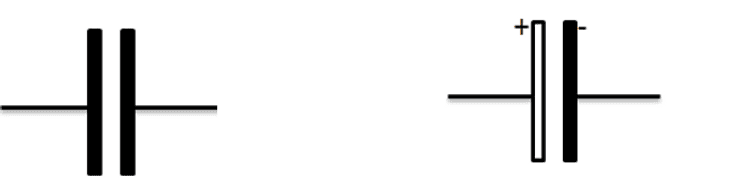
We can think of capacitors are short term ‘charge-stores’. In other words, capacitors just store charge inside them. A capacitor consists of two metal plates separated by a layer of insulating material called a dielectric.
There are 2 types of capacitor:
- Electrolytic capacitors. These hold much more charge and must be connected with the correct polarity, otherwise they can explode.
- Non-electrolytic. These hold less charge and can be connected either way round in a circuit.
How Does a Capacitor Work?
When two conducting plates are connected to a battery, electrons move towards one plate. The positive plate loses electrons , eventually leaving both plates with equal and opposite charge, +Q and -Q. When a capacitor is charged, we say that the capacitor has charge Q.

Define Capacitance
Capacitance, C = “the charge, Q, required to cause potential difference, V, in a conductor. It is measured in Farads”.
“1 Farad is the capacitance of a conductor, which has potential difference of 1 volt when it carries a charge of 1 coulomb”.

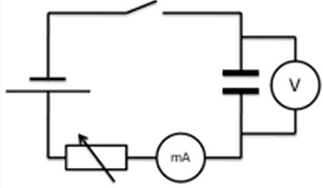
Charging a Capacitor Using D.C.
At any time, t, after the switch is closed, the charge, Q, on the capacitor can be calculated using Q=It where I = the current (Amps).
The variable resistor can be altered to keep the current constant.
Plot a graph of capacitance against voltage and since:
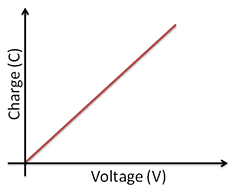
The gradient of the graph will equal the capacitance of that capacitor.
Charge Stored in a Capacitor
Electrical potential energy is stored when a capacitor is charged.
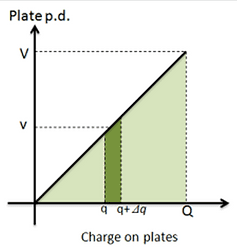
The area under this graph is equal to the energy stored = (½bh)
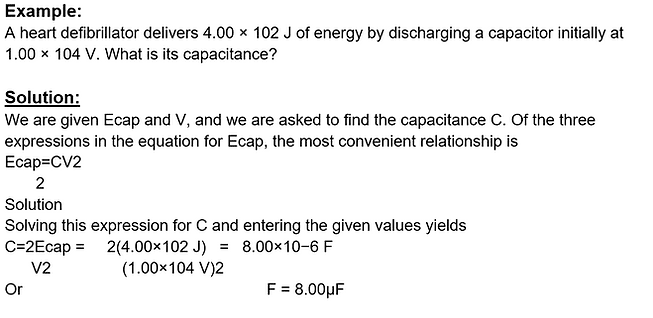
We can combine previous equations to give the following:

Charging and Discharging a Capacitor
When discharging, the current decreases with the potential difference, p.d. This decrease is exponential as can be seen below. Q0, V0 and I0 are all the initial charge, voltage and current through the capacitor at the initial discharge.
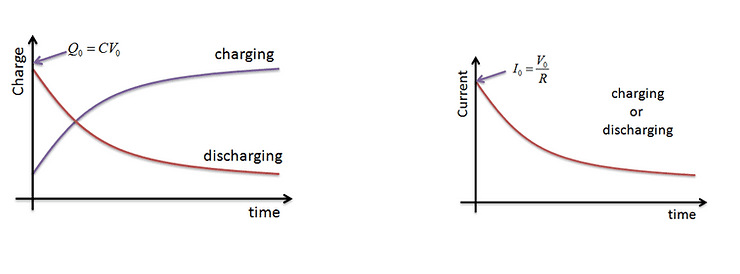
Decay Curve
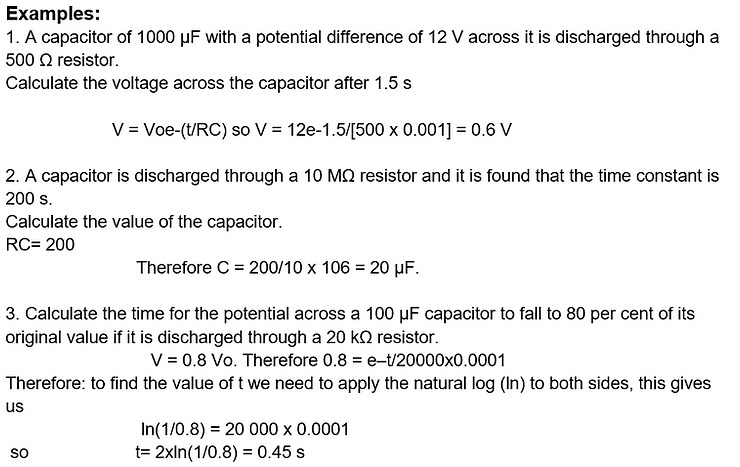
Let us now examine the process of discharging the capacitor. Charge, Q, falls to 1/e of its initial value in a time equal to the time constant, RC.

When the initial charge is Q0,
- After RC seconds = 0.37 x Q0
- After 2RC seconds = 0.37 x 2 x Q0
- After nRC seconds = 0.37n x Q0.
The time taken to halve, T½, is always the same:

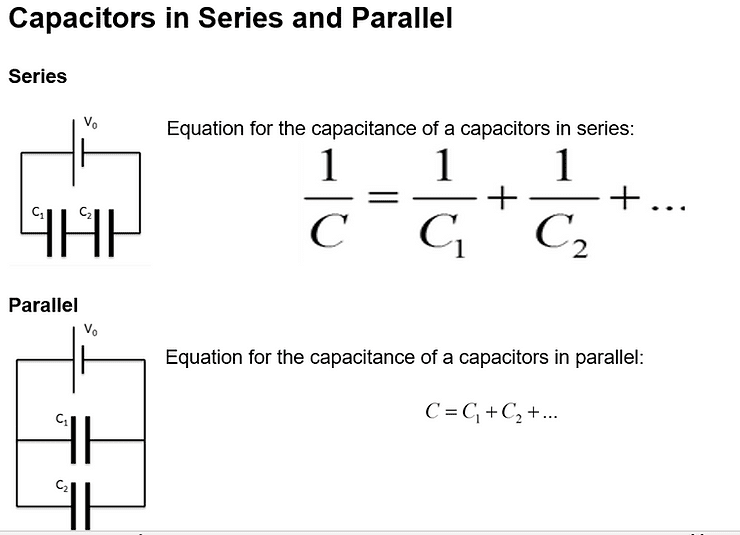
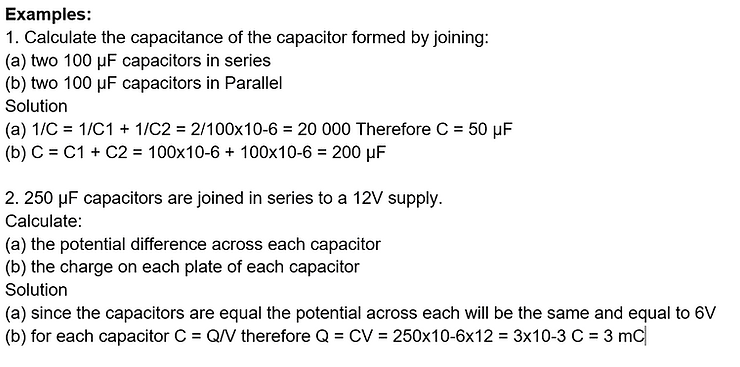
Example of Capacitors in Series and Parallel
Interested in electrical and electronic engineering? Find out more about all the electrical engineering courses we have available by clicking here.
Diploma in Electrical Technology
Diploma in Renewable Energy (Electrical)
Diploma in Electrical and Electronic Engineering
Alternatively, you can view all our online engineering courses here.
Recent Posts
Why a Headwind Reduces Take-Off Distance: The Airspeed–Groundspeed Derivation
Why a Headwind Reduces Take-Off Distance: The Airspeed–Groundspeed Derivation Aeroplanes normally take off into wind because the wing must reach a required airspeed to produce lift, whereas the runway distance is travelled at groundspeed. A headwind contributes to the airspeed before the aircraft has covered any runway. It therefore reduces the groundspeed required at lift-off […]
How to Calculate Aircraft Take-Off Ground Run: A Flight Mechanics Tutorial
How to Calculate Aircraft Take-Off Ground Run: A Flight Mechanics Tutorial An aircraft does not become airborne simply because its engines are producing thrust. During the take-off ground run, thrust must overcome aerodynamic drag and rolling resistance. On a sloping runway, it must also overcome a component of the aircraft’s weight. This tutorial derives a […]
Types of Aircraft Drag Explained: Induced, Profile and Interference Drag
Types of Aircraft Drag Explained: Induced, Profile and Interference Drag An aircraft experiences several forms of aerodynamic drag at the same time. Some result from generating lift, some arise as air flows over the aircraft’s surfaces, and others are created when airflow around neighbouring components interacts. For a conventional aircraft in subsonic flight, total drag […]