

Why Lean Manufacturing Matters: Principles of waste
Introduction
Lean manufacturing isn’t just a toolkit for improving efficiency, it’s a mindset that reshapes how organisations think about value. At its core, lean focuses on delivering exactly what the customer needs, when they need it, with as little waste as possible. In an increasingly competitive and resource-conscious world, this approach has become more relevant than ever.
But what exactly is “waste”? In lean terms, waste refers to any activity that consumes time, resources, or effort without adding value from the customer’s perspective. Whether it’s excess inventory sitting idle, unnecessary movement on the shop floor, or defects requiring rework, these inefficiencies quietly erode productivity and profitability.
Understanding the principles of waste is the first step toward building a lean organisation. By identifying and eliminating these non-value-added activities, businesses can streamline processes, improve quality, reduce costs, and respond more quickly to customer demands. More importantly, lean empowers teams to continuously improve the way they work, creating a culture where efficiency and innovation go hand in hand.
In this blog, we’ll explore why lean manufacturing matters and break down the key principles of waste, helping you see where opportunities for improvement may be hiding in plain sight.
The Seven Types of Waste
The traditional lean model identifies seven types of waste, often remembered using the acronym TIM WOOD:
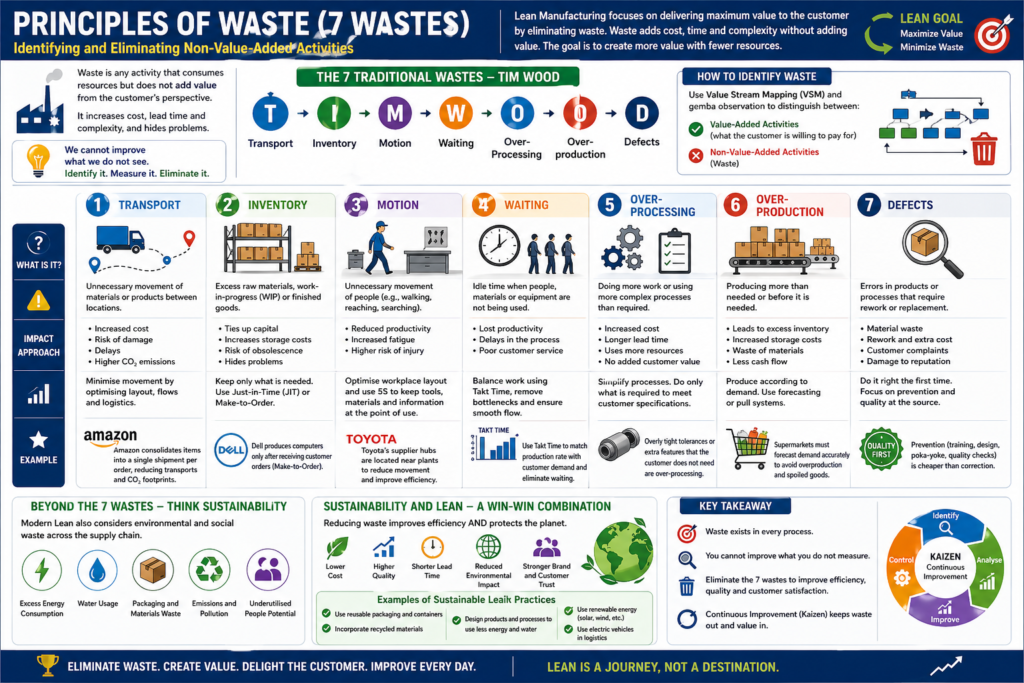
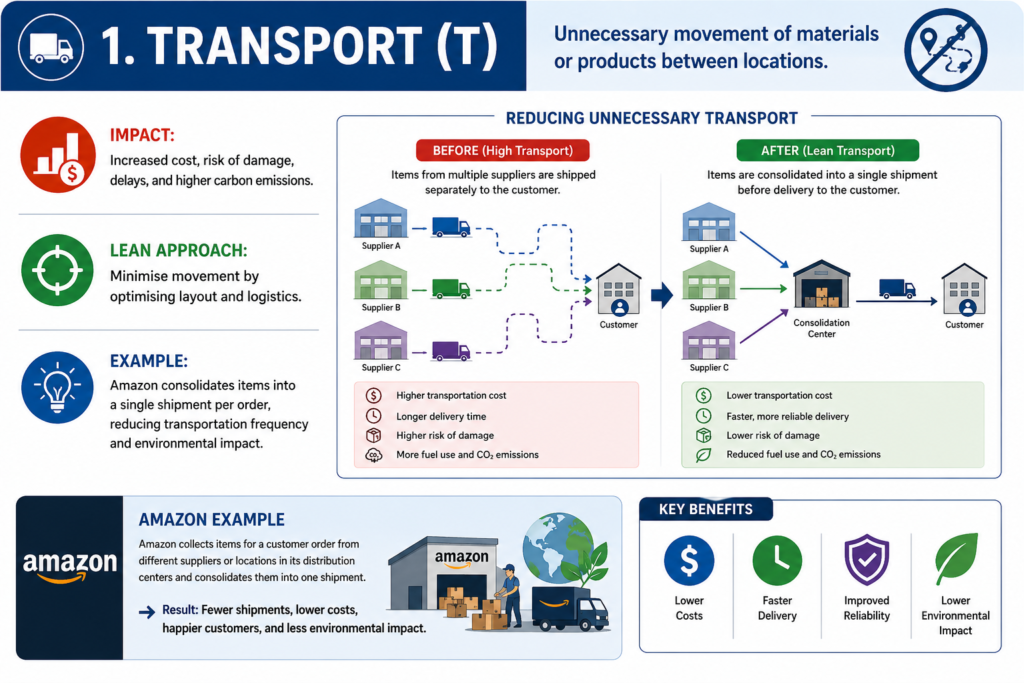
1. Transport (T)
Unnecessary movement of materials or products between locations.
- Impact: Increased cost, risk of damage, delays, and higher carbon emissions.
- Lean Approach: Minimise movement by optimising layout and logistics.
- Example: Amazon consolidates items into a single shipment per order, reducing transportation frequency and environmental impact.
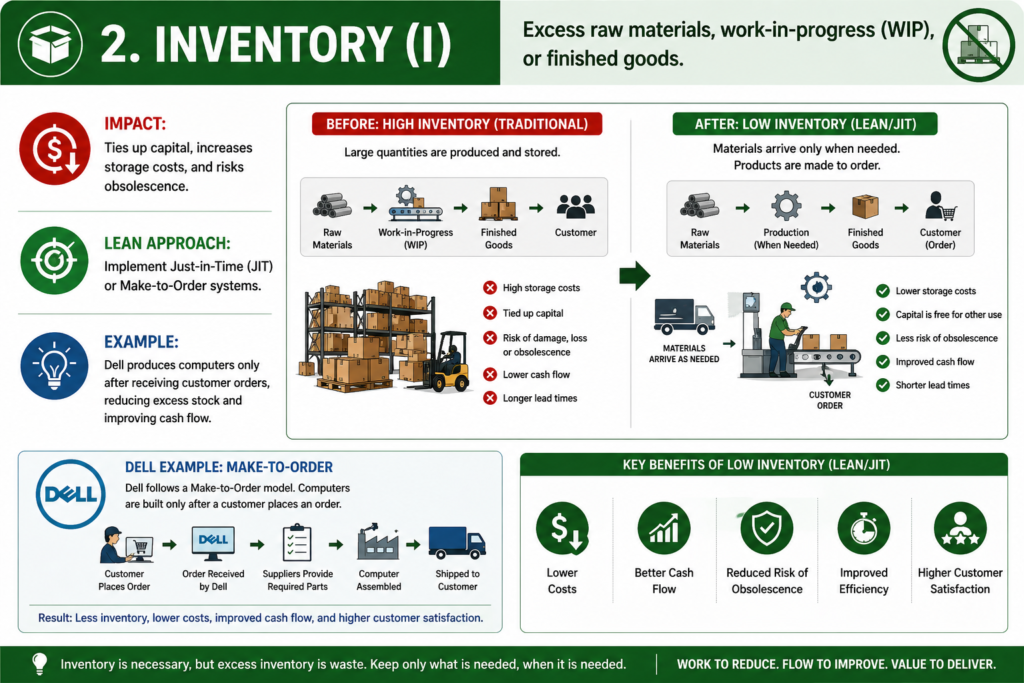
2. Inventory (I)
Excess raw materials, work-in-progress (WIP), or finished goods.
- Impact: Ties up capital, increases storage costs, and risks obsolescence.
- Lean Approach: Implement Just-in-Time (JIT) or Make-to-Order systems.
- Example: Dell produces computers only after receiving customer orders, reducing excess stock and improving cash flow.
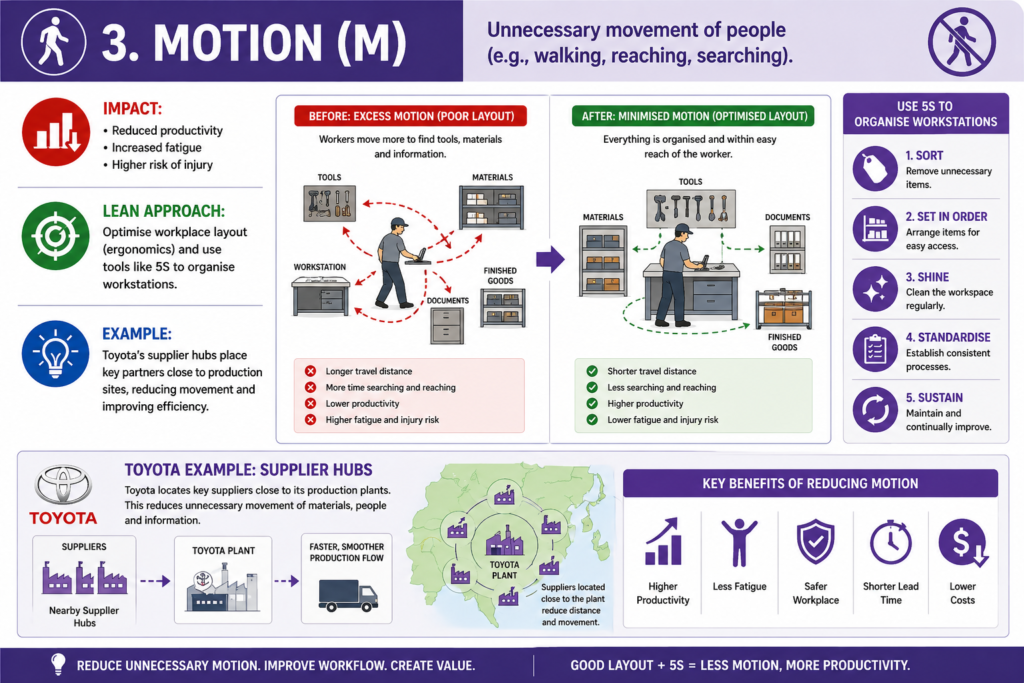
3. Motion (M)
Unnecessary movement of people (e.g., walking, reaching, searching).
- Impact: Reduced productivity, increased fatigue, and higher risk of injury.
- Lean Approach: Optimise workplace layout (ergonomics) and use tools like 5S to organise workstations.
- Example: Toyota’s supplier hubs place key partners close to production sites, reducing movement and improving efficiency.
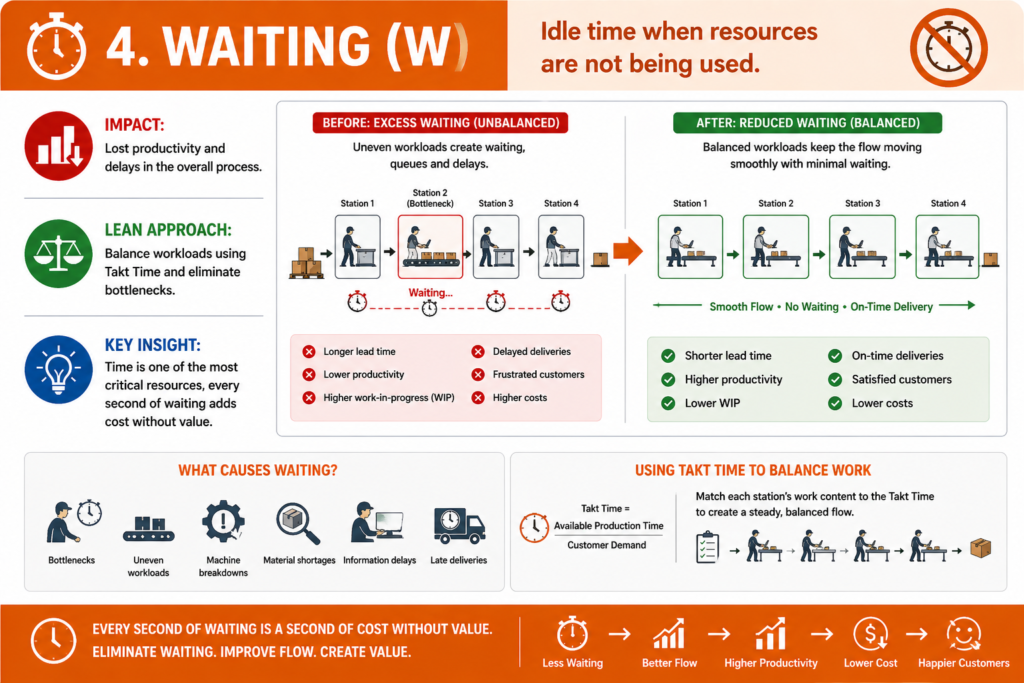
4. Waiting (W)
Idle time when resources are not being used.
- Impact: Lost productivity and delays in the overall process.
- Lean Approach: Balance workloads using Takt Time and eliminate bottlenecks.
- Key Insight: Time is one of the most critical resources, every second of waiting adds cost without value.
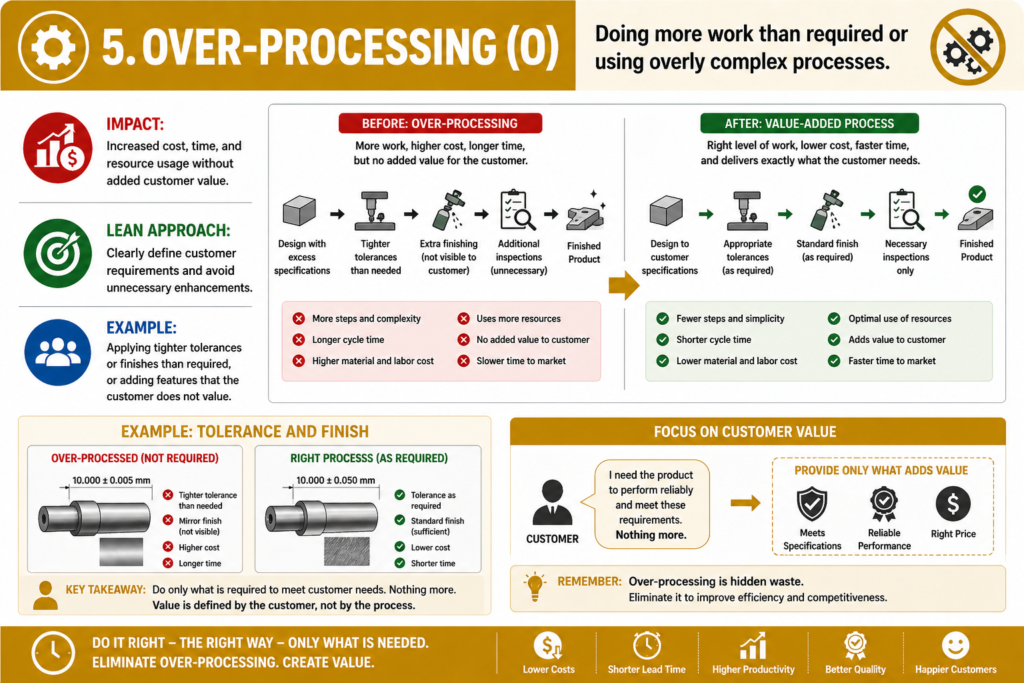
5. Over-Processing (O)
Doing more work than required or using overly complex processes.
- Impact: Increased cost, time, and resource usage without added customer value.
- Lean Approach: Clearly define customer requirements and avoid unnecessary enhancements.
- Example: Applying tighter tolerances or finishes than required, or adding features that the customer does not value.
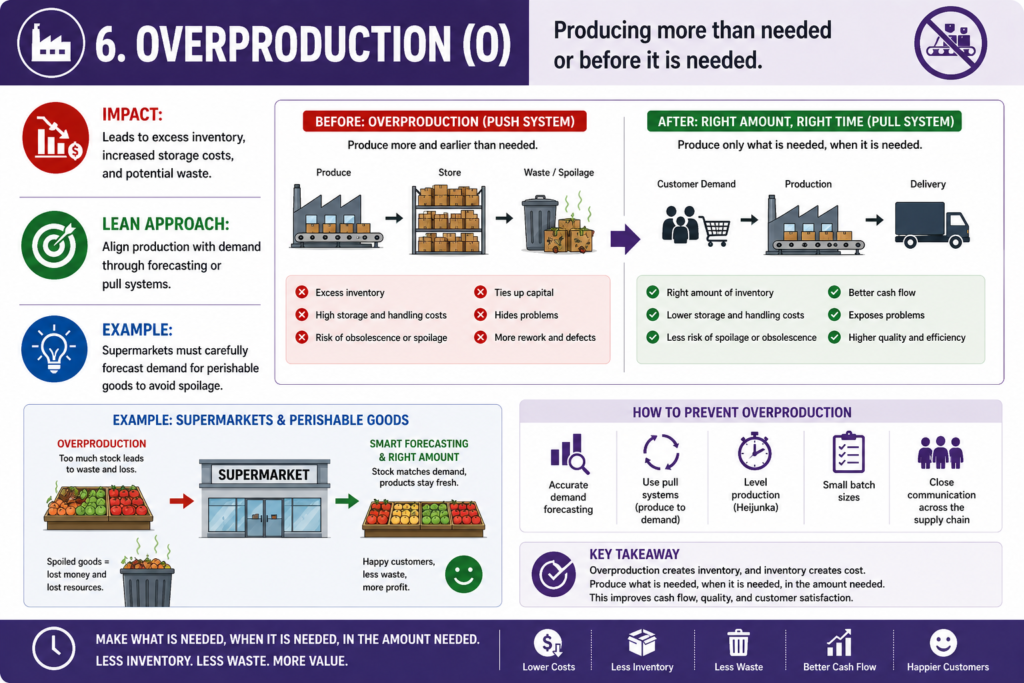
6. Overproduction (O)
Producing more than needed or before it is needed.
- Impact: Leads to excess inventory, increased storage costs, and potential waste.
- Lean Approach: Align production with demand through forecasting or pull systems.
- Example: Supermarkets must carefully forecast demand for perishable goods to avoid spoilage.
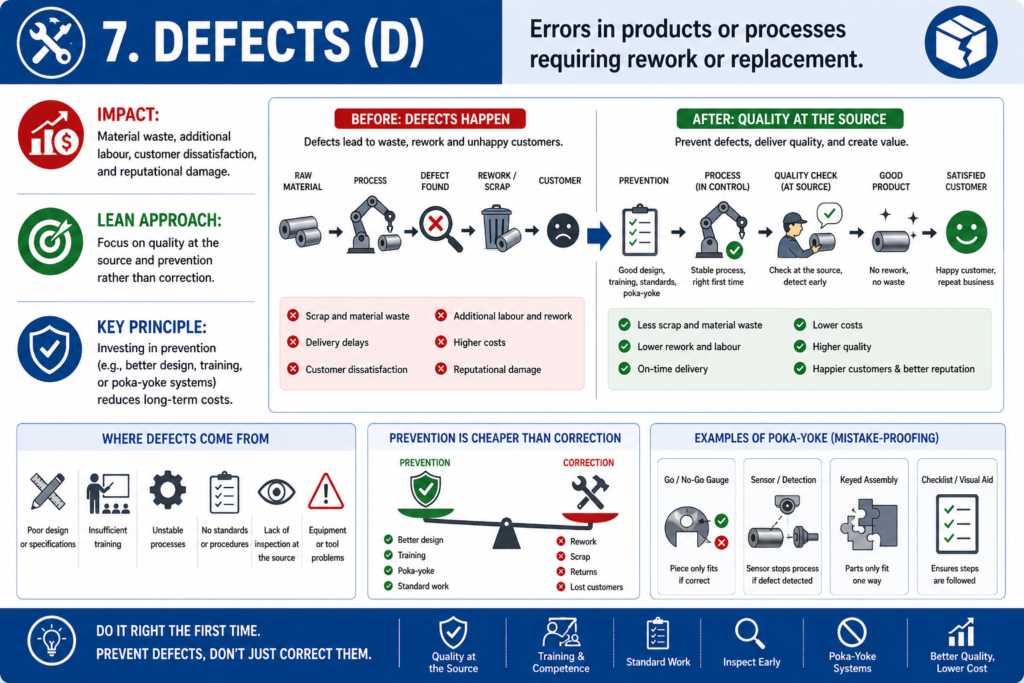
7. Defects (D)
Errors in products or processes requiring rework or replacement.
- Impact: Material waste, additional labour, customer dissatisfaction, and reputational damage.
- Lean Approach: Focus on quality at the source and prevention rather than correction.
- Key Principle: Investing in prevention (e.g., better design, training, or poka-yoke systems) reduces long-term costs.
Identifying Waste
Waste can be effectively identified through tools such as Value Stream Mapping (VSM), which helps visualise the entire process and distinguish between:
- Value-Added Activities (what the customer is willing to pay for)
- Non-Value-Added Activities (Waste)
By analysing these activities, organisations can target improvements where they will have the greatest impact.
Beyond the Traditional 7 Wastes
While the seven wastes focus primarily on production processes, modern lean thinking also considers environmental and sustainability-related waste, including:
- Excess energy consumption
- Water usage
- Packaging and materials waste
Sustainability and Lean
Today, organisations are increasingly integrating lean principles with environmental sustainability. Reducing waste not only improves efficiency but also contributes to:
- Lower operational costs
- Reduced environmental impact
- Improved corporate responsibility and brand image
Examples:
- Using reusable packaging instead of single-use materials
- Incorporating recycled materials into production
- Designing processes and products to consume less energy
- Adopting renewable energy sources such as solar power
- Transitioning to electric vehicles in logistics
Interested in our Industrial & Manufacturing Engineering Courses?
At iLearn Engineering®, we offer a diverse range of online accredited Industrial, Manufacturing and Mechanical Engineering courses and qualifications to cater to different academic and career goals. Our industrial courses are available in varying credit values and levels, ranging from 40 credit Engineering Diplomas to a Bachelor’s equivalent 360 credit International Graduate Diploma.
All Industrial / Manufacturing Engineering Courses
All Industrial / Manufacturing Engineering Diploma Courses can be seen here.
All Mechanical Engineering Diploma Courses can be seen here.
Short Courses for Industrial Engineering (40 Credits)
- Diploma in Manufacturing
- Diploma in Composites, Smart Materials & Nanotechnology
- Diploma in Lean Manufacturing
- Diploma in Mechanical Technology
- Diploma in Electrical Technology
- Diploma in Material Science
First Year of Undergraduate (Level 4 – 120 Credits)
Higher International Certificate in Industrial Engineering
Higher International Certificate in Mechanical Engineering
Years One and Two of Undergraduate (Level 5 – 240 Credits)
Higher International Diploma in Industrial Engineering
Higher International Diploma in Mechanical Engineering
Degree Equivalent International Graduate Diplomas in Engineering Management and Mechanical Engineering (Level 6 – 360 Credits)
International Graduate Diploma in Engineering Management (Level 6) [120 Credit Top Up]
International Graduate Diploma in Mechanical Engineering (Level 6) [120 Credit Top Up]
Complete Engineering Course Catalogue (all courses)
Alternatively, you can view all our online engineering courses here.
Get started today
Explore our range of Industrial and Manufacturing Engineering courses
Recent Posts
Types of Aircraft Drag Explained: Induced, Profile and Interference Drag
Types of Aircraft Drag Explained: Induced, Profile and Interference Drag An aircraft experiences several forms of aerodynamic drag at the same time. Some result from generating lift, some arise as air flows over the aircraft’s surfaces, and others are created when airflow around neighbouring components interacts. For a conventional aircraft in subsonic flight, total drag […]
Induced Drag Explained: Why Flying Slower Can Increase Drag
Induced Drag Explained: Why Flying Slower Can Increase Drag Why can an aircraft experience more drag when it flies more slowly? We usually associate greater speed with greater air resistance, but a wing must also generate enough lift to support the aircraft. Induced drag is the drag associated with producing lift on a finite-span wing. […]
Laminar vs Turbulent Boundary Layers: Why Airflow Separates from Aircraft Wings
Laminar vs Turbulent Boundary Layers: Why Airflow Separates from Aircraft Wings Airflow around an aircraft wing is often shown as smooth streamlines passing neatly over the aerofoil. In reality, the thin layer of air immediately next to the wing surface behaves very differently from the undisturbed airflow further away. This region is called the boundary […]