

Kirchhoff’s current and voltage laws
In our last article, we looked at the principles and operation of a d.c motor. In this article, we’re going to investigate Kirchoff’s current and voltage laws, as well as how to apply them to engineering problems.
Kirchoff’s law of current
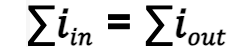
Kirchoff’s law of current states that the algebraic sum of all current at any node in an electrical circuit is equal to zero or the sum of the currents flowing into a node is equal to the sum of the currents flowing out of that node.
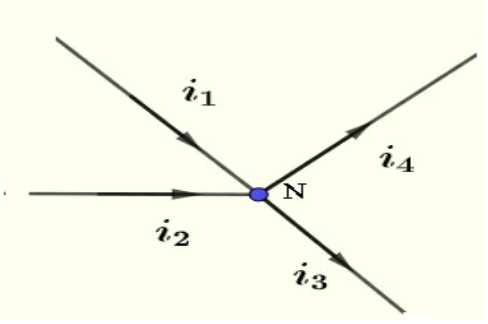
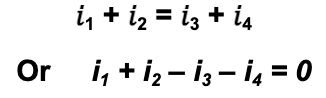
At the node N above, we write:
Kirchoff’s law of voltage
Kirchoff’s law of voltage states that in any closed loop in an electrical circuit, the algebraic sum of all voltages around the loop is equal to zero.
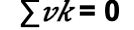
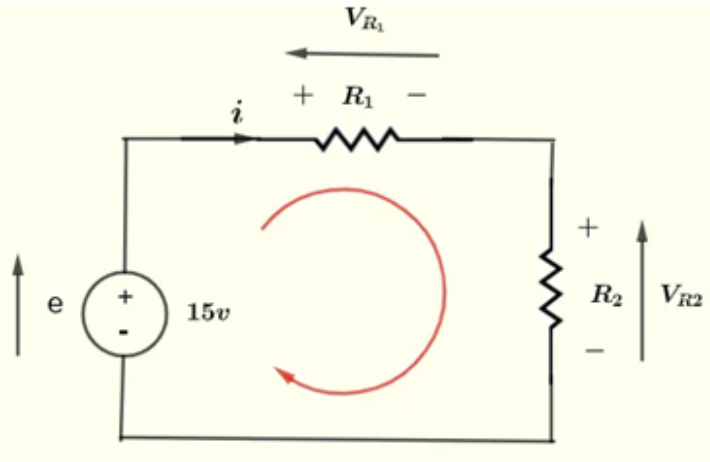
Using the closed loop, we may write:
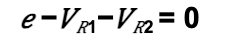
Since the voltages across the resistors are in the opposite direction to the e.m.f of the cell.
Electromotive force e.m.f and internal resistance
The electromotive force (e) or e.m.f is the energy provided by a cell or battery per coulomb of charge passing through it, and it’s measured in volts V.
It’s equal to the potential difference across the terminal of the cell when no current is flowing:
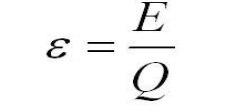
- ꜫ = electromotive force in volts, V
- E = energy in joules, J
- Q = charge in coulombs, C
Batteries and cells have an internal resistance (r) which is measured in ohm’s (Ω). When electricity flows around a circuit the internal resistance of the cell itself resists the flow of current and so thermal (heat) energy is wasted in the cell itself.
Ohms law is then expanded to include this internal resistance

- ꜫ = electromotive force in volts, V
- I = current in amperes, A
- R = resistance of the load in the circuit in ohms, Ω
- r = internal resistance of the cell in ohms, Ω
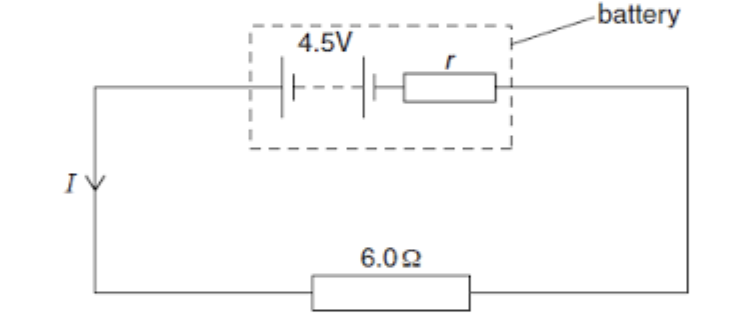
We can rearrange the above equation;
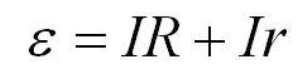
and then to
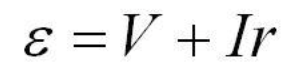
In this equation (V) appears which is the terminal potential difference, measured in volts (V).
The potential difference across the terminals of the cell when current is flowing in the circuit is always less than the e.m.f. of the cell.
We can also calculate the e.m.f from a graph of V against I. If we plot a graph of terminal potential difference (V) against the current in the circuit (I) we get a straight line with a negative gradient.
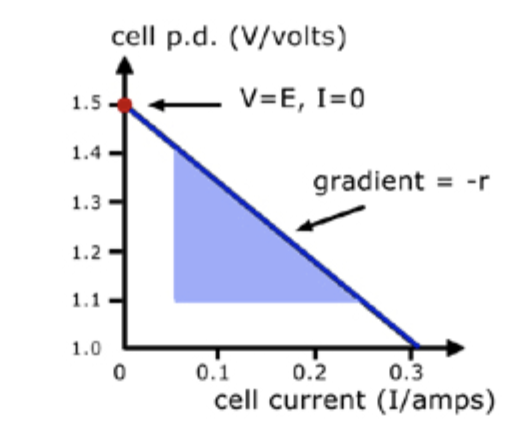
We can then rearrange the e.m.f. equation from above to match the general expression for
a straight line, y = mx +c.
If we start with ꜫ = V + Ir
Rearrange to make V the subject: V = -Ir + ꜫ
Compare this to Y = mx + c (typical equation for a straight line graph)
We can see that the gradient = – r and the intercept = ꜫ
Interested in our courses?
You can read more about our selection of accredited online electrical engineering courses here.
Check out individual courses pages below:
Diploma in Electrical and Electronic Engineering
Higher International Certificate in Electrical and Electronic Engineering
Diploma in Electrical Technology
Diploma in Renewable Energy (Electrical)
Higher International Diploma in Electrical and Electronic EngineeringAlternatively, you can view all our online engineering courses here.
Recent Posts
Catching a Rocket: The Engineering Behind SpaceX’s Incredible Starship Achievement
Catching a Rocket: The Engineering Behind SpaceX’s Incredible Starship Achievement How do you catch a rocket falling from space? We explore the mechanical, electrical and control engineering principles behind one of the most remarkable achievements in modern aerospace engineering. Imagine trying to catch a 50-metre-tall rocket as it returns from space, travelling at enormous speeds, […]
Why a Headwind Reduces Take-Off Distance: The Airspeed–Groundspeed Derivation
Why a Headwind Reduces Take-Off Distance: The Airspeed–Groundspeed Derivation Aeroplanes normally take off into wind because the wing must reach a required airspeed to produce lift, whereas the runway distance is travelled at groundspeed. A headwind contributes to the airspeed before the aircraft has covered any runway. It therefore reduces the groundspeed required at lift-off […]
How to Calculate Aircraft Take-Off Ground Run: A Flight Mechanics Tutorial
How to Calculate Aircraft Take-Off Ground Run: A Flight Mechanics Tutorial An aircraft does not become airborne simply because its engines are producing thrust. During the take-off ground run, thrust must overcome aerodynamic drag and rolling resistance. On a sloping runway, it must also overcome a component of the aircraft’s weight. This tutorial derives a […]