

What Is a Fuselage? Exploring Its Structure and Function in Aircraft
Introduction
The fuselage should carry the payload, and is the main body to which all parts are connected. It must be able to resist bending moments (caused by weight and lift from the tail), torsional loads (caused by fin and rudder) and cabin pressurization. The structural strength and stiffness of the fuselage must be high enough to withstand these loads. At the same time, the structural weight must be kept to a minimum.
The fundamental purpose of the fuselage structure is to provide an envelope to support the payload, crew, equipment, systems and (possibly) the powerplant. Furthermore, it must react against the in-flight manoeuvre, pressurisation and gust loads; also the landing gear and possibly any powerplant loads. Finally, it must be able to transmit control and trimming loads from the stability and control surfaces throughout the rest of the structure.
Fuselage Layout Concepts
There are two main categories of layout concept in common use:
Mass Boom & Longeron Layout
This is fundamentally very similar to the mass-boom wing-box concept. It is used when the overall structural loading is relatively low or when there are extensive cut-outs in the shell. The concept comprises four or more continuous heavy booms (longerons), reacting against any direct stresses caused by applied vertical and lateral bending loads.
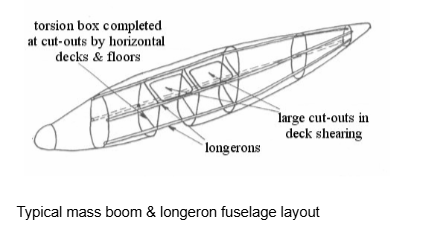
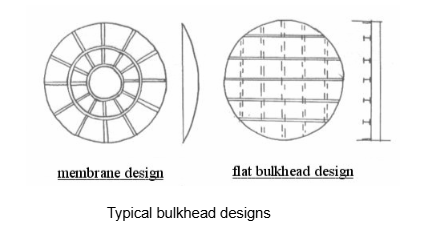
Frames or solid section bulkheads are used at positions where there are distinct direction changes and possibly elsewhere along the lengths of the longeron members. The outer shell helps to support the longerons against the applied compression loads and also helps in the shear- carrying. Floors are needed where there are substantial cut-outs and the skin is stabilised against buckling by the use of frames and bulkheads.
Semi Monocoque Layout
This is the most common layout, especially for transport types of aircraft, with a relatively small number and size of cut-outs in use. The skin carries most of the loading with the skin thickness determined by pressurisation, shear loading & fatigue considerations.
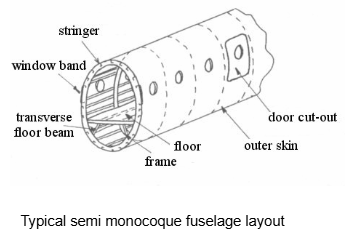
Longitudinal stringers provide skin stabilisation and also contribute to the overall load carrying capacity. Increased stringer cross-section sizes and skin thicknesses are often used around edges of cut-outs. Less integral machining is possible than on an equivalent wing structure.Frames are used to stabilise the resultant skin-stringer elements and also to transmit shear loads into the structure. They may also help to react against any pressurisation loads present. They are usually manufactured as pressings with reinforced edges. Their spacing (pitch) is usually determined by damage tolerance considerations, i.e. crack-stopping requirements. The frames are usually in direct contact with the skin; stringers pass through them and are cleated into place.
Fuselage Layout Considerations
The structural layout of an aircraft’s fuselage is critically affected in accordance with whether it is a combat or transport type (in broad terms).
Fighter Aircraft
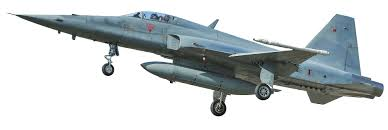
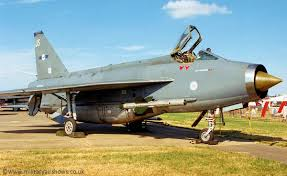
For the majority of fighter aircraft designs, the main features affecting the fuselage layout include:
Powerplant installation: The number and location of the engines directly influences the fuselage shape and sectional area.
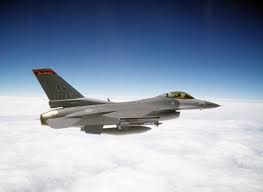
Single central location (e.g. F16, F102, F106, Mirage, Gnat, MiG-17, etc.)
Twin side-by-side installation (e.g. F5, F14, F15, F18, Jaguar, MiG-19, Su-15, etc.)
Twin vertical installation (uncommon, e.g. English Electric Lightning).
Fuel/undercarriage installation
Weapons carriage/integration: The selection of either internal or external carriage will significantly affect the resultant fuselage structure. The advantages of internal carriage include: Improved stealth characteristics. Reduced wave drag. Constant area rule for further reductions in wave drag.
Internal carriage disadvantages include: Reduced flexibility to different roles and changed specifications. A significant volume and mass penalty with empty weapon compartment. Structural penalties due to the large cut-outs. The use of area ruling on transonic/supersonic fighters also significantly affects fuselage section. Pressurisation is usually only required locally in the crew compartment and not in the rest of the fuselage, leading to reduced loading requirements.
Transport Aircraft
Transport aircraft have substantially longer “in-service” lifetimes than fighters and this leads to two potential problem areas, fatigue and corrosion.
Fatigue prevention involves: Careful materials selection. Reduction of loads, stress levels and concentrations. Eased inspection and maintenance procedures.
Corrosion prevention involves: Adequate provision for moisture drainage. Maintenance of the surface finish and protective treatment integrity.
Fuselage Cross-Section
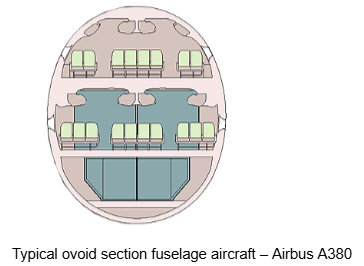
The sizing and selection of the fuselage cross-section of a transport aircraft is a lengthy process and involves compromises between weight, drag, systems, stowage and comfort considerations (also stealth & weapons integration for military transports). For pressurised aircraft a circular section is the most efficient in purely structural terms; however, this is often relatively wasteful in terms of volume so that “double bubble” or “ovoid” sections are often used instead.
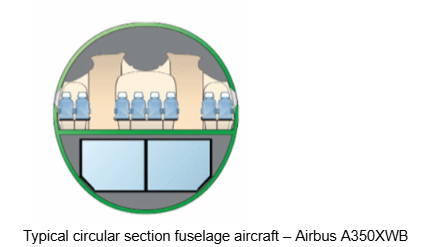
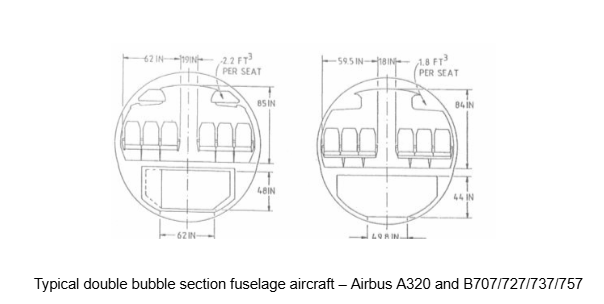
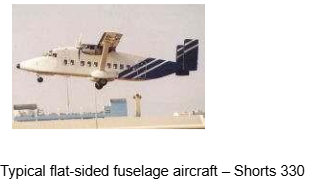
For aircraft with low pressurisation requirements, flat-sided fuselages are often used as these are significantly cheaper to design and build.
Interested in our Aerospace Engineering Courses?
At iLearn Engineering®, we offer a diverse range of online accredited aerospace engineering courses and qualifications to cater to different academic and career goals. Our aerospace courses are available in varying credit values and levels, ranging from 40 credit Engineering Diplomas to a Bachelor’s equivalent 360 credit International Graduate Diploma.
All Aerospace Engineering Courses
All Aerospace Engineering Diploma Courses can be seen here.
Short Aerospace Courses (40 Credits)
- Diploma in Aerospace Engineering
- Diploma in Aircraft Design
- Diploma in Principles of Flight
- Diploma in Aerospace Structures
- Diploma in Aerodynamics
- Diploma in Aerodynamics, Propulsion and Space
First Year of Undergraduate (Level 4 – 120 Credits)
Higher International Certificate in Aerospace Engineering
Years One and Two of Undergraduate (Level 5 – 240 Credits)
Higher International Diploma in Aerospace Engineering
Degree Equivalent International Graduate Diploma (Level 6 – 360 Credits)
International Graduate Diploma in Aerospace Engineering
Complete Engineering Course Catalogue (all courses)
Alternatively, you can view all our online engineering courses here.
Recent Posts
Types of Aircraft Drag Explained: Induced, Profile and Interference Drag
Types of Aircraft Drag Explained: Induced, Profile and Interference Drag An aircraft experiences several forms of aerodynamic drag at the same time. Some result from generating lift, some arise as air flows over the aircraft’s surfaces, and others are created when airflow around neighbouring components interacts. For a conventional aircraft in subsonic flight, total drag […]
Induced Drag Explained: Why Flying Slower Can Increase Drag
Induced Drag Explained: Why Flying Slower Can Increase Drag Why can an aircraft experience more drag when it flies more slowly? We usually associate greater speed with greater air resistance, but a wing must also generate enough lift to support the aircraft. Induced drag is the drag associated with producing lift on a finite-span wing. […]
Laminar vs Turbulent Boundary Layers: Why Airflow Separates from Aircraft Wings
Laminar vs Turbulent Boundary Layers: Why Airflow Separates from Aircraft Wings Airflow around an aircraft wing is often shown as smooth streamlines passing neatly over the aerofoil. In reality, the thin layer of air immediately next to the wing surface behaves very differently from the undisturbed airflow further away. This region is called the boundary […]