

Engineering the Tail: Structure and Function of the Empennage
Introduction
In most aircraft, the sole function of the tail unit is to provide the required stability and control. Stability is the tendency of the aircraft to return to its original attitude by itself.
Since an aircraft flies in three-dimensional space, stability and control are required in three directions. These axes are lateral (left and right), vertical (up and down) and longitudinal (fore and aft). For aircraft turns, three manoeuvre cases are used.
For pitch, which is rotation about the lateral axis, the horizontal tail with elevators is used.
For yaw, which is rotation about the vertical axis, the vertical fin with rudder is used.
For roll, which is rotation about the longitudinal axis, the ailerons are used.
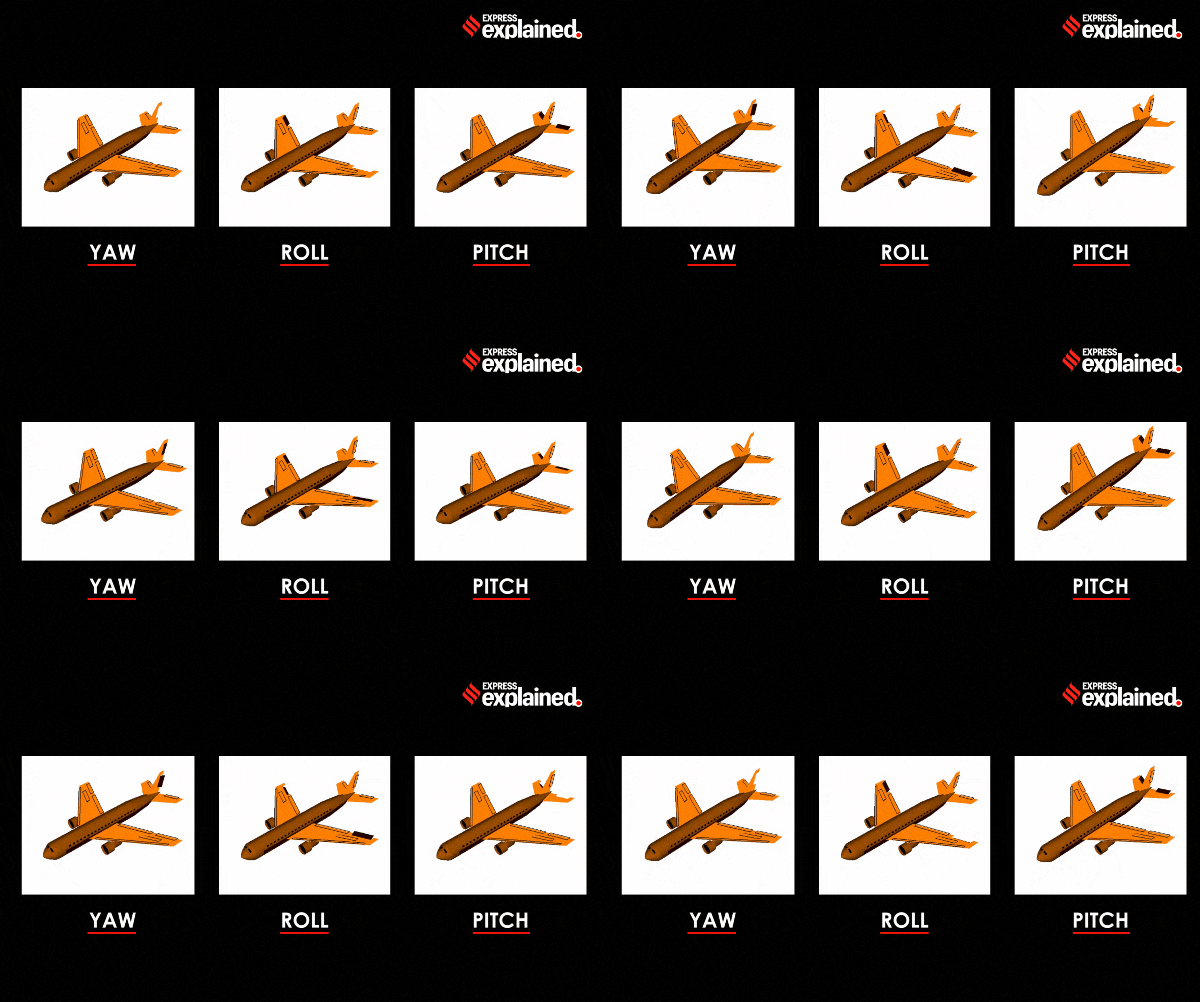
The fin provides stability in yaw. When the aircraft is required to yaw, the rudder is deflected. The tailplane provides stability in pitch. When the aircraft is required to climb or descend, the elevators are deflected.
If the position of the centre of gravity varies, or if the aircraft speed is changed, the elevator position necessary to maintain level flight will change. Therefore a small extra control surface is added to each main surface to allow the pilot to trim the aircraft.
This tends to be very similar in many respects to that of the wing structure, though is generally of a lower aspect ratio and therefore subjected to smaller bending moments.
Several designs are possible for both the vertical and horizontal tails, including:
- A single spar layout with spar caps taking the bending loads, very popular for light aircraft.
- A single spar with a root pivot operating either a full slab tail or a taileron, used on many high-speed (supersonic) fighters.
- A standard two spar construction.
- A multi-spar layout, especially on thin section tails.
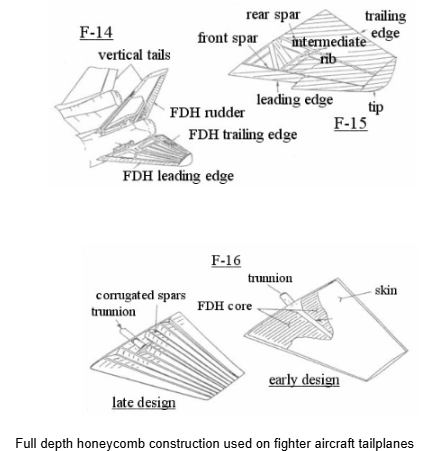
- Full-depth honeycomb construction.
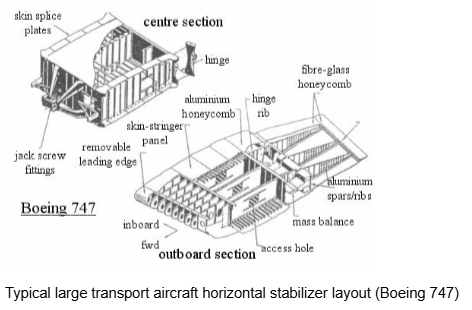
There are two main categories used for transport aircraft. The smaller ones generally use a standard built-up or integral layout but with simplifications due to the lack of any stringers
Smaller Aircraft
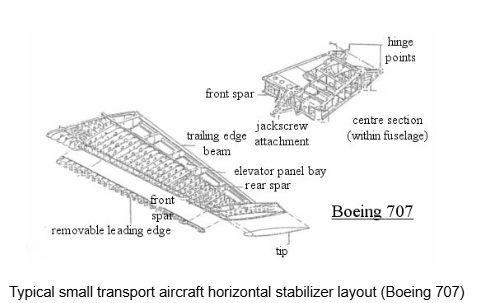
Larger Aircraft
Larger transports are even more conventional and have a classical configuration comprising spars, skin, ribs and stringers.
Fighter planes
Many fighters use full depth honeycomb (FDH) construction due to the required section thinness.
Vertical stabilizer (fin)
Regarding the vertical stabilizer (fin), it is common practice to combine the fin integrally with the rear fuselage section. Using this method, the fin spars are extended to form the rear fuselage frames or bulkheads. The fin “root rib” is made to coincide with the upper surface of the rear fuselage. The rear fuselage bulkhead is often inclined to continue the line of the rear spar. The fin root shear and bending loads are all transmitted into the fuselage skin via the root rib.
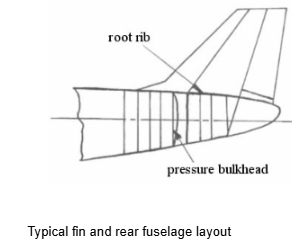
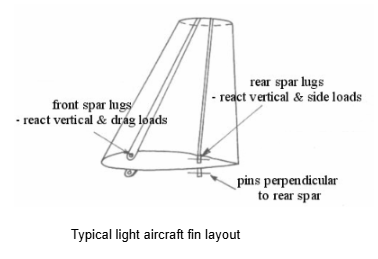
For smaller and lighter aircraft, the fin is often designed as a completely separate detachable component.
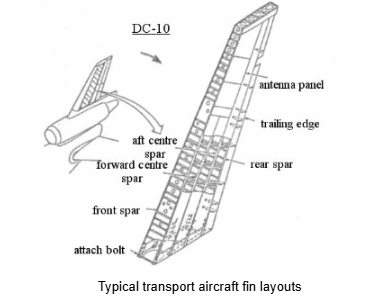
For transport aircraft the layout is usually similar to that of the conventional wing or horizontal tail.
Interested in our Aerospace Engineering Courses?
At iLearn Engineering®, we offer a diverse range of online accredited aerospace engineering courses and qualifications to cater to different academic and career goals. Our aerospace courses are available in varying credit values and levels, ranging from 40 credit Engineering Diplomas to a Bachelor’s equivalent 360 credit International Graduate Diploma.
All Aerospace Engineering Courses
All Aerospace Engineering Diploma Courses can be seen here.
Short Aerospace Courses (40 Credits)
- Diploma in Aerospace Engineering
- Diploma in Aircraft Design
- Diploma in Principles of Flight
- Diploma in Aerospace Structures
- Diploma in Aerodynamics
- Diploma in Aerodynamics, Propulsion and Space
First Year of Undergraduate (Level 4 – 120 Credits)
Higher International Certificate in Aerospace Engineering
Years One and Two of Undergraduate (Level 5 – 240 Credits)
Higher International Diploma in Aerospace Engineering
Degree Equivalent International Graduate Diploma (Level 6 – 360 Credits)
International Graduate Diploma in Aerospace Engineering
Complete Engineering Course Catalogue (all courses)
Alternatively, you can view all our online engineering courses here.
Recent Posts
Types of Aircraft Drag Explained: Induced, Profile and Interference Drag
Types of Aircraft Drag Explained: Induced, Profile and Interference Drag An aircraft experiences several forms of aerodynamic drag at the same time. Some result from generating lift, some arise as air flows over the aircraft’s surfaces, and others are created when airflow around neighbouring components interacts. For a conventional aircraft in subsonic flight, total drag […]
Induced Drag Explained: Why Flying Slower Can Increase Drag
Induced Drag Explained: Why Flying Slower Can Increase Drag Why can an aircraft experience more drag when it flies more slowly? We usually associate greater speed with greater air resistance, but a wing must also generate enough lift to support the aircraft. Induced drag is the drag associated with producing lift on a finite-span wing. […]
Laminar vs Turbulent Boundary Layers: Why Airflow Separates from Aircraft Wings
Laminar vs Turbulent Boundary Layers: Why Airflow Separates from Aircraft Wings Airflow around an aircraft wing is often shown as smooth streamlines passing neatly over the aerofoil. In reality, the thin layer of air immediately next to the wing surface behaves very differently from the undisturbed airflow further away. This region is called the boundary […]