

Catching a Rocket: The Engineering Behind SpaceX’s Incredible Starship Achievement
How do you catch a rocket falling from space? We explore the mechanical, electrical and control engineering principles behind one of the most remarkable achievements in modern aerospace engineering.
Imagine trying to catch a 50-metre-tall rocket as it returns from space, travelling at enormous speeds, using nothing more than two giant mechanical arms.
It sounds like something from a science fiction film. But on 14 November 2026, SpaceX achieved a remarkable milestone: catching the Starship spacecraft itself using the enormous mechanical arms of its launch tower in Texas.
The achievement followed the first successful catch of Starship’s Super Heavy booster in October 2024. Together, these developments demonstrate how far reusable rocket technology has progressed.
But behind the dramatic footage lies something even more interesting: the engineering principles that make it possible.
From Newton’s laws of motion to hydraulic systems, structural mechanics, sensors and automatic control, the technology involved draws on subjects taught to engineering students every day.
Let’s explore how it works.
What exactly did SpaceX achieve?
SpaceX’s Starship rocket system consists of two main sections: the Super Heavy booster, which provides the enormous thrust required for launch, and the Starship upper-stage spacecraft, which continues into space.
Traditionally, rocket stages have either been discarded after use or, more recently, landed using their own engines and landing legs.
SpaceX has developed a different approach.
Rather than landing on the ground, the rocket returns to its launch facility, where two enormous mechanical arms, nicknamed chopsticks, support it using specially designed catching points.
In November 2026, SpaceX successfully extended this technique to the Starship upper stage for the first time, following its return from orbit. The Super Heavy booster from that particular flight was diverted to an offshore splashdown after an automated safety check identified a problem with its return trajectory.
The long-term objective is simple: make rockets reusable, reduce the cost of spaceflight and potentially shorten the time between launches.
Achieving that objective, however, requires several engineering disciplines to work together with extraordinary precision.
1. Mechanical engineering: How do you support a rocket?
One of the first challenges is designing a structure capable of supporting the rocket’s enormous weight.
The launch tower uses two large steel arms that move into position around the returning vehicle. These arms must withstand significant forces while maintaining accurate alignment.
At its simplest, this is a problem involving forces, loads and structural strength.
Understanding the forces involved
Newton’s second law tells us:
\[ F=ma \]
Where:
- \(F\) = resultant force (newtons)
- \(m\) = mass (kilograms)
- \(a\) = acceleration (m/s²)
Consider a simplified example involving a rocket with a mass of 100,000 kg.
The gravitational force acting on it would be:
\[ W=mg=100,000\times9.81 \]
\[ W=981,000\text{ N} \]
That is approximately 981 kN of force, simply to support the rocket’s weight.
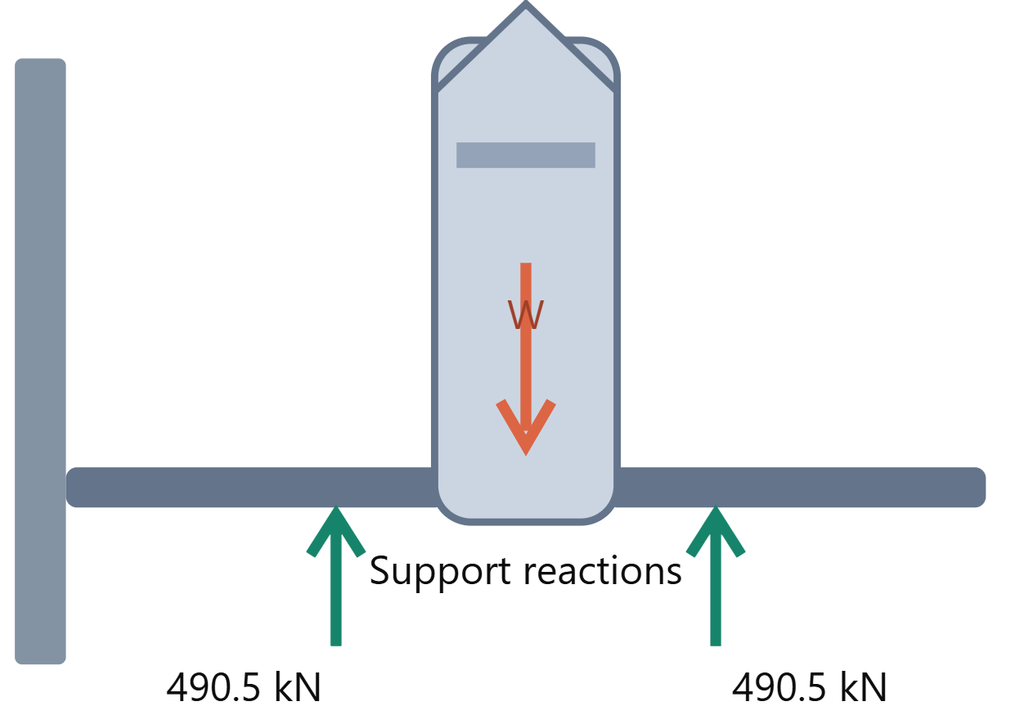
If the load were shared equally between two arms, each would need to support approximately 490.5 kN.
In reality, the engineering is much more complicated. The arms must also cope with uneven loading, vibration, bending moments and dynamic forces as the rocket settles onto its supports.
Engineers must therefore consider material selection, structural analysis, fatigue and factors of safety.
These are fundamental topics in mechanical and structural engineering.
2. Dynamics: Bringing a moving rocket to a stop
Supporting a stationary rocket is one thing. Catching a moving rocket is quite another.
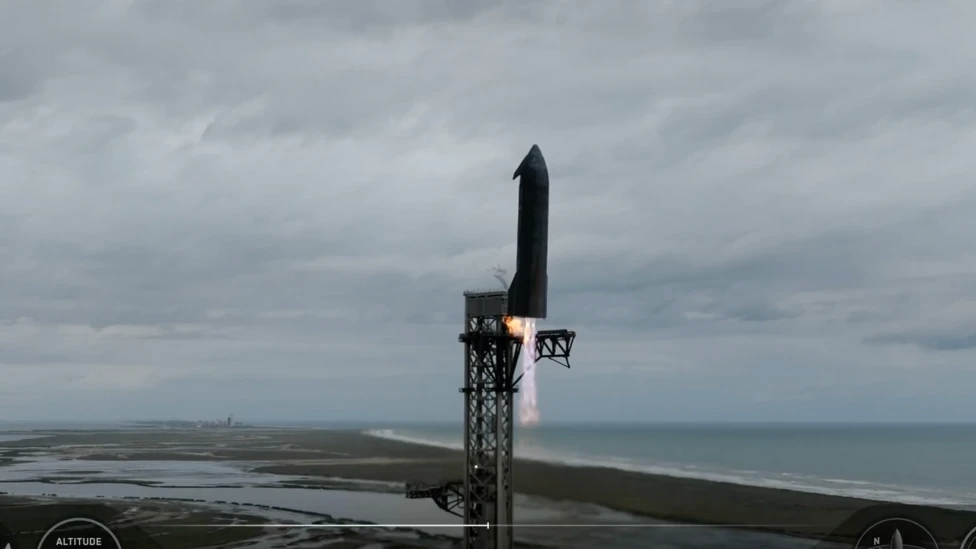
The key is to reduce the rocket’s velocity as much as possible before the catching mechanism takes its load.
The relationship between velocity, acceleration and stopping distance is:
\[ v^2=u^2+2as \]
Where \(u\) is initial velocity, \(v\) is final velocity, \(a\) is acceleration and \(s\) is displacement.
Imagine a simplified situation in which a 100,000 kg rocket is descending at 2 m/s when the catching mechanism begins slowing it.
If it is brought to rest over a distance of 0.5 metres:
\[ 0=2^2+2a(0.5) \]
\[ a=-4\text{ m/s}^2 \]
The average upward decelerating force required, in addition to supporting the rocket’s weight, is:
\[ F=100,000\times4=400,000\text{ N} \]
The total average upward support force would therefore be approximately:
\[ 981,000+400,000=\boxed{1,381,000\text{ N}} \]
That is 1.38 MN, compared with 0.981 MN when the rocket is stationary.
This is an illustrative constant-deceleration calculation, not a measurement of SpaceX’s actual catching forces. It assumes the catching system provides all the stopping force, with no remaining engine thrust.
The lesson is important: even a relatively small downward velocity can substantially increase the forces experienced during a catch.
This explains why controlled deceleration, damping and accurate positioning are so critical.
3. Control engineering: How does a rocket balance itself?
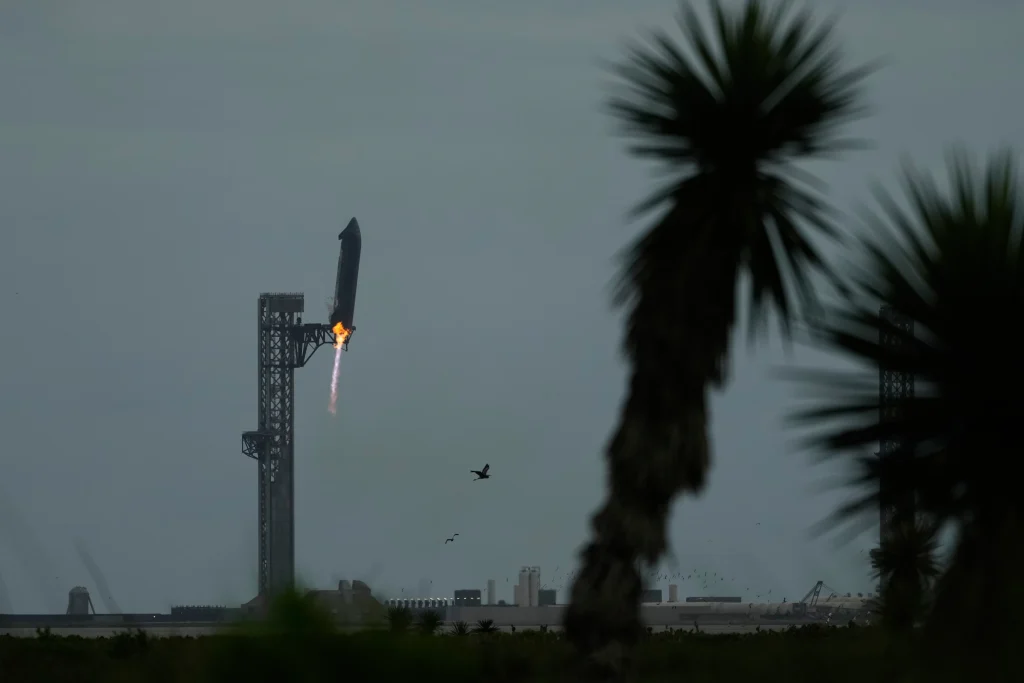
Perhaps the most impressive aspect of the process is the rocket’s ability to control its own movement.
A tall rocket is inherently difficult to stabilise, particularly while descending vertically. Small errors in angle or position can quickly develop into much larger problems.
To maintain control, the rocket uses a combination of sensors, onboard computers, aerodynamic surfaces and engines.
One of the most important concepts involved is closed-loop feedback control.
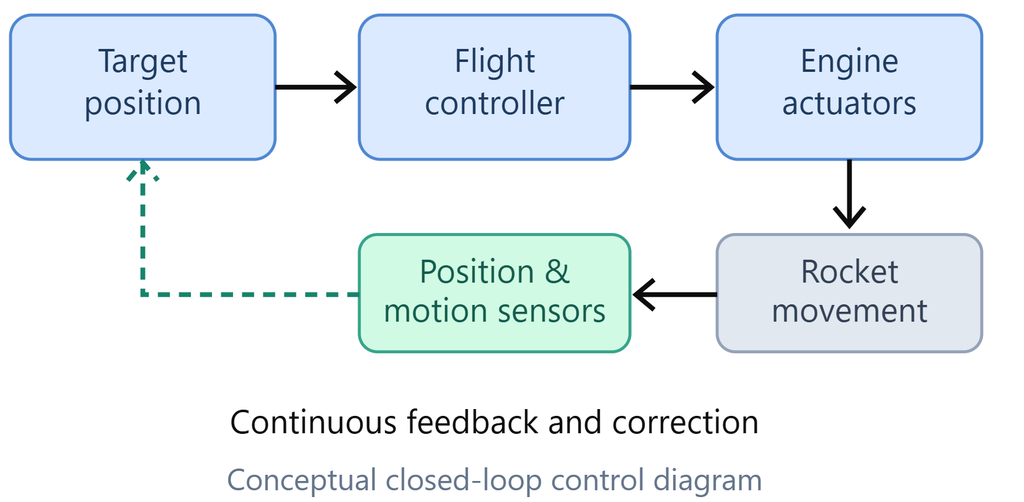
The process works as follows:
- Sensors measure the rocket’s position, velocity and orientation.
- The flight computer compares these measurements with the desired flight path.
- The control system calculates the required corrections.
- Engine thrust and direction are adjusted.
- Sensors measure the new position and the process repeats.
This happens continuously throughout the descent.
A commonly used technique in control engineering is the PID controller, which stands for Proportional, Integral and Derivative.
A PID controller responds to the current error, accumulated error and rate of change of error to help a system reach its target without excessive oscillation.
SpaceX’s actual flight-control algorithms are more sophisticated than a basic PID example, but the underlying feedback principles are similar.
The same principles are used in industrial robots, automated manufacturing systems, drones and even domestic heating systems.
4. Electrical engineering: Sensors and automation
For the rocket and tower to work together, both must know precisely what is happening.
This requires a complex network of electrical and electronic systems.
Position sensors, inertial measurement units, navigation equipment and control electronics provide information about the rocket’s movement.
Meanwhile, the tower uses its own instrumentation and control systems to monitor the position and condition of the catching equipment.
A successful catch depends on these systems communicating and responding reliably.
For example, if the rocket is approaching outside an acceptable position or velocity range, the control system must be able to recognise the problem and prevent an unsafe catch attempt.
This highlights the importance of several electrical engineering concepts: signal processing, sensor calibration, communication systems, programmable control and fault detection.
The electronics do not simply tell the machinery what to do. They also help determine whether it is safe to do it.
5. Materials engineering: Making the structure strong enough
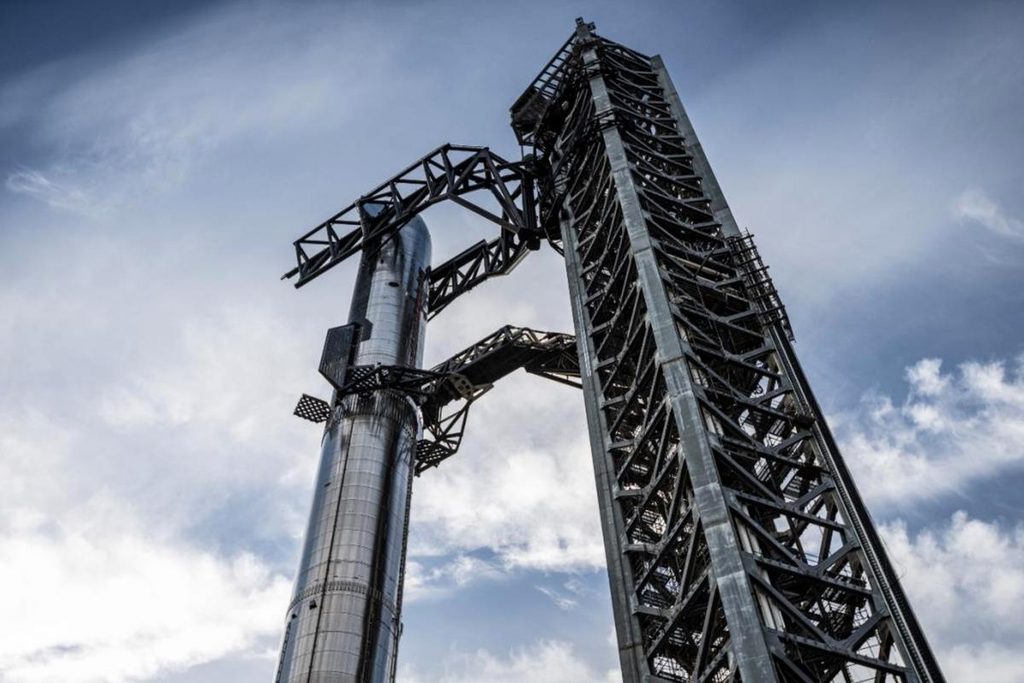
The enormous steel catching arms might appear relatively simple, but their design presents significant materials engineering challenges.
When the rocket is caught, the structure experiences concentrated loads at the contact points. Those forces must be transferred through the arms, their supporting mechanisms and ultimately into the launch tower and foundations.
Engineers must consider several important properties:
- Yield strength: The maximum stress a material can withstand before permanent deformation begins.
- Stiffness: The ability of a structure to resist deformation under load.
- Fatigue resistance: The ability to withstand repeated loading and unloading.
- Toughness: The ability to absorb energy without fracturing.
One of the simplest calculations used in materials engineering is stress:
\[ \sigma=\frac{F}{A} \]
Where \(\sigma\) is stress, \(F\) is applied force and \(A\) is the area over which the force acts.
For example, if a load of 500,000 N acts uniformly over a supporting area of 0.05 m²:
\[ \sigma=\frac{500,000}{0.05}=10,000,000\text{ Pa} \]
This gives a nominal compressive stress of 10 MPa.
In practice, engineers would need to investigate local contact stresses, bending, buckling, weld strength and dynamic loading. Computer-based Finite Element Analysis (FEA) can help predict where the highest stresses and deflections will occur.
The goal is not simply to make the structure as strong as possible. It is to make it sufficiently strong, reliable and efficient without using unnecessary material.
6. Systems engineering: Making everything work together
Perhaps the greatest challenge is not any individual component, but getting the entire system to operate together.
The rocket engines, sensors, computers, mechanical arms, structural supports and safety systems must all perform their functions at precisely the right moment.
A perfectly designed mechanical arm would be useless if the rocket arrived in the wrong position. Similarly, a perfectly controlled rocket could still be damaged if the catching mechanism failed to respond correctly.
This is where systems engineering becomes essential.
Before attempting the original Super Heavy booster catch, SpaceX had to verify thousands of vehicle and launch-pad conditions. The successful catch in October 2024 followed extensive testing, simulation and analysis of previous flights. Institution of Mechanical Engineers+1
Engineers use techniques such as Failure Mode and Effects Analysis (FMEA), risk assessment, simulation and staged testing to identify problems before they become catastrophic failures.
The November 2026 flight also demonstrated the importance of safe failure handling: when the booster could not meet the conditions for a tower catch, it diverted away from the launch site rather than continuing with an unsafe approach.
Could You Catch a Rocket?
A 50,000 kg rocket is descending at 1 m/s. A catching mechanism brings it to rest over a vertical distance of 0.25 m, with constant deceleration.
What is the average upward force the catching mechanism must apply, including the force required to support the rocket’s weight?
The bigger picture: Why engineering fundamentals matter
It is easy to look at the Starship catch and see a futuristic achievement made possible by highly advanced technology.
But strip away the enormous rocket, sophisticated computers and dramatic footage, and the underlying principles are surprisingly familiar.
Newton’s laws explain how the rocket moves. Mechanical engineering determines how the structure supports it. Electrical engineering provides the sensors and automation. Control engineering keeps the rocket on course. Materials engineering ensures the components can withstand the forces involved.
And systems engineering brings everything together.
That is what makes engineering so exciting: the same fundamental principles learned in the classroom can be applied to everything from a small automated machine to a spacecraft returning from orbit.
As reusable rocket technology continues to develop, it will undoubtedly present new challenges. But the engineers solving those challenges will continue to rely on the fundamentals of mathematics, mechanics, electronics and design.
Start your engineering journey with iLearn Engineering
At iLearn Engineering, we believe that understanding the fundamental principles of engineering is the first step towards solving real-world challenges.
Our flexible online engineering courses allow students to develop their knowledge of mechanical, electrical and electronic engineering through self-paced study, helping them build the skills and understanding that underpin modern engineering technology.
Whether you’re looking to develop your existing engineering knowledge, progress your career or take your first steps into the profession, studying engineering can open the door to an exciting range of opportunities.
Explore our online engineering courses at iLearn Engineering.
Recent Posts
Why a Headwind Reduces Take-Off Distance: The Airspeed–Groundspeed Derivation
Why a Headwind Reduces Take-Off Distance: The Airspeed–Groundspeed Derivation Aeroplanes normally take off into wind because the wing must reach a required airspeed to produce lift, whereas the runway distance is travelled at groundspeed. A headwind contributes to the airspeed before the aircraft has covered any runway. It therefore reduces the groundspeed required at lift-off […]
How to Calculate Aircraft Take-Off Ground Run: A Flight Mechanics Tutorial
How to Calculate Aircraft Take-Off Ground Run: A Flight Mechanics Tutorial An aircraft does not become airborne simply because its engines are producing thrust. During the take-off ground run, thrust must overcome aerodynamic drag and rolling resistance. On a sloping runway, it must also overcome a component of the aircraft’s weight. This tutorial derives a […]
Types of Aircraft Drag Explained: Induced, Profile and Interference Drag
Types of Aircraft Drag Explained: Induced, Profile and Interference Drag An aircraft experiences several forms of aerodynamic drag at the same time. Some result from generating lift, some arise as air flows over the aircraft’s surfaces, and others are created when airflow around neighbouring components interacts. For a conventional aircraft in subsonic flight, total drag […]