

Smooth Transitions: The Role of Flight Controls in Climb
Introduction
The transition from takeoff to climb is a critical phase of flight that demands precise coordination of aircraft flight controls. During this period, pilots rely on control surfaces such as elevators, ailerons, rudder, and high-lift devices to establish a stable climb attitude while maintaining airspeed, balance, and directional control. Smooth and effective control inputs are essential for ensuring aircraft performance, passenger comfort, and flight safety. This article examines the role of flight controls during the climb transition and explains how they contribute to a controlled and efficient ascent.
This blog will take a brief look at the way a pilot would use the aircraft controls to transition from straight, level and steady flight into a climb. An overview of the controls used and the reasoning behind such movements will be given.
If we consider the forces acting upon the aircraft, as shown below, the weight is no longer acting perpendicular to the flight path.
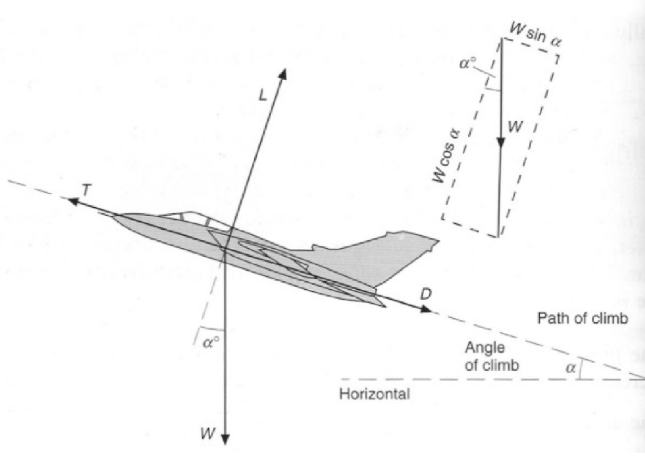
There will be a component acting to the rear, increasing the drag and meaning excess thrust is required to climb. A climb is carried out by increasing the lift of the aerofoils so that it exceeds the weight. If a climb is entered by solely increasing the angle of attack of the aerofoils without increasing power to the engine, the airspeed will slowly decrease, as the excess thrust is required to maintain the same speed in climb as that in level flight.
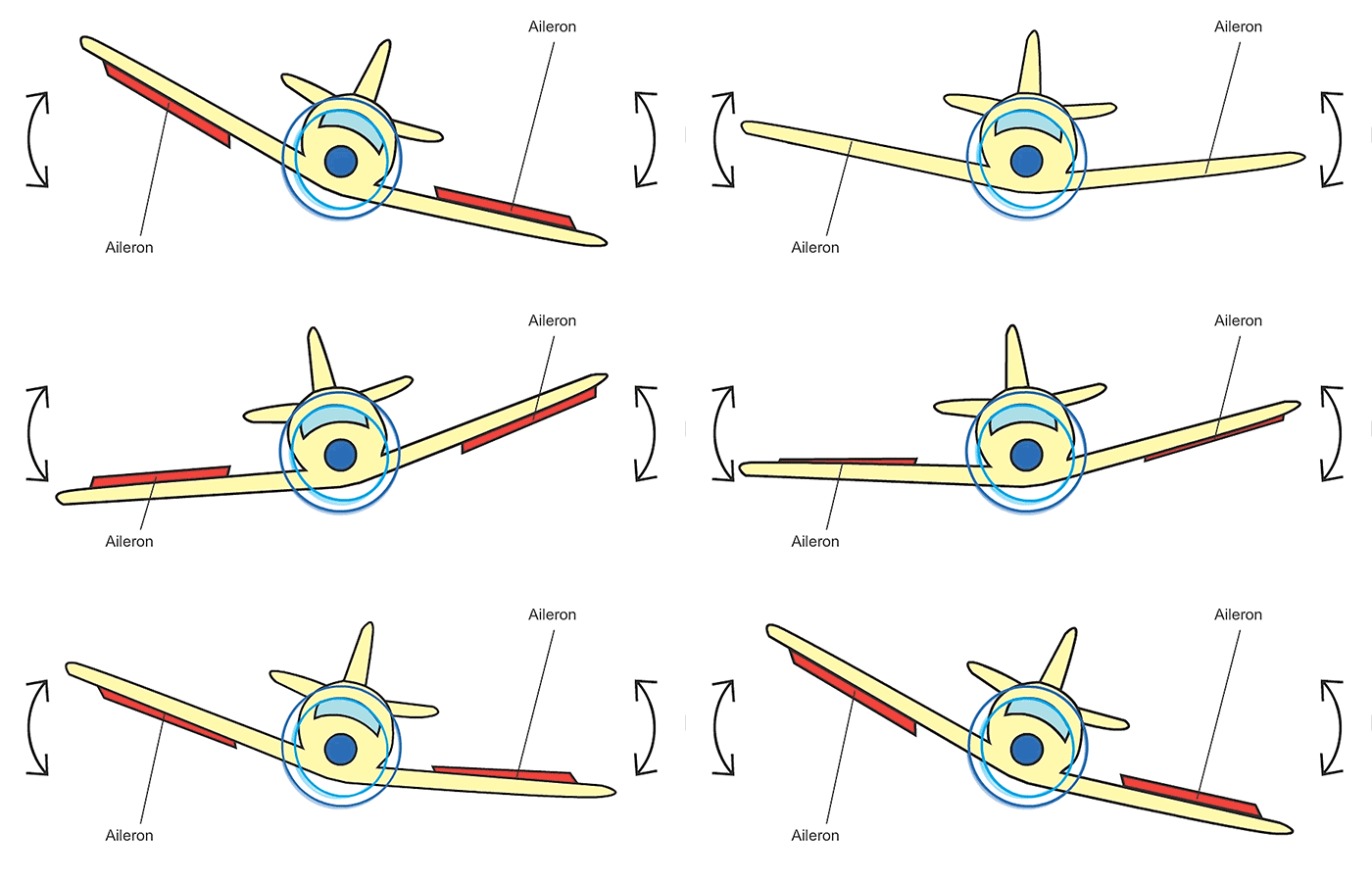
The first stage in initiating a climb is for the pilot to apply back pressure on the yoke. The yoke is a control column which is used to physically control the attitude of the aircraft. Rotating the yoke will control the ailerons and cause the aircraft to roll. Fore and aft movement of the control column controls the elevator and the pitch axis.
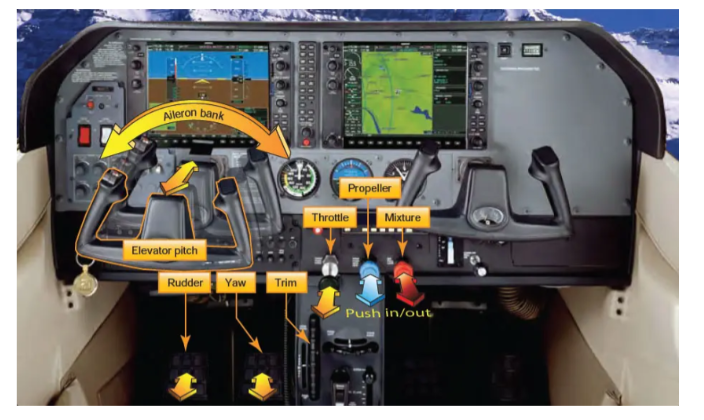
As the pilot pulls back on the yoke, this causes the elevators to move in an upwards position. Small to medium-size aircraft, usually limited to propeller-driven, feature a mechanical system whereby the yoke is connected directly to the control surfaces with cables and rods. Human muscle power alone is not enough for larger and more powerful aircraft, so hydraulic systems are used, in which yoke movements control hydraulic valves and actuators.
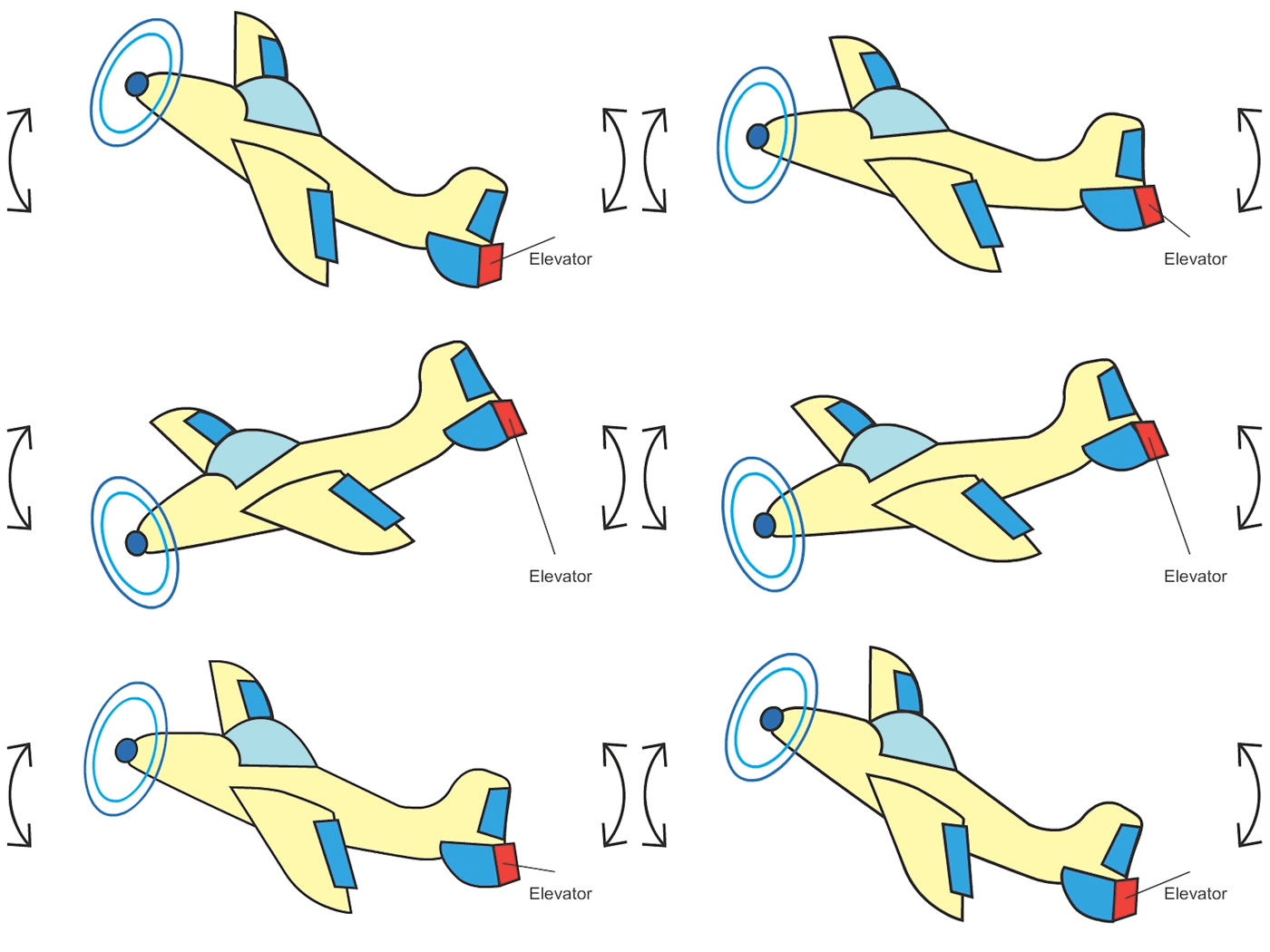
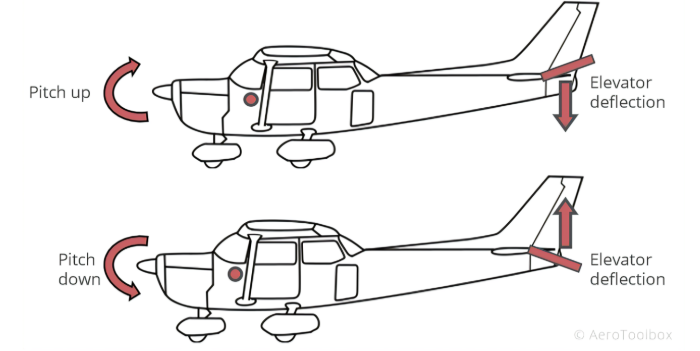
The picture below demonstrates how when the controls are pulled back the elevator is deflected upwards. As the elevator is deflected upwards this decreases the lift over the tail section of the aircraft. It is this decrease in lift that causes the aircraft to pitch upwards. The pitching up motion allows the aircraft to have the correct attitude for the climb.
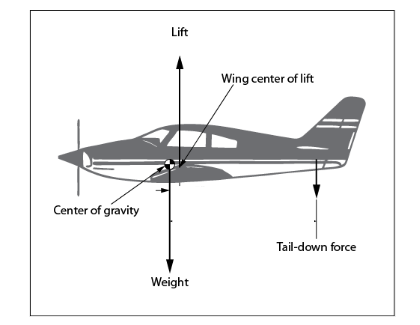
The reasoning behind this pitching up movement is all due to the pitching moments created by the wings and the tail. The diagram above demonstrates the actual position of the forces of lift and weight. The centre of gravity of the aircraft is where the weight is considered to act. The aerodynamic centre, or centre of lift, is the point at which the lift is considered to act on the wing or tail section. As the tail down force is increased (or lift decreased) this increases the clockwise moment produced around the centre of gravity and hence causes the pitching up motion of the nose.
Now that the pilot has pulled back on the yoke, causing the elevator to move up and the aircraft to pitch upwards, they must increase power to the engines. As the power is increased to engines (and the aircraft is a turbo-prop) this also increases the power of the rotational force of the propeller slipstream. The pilot increases power to the engines by pushing the thrust lever, or throttle, forward.
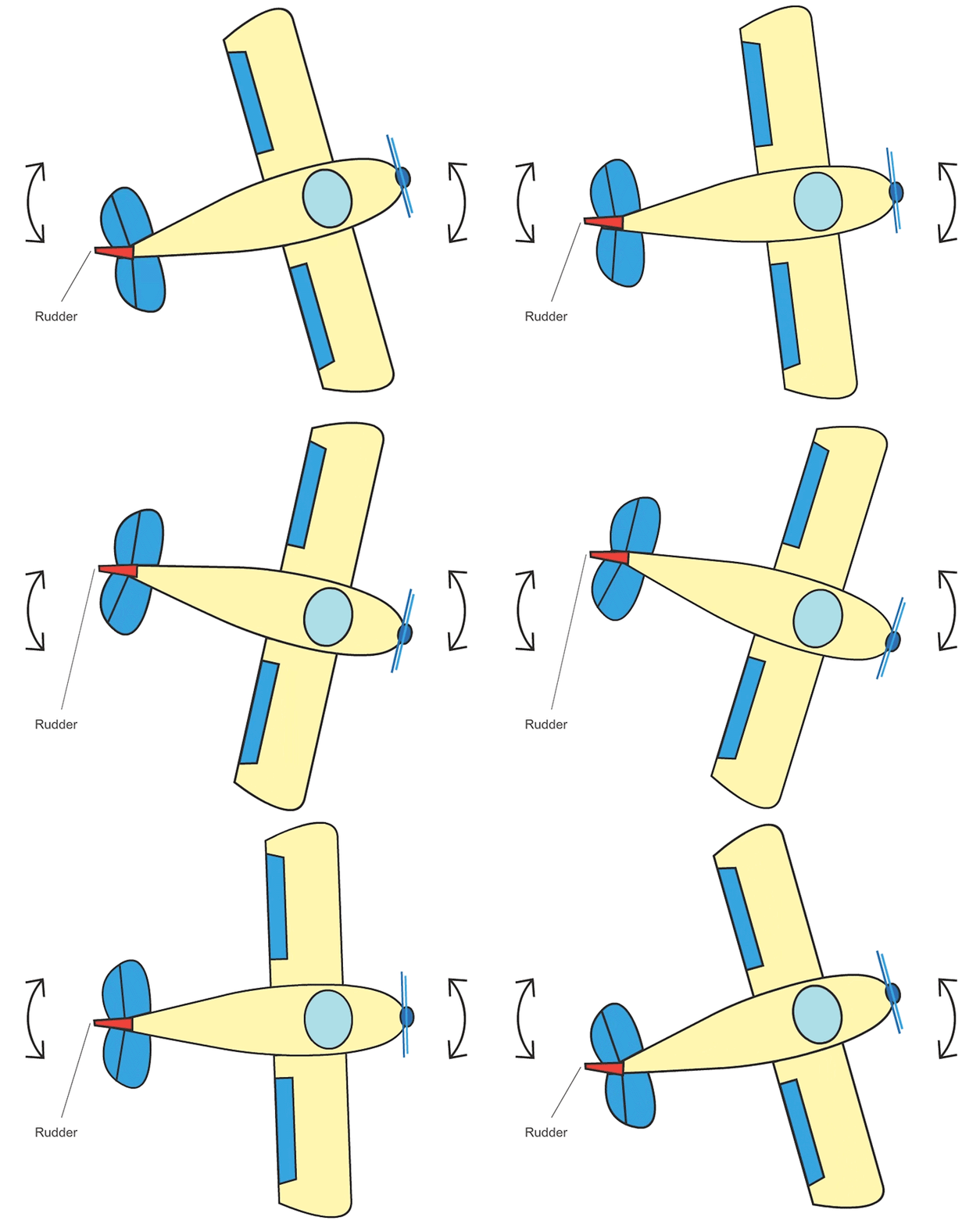
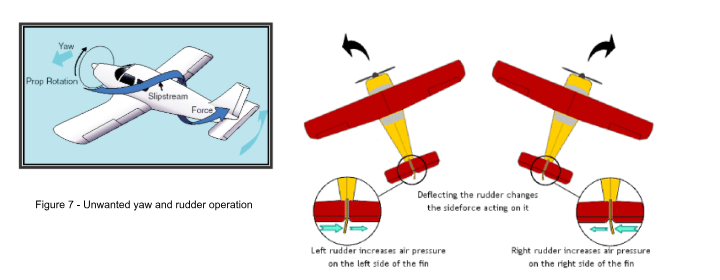
As the image below shows when this rotational force is increased the rear section of the aircraft wants to swing around, ultimately causing the aircraft to yaw to the left. The way in which the pilot can combat this unwanted yawing motion is to use the pedals in the cockpit to add right rudder, increasing the air pressure on the right hand side of the fin and causing the aircraft to yaw to the right and cancel out the unwanted yaw from the propeller slipstream.
At this point the aircraft pilot may wish to trim the elevator. to “trim” an aircraft is to adjust the aerodynamic forces on the control surfaces so that the aircraft maintains the set attitude without any control input. This will ease the pressure required on the control stick in order to maintain the constant rate of climb and is accomplished by moving the trim wheel upwards.
Once the desired altitude is reached from the climb the pilot must then enter steady and level flight. In order to do this the pilot will push forward on the yoke, causing the elevator to move downwards. This increases the lift force on the tail section and causes the aircraft to pitch nose down. Once level flight is reached the pilot will no longer need to apply forward pressure. Gradually less right rudder will be needed as the aircraft levels off and the pilot can ease off the rudder. At this point excess thrust is no longer required and the pilot can pull back on the throttle to decrease the power supplied from the engines. If trim was applied it can be removed at this point by simply moving the trim wheel down.
Interested in our Aerospace Engineering Courses?
At iLearn Engineering®, we offer a diverse range of online accredited aerospace engineering courses and qualifications to cater to different academic and career goals. Our aerospace courses are available in varying credit values and levels, ranging from 40 credit Engineering Diplomas to a Bachelor’s equivalent 360 credit International Graduate Diploma.
All Aerospace Engineering Courses
All Aerospace Engineering Diploma Courses can be seen here.
Short Aerospace Courses (40 Credits)
- Diploma in Aerospace Engineering
- Diploma in Aircraft Design
- Diploma in Principles of Flight
- Diploma in Aerospace Structures
- Diploma in Aerodynamics
- Diploma in Aerodynamics, Propulsion and Space
First Year of Undergraduate (Level 4 – 120 Credits)
Higher International Certificate in Aerospace Engineering
Years One and Two of Undergraduate (Level 5 – 240 Credits)
Higher International Diploma in Aerospace Engineering
Degree Equivalent International Graduate Diploma (Level 6 – 360 Credits)
International Graduate Diploma in Aerospace Engineering
Complete Engineering Course Catalogue (all courses)
Alternatively, you can view all our online engineering courses here.
Recent Posts
Why a Headwind Reduces Take-Off Distance: The Airspeed–Groundspeed Derivation
Why a Headwind Reduces Take-Off Distance: The Airspeed–Groundspeed Derivation Aeroplanes normally take off into wind because the wing must reach a required airspeed to produce lift, whereas the runway distance is travelled at groundspeed. A headwind contributes to the airspeed before the aircraft has covered any runway. It therefore reduces the groundspeed required at lift-off […]
How to Calculate Aircraft Take-Off Ground Run: A Flight Mechanics Tutorial
How to Calculate Aircraft Take-Off Ground Run: A Flight Mechanics Tutorial An aircraft does not become airborne simply because its engines are producing thrust. During the take-off ground run, thrust must overcome aerodynamic drag and rolling resistance. On a sloping runway, it must also overcome a component of the aircraft’s weight. This tutorial derives a […]
Types of Aircraft Drag Explained: Induced, Profile and Interference Drag
Types of Aircraft Drag Explained: Induced, Profile and Interference Drag An aircraft experiences several forms of aerodynamic drag at the same time. Some result from generating lift, some arise as air flows over the aircraft’s surfaces, and others are created when airflow around neighbouring components interacts. For a conventional aircraft in subsonic flight, total drag […]