

Stronger, Safer, Smarter: The Shift in Aircraft Structural Design
Introduction
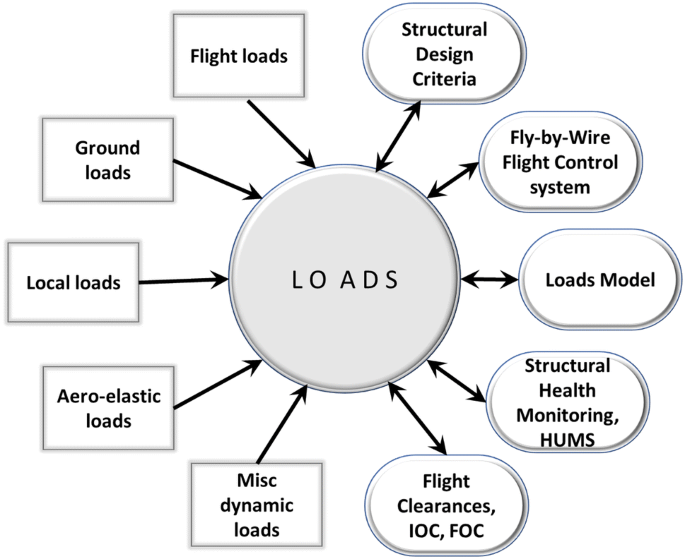
Although the major focus of structural design in the early development of aircraft was on strength, now structural designers also deal with fail-safety, fatigue, corrosion, maintenance and inspectability, and producibility.
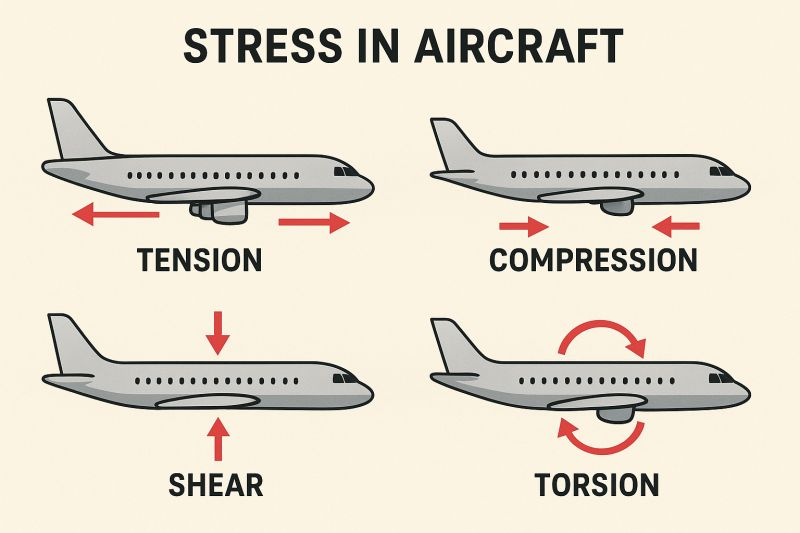
Stress levels, a very complex problem in highly redundant structures, are calculated using versatile computer matrix methods to solve for detailed internal loads.
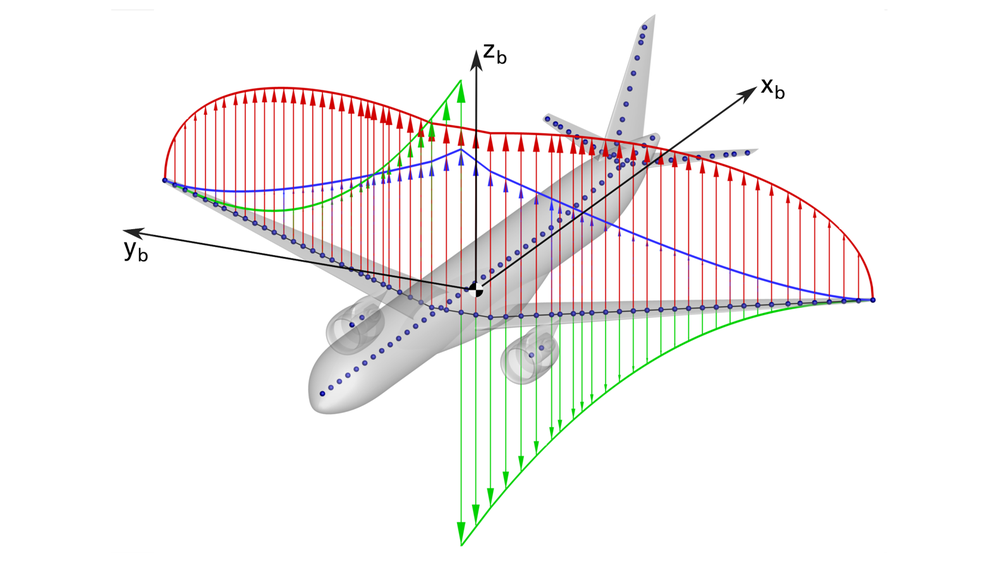
Modern finite element models of aircraft components include tens-of-thousands of degrees-of-freedom and are used to determine the required skin thicknesses to avoid excessive stress levels, deflections, strains, or buckling. The goals of detailed design are to reduce or eliminate stress concentrations, residual stresses, fretting corrosion, hidden undetectable cracks, or single failure causing component failure. Open sections, such as Z or J sections, are used to permit inspection of stringers and avoid moisture accumulation.
Fail-safe design is achieved through material selection, proper stress levels, and multiple load path structural arrangements which maintain high strength in the presence of a crack or damage.
Analyses introduce cyclic loads from ground-air-ground cycle and from power spectral density descriptions of continuous turbulence. Component fatigue test results are fed into the program and the cumulative fatigue damage is calculated. Stress levels are adjusted to achieve required structural fatigue design life.
Fatigue life of a structural member is usually defined as the time to initiate a crack which would tend to reduce the ultimate strength of the member.
Fatigue design life implies the average life to be expected under average aircraft utilisation and loads environment. To this design life, application of a fatigue life scatter factor accounts for the typical variations from the average utilisation, loading environments, and basic fatigue strength allowables. This leads to a safe-life period during which the probability of a structural crack occurring is very low. With fail-safe, inspectable design, the actual structural life is much greater.
The overall fatigue life of the aircraft is the time at which the repair of the structure is no longer economically feasible.
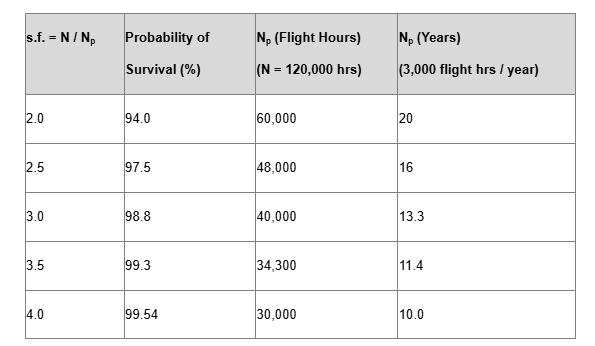
Scatter factors of 2 to 4 have been used to account for statistical variation in component fatigue tests and unknowns in loads. Load unknowns involve both methods of calculation and type of service actually experienced.
Primary structure for present transport aircraft is designed, based on average expected operational conditions and average fatigue test results, for 120,000 hrs. For the best current methods of design, a scatter factor of 2 is typically used, so that the expected crack-free structural life is 60,000 hrs, and the probability of attaining a crack-free structural life of 60,000 hrs is 94 percent as shown in the following table.
Fail-Safe & Safe-Life
There are multiple ways of considering part safety. The fail-safe principle accepts that there is a chance that part of the structure fails. However, there should be no chance of the whole structure failing.
In the safe-life philosophy, the chance of the structure failing within its prescribed lifetime should be zero. If this were to happen, then the chance of the whole structure failing is substantial.
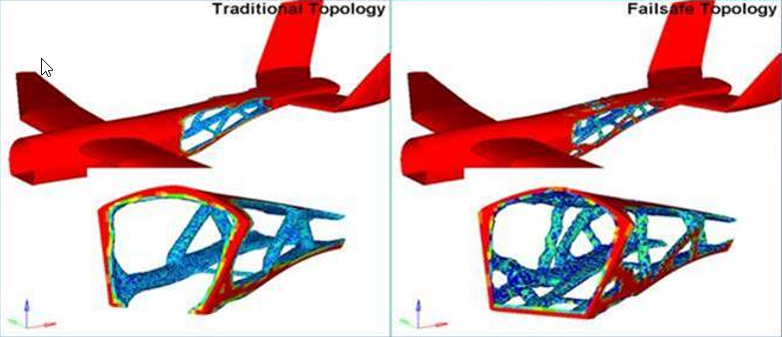
The stiffness of a structure is a measure of its resistance to a change in shape when subjected to forces. The stiffness of a complete structure is always a combination of its material properties and its geometry.
Aircraft wings and tail-sections can be subjected to three types of forces, namely aerodynamic forces, elastic forces and mass forces. These forces can work together in such an unfortunate way that they induce a type of vibration known as flutter. Flutter only occurs above a certain speed, which we call the critical speed. Flutter is caused by two coordinated types of vibration that amplify each other’s effect.
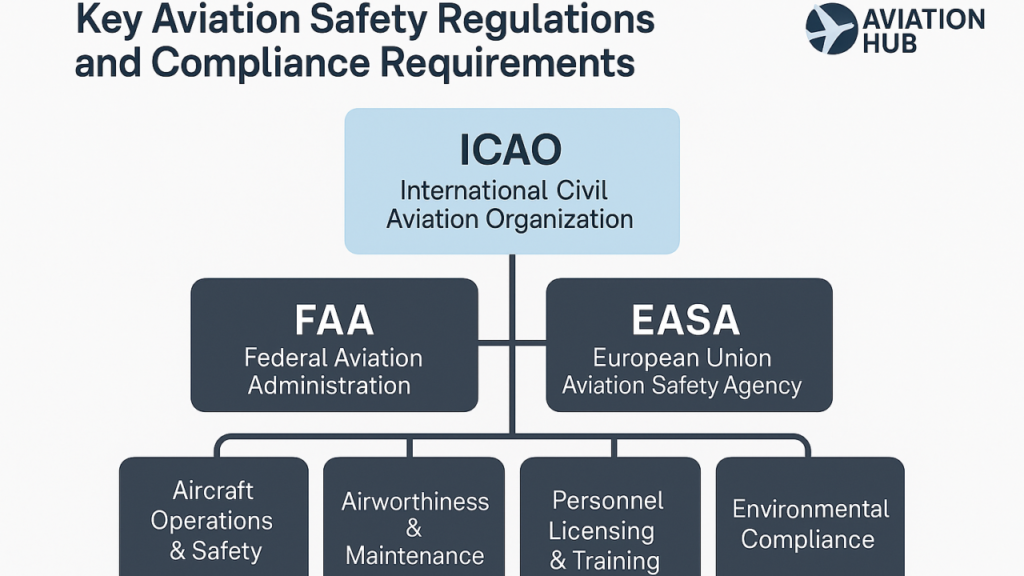
Air-transport safety is the responsibility of the manufacturer, the user and the government. As part of this responsibility, the government exercises control over the airfield through the State Air-Transport Service (In the Netherlands this is the Luchtvaart Autoriteit). The Luchtvaart Autoriteit is responsible for monitoring design, manufacturing, use and maintenance of aircraft, education, training and testing of personnel, and operational guidelines, accident investigation, traffic management and traffic regulations.
With fail-safe design concepts, the usable structural life would be much greater, but in practice, each manufacturer has different goals regarding aircraft structural life.
Materials
Choice of materials emphasises not only strength/weight ratio but also:
- Fracture toughness
- Crack propagation rate
- Notch sensitivity
- Stress corrosion resistance
- Exfoliation corrosion resistance
Acoustic fatigue testing is important in affected portions of structure.
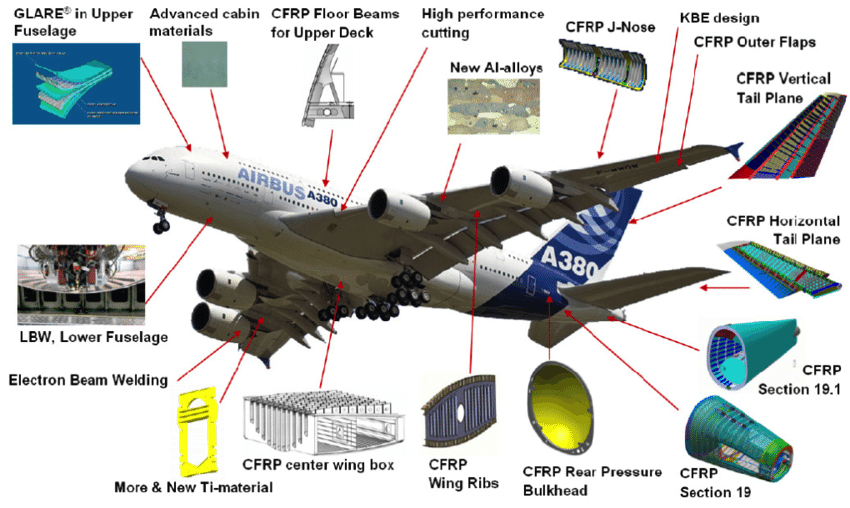
Doublers are used to reduce stress concentrations around splices, cut-outs, doors, windows, access panels, etc., and to serve as tear-stoppers at frames and longerons.
Structural Optimization and Design
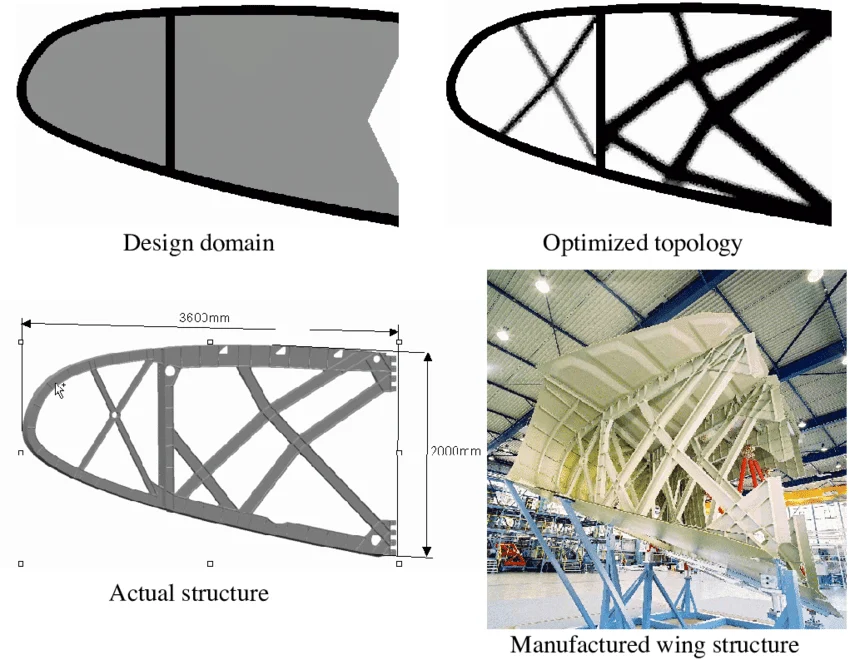
Structures are often analysed using complex finite element analysis methods. These tools have evolved over the past decades to be the basis of most structural design tasks. A candidate structure is analysed subject to the predicted loads and the finite element program predicts deflections, stresses, strains, and even buckling of the many elements.
The designer can then resize components to reduce weight or prevent failure. In recent years, structural optimization has been combined with finite element analysis to determine component gauges that may minimise weight subject to a number of constraints. Such tools are becoming very useful and there are many examples of substantial weight reduction using these methods.
Aircraft Requirements and Safety
The design process of an aircraft starts with specification of the requirements. An aircraft design is always a compromise. The first and most important requirement of an aircraft part is that it fulfils its function in all circumstances, particularly in critical situation.
The strength of a structure is a measure of the risks taken – the acceptance that the structure will fail in extreme conditions. Society sets standards for such risks. We accept that all structures fail in certain conditions. When calculating the loads, we name the force which will just make the structure fail, the ultimate load.
Structural failures often occur due to a very large series of normal repetitive loads that cause fracturing of the material: metal-fatigue. It is very important to know the rate of crack-growth and the residual strength (the strength in the presence of cracks) of a structure.
A number of European countries have formulated a set of Joint Airworthiness Requirements, the J.A.R, which are based on the American Federal Airworthiness Requirements, or F.A.R. The airworthiness standards define primary structures, those that would endanger the aircraft upon failure, secondary structures, those that do not cause immediate danger upon failure, and non load-bearing structures, which do not carry loads.
Interested in our Aerospace Engineering Courses?
At iLearn Engineering®, we offer a diverse range of online accredited aerospace engineering courses and qualifications to cater to different academic and career goals. Our aerospace courses are available in varying credit values and levels, ranging from 40 credit Engineering Diplomas to a Bachelor’s equivalent 360 credit International Graduate Diploma.
All Aerospace Engineering Courses
All Aerospace Engineering Diploma Courses can be seen here.
Short Aerospace Courses (40 Credits)
- Diploma in Aerospace Engineering
- Diploma in Aircraft Design
- Diploma in Principles of Flight
- Diploma in Aerospace Structures
- Diploma in Aerodynamics
- Diploma in Aerodynamics, Propulsion and Space
First Year of Undergraduate (Level 4 – 120 Credits)
Higher International Certificate in Aerospace Engineering
Years One and Two of Undergraduate (Level 5 – 240 Credits)
Higher International Diploma in Aerospace Engineering
Degree Equivalent International Graduate Diploma (Level 6 – 360 Credits)
International Graduate Diploma in Aerospace Engineering
Complete Engineering Course Catalogue (all courses)
Alternatively, you can view all our online engineering courses here.
Recent Posts
Types of Aircraft Drag Explained: Induced, Profile and Interference Drag
Types of Aircraft Drag Explained: Induced, Profile and Interference Drag An aircraft experiences several forms of aerodynamic drag at the same time. Some result from generating lift, some arise as air flows over the aircraft’s surfaces, and others are created when airflow around neighbouring components interacts. For a conventional aircraft in subsonic flight, total drag […]
Induced Drag Explained: Why Flying Slower Can Increase Drag
Induced Drag Explained: Why Flying Slower Can Increase Drag Why can an aircraft experience more drag when it flies more slowly? We usually associate greater speed with greater air resistance, but a wing must also generate enough lift to support the aircraft. Induced drag is the drag associated with producing lift on a finite-span wing. […]
Laminar vs Turbulent Boundary Layers: Why Airflow Separates from Aircraft Wings
Laminar vs Turbulent Boundary Layers: Why Airflow Separates from Aircraft Wings Airflow around an aircraft wing is often shown as smooth streamlines passing neatly over the aerofoil. In reality, the thin layer of air immediately next to the wing surface behaves very differently from the undisturbed airflow further away. This region is called the boundary […]