

Online Engineering Courses: A Complete Guide for Working Learners
Introduction
In today’s fast-evolving engineering landscape, the ability to upskill while continuing to work is more important than ever. Traditional education routes can be restrictive, often requiring fixed schedules and in-person attendance. iLearn Engineering® addresses this challenge by offering a fully online, flexible pathway into engineering, designed specifically for modern learners.
With a strong reputation for delivering accredited engineering qualifications, iLearn Engineering® supports professionals across industries, including those working in aerospace, mechanical, and manufacturing sectors. Its courses are structured to combine academic rigour with real-world relevance, ensuring that learners gain both knowledge and practical capability.
A Flexible, Modern Approach to Engineering Education
One of the defining features of iLearn Engineering® is its modular course structure. Rather than overwhelming learners with large volumes of content, each programme is divided into clearly defined units. This allows students to focus on one subject area at a time, building confidence and competence step by step.
This approach is particularly beneficial for working learners. With fully self-paced study and no fixed deadlines, individuals can tailor their learning around professional and personal commitments. Whether studying in the evenings, on weekends, or alongside a full-time role, learners remain in control of their progress.
In addition, the courses are designed to be stackable, enabling progression from EduQual Level 4 through to Level 6. This creates a clear academic pathway, ultimately leading to a qualification equivalent to a bachelor’s degree.
Building Strong Foundations at Eduqual Level 4
The Level 4 Higher International Certificate introduces the essential principles that underpin all areas of engineering. At this stage, learners develop a solid grounding in key subjects such as Engineering Design & Ethics, Engineering Mathematics, and Engineering Science.
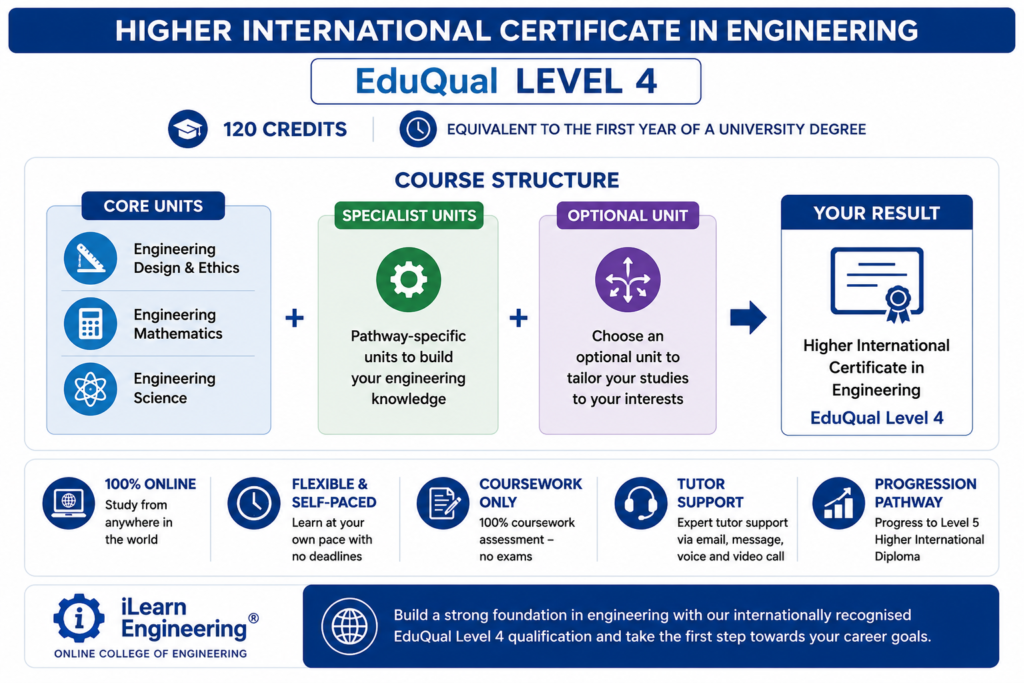
Alongside these core areas, learners begin to explore specialist topics aligned with their chosen discipline within the Engineering Diplomas catalogue. Depending on the pathway, this may include Structural Mechanics & Dynamics, Electrical & Electronic Engineering Principles, Aerospace Structures, or Manufacturing Engineering Principles.
This combination of core and specialist study ensures that learners not only understand fundamental concepts, but also begin to see how these principles are applied within specific engineering fields.
Advancing Knowledge and Skills at EduQual Level 5
Progressing to the Level 5 Higher International Diploma, learners build upon their existing knowledge and move into more advanced areas of engineering. This stage integrates the full Level 4 qualification and introduces new content that deepens both technical understanding and professional capability.
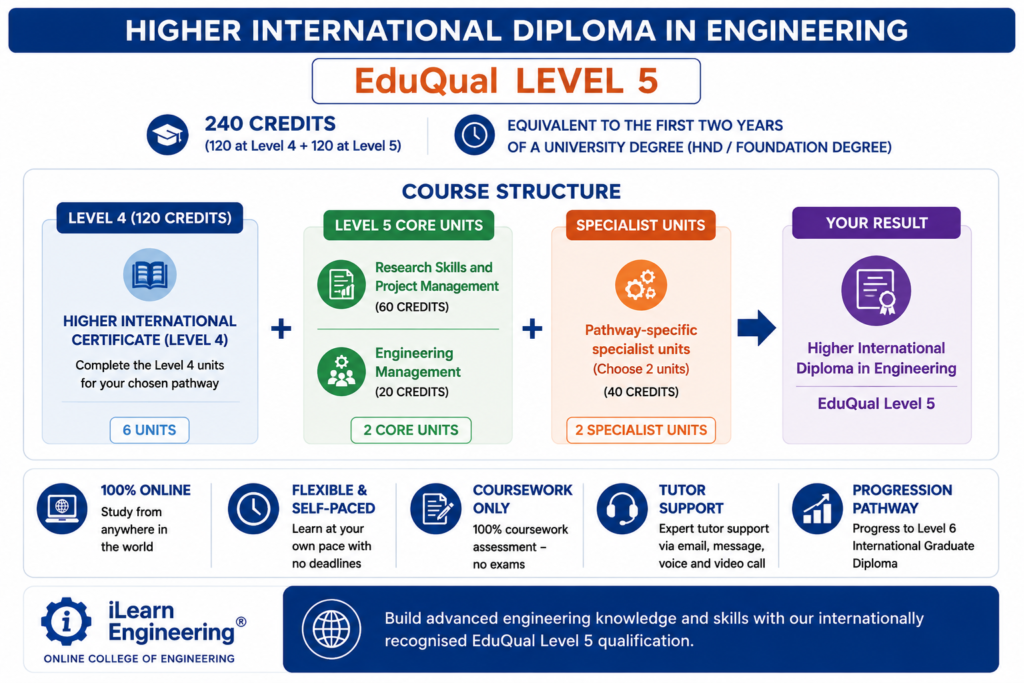
Subjects such as Engineering Management and Engineering Materials provide valuable insight into how engineering operates within organisational and industrial contexts. Meanwhile, specialist units, ranging from Fluid Mechanics to Digital Engineering or Civil Infrastructure, allow learners to further tailor their studies.
A key highlight at this level is Research Skills & Project Management. This unit encourages learners to think independently, approach complex problems systematically, and develop structured solutions, skills that are essential in any engineering role.
Level 6- The international Graduate Diploma
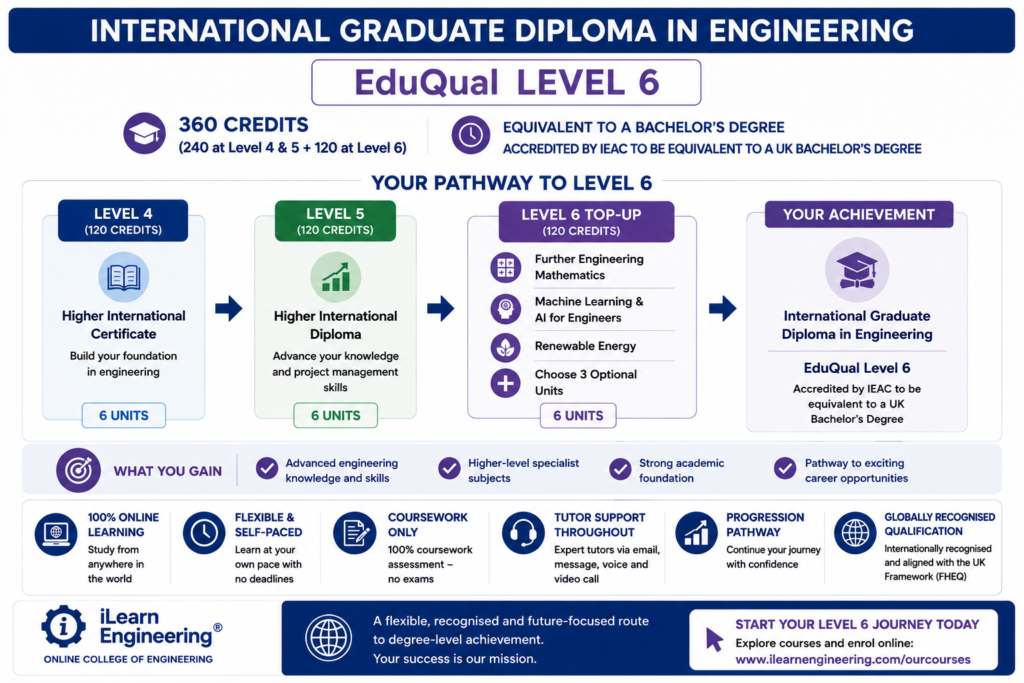
Progressing to Level 6 – the International Graduate Diploma, learners reach the most advanced stage of the iLearn Engineering® pathway, building upon the full Level 5 qualification and consolidating their knowledge into a degree-level standard. At this stage, the programme integrates all prior learning while introducing highly specialised and forward-looking engineering topics.
Core subjects such as Further Engineering Mathematics, Machine Learning & AI for Engineers, and Renewable Energy enhance analytical capability and prepare learners for modern engineering challenges. In addition, advanced specialist units, ranging from Advanced Structural Engineering and Thermodynamics to Communications, Networks & Signal Processing or Aerodynamics, allow learners to deepen expertise within their chosen discipline.
A defining feature of Level 6 is the emphasis on advanced problem-solving, innovation, and independent thinking. Learners are expected to apply their accumulated knowledge to complex, real-world engineering scenarios, demonstrating both technical mastery and professional judgement.
This 360-credit Level 6 qualification is recognised as equivalent to a UK bachelor’s degree in engineering, providing a strong platform for career advancement, leadership roles, or further academic progression.
Learning Through Real-World Application
A major strength of iLearn Engineering® lies in its emphasis on project-based learning. Rather than relying on traditional exams, learners are assessed through coursework that reflects real engineering challenges.
Throughout the course, students engage with:
- Design-based assignments
- Analytical case studies
- Problem-solving tasks
- Research-driven projects
This approach transforms learning from a theoretical exercise into a practical experience. By working through realistic scenarios, learners develop the ability to analyse problems, evaluate options, and justify their decisions, mirroring the demands of the engineering workplace.
Developing Practical Skills in an Online Environment
Although iLearn Engineering® is delivered entirely online, practical understanding remains a central focus. Instead of physical workshops, learners develop applied skills through carefully designed tasks that simulate real-world engineering situations.
These include interpreting technical data, evaluating design solutions, and applying engineering principles to solve complex problems. This method ensures that learners build practical competence in a way that is directly relevant to modern engineering roles, where analytical thinking and decision-making are key.
Supporting Every Step of the Learning Journey
To ensure a high-quality learning experience, iLearn Engineering® provides a wide range of digital learning resources. These include video tutorials, detailed e-workbooks, worked examples, and practice questions. All of which are regularly updated.
Such resources cater to different learning styles and allow students to revisit material whenever needed. This flexibility not only reinforces understanding but also helps learners build confidence as they progress through the course.
In addition, tutor support is available throughout, offering guidance and feedback to help learners stay on track and achieve their goals.
Assessment Designed for Real Understanding
Assessment at iLearn Engineering® is both practical and meaningful. All courses are 100% coursework-based, removing the pressure of traditional examinations.
Instead, learners complete a variety of assignments, including written responses, case studies, and applied problem-solving tasks. This continuous assessment model ensures that learners are evaluated on their ability to understand concepts, apply knowledge, and think critically, skills that are highly valued in the engineering industry.
A Clear Pathway to Career Progression
iLearn Engineering® offers recognised qualifications at Levels 4, 5, and 6, providing a structured route from foundational study through to degree-level achievement. This makes it an ideal option for those looking to:
- Start a career in engineering
- Progress within their current role
- Formalise existing experience with recognised qualifications
With its flexible structure, industry-relevant content, and strong academic foundation, iLearn Engineering® equips learners with the tools they need to succeed in a competitive and evolving field.

Start Your Engineering Journey
Getting started with iLearn Engineering® is straightforward. With flexible enrolment and an entirely online application process, learners can begin their studies at a time that suits them.
To explore available courses and take the next step in your engineering career, visit:
https://www.ilearnengineering.com/ourcourses
Interested in our Engineering Courses?
At iLearn Engineering®, we offer a diverse range of online accredited Engineering courses and qualifications to cater to different academic and career goals. Our civil courses are available in varying credit values and levels, ranging from 40 credit Engineering Diplomas to a Bachelor’s equivalent 360 credit International Graduate Diploma.
Recent Posts
Why There Is No Perfect Aerofoil: The Design Trade-Offs Behind Every Aircraft Wing
Why There Is No Perfect Aerofoil: The Design Trade-Offs Behind Every Aircraft Wing If a designer could create a perfect aerofoil, it would produce very high lift with almost no drag, remain stable at every angle of attack, fit a lightweight structure inside the wing and work equally well at low and high speed. No […]
How Aerofoils Generate Lift: A Beginner’s Guide to Angle of Attack, Camber and Pressure Distribution
How Aerofoils Generate Lift: A Beginner’s Guide to Angle of Attack, Camber and Pressure Distribution An aerofoil does not create lift simply because its upper surface is curved. Lift is produced because the aerofoil meets the airflow at a suitable angle and shape, causing a pressure distribution that results in an aerodynamic force. For aircraft […]
Why Aircraft Engine Intakes Use Diffusers: Slowing Air to Recover Pressure
Why Aircraft Engine Intakes Use Diffusers: Slowing Air to Recover Pressure An aircraft engine needs a large, steady supply of air at its compressor face. That may sound simple, but the air approaching an aircraft is moving quickly, often with changes in direction, velocity and pressure caused by the aircraft’s shape and flight condition. An […]