

What Is an EduQual Level 5 Engineering Diploma?
Introduction:
There comes a point in every aspiring engineer’s journey where curiosity evolves into commitment. You’ve grasped the basics, explored the principles, and begun to see how theory connects to the real world. The EduQual Level 5 Engineering Diploma is where that transformation truly accelerates, where learners stop studying engineering and start thinking like engineers.
From Foundations to Real Engineering Thinking
At Level 4, you build the groundwork,mathematics, science, and core engineering concepts. But Level 5 is different. It asks more of you.
It challenges you to:
- Analyse rather than memorise
- Apply rather than observe
- Solve rather than follow
This is where engineering becomes less about learning formulas and more about making decisions in complex, real-world situations.
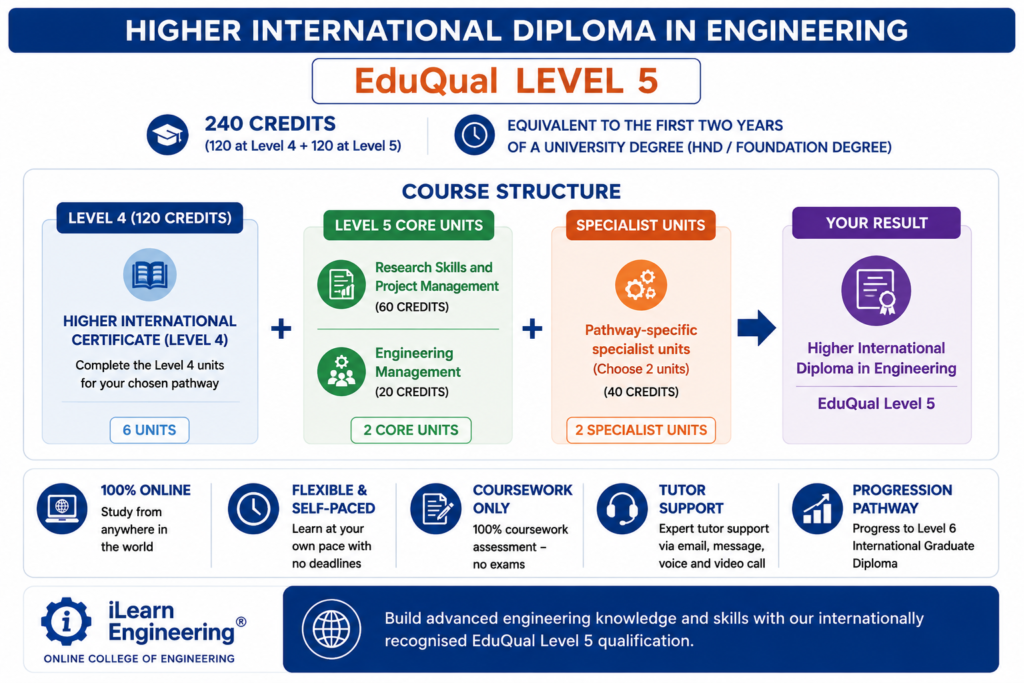
With 240 credits, the qualification represents a significant body of knowledge and skill. Half of this comes from Level 4 foundations, while the other half is dedicated to advanced study at Level 5, pushing your understanding into deeper, more practical territory.
The Shift: Learning to Apply Knowledge
Imagine moving from solving textbook problems to tackling real engineering challenges:
- Instead of calculating forces, you analyse how structures behave under stress
- Instead of learning theory, you explore how systems perform in practice
- Instead of following steps, you begin to design solutions independently
This shift is at the heart of the Level 5 Diploma.
A defining feature is the major project module, where everything comes together. Here, you don’t just study engineering, you do engineering. You plan, research, design, and justify your decisions, much like you would in a professional role.
A Qualification That Reflects Industry Reality
Engineering is not just technical, it’s collaborative, structured, and often time-sensitive. That’s why the Level 5 Diploma introduces elements many learners don’t expect but employers value highly:
- Project management skills
- Research and analytical thinking
- Engineering management principles
These aren’t just academic additions, they mirror the real demands of engineering roles. Whether you’re designing a system, managing a team, or improving a process, these skills are essential.
Time, Credits and Commitment
Every qualification tells a story, not just of knowledge gained, but of time invested, effort sustained, and persistence shown. The EduQual Level 5 Engineering Diploma is no exception. Behind its structure lies a carefully measured balance of academic depth and real-world flexibility.
At its core are 240 credits, representing a substantial and comprehensive programme of study. These credits aren’t just numbers; they reflect the breadth of engineering principles you’ll engage with and the level of understanding you’re expected to achieve. In practical terms, this equates to around 2,400 hours of learning, time spent building not only technical knowledge, but also confidence in applying it.
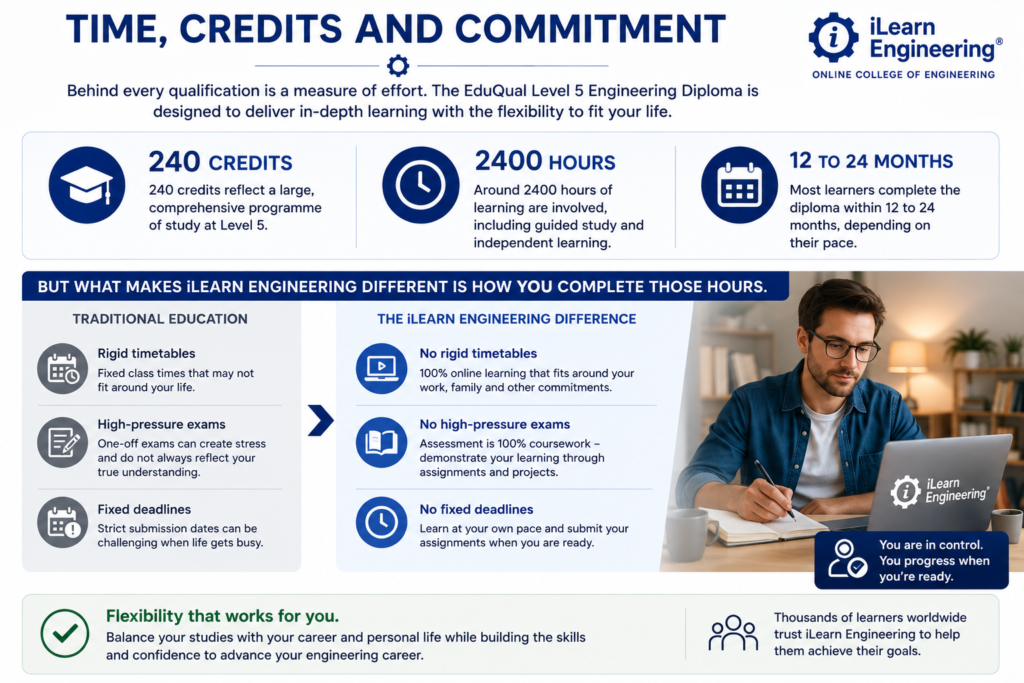
Traditionally, that level of commitment might feel overwhelming. Fixed timetables, looming deadlines, and high-pressure exams often define the learning experience. But this is where iLearn Engineering quietly reshapes expectations.
Instead of forcing you into a rigid academic schedule, the programme adapts to your life. There are no set timetables dictating when you must study, no exams that hinge everything on a single moment, and no deadlines pushing you forward before you’re ready. Progress becomes something personal, something you control.
You might move quickly, completing the diploma in closer to 12 months, driven by momentum and focus. Or you might take a steadier path, spreading your learning over 24 months as you balance work, family, and other commitments. Both journeys are equally valid, because the emphasis is not on speed, but on understanding.
In this way, the qualification becomes more than a measure of academic achievement. It becomes a reflection of real life, where learning fits around you, not the other way around.
A Turning Point for Your Career
For many learners, reaching Level 5 is more than just academic progression, it’s a defining moment. It marks the shift from learning about engineering to truly thinking and operating like an engineer. The fundamentals are no longer your focus; instead, you begin to engage with the discipline in a more practical, applied, and confident way.
At this stage, your role evolves. You’re trusted to take on real technical responsibility, to contribute meaningfully to engineering projects, and to step into positions that require not just knowledge, but judgement. Whether it’s supporting design decisions, solving practical problems, or overseeing elements of a project, you begin to add tangible value in professional environments.
This is why Level 5 carries such weight with employers. It signals that you are no longer at the beginning of your journey, you have developed the skills, discipline, and understanding needed to operate at a higher level. You’re seen as someone capable of stepping into supervisory or senior technician roles, someone who can bridge the gap between theory and real-world application.
Ultimately, it represents a turning point: a transition from potential to capability. It tells employers not just that you understand engineering, but that you can apply it with confidence and purpose.
.
The Bridge to a Full Degree
Perhaps the most exciting aspect of the Level 5 Diploma isn’t just what you achieve during the course, it’s what becomes possible once you’ve completed it. Rather than marking the end of your journey, it opens a series of new doors, each leading to higher levels of achievement and opportunity.
At this point, you’re no longer simply progressing, you’re choosing direction. For some, that means continuing on to Level 6, building on the 240 credits already achieved to complete a full 360-credit qualification, widely recognised as equivalent to a UK bachelor’s degree. For others, it’s the opportunity to take a more traditional academic route, applying for a university top-up programme and converting their diploma into a BEng or BSc.
But the pathway doesn’t stop there. With this foundation in place, further progression into postgraduate study or more specialised, higher-responsibility roles becomes a realistic and achievable next step. What once may have seemed distant, degree-level qualifications, advanced engineering positions, now feels firmly within reach.
What makes this journey particularly powerful is how accessible it is. Many learners follow this route not by stepping away from their careers or personal responsibilities, but by progressing alongside them. It offers a way to reach university-level achievement through a more flexible, manageable, and cost-effective path, one that fits around your life, rather than requiring you to put everything else on hold.
Engineering Education Without Barriers
One of the most defining qualities of iLearn Engineering is its commitment to accessibility, not just in terms of entry requirements, but in how learning itself is experienced. It challenges the traditional idea that higher education must follow a fixed, rigid path, opening the door to learners who may have once felt that engineering was out of reach.
Here, the usual barriers begin to fall away. You don’t need a long list of prior academic qualifications to get started. You’re not required to sit in a classroom at a specific time each week. There’s no fixed schedule dictating when and how you must learn. Instead, the focus shifts to something far more important: your willingness to commit and progress.
The programme is built with this in mind. It doesn’t assume what you already know, it’s designed to guide you, step by step, teaching the essential maths, science, and engineering principles as you move forward. This makes it a particularly powerful option for those taking a non-traditional route.
For career changers, it offers a genuine pathway into engineering without the need to start from scratch in a conventional university setting. For technicians already working in the field, it provides a structured way to advance, turning practical experience into recognised qualifications and opening doors to higher-level roles. And for international learners, it delivers access to UK-accredited education in a way that is flexible, achievable, and globally relevant.
In essence, accessibility here isn’t just about entry, it’s about opportunity. It’s about creating a learning experience that adapts to your life, giving you the tools, support, and structure to move forward on your own terms.
Final Reflection: More Than Just a Diploma
The EduQual Level 5 Engineering Diploma is not simply a step up, t’s a step forward.
It represents:
- A deeper level of thinking
- A stronger connection to real-world engineering
- A clear path toward higher qualifications and career growth
For many, it’s the moment where engineering stops being an interest and becomes a profession.
The Level 5 Engineering Diploma transforms foundational knowledge into practical expertise, preparing you for real engineering roles and opening the door to a full degree and beyond.
>> Discover the Higher International Diploma (EduQual Level 5) engineering courses on offer.
Interested in our Engineering Courses?
At iLearn Engineering®, we offer a diverse range of online accredited Engineering courses and qualifications to cater to different academic and career goals. Our civil courses are available in varying credit values and levels, ranging from 40 credit Engineering Diplomas to a Bachelor’s equivalent 360 credit International Graduate Diploma.
Recent Posts
Why There Is No Perfect Aerofoil: The Design Trade-Offs Behind Every Aircraft Wing
Why There Is No Perfect Aerofoil: The Design Trade-Offs Behind Every Aircraft Wing If a designer could create a perfect aerofoil, it would produce very high lift with almost no drag, remain stable at every angle of attack, fit a lightweight structure inside the wing and work equally well at low and high speed. No […]
How Aerofoils Generate Lift: A Beginner’s Guide to Angle of Attack, Camber and Pressure Distribution
How Aerofoils Generate Lift: A Beginner’s Guide to Angle of Attack, Camber and Pressure Distribution An aerofoil does not create lift simply because its upper surface is curved. Lift is produced because the aerofoil meets the airflow at a suitable angle and shape, causing a pressure distribution that results in an aerodynamic force. For aircraft […]
Why Aircraft Engine Intakes Use Diffusers: Slowing Air to Recover Pressure
Why Aircraft Engine Intakes Use Diffusers: Slowing Air to Recover Pressure An aircraft engine needs a large, steady supply of air at its compressor face. That may sound simple, but the air approaching an aircraft is moving quickly, often with changes in direction, velocity and pressure caused by the aircraft’s shape and flight condition. An […]