

Determine the deflection of cantilever beams with a single load.
If you read our previous article on what is deflection, you’ll have some idea of deflection and it’s magnitude. Now we’re going to investigate how we determine deflection.
What is a cantilever beam?
Cantilever beams are constrained at one end and free at their other end. At the fixed end of the cantilever beam, deflection must be zero. Deflection increases as we move away from the support and the maximum deflection will occur at the free end. The image below shows a cantilever beam in a structure:

Cantilever beams can either be end-loaded or uniformly loaded, and this video can give you some more information on the slope and deflection of a beam along key points.
End-Loaded Cantilever Beams
In end-loaded cantilever beams, the load is applied at a single point on the beam. A cantilever beam with a deflected shape is shown in the first image, while a cantilever beam carrying a point load at its free end is shown in the second image.


Uniformly-Loaded Cantilever Beams
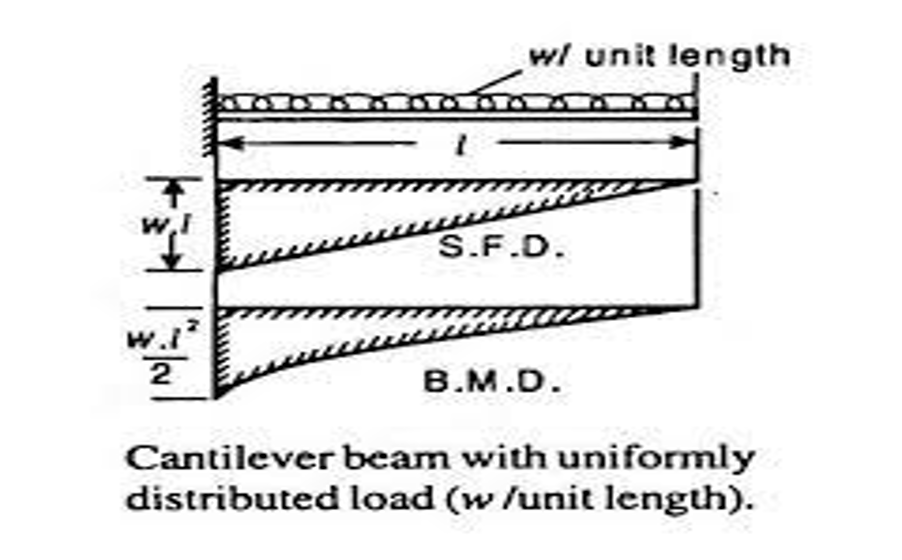
Uniformly loaded cantilever beams have the force acting uniformly throughout the length of the beam. An example of cantilever beam carrying uniformly distributed load (UDL) is mostly found in balconies. A representation of this type of cantilever beam is shown in the image below:
Standard Data Table for Deflection of Cantilever Beams
Using standard tables is the most practical and fastest approach for calculating the deflection and slope of a beam. For a cantilever beam subjected to a single type of loading, such as point or concentrated load, uniformly distributed load, and couple, deflection and slope can be determined using the formulae in the Table below.

Let’s have a look at an example. Suppose a 3m long cantilever beam is carrying a 25kN point load at its free end. If the moment of inertia of the beam is 108mm4 and the Young’s Modulus is 2.1 105N/mm2, then how would we find the deflection at the free end?
Length of the beam = 3m
Point Load = 25kN = 25000N
Moment of inertia (i) = 108mm4 = 0.0001m4
Young’s Modulus (E) = 2.1 105 N/mm2 = 2.1 1011N/m2
Deflection at the free end = PI33EI = 25000 333 2.1 1011 0.0001 = 0.01071m
Let’s take another example where the beam is 4m long and subjected to a point load of 5kN at the free end. Let’s determine the slope and deflection at the free end, taking flexural stiffness EI as 53.3 MNm2.
Length of beam = 4m
Point load on beam = 5 kN = 5000 N
Flexural stiffness = 53.3 MNm2 = 53.3 106 Nm2
From the Table, the deflection at the free end is given by Pl33EI = 5000 433 53.3 106 = 0.002 m
We’re going to continue our series on deflection with more articles on various calculations with various loads on a beam so stay tuned.
Interested in our courses?
Interested in civil or mechanical engineering? Find out more about all the civil engineering courses we have available by clicking here, and the mechanical engineering courses by clicking here.
Diploma in Mechanical Engineering
Diploma in Mechanical Technology
Diploma in Sustainable Construction
Diploma in Structural Engineering
Diploma in Building and Construction Engineering
Higher International Certificate in Civil Engineering
Higher International Diploma in Civil Engineering
Higher International Diploma in Mechanical Engineering
Higher International Certificate in Mechanical Engineering
Alternatively, you can view all our online engineering courses here.
Recent Posts
Electrical and Electronic Engineering Courses and Diplomas: A Complete Guide
Electrical and Electronic Engineering Courses and Diplomas: A Complete Guide Introduction: Electrical and electronic engineering courses teach learners how electrical power, circuits, machines, electronic devices and control systems operate. The right course depends on whether the learner wants to study a focused subject, establish a broad foundation at Level 4, progress to Level 5 or […]
What Are Complex Numbers and Why Do Engineers Use Them?
What Are Complex Numbers and Why Do Engineers Use Them? Complex numbers can appear abstract when they are first encountered. After all, how can the square root of a negative number represent anything useful in the real world? For engineers, complex numbers are not merely a mathematical curiosity. They provide an efficient way to represent […]
Pascal’s Law Explained: How Hydraulic Systems Multiply Force
Pascal’s Law Explained: How Hydraulic Systems Multiply Force How can a relatively small force applied to a brake pedal, jack handle or hydraulic control move a much heavier load? The answer is Pascal’s law. When pressure is applied to a confined fluid, the resulting pressure change is transmitted throughout the fluid. If that pressure acts […]