

How can we analyse undamped vibration problems.
In our previous article on harmonic motion, we looked at how we can analyse problems involving simple harmonic motion, now we’re going to look at solving vibration problems with a single degree of freedom.
Vibration Analysis
In vibration analysis, there are two approaches we are interested in. One is to control undesirable vibration, for example, the loosening of bolts. The other is to enhance desirable vibration, such as mechanical agitators.
To look at either, we need to think about what the cause of vibration is. Any disturbance in a mechanical system in a state of equilibrium results in a vibration response. Disturbance can be from wind gusts on a bridge or aircraft, or periodic impulses from firing events in an internal combustion engine.
Basic concepts
Let’s think about a typical motor vehicle with a wheel and suspension system at each corner. It will look something like this:
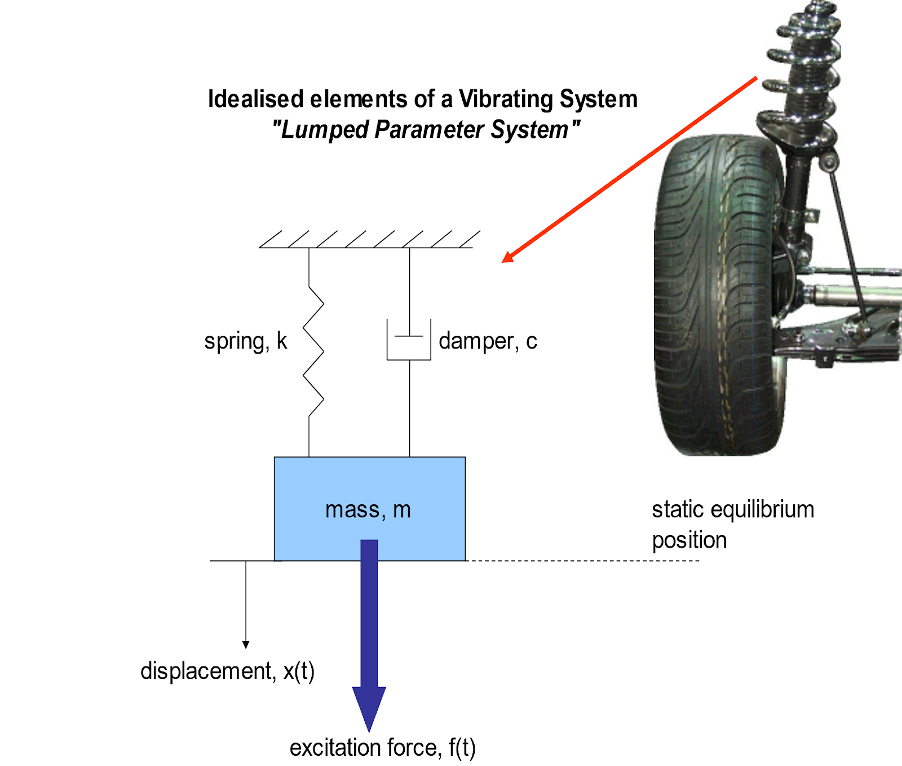
The system is shown as an idealised lumped parameter system. What this means is that all the mass, stiffness, and damping of the real structure have been ‘lumped’ together into idealised lumped parameters.
A lumped parameter system is made up of:
- Mass (kg): the inertia of the real structure is represented and modelled. The idealised mass has a rigid body where work done is stored as kinetic energy – this is where all the mass of the real suspension system is modelled.
- Spring (N/m): this is where the stiffness of the real structure is represented and modelled. The idealised spring has no mass, models an elastic component of the structure, the linear spring obeys Hooke’s Law and spring constant = stiffness = k = force / unit deflection.
- Damper (Ns/m): this is where the damping of the real structure is represented and modelled. The idealised damper has no mass, no elasticity, viscous damping force proportional to velocity, viscous damping coefficient, c = force / unit velocity, work done and energy dissipated as heat (non-conservative system)
Effect of Damping on Response
The response of a system that is undamped typically looks like this:
where the amplitude of the response, y, is A and the time to complete one revolution is the so-called time period, T, and the equation is as we have seen previously, as follows:
y=Asinωt
Now let us look at the response with damping included:
It is clear from the above that damping takes energy out of the system, allowing the mass to decay and rest. The energy is lost as heat in the damper.
Degrees of Freedom (DOF)
The degrees of freedom of a dynamic model are the number of independent coordinates necessary to describe its motion. The mass on a spring example discussed above is known as a single degree of freedom (SDOF) model because there is only one independent coordinate.
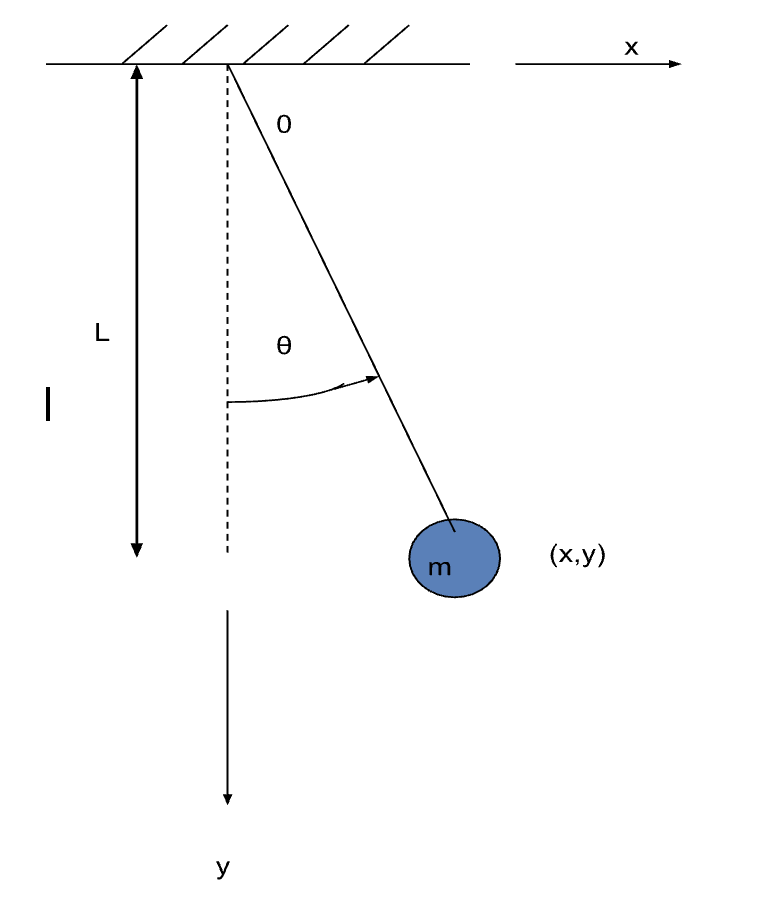
Below, we can see a simple pendulum model. It can be seen that the system is constrained to move in the x-y plane. The configuration can be defined by [x(t) , y(t)] or by θ(t) alone. The (x,y) coordinates are NOT independent as they are related by the following equation of constraint:
x2 + y2 = L2
Therefore, the system is SDOF.
If you find this interesting, make sure to check out our next article on damped vibrations.
Interested in our courses?
Interested in civil or mechanical engineering? Find out more about all the civil engineering courses we have available by clicking here, and the mechanical engineering courses by clicking here.
Diploma in Mechanical Engineering
Diploma in Mechanical Technology
Diploma in Sustainable Construction
Diploma in Structural Engineering
Diploma in Building and Construction Engineering
Higher International Certificate in Civil Engineering
Higher International Diploma in Civil Engineering
Higher International Diploma in Mechanical Engineering
Higher International Certificate in Mechanical Engineering
Alternatively, you can view all our online engineering courses here.
Recent Posts
Types of Aircraft Drag Explained: Induced, Profile and Interference Drag
Types of Aircraft Drag Explained: Induced, Profile and Interference Drag An aircraft experiences several forms of aerodynamic drag at the same time. Some result from generating lift, some arise as air flows over the aircraft’s surfaces, and others are created when airflow around neighbouring components interacts. For a conventional aircraft in subsonic flight, total drag […]
Induced Drag Explained: Why Flying Slower Can Increase Drag
Induced Drag Explained: Why Flying Slower Can Increase Drag Why can an aircraft experience more drag when it flies more slowly? We usually associate greater speed with greater air resistance, but a wing must also generate enough lift to support the aircraft. Induced drag is the drag associated with producing lift on a finite-span wing. […]
Laminar vs Turbulent Boundary Layers: Why Airflow Separates from Aircraft Wings
Laminar vs Turbulent Boundary Layers: Why Airflow Separates from Aircraft Wings Airflow around an aircraft wing is often shown as smooth streamlines passing neatly over the aerofoil. In reality, the thin layer of air immediately next to the wing surface behaves very differently from the undisturbed airflow further away. This region is called the boundary […]