

How can we solve practical problems involving distance and velocity?
In our last article we looked at SI units, what they are and why we use them, giving us a solid introduction to Engineering Science. In this article, we’re going to see how we can solve some practical problems with engineering.
Introduction to definitions
Before we dive in, it’s useful to introduce some definitions. In engineering, words such as distance and velocity are associated with mathematical quantities and have strict definitions. The mathematical quantities used to describe object motion are divided into two categories. The quantity is either a vector or a scalar and have distinct definitions:
- Scalars are quantities fully described by a magnitude (numerical value) alone.
- Vectors are quantities fully described by both magnitude and direction.
Distance is a scalar quantity that refers to “how much ground an object has covered” during its motion. Velocity is a vector quantity, and is direction aware. So, it’s not enough to say an object has a velocity of 55 m/s; we have to also include direction information.
Constant Acceleration Equations
An object with an initial velocity of u is moving in a straight line with constant acceleration a. The equations below connect the final velocity v and displacement s in a given time t.
| s = ½(u + v)tv = u + ats = ut + ½ at2s = vt – 1/2 at2v2 = u2 + 2as | s = distance or displacement (m)u = initial velocity (m/s)v = final velocity (m/s)a = acceleration (m/s2) |
It’s worth noting that these equations can only be used if the acceleration is constant; for example, in a free fall situation, the acceleration is fixed due to gravity. The equations are often referred to as SUVAT equations.
Let’s have a look at some examples to see how we can use these equations. Imagine a vehicle moving in a straight line from O to A, with a constant acceleration of 2m/s². Its velocity at A is 30m/s, and it takes 15 seconds to travel from O to A. We’re going to find the vehicle’s velocity at O.
So, the known quantities we have are:
- a = 2m/s²
- v = 30 m/s
- t = 15s
To find u, the initial velocity at O, we use v = u + at. Which is 30 = u+(2)(15) and gives us 0ms. Now we’re going to find the distance between O and A, and use the equation s = ut + 1/2 at2. So, s = 0 + ½(2)(15), which gives us 225 m.
We’ll look at another example. An object is projected vertically upwards with a velocity of 20 m/s. The point of projection is on the edge of a deep (30 m) hole, so that the object will continue descending to the bottom of the hole. We’ll assume gravity, g, is 9.81 m/s². We’re going to find:
- The maximum height reached.
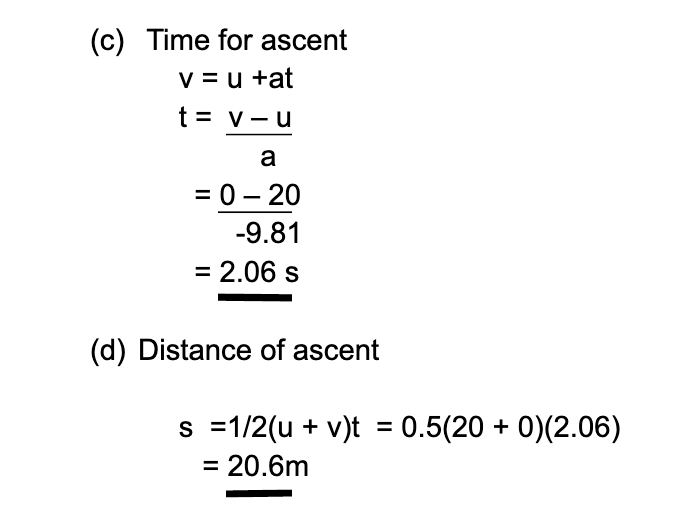
- The time taken to reach the maximum height.
- The total time of the flight.
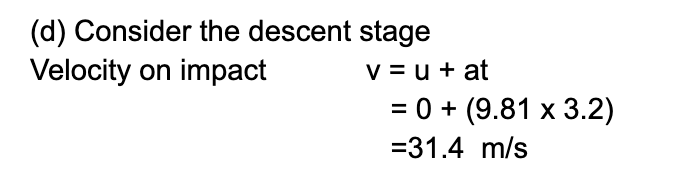
- The velocity with which the object hits the bottom of the hole.
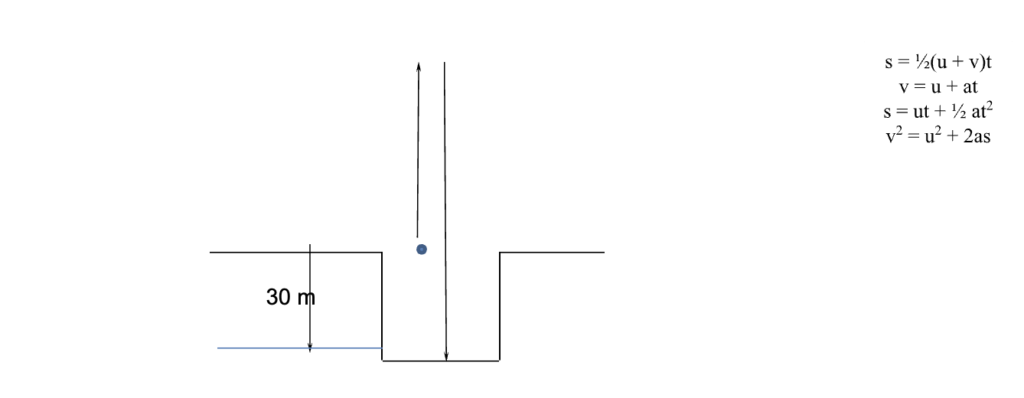
It makes sense to split the motion into ascent and descent. For the ascent: u=20 m/s, u=0, a=-g

It also makes sense to split the motion into ascent and descent. For the ascent: u=20 m/s, u=0, a=-g
For the descent: u = 0, s = 20.60 + 30 = 50.6m
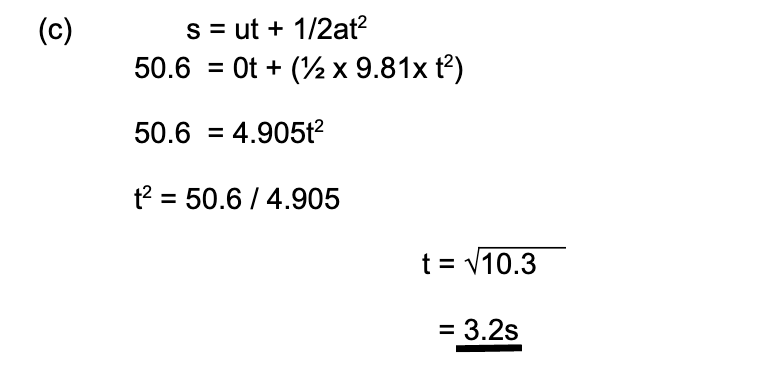
So, the total time of flight = time ascent + time descent = 2.06 + 3.2 = 5.3 s
In our next article, we’re going to look at how we can use engineering concepts to solve practical problems, so make sure you keep an eye out for it.
Interested in our courses?
You can read more about our selection of accredited online mechanical, electrical, civil and aerospace engineering courses here.
Check out individual courses pages below:
Diploma in Electrical and Electronic Engineering
Higher International Certificate in Electrical and Electronic Engineering
Diploma in Electrical Technology
Diploma in Renewable Energy (Electrical)
Higher International Diploma in Electrical and Electronic Engineering
Diploma in Sustainable Construction
Diploma in Structural Engineering
Diploma in Building and Construction Engineering
Higher International Certificate in Civil Engineering
Higher International Diploma in Civil Engineering
Diploma in Aerospace Structures
Diploma in Principles of Flight
Diploma in Aerodynamics, Propulsion and Space
Higher International Diploma in Mechanical Engineering
Higher International Certificate in Mechanical Engineering
Diploma in Mechanical Engineering
Diploma in Mechanical Technology
Alternatively, you can view all our online engineering courses here.
Recent Posts
Why a Headwind Reduces Take-Off Distance: The Airspeed–Groundspeed Derivation
Why a Headwind Reduces Take-Off Distance: The Airspeed–Groundspeed Derivation Aeroplanes normally take off into wind because the wing must reach a required airspeed to produce lift, whereas the runway distance is travelled at groundspeed. A headwind contributes to the airspeed before the aircraft has covered any runway. It therefore reduces the groundspeed required at lift-off […]
How to Calculate Aircraft Take-Off Ground Run: A Flight Mechanics Tutorial
How to Calculate Aircraft Take-Off Ground Run: A Flight Mechanics Tutorial An aircraft does not become airborne simply because its engines are producing thrust. During the take-off ground run, thrust must overcome aerodynamic drag and rolling resistance. On a sloping runway, it must also overcome a component of the aircraft’s weight. This tutorial derives a […]
Types of Aircraft Drag Explained: Induced, Profile and Interference Drag
Types of Aircraft Drag Explained: Induced, Profile and Interference Drag An aircraft experiences several forms of aerodynamic drag at the same time. Some result from generating lift, some arise as air flows over the aircraft’s surfaces, and others are created when airflow around neighbouring components interacts. For a conventional aircraft in subsonic flight, total drag […]