

Up and Over: Evaluating Flight Parameters in Pull-Up and Vertical Loop Manoeuvres
Introduction
In this following blog we will analyse an aircraft performing a loop manoeuvre. Loops will be analysed using our previous definition of load factor and the basics of circular motion. If we are able to analyse the forces on the aircraft in such a manoeuvre we can also apply this to an aircraft performing a general pulling up manoeuvre.
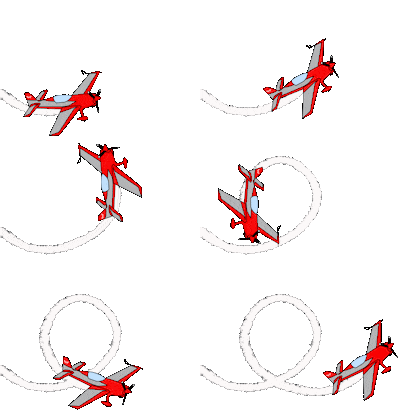
If the pilot pulls back on the stick, provided there is sufficient thrust, the angle of attack will be increased and the lift will also increase. This increases the load factor. If the aircraft enters a constant radius loop, that is one with constant radius and constant airspeed we can consider, the forces are shown below..
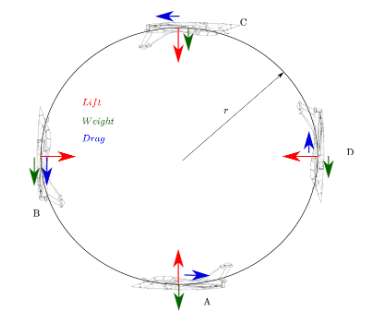
If the angular displacement is denoted by γ, with γ = 0 being the bottom of the loop, increasing clockwise, then the equations of motion are, in the aircraft longitudinal direction:
T -d-W sin γ = 0
L – W cos γ = WV2 / gr
Where, Fc =WV2 /gr
is the force generated from the centripetal acceleration in circular motion.
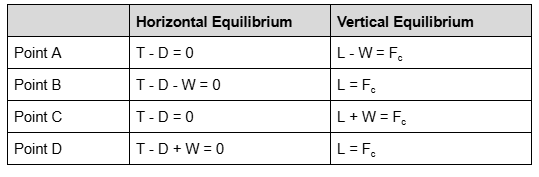
At different point in the loop, we can summarise:
For a perfect loop the normal acceleration is constant, the load factor will vary according to:
L – W cos γ = WV2 / gr
L / W – cos γ = V2 / gr
Since n = L / W , then
n = cos γ + v2 / gr
At points A to D in the loop above, we have the load factor as:
Point A: 1 + V2/gr
Point B : V2/gr
Point C: V2/gr -1
Point D: V2/gr
Hence it is the load factor required to initiate the loop, point A, that will set the minimum turn radius, and hence the minimum turn radius is given by:
rmin = V2 /g(n-1)
Therefore the minimum value of the equation above will give the minimum radius for a constant radius loop.
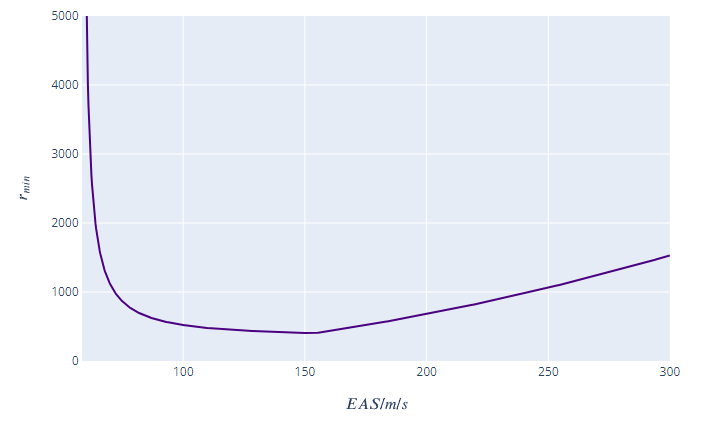
The graph below demonstrates how the minimum loop radius changes with speed.
Some key points that can be made from this graph are:
- The minimum turn radius speed is the same as the manoeuvre speed, VA The lowest point on the graph above is approximately 450m with a speed of 155 m/s.
- At speeds below VA the turns are limited by the onset of stall.
- At speeds above VA the turns are limited by structural limitations.
In our example illustrated above it is therefore apparent that the aircraft will need to vary the thrust and lift produced throughout this manoeuvre in order to produce a constant centripetal force and keep the radius of the loop constant. With this in mind we will analyse a loop with a constant load factor and determine the shape of the loop produced by aircraft making this manoeuvre. The equation for the load factor in a constant radius loop can be rearranged for the radius:
r = V2 / g(n-cos γ)
The radius used in this equation could be confusing. In the equation the radius refers to the radius of a theoretical circle that would be flown if, at any point in the loop, the instantaneous value of the pitching velocity were maintained. Effectively, the equation shows that the distance flown during a given section of the loop is inversely proportional to the load factor – so the aircraft flies further during the parts where cos γ is closer to zero as the radius of the turn increases at these points. This means that the shape flown is elongated vertically to give a tighter turn at the top and bottom of the loop.
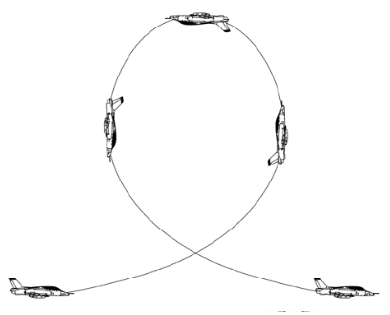
Flightpath in loop manoeuvre with constant load factor and speed
Interested in our Aerospace Engineering Courses?
At iLearn Engineering®, we offer a diverse range of online accredited aerospace engineering courses and qualifications to cater to different academic and career goals. Our aerospace courses are available in varying credit values and levels, ranging from 40 credit Engineering Diplomas to a Bachelor’s equivalent 360 credit International Graduate Diploma.
All Aerospace Engineering Courses
All Aerospace Engineering Diploma Courses can be seen here.
Short Aerospace Courses (40 Credits)
- Diploma in Aerospace Engineering
- Diploma in Aircraft Design
- Diploma in Principles of Flight
- Diploma in Aerospace Structures
- Diploma in Aerodynamics
- Diploma in Aerodynamics, Propulsion and Space
First Year of Undergraduate (Level 4 – 120 Credits)
Higher International Certificate in Aerospace Engineering
Years One and Two of Undergraduate (Level 5 – 240 Credits)
Higher International Diploma in Aerospace Engineering
Degree Equivalent International Graduate Diploma (Level 6 – 360 Credits)
International Graduate Diploma in Aerospace Engineering
Complete Engineering Course Catalogue (all courses)
Alternatively, you can view all our online engineering courses here.
Recent Posts
Why a Headwind Reduces Take-Off Distance: The Airspeed–Groundspeed Derivation
Why a Headwind Reduces Take-Off Distance: The Airspeed–Groundspeed Derivation Aeroplanes normally take off into wind because the wing must reach a required airspeed to produce lift, whereas the runway distance is travelled at groundspeed. A headwind contributes to the airspeed before the aircraft has covered any runway. It therefore reduces the groundspeed required at lift-off […]
How to Calculate Aircraft Take-Off Ground Run: A Flight Mechanics Tutorial
How to Calculate Aircraft Take-Off Ground Run: A Flight Mechanics Tutorial An aircraft does not become airborne simply because its engines are producing thrust. During the take-off ground run, thrust must overcome aerodynamic drag and rolling resistance. On a sloping runway, it must also overcome a component of the aircraft’s weight. This tutorial derives a […]
Types of Aircraft Drag Explained: Induced, Profile and Interference Drag
Types of Aircraft Drag Explained: Induced, Profile and Interference Drag An aircraft experiences several forms of aerodynamic drag at the same time. Some result from generating lift, some arise as air flows over the aircraft’s surfaces, and others are created when airflow around neighbouring components interacts. For a conventional aircraft in subsonic flight, total drag […]