

Why Planes Don’t Spin Out of Control: Lateral and Directional Stability Made Simple
Introduction
Ever wondered why an aircraft doesn’t suddenly roll over or yaw uncontrollably while flying through turbulence? The answer lies in lateral and directional stability, the built-in aerodynamic features that help an aircraft stay balanced and pointed in the right direction.
In this blog, we’ll break down how roll and yaw stability work, what causes unwanted motions like sideslip, and how control surfaces like ailerons and rudders keep a plane steady and controllable in the air.
Lateral Stability
Lateral stability is the inbuilt ability of the aircraft to recover from a disturbance in the lateral plane. A disturbance in the lateral plane will cause the aircraft to roll about the longitudinal axis, without pilot input. When the aircraft is rolling one wing will be raised and the other lowered.
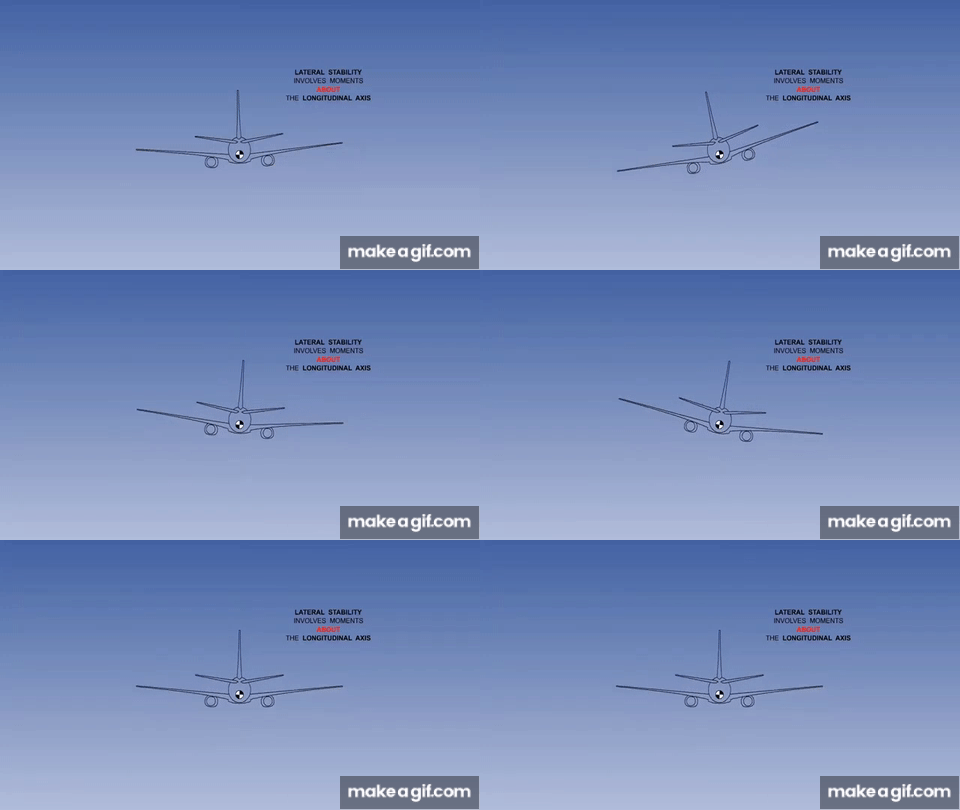
Let us consider an aircraft that undergoes a disturbance that causes the starboard wing to dip. As an aircraft rolls and the wings are no longer perpendicular to the direction of gravitational acceleration, the lift force, which acts perpendicular to the surface of the wings, is also no longer parallel with gravity. Hence, rolling an aircraft creates both a vertical lift component in the direction of gravity and a horizontal side load component, thereby causing the aircraft to sideslip. If these sideslip loads contribute towards returning the aircraft to its original configuration, then the aircraft is laterally stable, if it causes the aircraft to move further from the original flight condition it is laterally unstable.
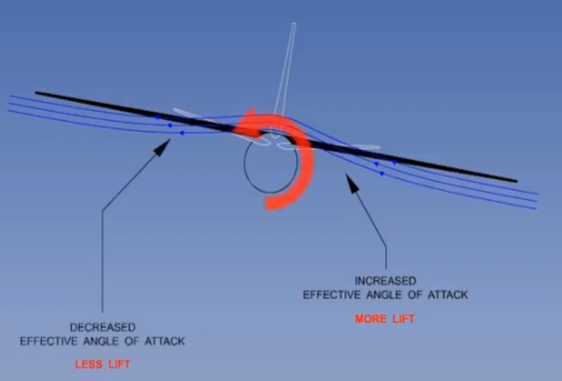
Rear view of aircraft in side slip
Consider the plane in the diagram above undergoing a disturbance. As the starboard wing dips the lift vector now has a sideways component (toward the right hand side) The aircraft now moves sideways due to this force (sideslip). Once the aircraft begins to move sideways there will be a relative wind flow from right to left over the body of the aircraft. With the starboard wing positioned at the top of the aircraft we can see that the effective angle of attack of the wing is increased. This in turn causes higher amounts of lift. The opposite happens on the port wing as the effective angle of attack and therefore lift is reduced. The way these forces change causes the anticlockwise moment about the longitudinal axis, shown above, which tends to restore the aircraft back to the original bank, or level flight. Hence the aircraft is considered to be laterally stable (positive lateral stability).
If we were to consider the same scenario but with wings mounted lower vertically, as shown below, the aircraft would have negative lateral stability, or be laterally unstable.
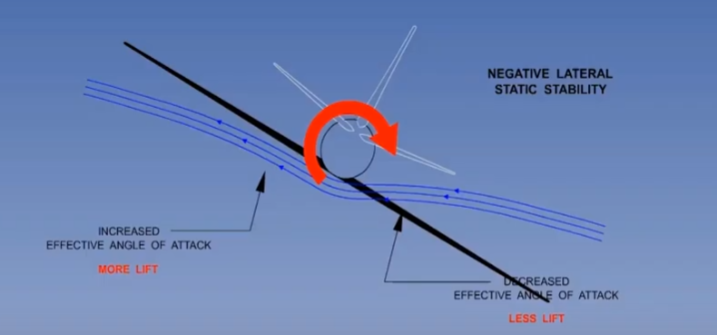
In this instance the lift is increased more so on the port wing which causes the bank angle to become steeper and without any pilot interference the aircraft will not return to straight and level flight.
To summarise the effect of vertical wing placement on lateral stability:
- High wing: gets an upward crossflow component on its upwind wing and downward component on its downwind wing (roll “away” from the sideslip: contribute to positive lateral stability)
- Mid wing: gets no effect (no net rolling moment and neutral lateral stability)
- Low wing: opposite of high wing (roll “toward” the sideslip: contribute to negative stability)
Some other design features that improve static lateral stability include adding a dihedral angle on the wing. The effect of dihedral is discussed below:
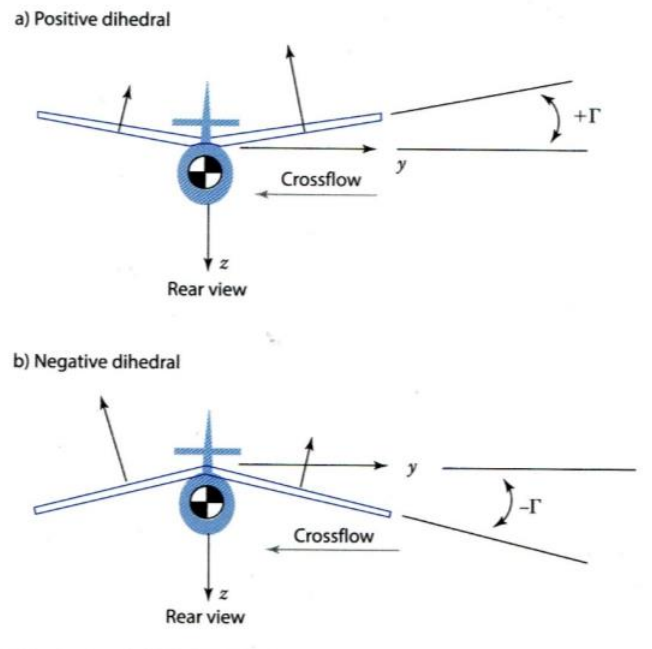
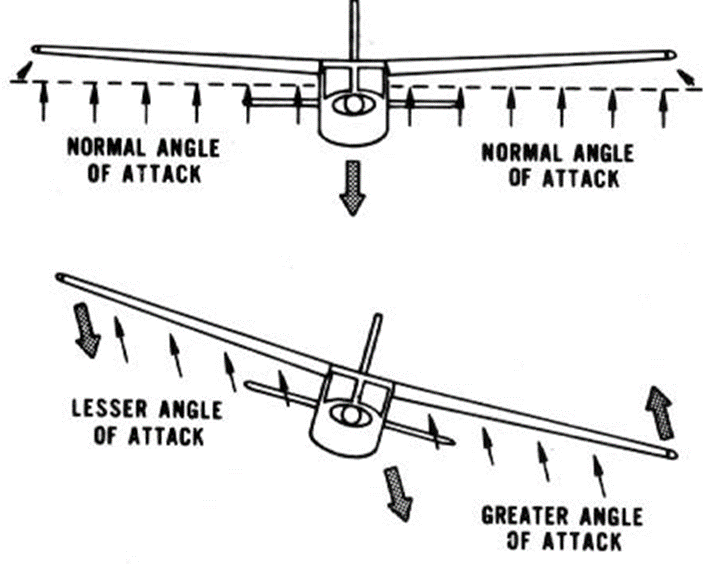
In the image above, the wing dihedral angle Γ is the angle in a rear view of the aircraft between its y axis and a line drawn from the middle of the wing root to the middle of the wing tip. As sideslip results in a difference in the angle of attack between the higher and lower wing with the greatest angle of attack on the lower wing. The increased angle of attack from the dihedral angle produces increased lift on the lower wing with a tendency to return the aeroplane to wings-level flight
- Positive dihedral: positive sideslip angle results in a negative (roll “away”) rolling moment (contribute to positive lateral stability)
- Negative dihedral (anhedral): opposite (roll “toward”) rolling: contribute to negative lateral stability)
Finally wing sweep can have a significant effect on lateral stability. Most high-speed aircraft are given swept-back wings to improve high-speed aerodynamics, but sweeping the wing back can also improve lateral stability. When a swept wing aircraft flies straight and level, the freestream airflow over the wings has two components of velocity:
Parallel to the leading edge (Vp)
Perpendicular to the leading edge (Vn)
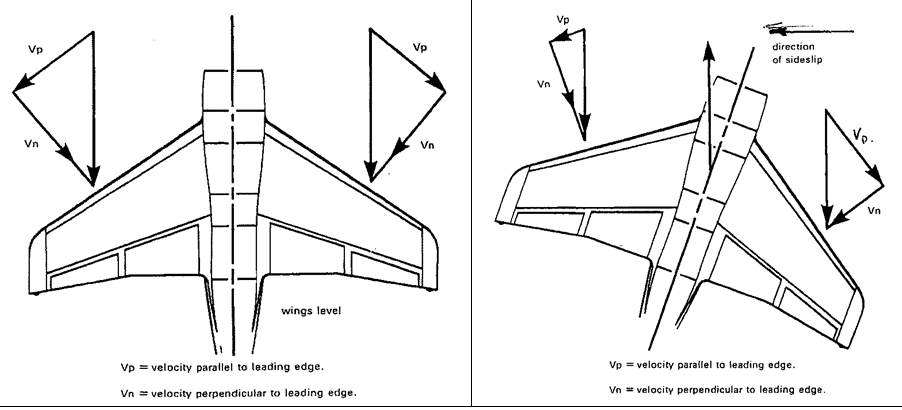
In a sideslip the relative sideslip wind velocity increases this normal component on the leading wing whilst decreasing that on the other. The effect is to produce a distorted spanwise lift distribution that restores the aircraft to an even keel (area facing into sideslip). The increased lift rolls the aircraft (lateral stability) but also produces increased lift-induced drag which pulls it back to straight flight (directional stability).
A tall vertical tail contributes to positive lateral stability. Because its aerodynamic centre is above the aircraft’s centre of gravity, it generates a negative rolling moment when the aircraft has a positive sideslip angle. This is a positive contribution to lateral stability. In addition, placing an aircraft’s horizontal tail on top of its vertical tail (T-tail) will create an effect of an end-plate on the vertical tail. This will increase the effective aspect ratio of the vertical tail, and therefore increase its lift curve slope. This will also make the aircraft’s rolling moment (due to sideslip) more negative (contribute to positive lateral stability).
Directional Stability
We will now discuss what is meant by directional stability. The directional stability of the aircraft is the inherent ability to recover from a disturbance in the yawing plane, or the vertical axis. When an aeroplane is flying in the normal way the airflow will approach it directly from the front, i.e. parallel to its longitudinal axis. Now imagine it to be deflected from its course as shown below
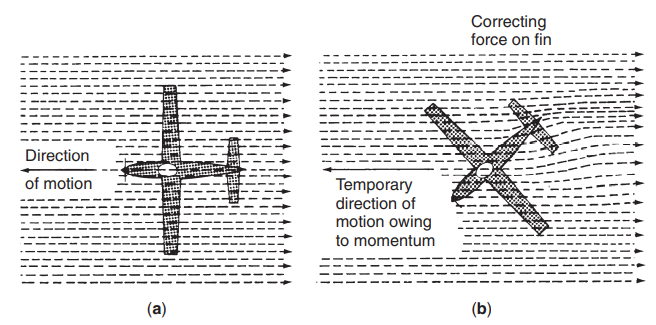
Before and after disturbance
Because of the initial momentum of the aircraft it will initially continue moving in its old direction, therefore the longitudinal axis will be inclined to the airflow, and a pressure will be created on all the side surfaces on one side of the aeroplane.
If the turning effect of the pressures behind the centre of gravity is greater than the turning effect in front of the centre of gravity, the aeroplane will tend to its original course. If, on the other hand, the turning effect in front is greater than that behind, the aeroplane will turn still farther off its course. Notice that it is the turning effect or the moment that matters, and not the actual pressure; therefore it is not merely a question of how much side surface, but also of the distance from the centre of gravity of each side surface.
For instance, a small fin at the end of a long fuselage may be just as effective in producing directional stability as a large fin at the end of a short fuselage. Also, there may sometimes be more side surface in the front than in the rear, but the rear surfaces will be at a greater distance. Therefore a more forward Center of Gravity is preferable to an aft Center of Gravity as it gives a longer moment arm for the fin or vertical stabiliser.
A secondary effect of power or thrust is that caused by the slipstream. Propeller slipstream can affect the airflow over the fin, and therefore the fin’s effectiveness as a directional stabiliser. Changes in power cause changes in the slipstream and can lead to large changes in directional trim requirements.
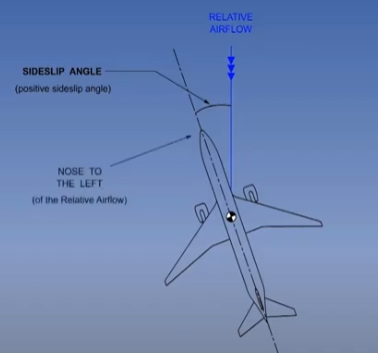
Sideslip
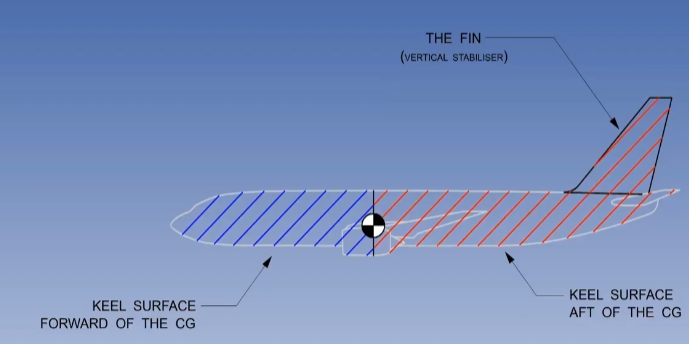
keel surface
Firstly the aircraft enters a sideslip, in the case of the diagram above, a positive sideslip. What this means is that the side of the aircraft is exposed to the relative airflow. This surface is referred to as the keel surface. The diagram demonstrates there will be two portions in contact with the flow now – the keel surface forward of the center of gravity and the keel surface aft of the center of gravity.
The airflow hitting the keel surface forward of center of gravity will produce an anticlockwise moment around the center of gravity and the airflow hitting the keel surface aft of the center of gravity will produce a restorative clockwise moment around the center of gravity.
This clearly demonstrates that increasing the size of the keel surface aft of center of gravity such as increasing vertical fin area, increases directional stability. However as most of the side area of an aircraft will typically be behind the center of gravity to provide this positive directional stability, any crosswind will naturally create a yawing moment tending to turn the nose of the aircraft into the wind, this phenomenon is referred to as weathercocking.
The main contributor to the static directional stability is the fin. Both the size and arm of the fin determine the directional stability of the aircraft. The further the vertical fin is behind the centre of gravity the more static directional stability the aircraft will have.
Interested in our Aerospace Engineering Courses?
At iLearn Engineering®, we offer a diverse range of online accredited aerospace engineering courses and qualifications to cater to different academic and career goals. Our aerospace courses are available in varying credit values and levels, ranging from 40 credit Engineering Diplomas to a Bachelor’s equivalent 360 credit International Graduate Diploma.
All Aerospace Engineering Courses
All Aerospace Engineering Diploma Courses can be seen here.
Short Aerospace Courses (40 Credits)
- Diploma in Aerospace Engineering
- Diploma in Aircraft Design
- Diploma in Principles of Flight
- Diploma in Aerospace Structures
- Diploma in Aerodynamics
- Diploma in Aerodynamics, Propulsion and Space
First Year of Undergraduate (Level 4 – 120 Credits)
Higher International Certificate in Aerospace Engineering
Years One and Two of Undergraduate (Level 5 – 240 Credits)
Higher International Diploma in Aerospace Engineering
Degree Equivalent International Graduate Diploma (Level 6 – 360 Credits)
International Graduate Diploma in Aerospace Engineering
Complete Engineering Course Catalogue (all courses)
Alternatively, you can view all our online engineering courses here.
Recent Posts
Why a Headwind Reduces Take-Off Distance: The Airspeed–Groundspeed Derivation
Why a Headwind Reduces Take-Off Distance: The Airspeed–Groundspeed Derivation Aeroplanes normally take off into wind because the wing must reach a required airspeed to produce lift, whereas the runway distance is travelled at groundspeed. A headwind contributes to the airspeed before the aircraft has covered any runway. It therefore reduces the groundspeed required at lift-off […]
How to Calculate Aircraft Take-Off Ground Run: A Flight Mechanics Tutorial
How to Calculate Aircraft Take-Off Ground Run: A Flight Mechanics Tutorial An aircraft does not become airborne simply because its engines are producing thrust. During the take-off ground run, thrust must overcome aerodynamic drag and rolling resistance. On a sloping runway, it must also overcome a component of the aircraft’s weight. This tutorial derives a […]
Types of Aircraft Drag Explained: Induced, Profile and Interference Drag
Types of Aircraft Drag Explained: Induced, Profile and Interference Drag An aircraft experiences several forms of aerodynamic drag at the same time. Some result from generating lift, some arise as air flows over the aircraft’s surfaces, and others are created when airflow around neighbouring components interacts. For a conventional aircraft in subsonic flight, total drag […]