

Breaking the Sound Barrier: How Supersonic Flight Changes Aircraft Stability
Introduction
What really happens when an aircraft breaks the sound barrier? As speed increases beyond Mach 1, airflow changes dramatically, shock waves form, pressure distribution shifts, and aerodynamic forces behave very differently from subsonic flight. These changes don’t just affect drag and lift; they significantly influence aircraft stability and control. In this blog, we’ll explore how supersonic flight alters longitudinal, lateral, and directional stability, and why aircraft must be specially designed to remain stable beyond the speed of sound.
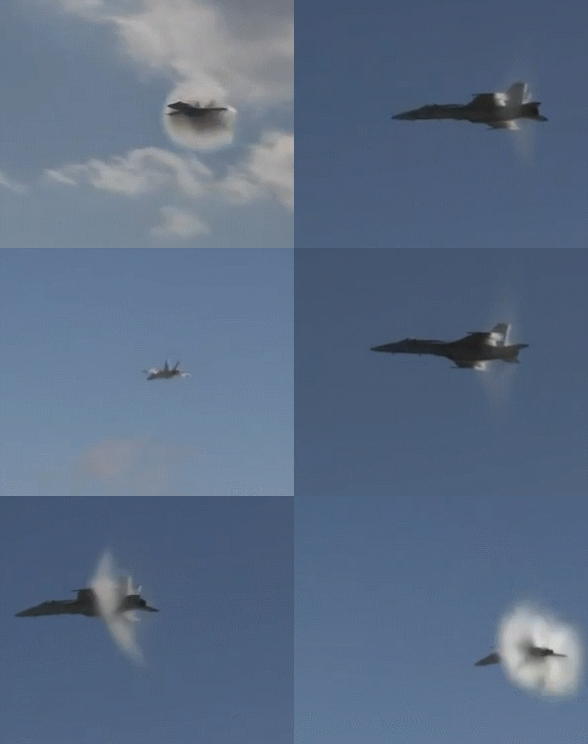
Mach Number
To first understand what supersonic flight has on the stability of aircraft we must first introduce the concept of supersonic flight. Broadly speaking supersonic flight is related to a flight speed greater than that of the local speed of sound. As we can see from the ISA tables the speed of sound decreases with altitude, or more specifically, temperature. We can use a parameter called the Mach number, M, which compares the local speed of sound, c, with flight or flow speed, u.
M = u / c
The mach number is a convenient way of expressing the speed of aircraft as the magnitude of compressibility effects can vary by large amounts the closer to the speed of sound the aircraft is travelling at.
It is important to classify the different Mach regimes that an aircraft will experience during its flight envelope. It is not as simple as placing anything above Mach 1 in the supersonic category as there are more complex interactions to consider. The different Mach regimes are as follows:
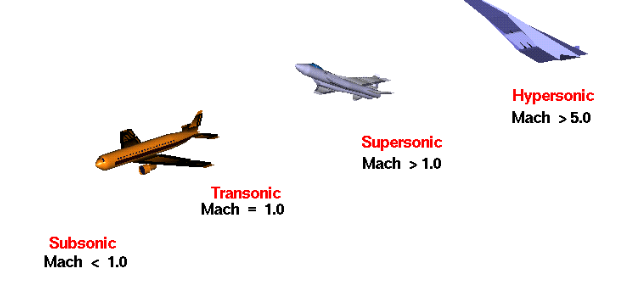
Subsonic; Mach number < 0.8. The subsonic speed range is that range of speeds within which all of the airflow over an aircraft is less than Mach 1.
Transonic; 0.8 < Mach number < 1.2. The transonic speed range is that range of speeds within which the airflow over different parts of an aircraft is between subsonic and supersonic.
Supersonic; 1.2 < Mach number < 5. The supersonic speed range is that range of speeds within which all of the airflow over an aircraft is supersonic (more than Mach 1). But airflow meeting the leading edges is initially decelerated, so the free stream speed must be slightly greater than Mach 1 to ensure that all of the flow over the aircraft is supersonic. It is commonly accepted that the supersonic speed range starts at a free stream speed greater than Mach 1.3. for Mach numbers greater than one, 1 < M < 3. Compressibility effects are important for supersonic aircraft, and shock waves are generated by the surface of the object. For high supersonic speeds, 3 < M < 5, aerodynamic heating also becomes very important for aircraft design.
Hypersonic; Mach number > 5 At these speeds, some of the energy of the object now goes into exciting the chemical bonds which hold together the nitrogen and oxygen molecules of the air. At hypersonic speeds, the chemistry of the air must be considered when determining forces on the object. The Space Shuttle re-enters the atmosphere at high hypersonic speeds, M ~ 25. Under these conditions, the heated air becomes an ionised plasma of gas and the spacecraft must be insulated from the high temperatures.
As the aircraft approaches the speed of sound, which is usually around 343 m/s at sea level and standard temperature of 20 degrees celsius, some interesting things begin to happen. If we consider the way in which sound propagates through the atmosphere we can start to appreciate what happens to aircraft approaching the speed of sound. A sound is a form of energy or we can say that a vibration that travels through a medium, like air or water. Sound even travels through a gaseous medium. It is something that can be heard. A sound wave is a simple pressure wave that is caused by the movement of air molecules away from the source and like all waves we expect it to have a frequency and an amplitude, they propagate through air at the local speed of sound.
Disturbance in air
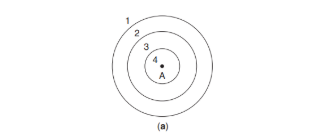
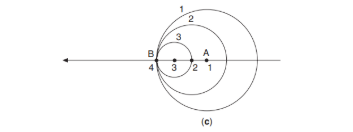
Consider a which shows how a disturbance (A) in air transmits sound waves. When the stationary disturbance causes a vibration, the disturbance moves at the speed of sound in all directions away from it. The lines 1, 2, 3 and 4 represent the position of sound waves from the initial disturbance. (shown in a)
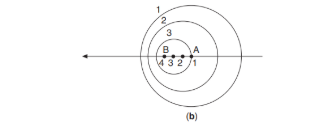
In b in which the object B is moving we can see how the distance between pressure waves in front of the disturbance is decreasing and increasing in its wake.
In c the object B is travelling at the speed of sound (Mach 1) and there is a build up of pressure waves in front of the disturbance. Essentially this build up of pressure waves is what causes a shock wave and as the speed of sound is reached a sonic boom will take place.
A more thorough examination of shockwaves will not be provided here but we can look at how the property of air is changed and the impact this will have on the stability and control of the aircraft. Shockwaves can begin to form over the wing of an aircraft even at speeds lower than Mach 1. As the flow begins to pass over a wing it is sped up, with the fastest region of flow occurring at the thickest part of the aerofoil. The lowest speed of the aircraft which causes supersonic flow over the aerofoil is called the critical Mach number, this critical Mach number can often lie in the transonic range and is the reason why shocks can be formed below supersonic speeds.
When a normal shock wave forms on the surface of an aircraft wing, due to high pressure difference across the shock wave, the boundary layer starts to thicken and will eventually separate at the attachment point of the shock wave. This is called shock induced separation.
The results of this separation are as follows:
Severe buffeting
Rapid increase in CD
Sudden decrease in CL
Large and erratic changes of pitching moment
Loss of control effectiveness
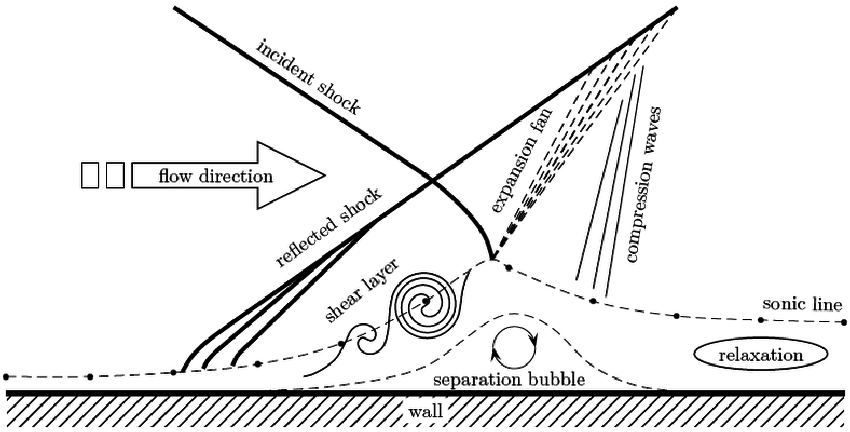
The sudden extra drag which is such a marked feature of the shock stall has two main components. First the energy dissipated in the shock wave itself is reflected in additional drag (wave drag) on the aerofoil. Secondly, stated above, the shock wave may be accompanied by separation. Either of these will modify both the pressure on the surface and the skin friction behind the shock wave. So this shock drag may be considered as being made up of two parts, i.e. the wave-making resistance, or wave drag, and the drag caused by the thick turbulent boundary layer or region of separation which we will call boundary layer drag.
The large rise in drag and decrease in lift when an aircraft approaches the speed of sound is referred to as shock stall. By far the most important effect of shock stall is a considerable change of longitudinal trim, usually, but not always, towards nose-down, and sometimes first one way then the other. Remembering that aircraft trim is an adjustment to the control surfaces. An aircraft is trimmed when the flight controls are adjusted so that less effort is required from the pilot. Unfortunately the change of trim is made even worse by the very large forces required to move the controls, and the ineffectiveness of the trimmers.
There is also likely to be buffeting, vibration of the ailerons, and pitching and yawing oscillations which may become uncontrollable, and which are variously described as snaking (yawing from side to side), porpoising (pitching up and down), and the Dutch roll (a combination of roll and yaw)
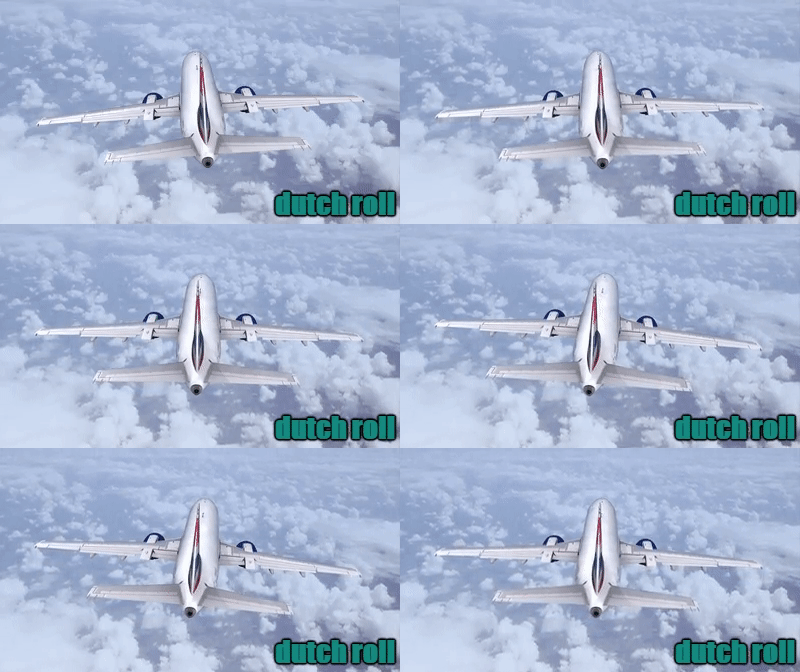
Dutch roll is a type of aircraft motion consisting of an out-of-phase combination of “tail-wagging” (yaw) and rocking from side to side (roll). This yaw-roll coupling is one of the basic flight dynamic modes. This motion is normally well damped in most light aircraft.
Designing for Supersonic Flight
One main design feature is to include swept wings. Whilst we discussed the importance of doing this in the previous section in terms of lateral stability, when the aircraft is in straight flight the velocity vector perpendicular to the wing is always reduced, meaning that shock stall is delayed and the critical mach number is increased. This means that shockwaves are not formed and a dramatic decrease in drag (drag divergence) only happens at much higher velocities.
The transonic area rule is due to drag created related to change in cross-sectional area of vehicle from nose to tail. Shape itself is not as critical in creation of drag, but rate of change in shape; it is a form of wave drag.
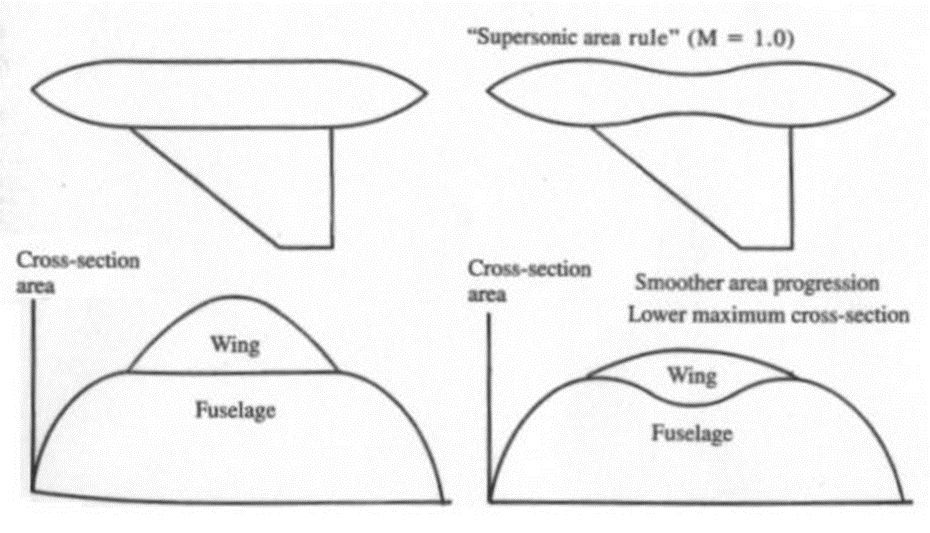
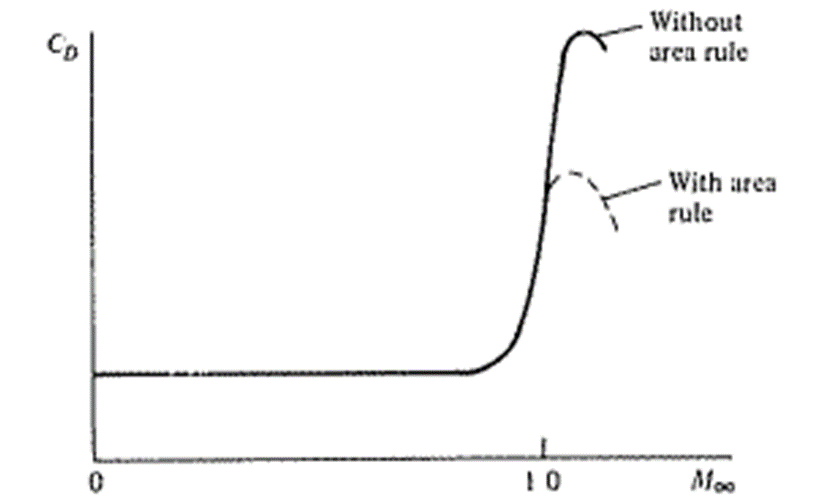
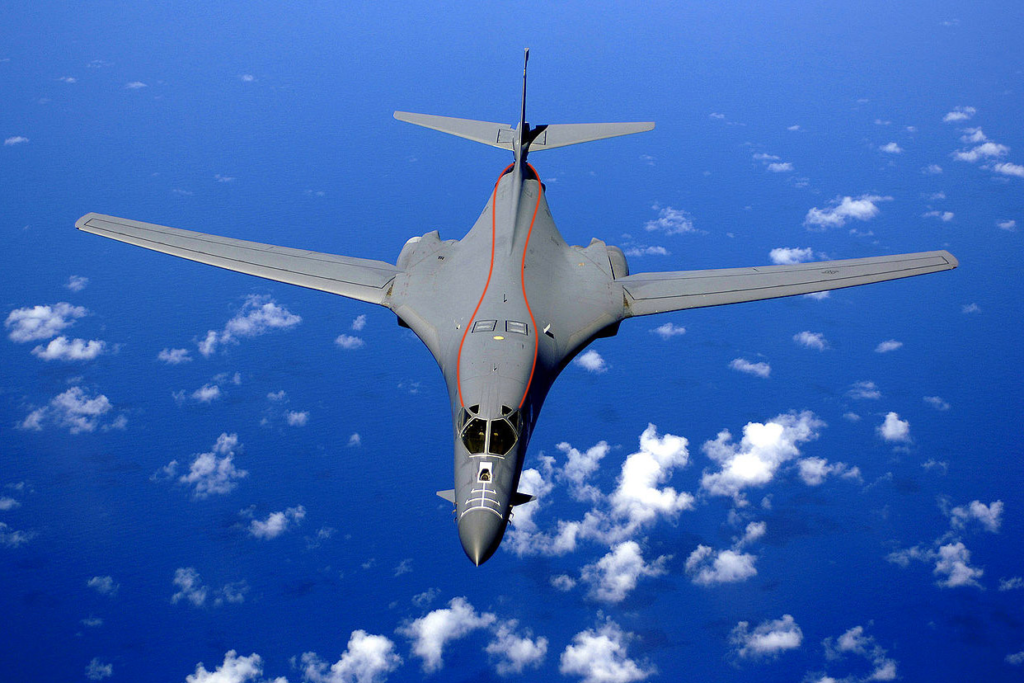
A smooth area distribution with minimal areas of large rates of change will provide minimum wave drag. Notice the change in shape of the body in the image below, the curved shape helps to keep the lengthwise change in area of cross section as smooth as possible.
Interested in our Aerospace Engineering Courses?
At iLearn Engineering®, we offer a diverse range of online accredited aerospace engineering courses and qualifications to cater to different academic and career goals. Our aerospace courses are available in varying credit values and levels, ranging from 40 credit Engineering Diplomas to a Bachelor’s equivalent 360 credit International Graduate Diploma.
All Aerospace Engineering Courses
All Aerospace Engineering Diploma Courses can be seen here.
Short Aerospace Courses (40 Credits)
- Diploma in Aerospace Engineering
- Diploma in Aircraft Design
- Diploma in Principles of Flight
- Diploma in Aerospace Structures
- Diploma in Aerodynamics
- Diploma in Aerodynamics, Propulsion and Space
First Year of Undergraduate (Level 4 – 120 Credits)
Higher International Certificate in Aerospace Engineering
Years One and Two of Undergraduate (Level 5 – 240 Credits)
Higher International Diploma in Aerospace Engineering
Degree Equivalent International Graduate Diploma (Level 6 – 360 Credits)
International Graduate Diploma in Aerospace Engineering
Complete Engineering Course Catalogue (all courses)
Alternatively, you can view all our online engineering courses here.
Recent Posts
Why a Headwind Reduces Take-Off Distance: The Airspeed–Groundspeed Derivation
Why a Headwind Reduces Take-Off Distance: The Airspeed–Groundspeed Derivation Aeroplanes normally take off into wind because the wing must reach a required airspeed to produce lift, whereas the runway distance is travelled at groundspeed. A headwind contributes to the airspeed before the aircraft has covered any runway. It therefore reduces the groundspeed required at lift-off […]
How to Calculate Aircraft Take-Off Ground Run: A Flight Mechanics Tutorial
How to Calculate Aircraft Take-Off Ground Run: A Flight Mechanics Tutorial An aircraft does not become airborne simply because its engines are producing thrust. During the take-off ground run, thrust must overcome aerodynamic drag and rolling resistance. On a sloping runway, it must also overcome a component of the aircraft’s weight. This tutorial derives a […]
Types of Aircraft Drag Explained: Induced, Profile and Interference Drag
Types of Aircraft Drag Explained: Induced, Profile and Interference Drag An aircraft experiences several forms of aerodynamic drag at the same time. Some result from generating lift, some arise as air flows over the aircraft’s surfaces, and others are created when airflow around neighbouring components interacts. For a conventional aircraft in subsonic flight, total drag […]