

Understanding Manufacturing Systems and Plant Structure
Introduction
At its core, manufacturing is about transformation, converting raw materials into finished products that meet customer needs and quality expectations. However, this transformation is far more than a simple physical process. It takes place within a complex, interconnected system made up of people, machines, processes, and information flows.
A well-designed manufacturing system ensures that all these elements work together seamlessly. Understanding how this system is structured is essential for improving productivity, reducing operational costs, maintaining quality, and scaling production efficiently in response to market demand.
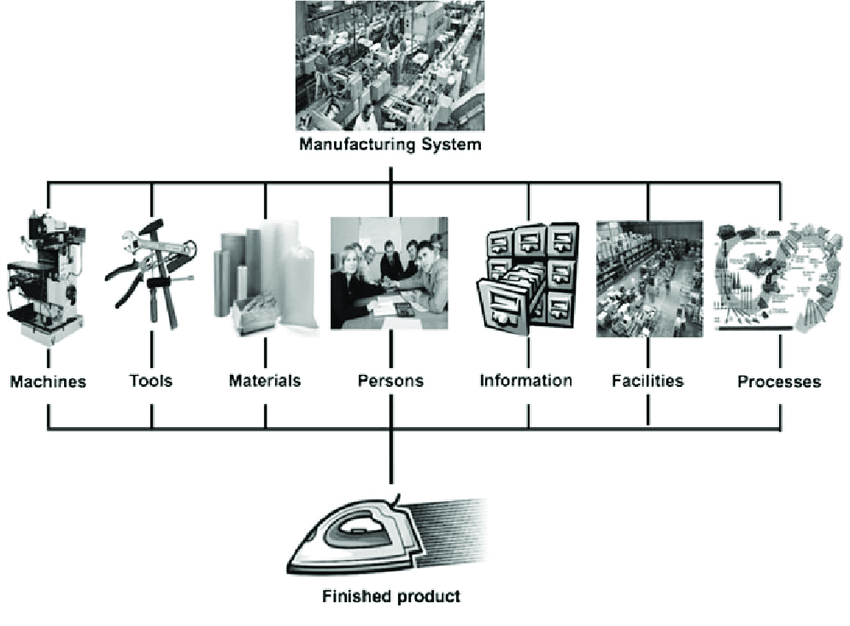
Levels of a Manufacturing System
Manufacturing systems are typically organized into three hierarchical levels. Each level plays a distinct role in ensuring smooth and efficient operations:
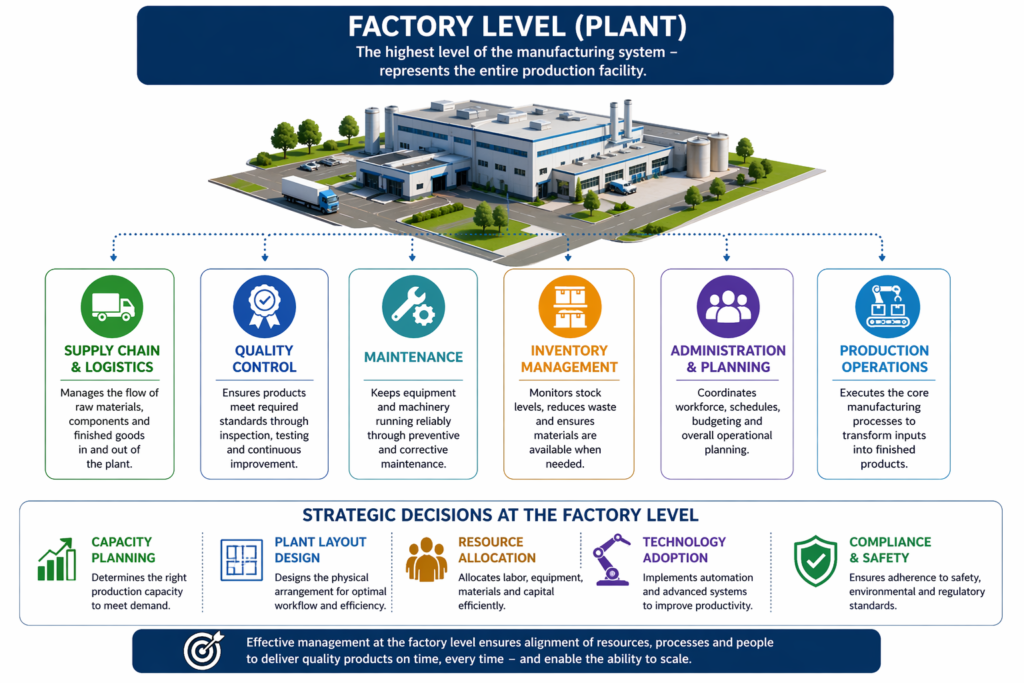
1. Factory Level (Plant)
The factory level represents the highest level of the manufacturing system and encompasses the entire production facility. It is where all manufacturing activities, support services, and business operations come together to deliver finished products.
This level goes beyond just production lines, it integrates multiple critical functions that ensure smooth and continuous operations, including:
- Supply Chain and Logistics: Managing the flow of raw materials, components, and finished goods in and out of the plant.
- Quality Control: Establishing standards, inspections, and testing processes to ensure products meet required specifications.
- Maintenance: Keeping equipment and machinery in optimal condition through preventive and corrective maintenance.
- Inventory Management: Monitoring stock levels, reducing waste, and ensuring materials are available when needed.
- Administration and Planning: Coordinating workforce, schedules, budgeting, and overall operational planning.
At this level, decisions are typically strategic and long-term in nature. These include:
- Determining production capacity to meet market demand
- Designing the plant layout for optimal workflow and minimal waste
- Allocating resources such as labor, equipment, and materials efficiently
- Implementing technology and automation systems
- Ensuring compliance with safety, environmental, and regulatory standards
The effectiveness of the factory level directly influences the overall performance of the manufacturing system. A well-managed plant ensures alignment between business goals and operational execution, enabling consistent output, cost control, and the ability to scale production as demand evolves.
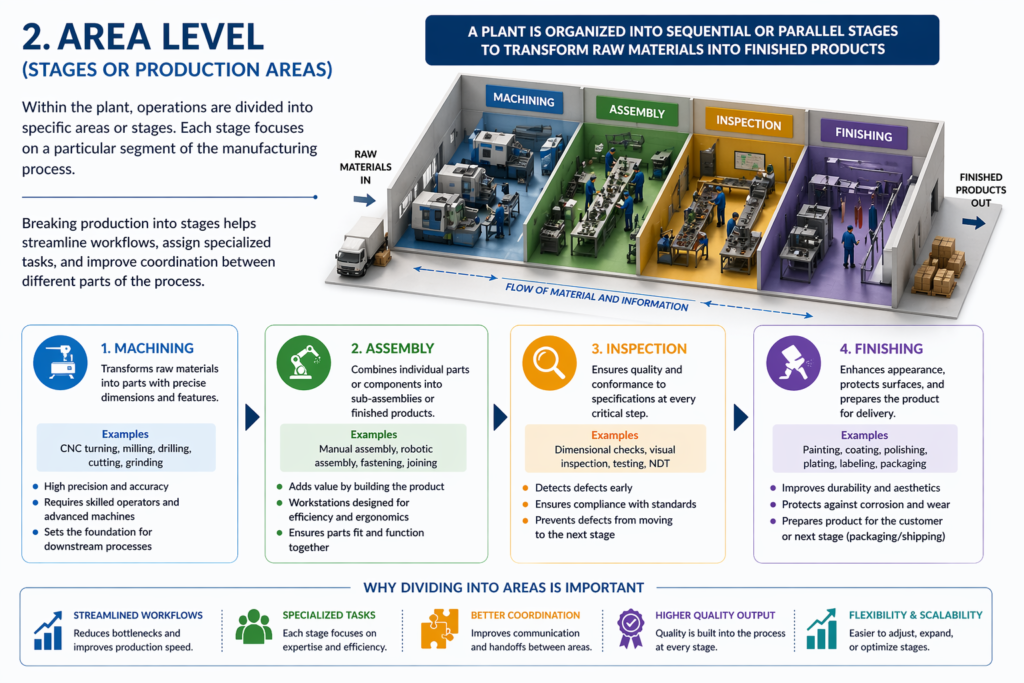
2. Area Level (Stations or Production Stages)
Within a manufacturing plant, operations are organized into distinct areas or production stages. Each stage is responsible for a specific segment of the overall manufacturing process, allowing complex production activities to be broken down into manageable and efficient units.
Typical production stages include:
- Machining: This stage involves shaping and transforming raw materials into precise components using processes such as cutting, drilling, milling, and turning. It lays the foundation for all downstream operations.
- Assembly: At this stage, individual parts and components are brought together to form sub-assemblies or complete products. This may involve manual work, automated systems, or robotic assembly lines.
- Inspection: Quality checks are carried out to ensure that components and products meet required specifications and standards. This stage helps detect defects early and prevents faulty products from progressing further.
- Finishing: The final stage focuses on enhancing the product’s appearance, durability, and functionality. Processes may include painting, coating, polishing, or packaging to prepare the product for delivery.
Importance of Dividing Production into Stages
Organizing manufacturing into clearly defined stages provides several operational advantages:
- Improved Workflow Efficiency: Structured stages reduce bottlenecks and ensure a smooth flow of materials and information across the production line.
- Specialization of Tasks: Each stage focuses on specific activities, allowing workers and machines to develop expertise and operate more efficiently.
- Better Coordination: Defined boundaries between stages improve communication, scheduling, and handoffs between different parts of the process.
- Enhanced Quality Control: Inspection points at each stage help identify and correct defects early, reducing rework and waste.
- Scalability and Flexibility: Individual stages can be optimized, expanded, or automated without disrupting the entire system.
The area level acts as the bridge between high-level plant operations and detailed workstation activities. By organizing production into stages, manufacturers can manage complexity more effectively while maintaining control over quality, cost, and throughput.
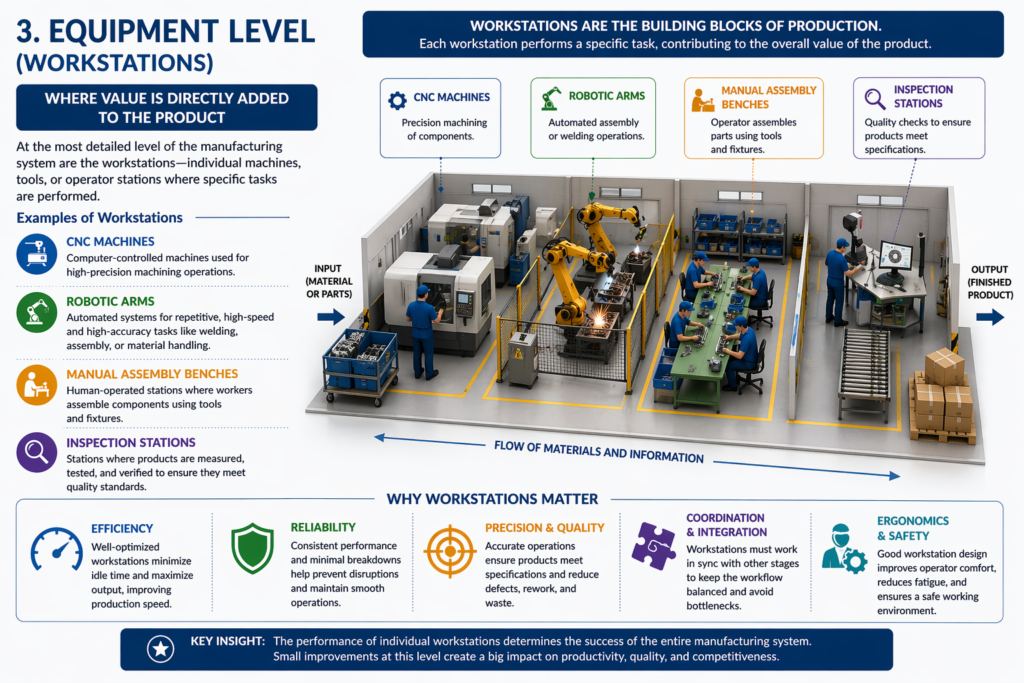
3. Equipment Level (Workstations)
At the most detailed level of a manufacturing system are the workstations, the points where actual production activities take place. These are individual machines, tools, or operator-controlled stations where specific tasks are executed to transform materials or components.
Workstations can take various forms depending on the level of automation and the nature of the process, including:
- CNC Machines: Computer-controlled equipment used for high-precision machining operations such as milling, turning, and drilling.
- Robotic Arms: Automated systems designed for repetitive, high-speed, and high-accuracy tasks such as welding, assembly, or material handling.
- Manual Assembly Benches: Human-operated stations where workers perform assembly tasks requiring flexibility, dexterity, or decision-making.
- Inspection Stations: Points where products are measured, tested, and verified to ensure they meet quality standards and specifications.
Role and Importance of Workstations
Workstations are where value is directly added to the product, making them the most critical level in terms of operational performance. Every cut, weld, assembly step, or inspection contributes to the final product quality and functionality.
Their effectiveness depends on several key factors:
- Efficiency: Well-optimized workstations minimize idle time and maximize output, directly impacting production speed.
- Reliability: Consistent performance and minimal breakdowns are essential to avoid disruptions across the entire production line.
- Precision and Quality: Accurate operations at this level ensure that defects are minimized and product standards are consistently met.
- Coordination and Integration: Workstations must operate in sync with upstream and downstream processes to maintain smooth workflow and avoid bottlenecks.
- Ergonomics and Safety: Proper workstation design improves operator comfort, reduces fatigue, and enhances overall productivity while maintaining safety standards.
Even in highly automated environments, the performance of individual workstations ultimately determines the success of the entire manufacturing system. Small inefficiencies at this level can scale into significant production losses, while well-optimized workstations drive quality, consistency, and throughput.
Real-World Example: Aircraft Wing Assembly
To better understand this structure, consider an aircraft wing assembly facility:
- Plant Level: The entire wing production facility
- Stages:
- Wing Component Assembly
- Wing Machining
- Wing Equipping (installation of systems and components)
- Workstations:
Each stage contains multiple stations handling tasks such as drilling, fastening, inspection, and left-hand/right-hand wing builds.
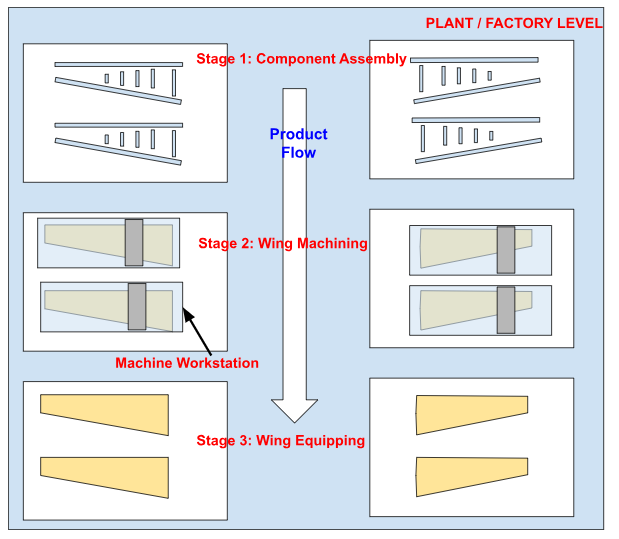
This layered approach ensures that complex products can be manufactured in a controlled, organized, and scalable manner.
Why Structure Matters
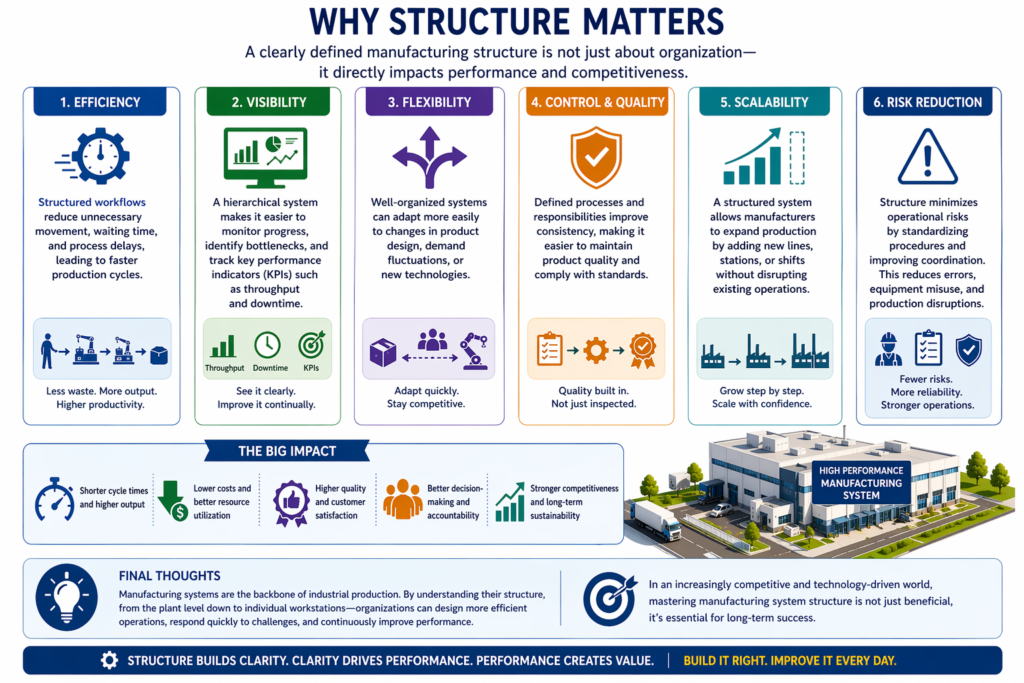
A clearly defined manufacturing structure is far more than an organizational tool, it is a critical driver of operational performance, competitiveness, and long-term success. By establishing clear relationships between processes, resources, and responsibilities, structure enables manufacturing systems to operate efficiently, consistently, and at scale.
Efficiency
A structured system streamlines workflows by clearly defining process sequences and responsibilities. This reduces unnecessary movement, idle time, and delays between stages, resulting in faster production cycles and improved resource utilization.
Visibility
Hierarchical organization provides better transparency across the entire production system. Managers and operators can easily monitor progress, identify bottlenecks, and track key performance indicators (KPIs) such as throughput, cycle time, and downtime, enabling faster, data-driven decision-making.
Flexibility
Well-structured manufacturing systems are more adaptable to change. Whether responding to new product designs, fluctuating demand, or the introduction of advanced technologies, structured systems can adjust processes and reallocate resources with minimal disruption.
Control and Quality
Clearly defined processes, roles, and checkpoints ensure consistency across operations. This improves quality control, reduces variability, and supports compliance with industry standards and regulatory requirements. Quality is built into each stage rather than inspected at the end.
Scalability
A structured system allows manufacturers to grow efficiently. New production lines, workstations, or shifts can be added without disrupting existing operations, making it easier to scale output in response to market demand.
Risk Reduction
Structure also minimizes operational risks by standardizing procedures and improving coordination. This reduces the likelihood of errors, equipment misuse, and production interruptions.
Manufacturing systems form the backbone of modern industrial production. Understanding their structure, from the plant level down to individual workstations, enables organizations to design operations that are efficient, resilient, and continuously improving.
A well-structured system not only enhances productivity and quality but also provides the foundation for innovation, automation, and digital transformation. In today’s competitive and technology-driven environment, mastering manufacturing system structure is not optional, it is essential for achieving sustainable growth and operational excellence.
Interested in our Industrial & Manufacturing Engineering Courses?
At iLearn Engineering®, we offer a diverse range of online accredited Industrial, Manufacturing and Mechanical Engineering courses and qualifications to cater to different academic and career goals. Our industrial courses are available in varying credit values and levels, ranging from 40 credit Engineering Diplomas to a Bachelor’s equivalent 360 credit International Graduate Diploma.
All Industrial / Manufacturing Engineering Courses
All Industrial / Manufacturing Engineering Diploma Courses can be seen here.
All Mechanical Engineering Diploma Courses can be seen here.
Short Courses for Industrial Engineering (40 Credits)
- Diploma in Manufacturing
- Diploma in Composites, Smart Materials & Nanotechnology
- Diploma in Lean Manufacturing
- Diploma in Mechanical Technology
- Diploma in Electrical Technology
- Diploma in Material Science
First Year of Undergraduate (Level 4 – 120 Credits)
Higher International Certificate in Industrial Engineering
Higher International Certificate in Mechanical Engineering
Years One and Two of Undergraduate (Level 5 – 240 Credits)
Higher International Diploma in Industrial Engineering
Higher International Diploma in Mechanical Engineering
Degree Equivalent International Graduate Diplomas in Engineering Management and Mechanical Engineering (Level 6 – 360 Credits)
International Graduate Diploma in Engineering Management (Level 6) [120 Credit Top Up]
International Graduate Diploma in Mechanical Engineering (Level 6) [120 Credit Top Up]
Complete Engineering Course Catalogue (all courses)
Alternatively, you can view all our online engineering courses here.
Get started today
Explore our range of Industrial and Manufacturing Engineering courses
Recent Posts
Why a Headwind Reduces Take-Off Distance: The Airspeed–Groundspeed Derivation
Why a Headwind Reduces Take-Off Distance: The Airspeed–Groundspeed Derivation Aeroplanes normally take off into wind because the wing must reach a required airspeed to produce lift, whereas the runway distance is travelled at groundspeed. A headwind contributes to the airspeed before the aircraft has covered any runway. It therefore reduces the groundspeed required at lift-off […]
How to Calculate Aircraft Take-Off Ground Run: A Flight Mechanics Tutorial
How to Calculate Aircraft Take-Off Ground Run: A Flight Mechanics Tutorial An aircraft does not become airborne simply because its engines are producing thrust. During the take-off ground run, thrust must overcome aerodynamic drag and rolling resistance. On a sloping runway, it must also overcome a component of the aircraft’s weight. This tutorial derives a […]
Types of Aircraft Drag Explained: Induced, Profile and Interference Drag
Types of Aircraft Drag Explained: Induced, Profile and Interference Drag An aircraft experiences several forms of aerodynamic drag at the same time. Some result from generating lift, some arise as air flows over the aircraft’s surfaces, and others are created when airflow around neighbouring components interacts. For a conventional aircraft in subsonic flight, total drag […]