

You Can’t Improve What You Don’t Measure: A Practical Guide to SQCDP in Manufacturing
Introduction
Walk onto any factory floor and you’ll see motion, machines running, operators assembling, materials flowing from one station to the next. But beneath that motion lies something less visible and far more important: measurement.
Because in manufacturing, improvement doesn’t come from instinct alone. It comes from understanding what’s really happening. And that understanding starts with a simple principle:
You can’t improve what you don’t measure.
This is where Key Performance Indicators (KPIs) come in. They turn day-to-day activity into meaningful insight. They highlight problems before they escalate. And they give teams a shared language for performance.
One framework that brings all of this together is SQCDP.
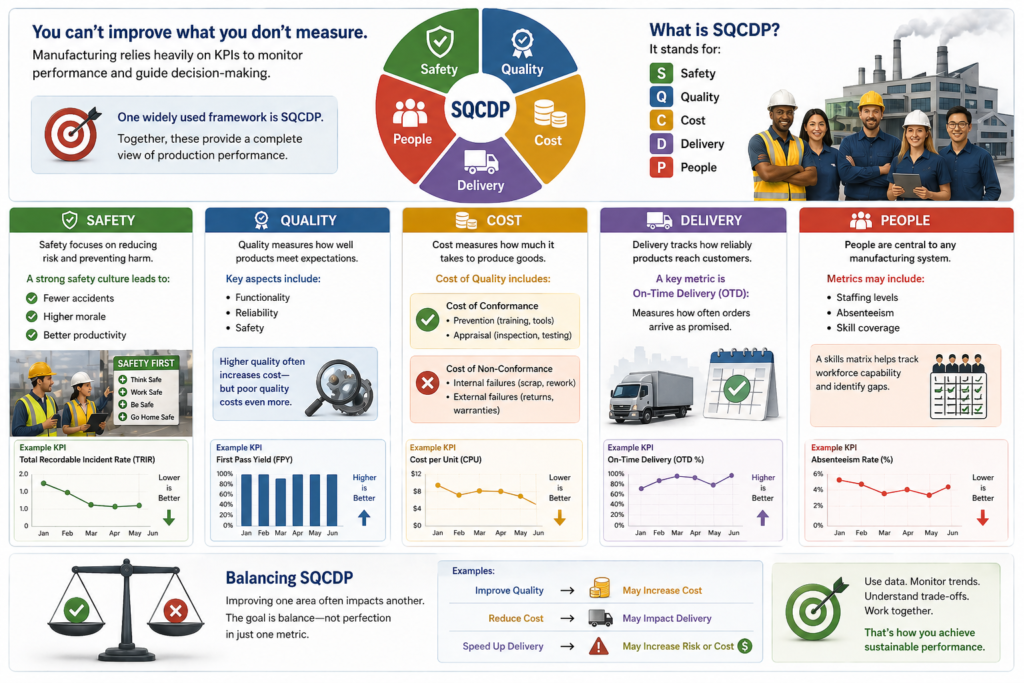
Seeing the Whole Picture with SQCDP
At first glance, SQCDP looks like just another acronym. But in practice, it’s a way of structuring how a business thinks about performance.
It stands for:
- Safety
- Quality
- Cost
- Delivery
- People
Each represents a different dimension of operations. Together, they form a balanced view, one that prevents teams from focusing too narrowly on just output or efficiency.
Think of SQCDP as a dashboard. If one light flashes red, you know where to look. If several are trending in the wrong direction, you know something deeper needs attention.
Safety: More Than Compliance
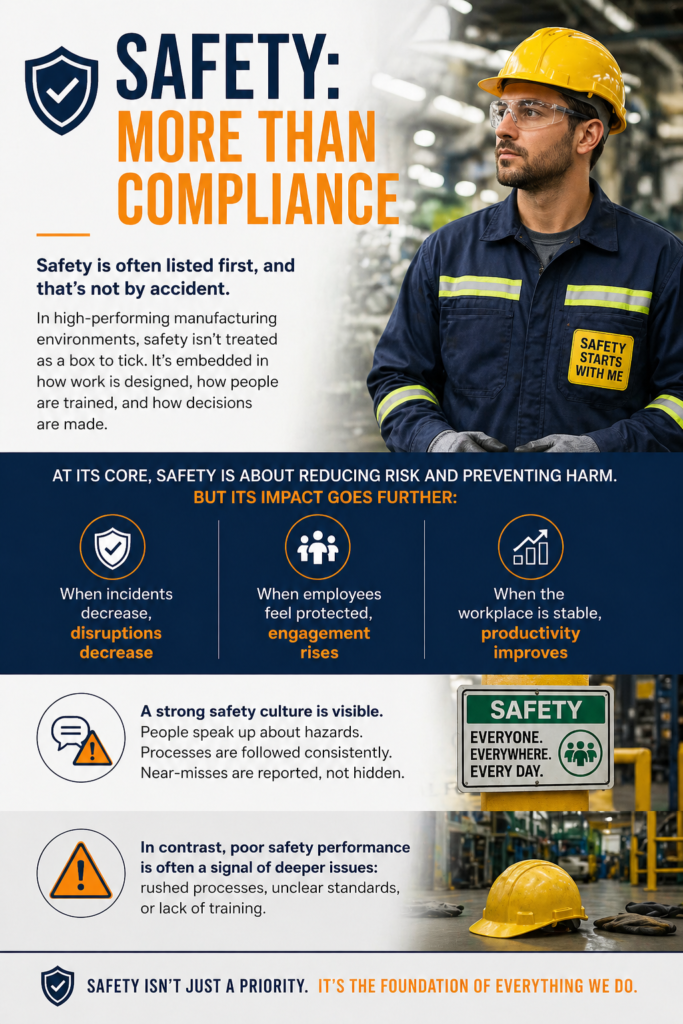
Safety is often listed first, and that’s not by accident. In high-performing manufacturing environments, safety isn’t treated as a box to tick. It’s embedded in how work is designed, how people are trained, and how decisions are made.
At its core, safety is about reducing risk and preventing harm. But its impact goes further:
- When incidents decrease, disruptions decrease
- When employees feel protected, engagement rises
- When the workplace is stable, productivity improves
A strong safety culture is visible. People speak up about hazards. Processes are followed consistently. Near-misses are reported, not hidden.
In contrast, poor safety performance is often a signal of deeper issues: rushed processes, unclear standards, or lack of training.
Quality: The True Cost of Getting It Wrong
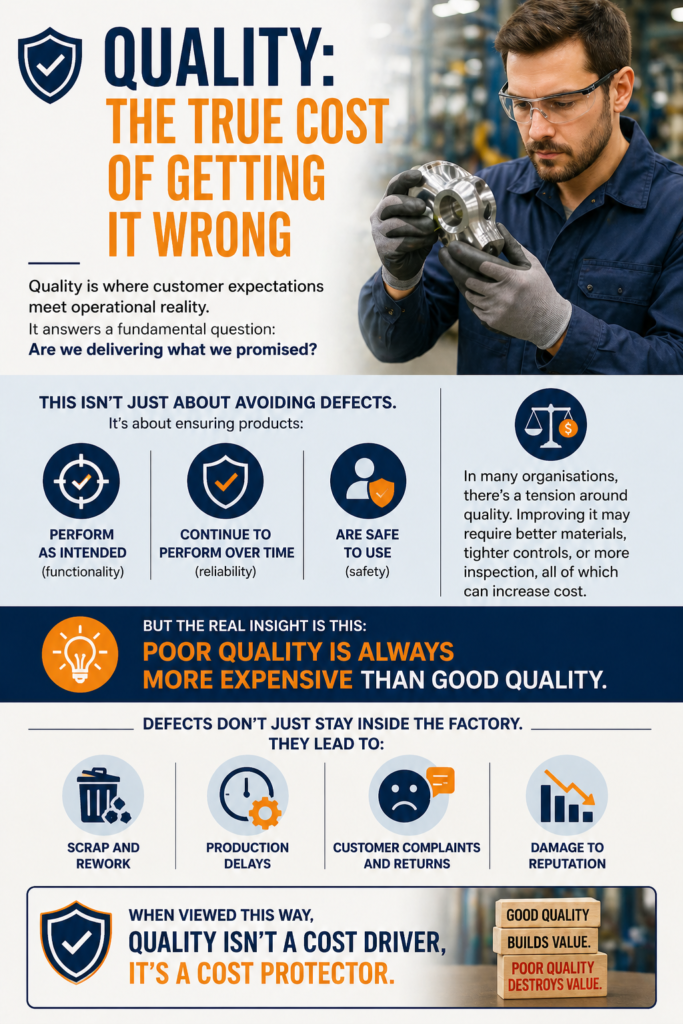
Quality is where customer expectations meet operational reality. It answers a fundamental question: Are we delivering what we promised?
This isn’t just about avoiding defects. It’s about ensuring products:
- Perform as intended (functionality)
- Continue to perform over time (reliability)
- Are safe to use (safety)
In many organisations, there’s a tension around quality. Improving it may require better materials, tighter controls, or more inspection, all of which can increase cost.
But the real insight is this:
Poor quality is always more expensive than good quality.
Defects don’t just stay inside the factory. They lead to: scrap and rework, production delays, customer complaints and returns, damage to reputation
When viewed this way, quality isn’t a cost driver, it’s a cost protector.
Cost: Looking Beyond the Obvious
Cost is often the most closely watched metric. But focusing only on direct costs, like materials and labor, can be misleading. A more complete view comes from understanding the Cost of Quality, which splits into two categories:
Cost of Conformance: These are the costs of doing things right:
- Training employees properly
- Maintaining equipment
- Designing robust processes
- Inspecting and testing products
Cost of Non-Conformance: These arise when things go wrong:
- Scrap and rework (internal failures)
- Returns, warranties, and complaints (external failures)
Here’s the trade-off: Spending more on prevention and control often reduces the much larger costs of failure. In other words, smart investment upstream saves money downstream.
Delivery: Keeping Promises in a Complex System
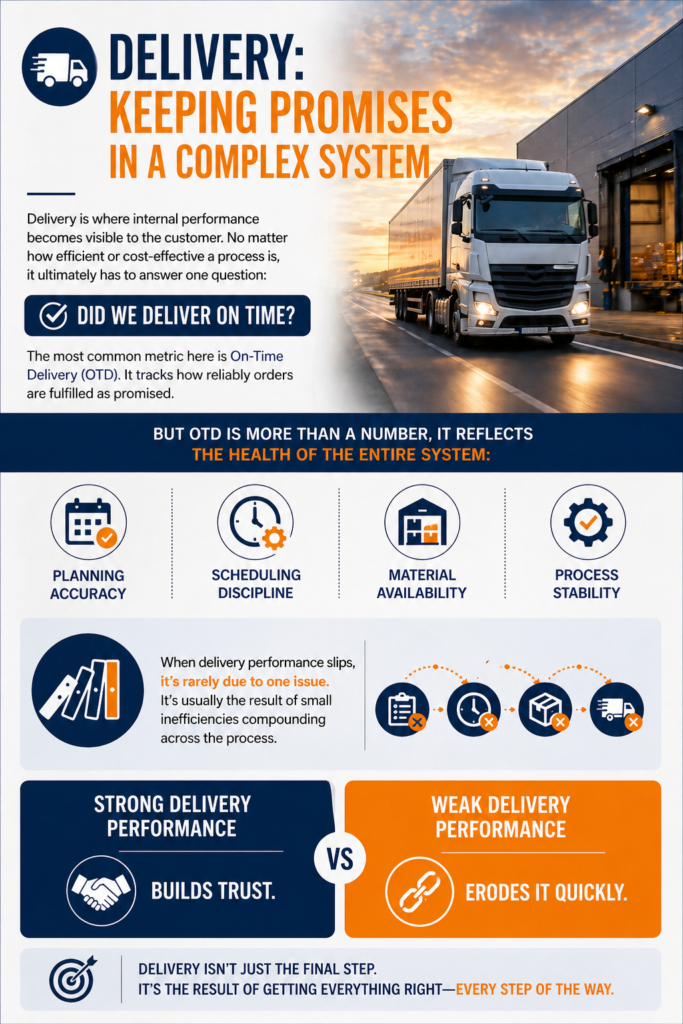
Delivery is where internal performance becomes visible to the customer. No matter how efficient or cost-effective a process is, it ultimately has to answer one question:
Did we deliver on time?
The most common metric here is On-Time Delivery (OTD). It tracks how reliably orders are fulfilled as promised.
But OTD is more than a number, it reflects the health of the entire system:
- Planning accuracy
- Scheduling discipline
- Material availability
- Process stability
When delivery performance slips, it’s rarely due to one issue. It’s usually the result of small inefficiencies compounding across the process.
Strong delivery performance builds trust. Weak delivery erodes it quickly.
People: The System Behind the System
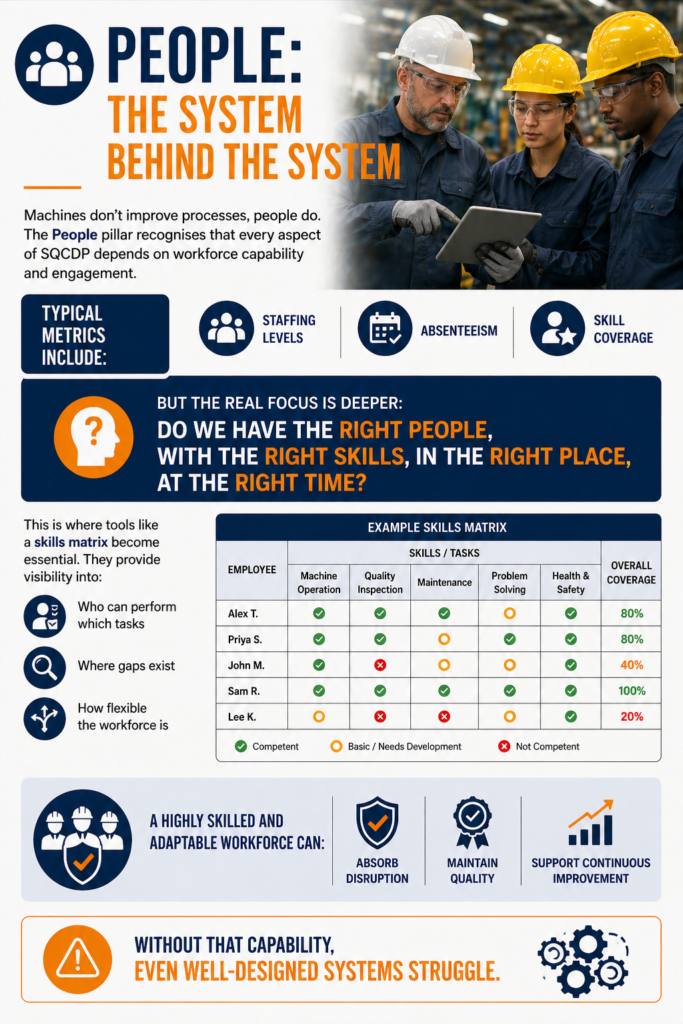
Machines don’t improve processes, people do. The People pillar recognises that every aspect of SQCDP depends on workforce capability and engagement.
Typical metrics include:
- Staffing levels
- Absenteeism
- Skill coverage
But the real focus is deeper: Do we have the right people, with the right skills, in the right place, at the right time?
This is where tools like a skills matrix become essential. They provide visibility into:
- Who can perform which tasks
- Where gaps exist
- How flexible the workforce is
A highly skilled and adaptable workforce can absorb disruption, maintain quality, and support continuous improvement.
Without that capability, even well-designed systems struggle.
The Balancing Act: Why SQCDP Matters
Perhaps the most important insight about SQCDP is this: The five elements are interconnected. You can’t optimise one in isolation without affecting the others.
- Pushing for faster delivery may increase safety risks
- Cutting costs aggressively may reduce quality
- Improving quality may initially increase cost
- Reducing staffing may impact delivery and morale
This is why SQCDP isn’t about perfection in one area, it’s about balance across all five.
High-performing organisations don’t chase single metrics. They understand trade-offs, monitor trends, and make informed decisions.
From Measurement to Improvement
Having KPIs and frameworks like SQCDP is only the starting point.
The real value comes from how they are used:
- Are teams reviewing them regularly?
- Are problems being discussed openly?
- Are actions being taken based on the data?
When SQCDP is embedded into daily management, through visual boards, team meetings, and continuous improvement, it becomes part of the culture.
And that’s when measurement turns into momentum.
Manufacturing is complex. There are countless moving parts, variables, and pressures. But clarity comes from measurement. SQCDP provides a structured way to see what’s working, what isn’t, and where to focus next. Because improvement doesn’t happen by chance. It happens when you measure what matters, and act on what you find.
Interested in our Industrial & Manufacturing Engineering Courses?
At iLearn Engineering®, we offer a diverse range of online accredited Industrial, Manufacturing and Mechanical Engineering courses and qualifications to cater to different academic and career goals. Our industrial courses are available in varying credit values and levels, ranging from 40 credit Engineering Diplomas to a Bachelor’s equivalent 360 credit International Graduate Diploma.
All Industrial / Manufacturing Engineering Courses
All Industrial / Manufacturing Engineering Diploma Courses can be seen here.
All Mechanical Engineering Diploma Courses can be seen here.
Short Courses for Industrial Engineering (40 Credits)
- Diploma in Manufacturing
- Diploma in Composites, Smart Materials & Nanotechnology
- Diploma in Lean Manufacturing
- Diploma in Mechanical Technology
- Diploma in Electrical Technology
- Diploma in Material Science
First Year of Undergraduate (Level 4 – 120 Credits)
Higher International Certificate in Industrial Engineering
Higher International Certificate in Mechanical Engineering
Years One and Two of Undergraduate (Level 5 – 240 Credits)
Higher International Diploma in Industrial Engineering
Higher International Diploma in Mechanical Engineering
Degree Equivalent International Graduate Diplomas in Engineering Management and Mechanical Engineering (Level 6 – 360 Credits)
International Graduate Diploma in Engineering Management (Level 6) [120 Credit Top Up]
International Graduate Diploma in Mechanical Engineering (Level 6) [120 Credit Top Up]
Complete Engineering Course Catalogue (all courses)
Alternatively, you can view all our online engineering courses here.
Get started today
Explore our range of Industrial and Manufacturing Engineering courses
Recent Posts
Types of Aircraft Drag Explained: Induced, Profile and Interference Drag
Types of Aircraft Drag Explained: Induced, Profile and Interference Drag An aircraft experiences several forms of aerodynamic drag at the same time. Some result from generating lift, some arise as air flows over the aircraft’s surfaces, and others are created when airflow around neighbouring components interacts. For a conventional aircraft in subsonic flight, total drag […]
Induced Drag Explained: Why Flying Slower Can Increase Drag
Induced Drag Explained: Why Flying Slower Can Increase Drag Why can an aircraft experience more drag when it flies more slowly? We usually associate greater speed with greater air resistance, but a wing must also generate enough lift to support the aircraft. Induced drag is the drag associated with producing lift on a finite-span wing. […]
Laminar vs Turbulent Boundary Layers: Why Airflow Separates from Aircraft Wings
Laminar vs Turbulent Boundary Layers: Why Airflow Separates from Aircraft Wings Airflow around an aircraft wing is often shown as smooth streamlines passing neatly over the aerofoil. In reality, the thin layer of air immediately next to the wing surface behaves very differently from the undisturbed airflow further away. This region is called the boundary […]