

Cycle Time vs Lead Time vs Takt Time: Key Differences Explained
Introduction
Step onto a production floor at the start of a busy day and everything appears to be in motion, machines running, operators moving with purpose, materials flowing from one station to the next. Orders are being processed, parts are being assembled, and shipments are being prepared.
But beneath all this activity lies a quieter, more powerful force that determines whether the system succeeds or struggles:
In manufacturing, time is not just a measure, it’s a constraint, a signal, and a guide. To truly understand how production performs, three key time-based metrics come into play:
- Cycle Time
- Lead Time
- Takt Time
Individually, they each tell part of the story. Together, they define how work flows through a system, and whether that flow is efficient, responsive, and sustainable.
Imagine production as a rhythm. Not just movement, but coordinated movement—where each step happens at the right pace, in the right sequence, for the right reason.
When that rhythm is off, problems appear:
- Bottlenecks slow everything down
- Inventory builds up unnecessarily
- Customers wait longer than expected
The three metrics, Cycle Time, Lead Time, and Takt Time, help you understand and control that rhythm.
Cycle Time: What You’re Capable Of
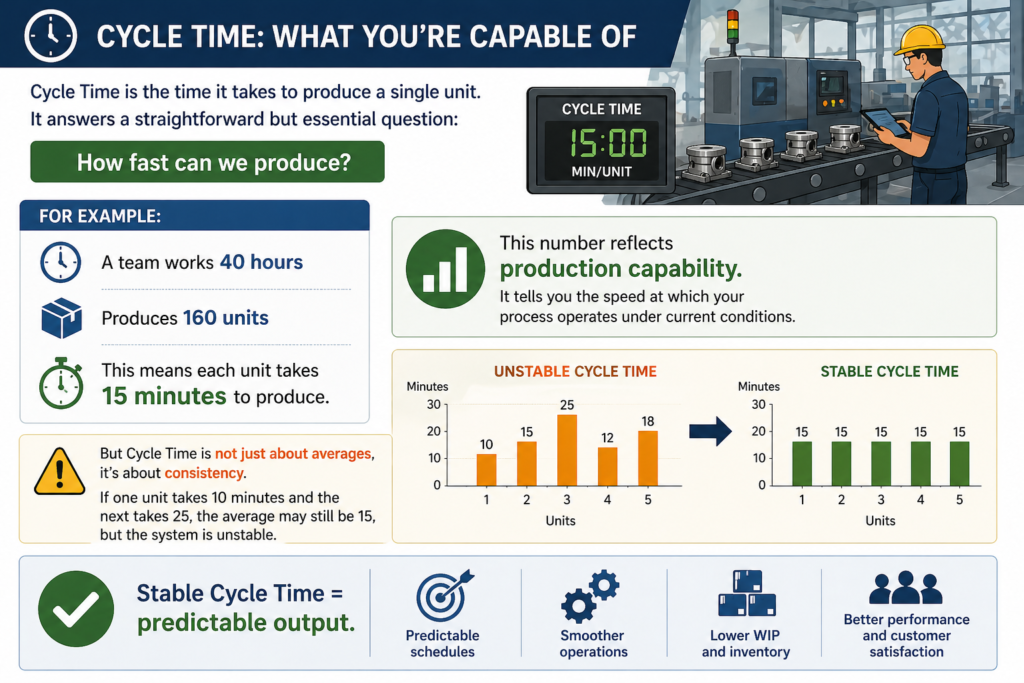
Cycle Time is the time it takes to produce a single unit. It answers a straightforward but essential question:
For example:
- A team works 40 hours
- Produces 160 units
This means each unit takes 15 minutes to produce. This number reflects production capability. It tells you the speed at which your process operates under current conditions.
But Cycle Time is not just about averages, it’s about consistency. If one unit takes 10 minutes and the next takes 25, the average may still be 15, but the system is unstable.
Stable Cycle Time = predictable output.
Process Time vs Cycle Time
It’s easy to confuse Cycle Time with another important concept: Process Time.
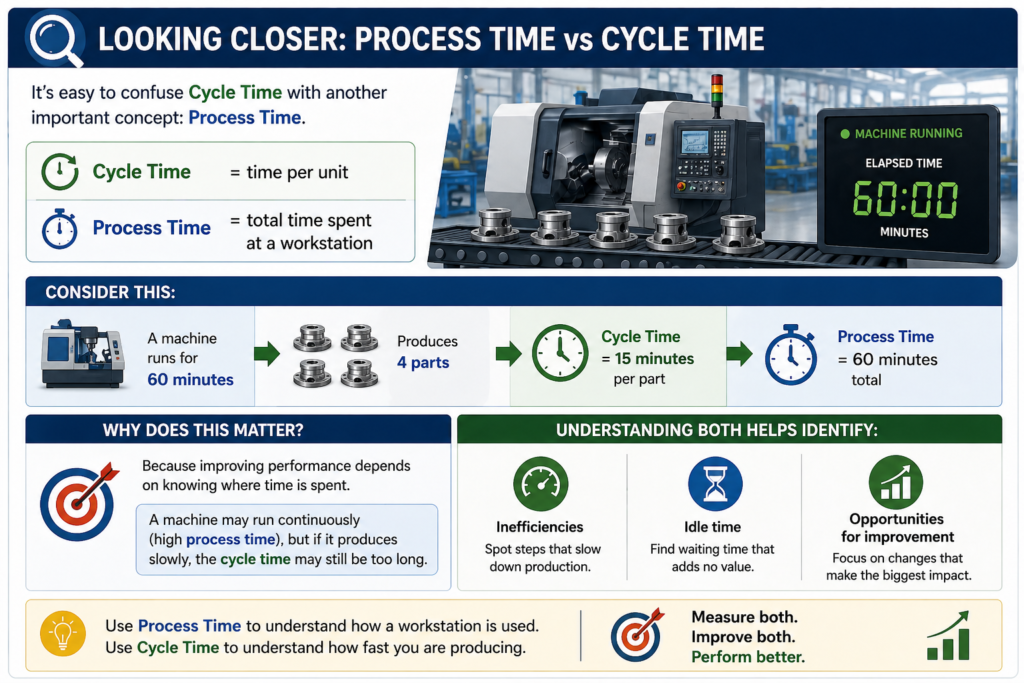
- Cycle Time = time per unit
- Process Time = total time spent at a workstation
Consider this:
- A machine runs for 60 minutes
- Produces 4 parts
- Cycle Time = 15 minutes per part
- Process Time = 60 minutes total
Why does this matter?
Because improving performance depends on knowing where time is spent. A machine may run continuously (high process time), but if it produces slowly, the cycle time may still be too long.
Understanding both helps identify:
- Inefficiencies
- Idle time
- Opportunities for improvement
Lead Time: What the Customer Feels
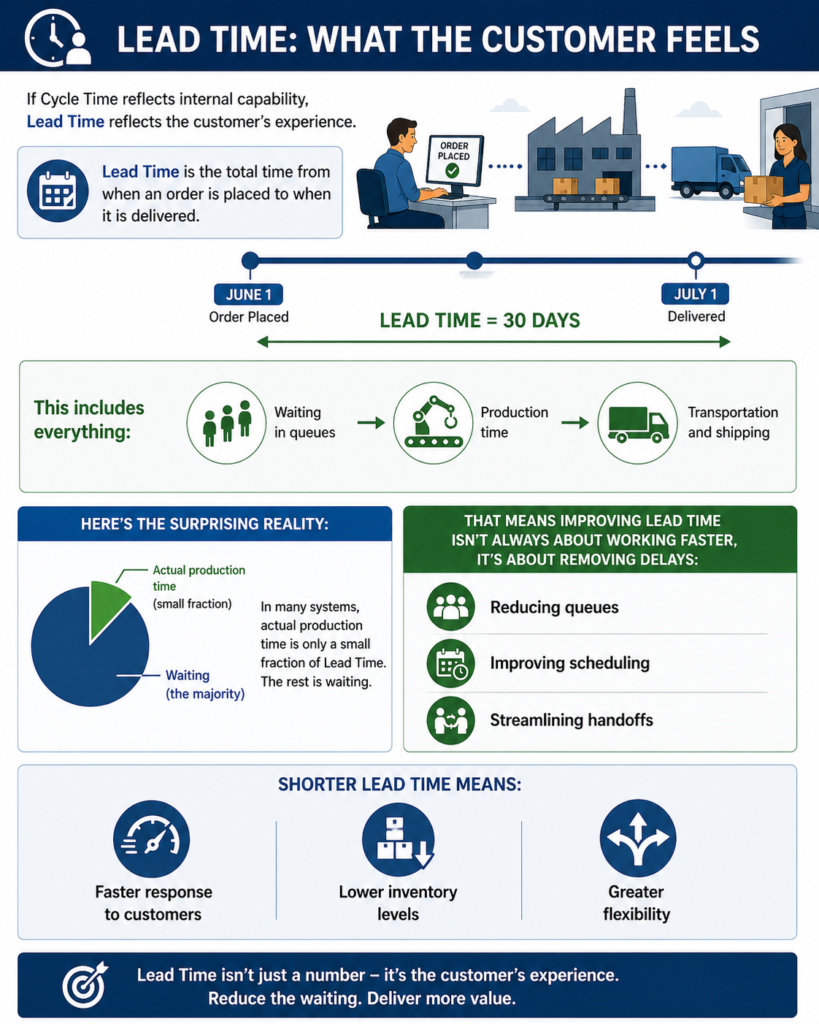
If Cycle Time reflects internal capability, Lead Time reflects the customer’s experience. Lead Time is the total time from when an order is placed to when it is delivered.
For example:
- Order placed: June 1
- Delivered: July 1
- Lead Time = 30 days
This includes everything: waiting in queues, production time, transportation and shipping
Here’s the surprising reality:
In many systems, actual production time is only a small fraction of Lead Time. The rest is waiting. That means improving Lead Time isn’t always about working faster, it’s about removing delays:
- Reducing queues
- Improving scheduling
- Streamlining handoffs
Shorter Lead Time means: faster response to customers, lower inventory levels, greater flexibility.
Takt Time: The Pace You Must Match
While Cycle Time tells you what you can do, Takt Time tells you what you need to do.
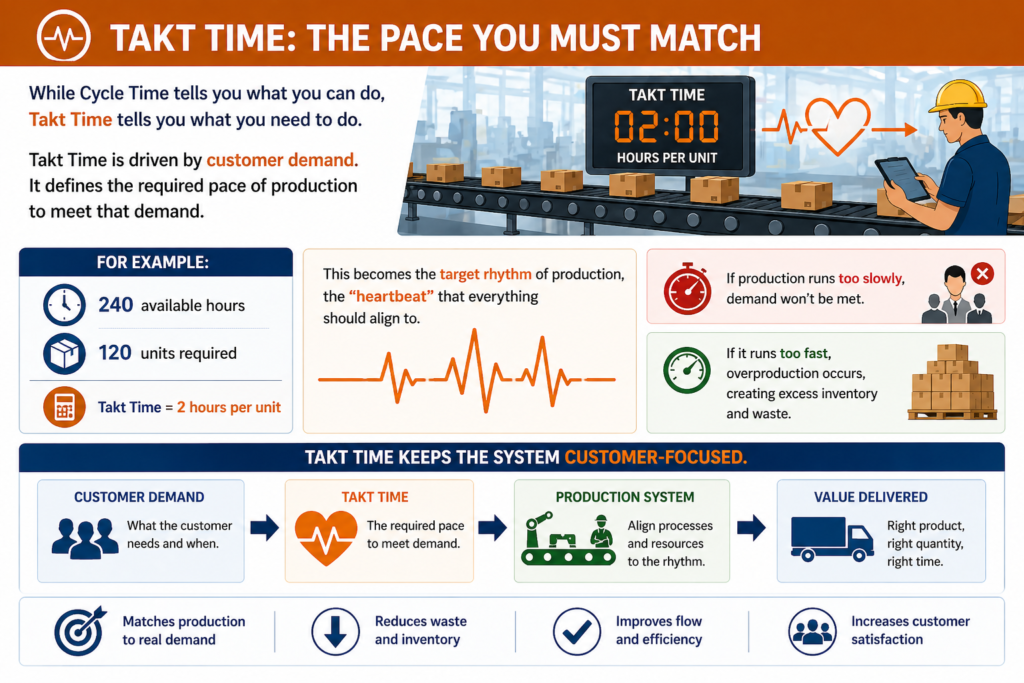
Takt Time is driven by customer demand. It defines the required pace of production to meet that demand.
For example:
- 240 available hours
- 120 units required
Takt Time = 2 hours per unit
This becomes the target rhythm of production, the “heartbeat” that everything should align to.
If production runs too slowly, demand won’t be met.
If it runs too fast, overproduction occurs,creating excess inventory and waste.
Takt Time keeps the system customer-focused.
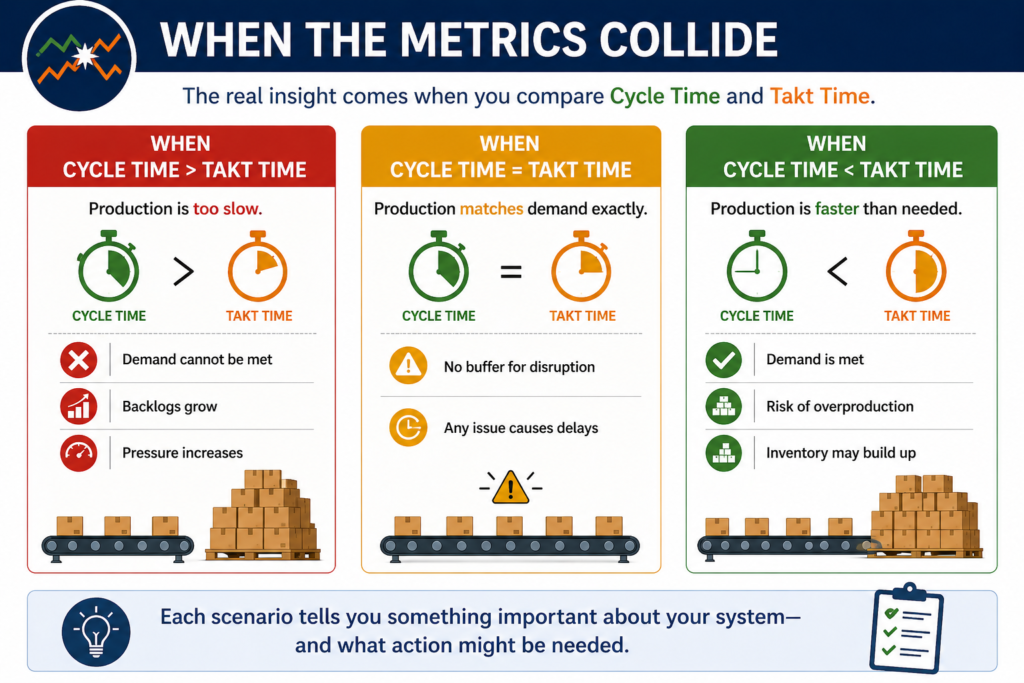
When the Metrics Collide
The real insight comes when you compare Cycle Time and Takt Time.
When Cycle Time > Takt Time
Production is too slow.
- Demand cannot be met
- Backlogs grow
- Pressure increases
When Cycle Time = Takt Time
Production matches demand exactly.
- No buffer for disruption
- Any issue causes delays
When Cycle Time < Takt Time
Production is faster than needed.
- Demand is met
- Risk of overproduction
- Inventory may build up
Each scenario tells you something important about your system, and what action might be needed.
These three metrics are most powerful when used together:
- Cycle Time → What you can produce
- Takt Time → What you need to produce
- Lead Time → What the customer experiences
Think of them as three perspectives:
- Internal capability
- External demand
- End-to-end flow
When they are aligned, production becomes:
- Predictable
- Efficient
- Responsive
When they are not aligned, inefficiencies emerge quickly.
The Real Goal: Flow, Not Just Speed
It’s tempting to focus on producing faster. But speed alone doesn’t create efficiency,flow does.
Good flow means:
- Work moves smoothly between steps
- Bottlenecks are minimized
- Waiting time is reduced
- Output matches demand
Achieving this requires balancing all three metrics, not optimizing one in isolation.
Understanding Cycle Time, Lead Time, and Takt Time is more than a technical exercise, it’s a shift in perspective.
It allows manufacturers to:
- See where time is lost
- Align production with demand
- Reduce waste and inefficiency
- Deliver more reliably to customers
And perhaps most importantly, it brings clarity, because once you understand how time flows through your system, you gain the ability to shape it. That’s where real improvement begins, and ultimately, build more resilient production systems.
Interested in our Industrial & Manufacturing Engineering Courses?
At iLearn Engineering®, we offer a diverse range of online accredited Industrial, Manufacturing and Mechanical Engineering courses and qualifications to cater to different academic and career goals. Our industrial courses are available in varying credit values and levels, ranging from 40 credit Engineering Diplomas to a Bachelor’s equivalent 360 credit International Graduate Diploma.
All Industrial / Manufacturing Engineering Courses
All Industrial / Manufacturing Engineering Diploma Courses can be seen here.
All Mechanical Engineering Diploma Courses can be seen here.
Short Courses for Industrial Engineering (40 Credits)
- Diploma in Manufacturing
- Diploma in Composites, Smart Materials & Nanotechnology
- Diploma in Lean Manufacturing
- Diploma in Mechanical Technology
- Diploma in Electrical Technology
- Diploma in Material Science
First Year of Undergraduate (Level 4 – 120 Credits)
Higher International Certificate in Industrial Engineering
Higher International Certificate in Mechanical Engineering
Years One and Two of Undergraduate (Level 5 – 240 Credits)
Higher International Diploma in Industrial Engineering
Higher International Diploma in Mechanical Engineering
Degree Equivalent International Graduate Diplomas in Engineering Management and Mechanical Engineering (Level 6 – 360 Credits)
International Graduate Diploma in Engineering Management (Level 6) [120 Credit Top Up]
International Graduate Diploma in Mechanical Engineering (Level 6) [120 Credit Top Up]
Complete Engineering Course Catalogue (all courses)
Alternatively, you can view all our online engineering courses here.
Recent Posts
Types of Aircraft Drag Explained: Induced, Profile and Interference Drag
Types of Aircraft Drag Explained: Induced, Profile and Interference Drag An aircraft experiences several forms of aerodynamic drag at the same time. Some result from generating lift, some arise as air flows over the aircraft’s surfaces, and others are created when airflow around neighbouring components interacts. For a conventional aircraft in subsonic flight, total drag […]
Induced Drag Explained: Why Flying Slower Can Increase Drag
Induced Drag Explained: Why Flying Slower Can Increase Drag Why can an aircraft experience more drag when it flies more slowly? We usually associate greater speed with greater air resistance, but a wing must also generate enough lift to support the aircraft. Induced drag is the drag associated with producing lift on a finite-span wing. […]
Laminar vs Turbulent Boundary Layers: Why Airflow Separates from Aircraft Wings
Laminar vs Turbulent Boundary Layers: Why Airflow Separates from Aircraft Wings Airflow around an aircraft wing is often shown as smooth streamlines passing neatly over the aerofoil. In reality, the thin layer of air immediately next to the wing surface behaves very differently from the undisturbed airflow further away. This region is called the boundary […]