

Why Lean Manufacturing Matters: Standardization.
Introduction
In today’s production environment, the term “lean manufacturing” is widely used. However, have you ever stopped to consider what it truly means within a production system?
Lean manufacturing is far more than just a collection of tools or techniques, it is a comprehensive philosophy focused on maximizing value while minimizing waste.
The Origins of Lean Manufacturing
The concept of lean manufacturing dates back to the period following World War II. During this time, a small Japanese automobile manufacturer sought ways to compete with larger and more established U.S. car manufacturers.
Leaders such as the Toyoda family and Taiichi Ohno studied Henry Ford’s assembly line and identified opportunities for improvement. Their goal was to create a more efficient and flexible production system.
This led to the development of several key practices, including:
- Just-In-Time (JIT) production to reduce inventory
- Kaizen (continuous improvement) at the shop floor level
- Kanban systems to manage production flow and scheduling
- Reduction of waste, errors, and production lead times
These innovations formed the foundation of the Toyota Production System (TPS) the origin of what we now call lean manufacturing.
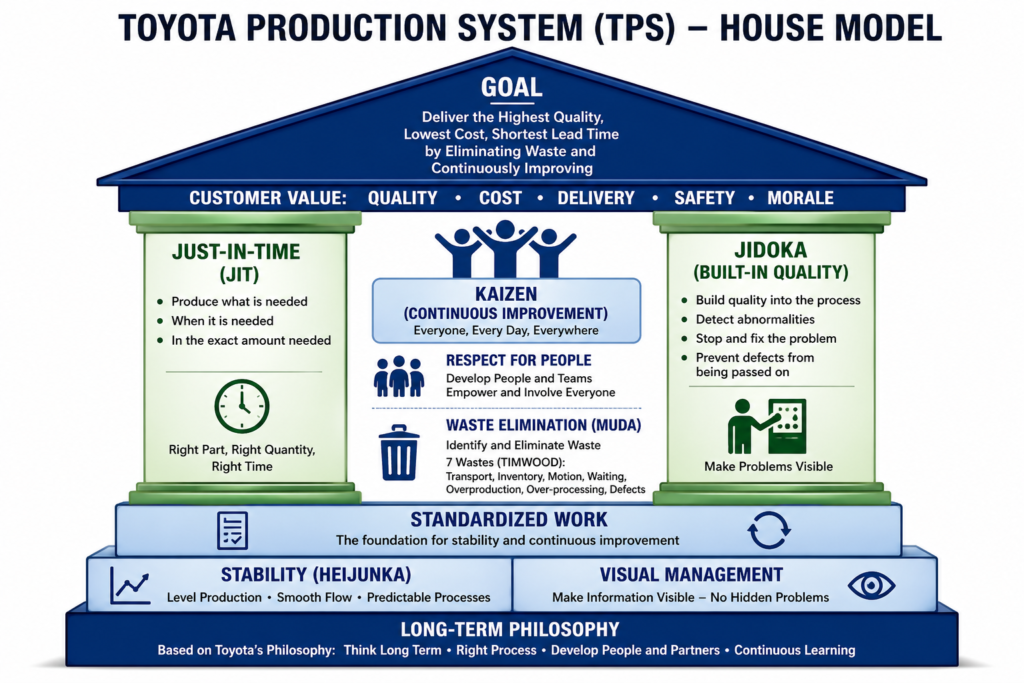
It is important to understand that lean manufacturing is not just about applying tools like Kanban or Kaizen. While these are important, they represent only part of the bigger picture.
Lean is a holistic philosophy that extends across the entire organization, including:
- Company vision, mission, and values
- Leadership and decision-making processes
- Shop floor operations and daily activities
- Supply chain and even product returns and disposal
In essence, lean thinking influences how an organization operates at every level.
Preparing for the Lean Journey
Implementing lean manufacturing is not something that happens overnight. It requires careful preparation and a strong organizational foundation.
Before introducing lean practices, companies must:
- Standardize processes to ensure consistency
- Eliminate obvious sources of waste
- Maintain order and cleanliness (often supported by 5S principles)
- Establish clear and efficient operational workflows
This preparation phase is critical for creating an environment where lean principles can thrive.ç
In this blog we are going to focus on standardisation
Standardisation.
The first and most fundamental step in lean manufacturing is standardisation. According to the Cambridge Dictionary, standardisation is “the process of making things of the same type all have the same basic features.” In a lean context, this goes beyond simple uniformity, it is about creating consistent, repeatable, and efficient ways of working that form the foundation for continuous improvement.
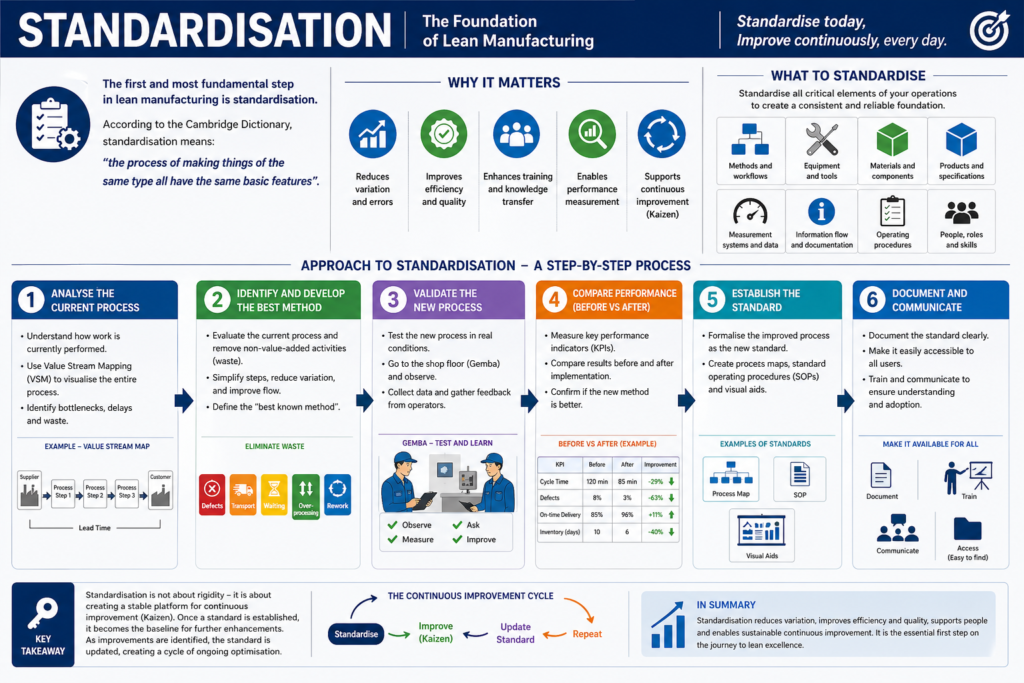
Standardisation ensures that best practices are clearly defined, documented, and followed across the organisation. Without it, variability increases, making it difficult to identify waste, measure performance, or sustain improvements. In essence, you cannot improve a process that is not stable or consistently performed.
To effectively implement standardisation, organisations should ensure that all critical elements are aligned and consistent. These include:
- Methods and workflows
- Equipment and tools
- Materials and components
- Products and specifications
- Measurement systems and data collection
- Information flow and documentation
- Operating procedures and work instructions
By standardising these elements, organisations create a reliable baseline from which lean improvements can be introduced and sustained.
Approaches to Standardisation
There are multiple methods to achieve standardisation, and the most appropriate approach depends on the organisation’s context, complexity, and objectives. However, a structured approach typically includes the following steps:
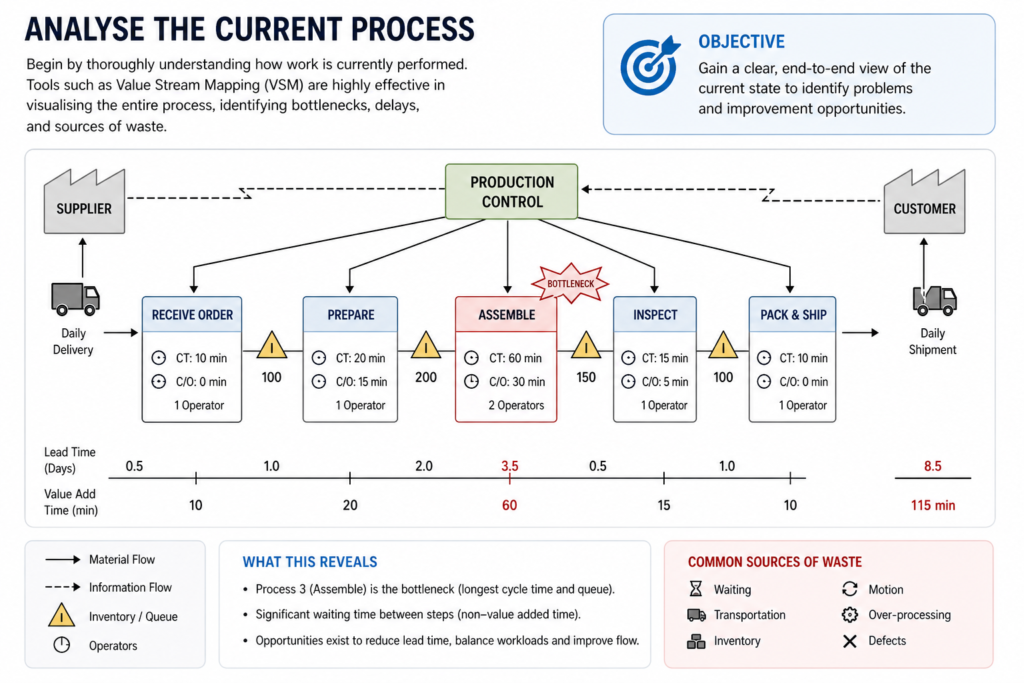
Analyse the Current Process
Begin by thoroughly understanding how work is currently performed. Tools such as Value Stream Mapping (VSM) are highly effective in visualising the entire process, identifying bottlenecks, delays, and sources of waste.
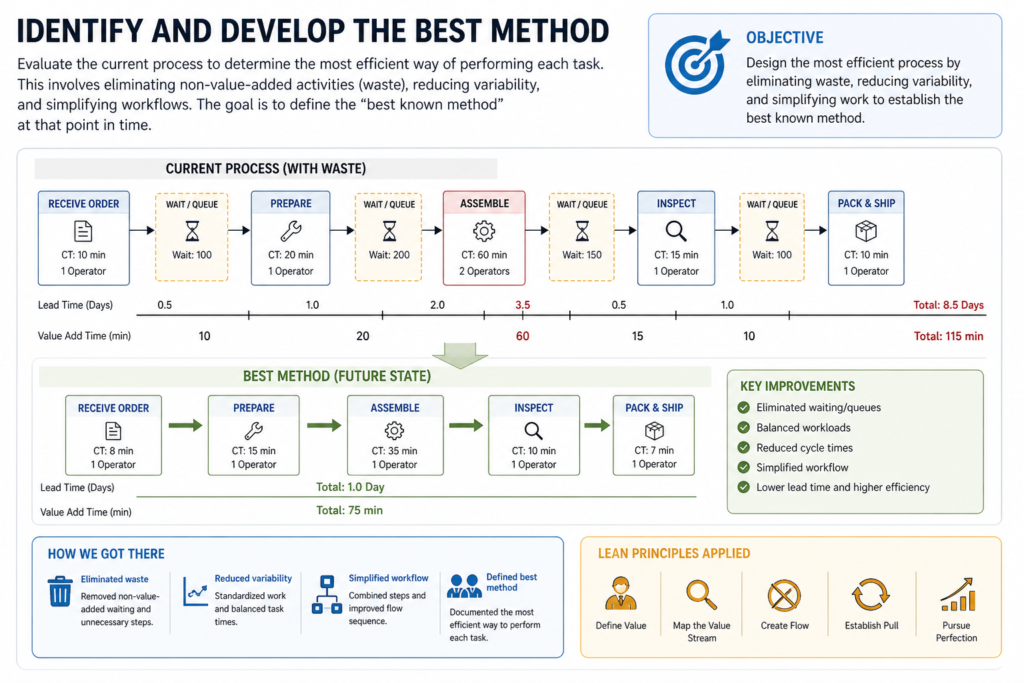
Identify and Develop the Best Method
Evaluate the current process to determine the most efficient way of performing each task. This involves eliminating non-value-added activities (waste), reducing variability, and simplifying workflows. The goal is to define the “best known method” at that point in time.
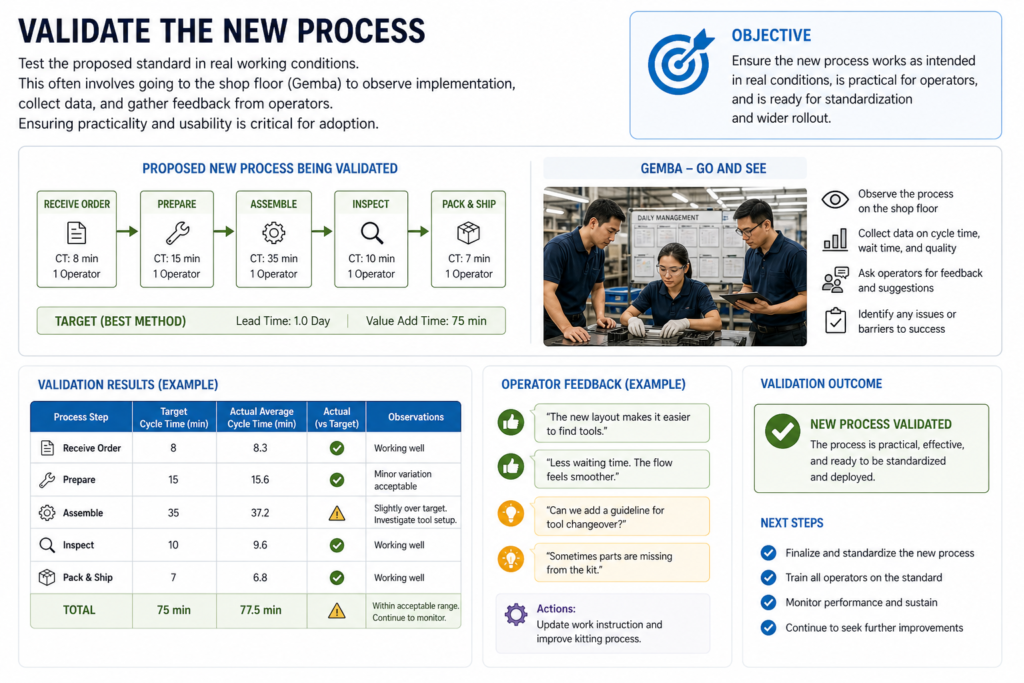
Validate the New Process
Test the proposed standard in real working conditions. This often involves going to the shop floor (Gemba) to observe implementation, collect data, and gather feedback from operators. Ensuring practicality and usability is critical for adoption.
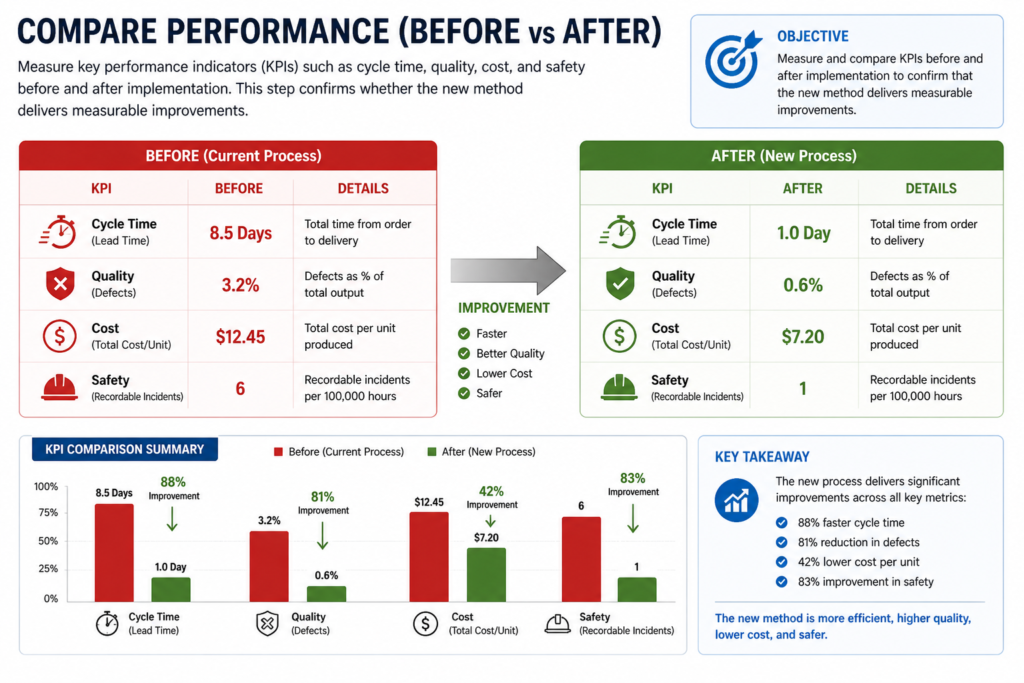
Compare Performance (Before vs After)
Measure key performance indicators (KPIs) such as cycle time, quality, cost, and safety before and after implementation. This step confirms whether the new method delivers measurable improvements.
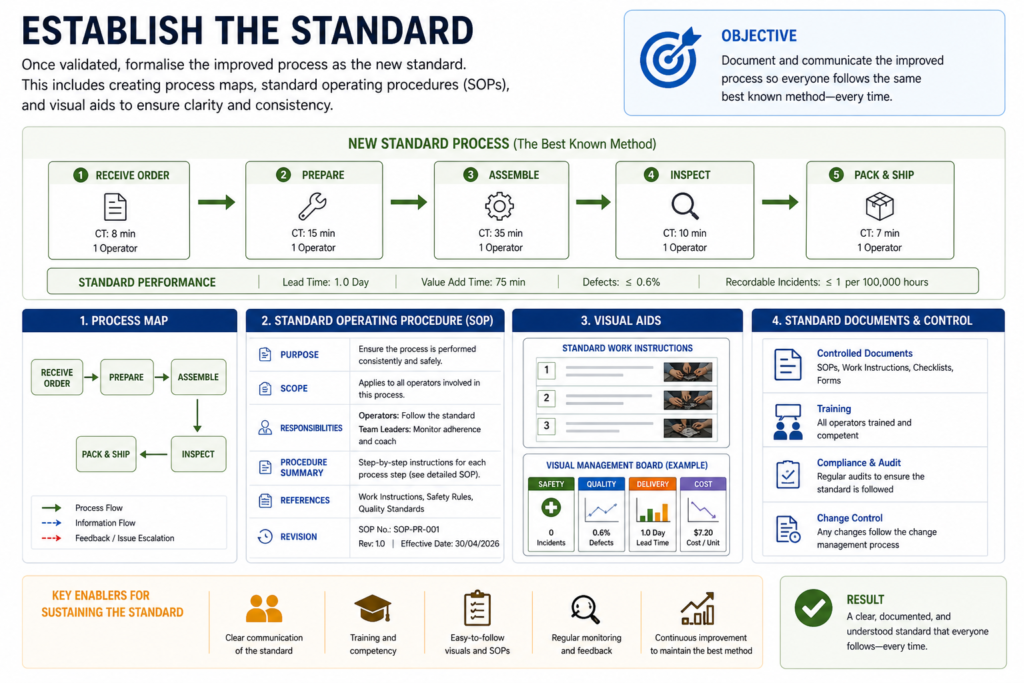
Establish the Standard
Once validated, formalise the improved process as the new standard. This includes creating process maps, standard operating procedures (SOPs), and visual aids to ensure clarity and consistency.
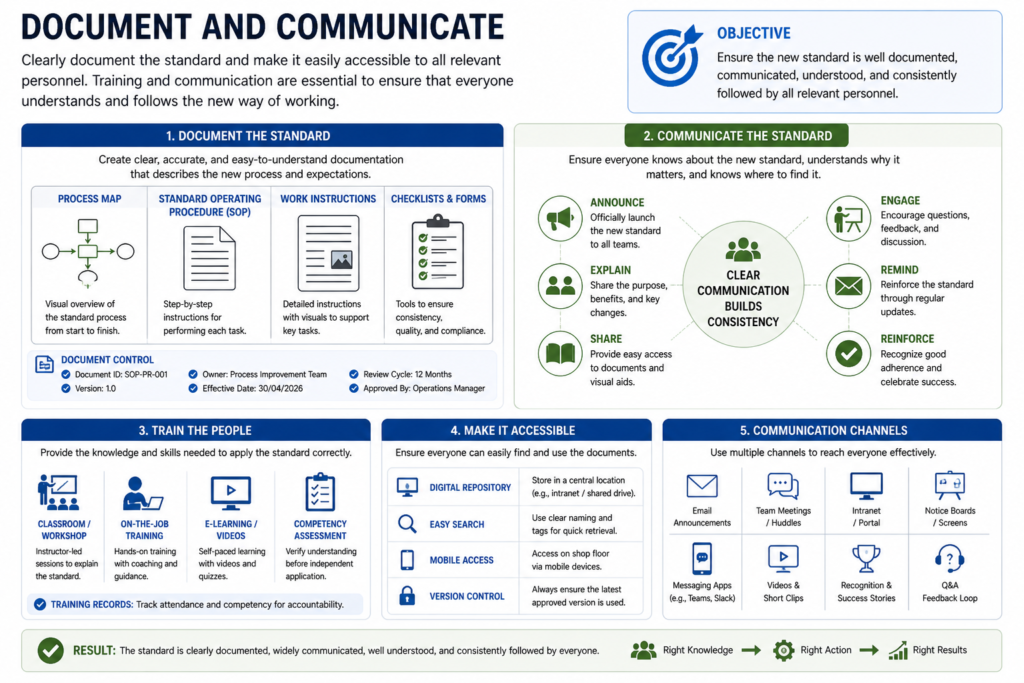
Document and Communicate
Clearly document the standard and make it easily accessible to all relevant personnel. Training and communication are essential to ensure that everyone understands and follows the new way of working.
Why Standardisation Matters in Lean
Standardisation is not about rigidity, it is about creating a stable platform for continuous improvement (Kaizen). Once a standard is established, it becomes the baseline for further enhancements. As improvements are identified, the standard is updated, creating a cycle of ongoing optimisation.
In summary, standardisation:
- Reduces variation and errors
- Improves efficiency and quality
- Enhances training and knowledge transfer
- Enables performance measurement
- Supports continuous improvement initiatives
Without standardisation, lean manufacturing efforts are unlikely to succeed or be sustained over time.
Interested in our Industrial & Manufacturing Engineering Courses?
At iLearn Engineering®, we offer a diverse range of online accredited Industrial, Manufacturing and Mechanical Engineering courses and qualifications to cater to different academic and career goals. Our industrial courses are available in varying credit values and levels, ranging from 40 credit Engineering Diplomas to a Bachelor’s equivalent 360 credit International Graduate Diploma.
All Industrial / Manufacturing Engineering Courses
All Industrial / Manufacturing Engineering Diploma Courses can be seen here.
All Mechanical Engineering Diploma Courses can be seen here.
Short Courses for Industrial Engineering (40 Credits)
- Diploma in Manufacturing
- Diploma in Composites, Smart Materials & Nanotechnology
- Diploma in Lean Manufacturing
- Diploma in Mechanical Technology
- Diploma in Electrical Technology
- Diploma in Material Science
First Year of Undergraduate (Level 4 – 120 Credits)
Higher International Certificate in Industrial Engineering
Higher International Certificate in Mechanical Engineering
Years One and Two of Undergraduate (Level 5 – 240 Credits)
Higher International Diploma in Industrial Engineering
Higher International Diploma in Mechanical Engineering
Degree Equivalent International Graduate Diplomas in Engineering Management and Mechanical Engineering (Level 6 – 360 Credits)
International Graduate Diploma in Engineering Management (Level 6) [120 Credit Top Up]
International Graduate Diploma in Mechanical Engineering (Level 6) [120 Credit Top Up]
Complete Engineering Course Catalogue (all courses)
Alternatively, you can view all our online engineering courses here.
Get started today
Explore our range of Industrial and Manufacturing Engineering courses
Recent Posts
Types of Aircraft Drag Explained: Induced, Profile and Interference Drag
Types of Aircraft Drag Explained: Induced, Profile and Interference Drag An aircraft experiences several forms of aerodynamic drag at the same time. Some result from generating lift, some arise as air flows over the aircraft’s surfaces, and others are created when airflow around neighbouring components interacts. For a conventional aircraft in subsonic flight, total drag […]
Induced Drag Explained: Why Flying Slower Can Increase Drag
Induced Drag Explained: Why Flying Slower Can Increase Drag Why can an aircraft experience more drag when it flies more slowly? We usually associate greater speed with greater air resistance, but a wing must also generate enough lift to support the aircraft. Induced drag is the drag associated with producing lift on a finite-span wing. […]
Laminar vs Turbulent Boundary Layers: Why Airflow Separates from Aircraft Wings
Laminar vs Turbulent Boundary Layers: Why Airflow Separates from Aircraft Wings Airflow around an aircraft wing is often shown as smooth streamlines passing neatly over the aerofoil. In reality, the thin layer of air immediately next to the wing surface behaves very differently from the undisturbed airflow further away. This region is called the boundary […]