

5S and Lean Manufacturing: Building Efficiency from the Ground Up
Introduction
Lean manufacturing is built on the principle of eliminating waste while maximizing productivity, quality, and efficiency. However, before any lean strategy can deliver lasting results, organizations need a strong operational foundation, and that foundation begins with 5S.
The 5S methodology is more than just workplace housekeeping. It is a structured system that helps businesses create organized, clean, safe, and standardized work environments where continuous improvement can thrive. By focusing on Sort, Set in Order, Shine, Standardize, and Sustain, companies can improve workflow, reduce downtime, increase employee engagement, and make problems easier to identify and solve.
Many organizations rush into advanced lean tools without first establishing workplace discipline and stability. Without proper organization and standardization, lean initiatives often struggle to succeed. Implementing 5S first creates the culture, consistency, and visual management needed to support long-term lean manufacturing success.
In this blog, we’ll explore why 5S is considered one of the most essential tools in lean manufacturing, how it supports operational excellence, and why every lean transformation should start with building efficiency from the ground up.
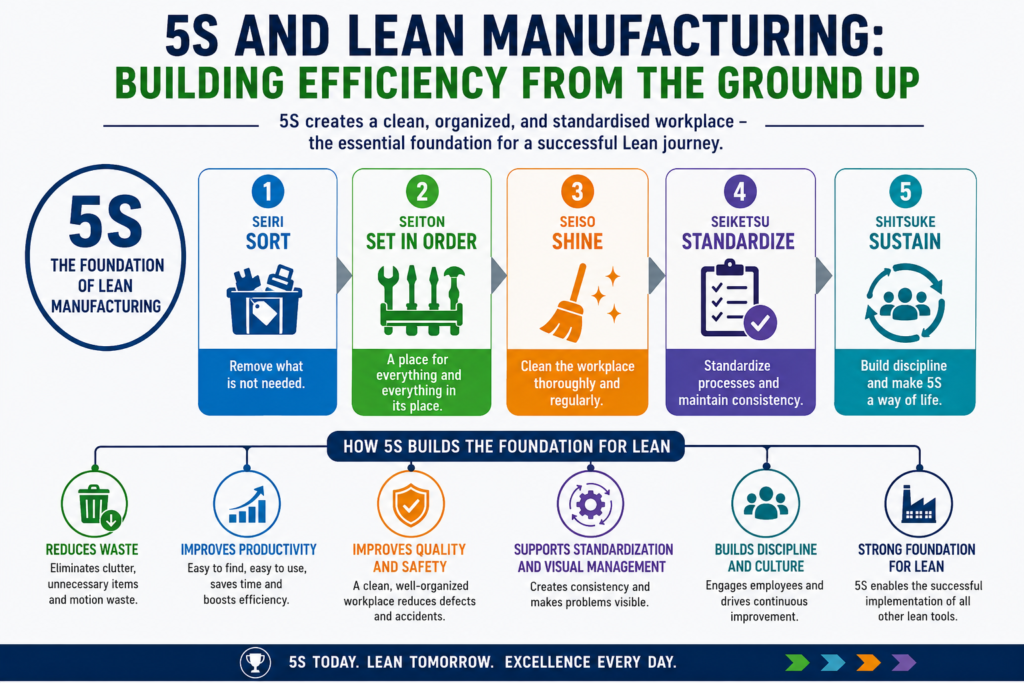
That is why it is very important to maintain an organised and clean workplace .
5S implementation will lead to benefits such as:
- Higher productivity and employee satisfaction
- High quality
- Safer work environment
- Costs reduction
The 5s are based on 5 Japanese words: Seiri, Seiton, Seiso, Seiketsu y Shitsuke.
Seiri: Sort.
Separate and sort items into clear categories, then organize them into logical groups based on their purpose or frequency of use. During this process, identify which items are essential for daily operations and which are unnecessary, outdated, or rarely used. Removing unneeded items helps reduce clutter, improve efficiency, and create a more organized workspace.
Grouping similar items together also makes tools and materials easier to locate, reduces wasted time searching, and supports smoother workflow processes. Items that are used for the same tasks or belong to the same function should always be stored together in designated areas.
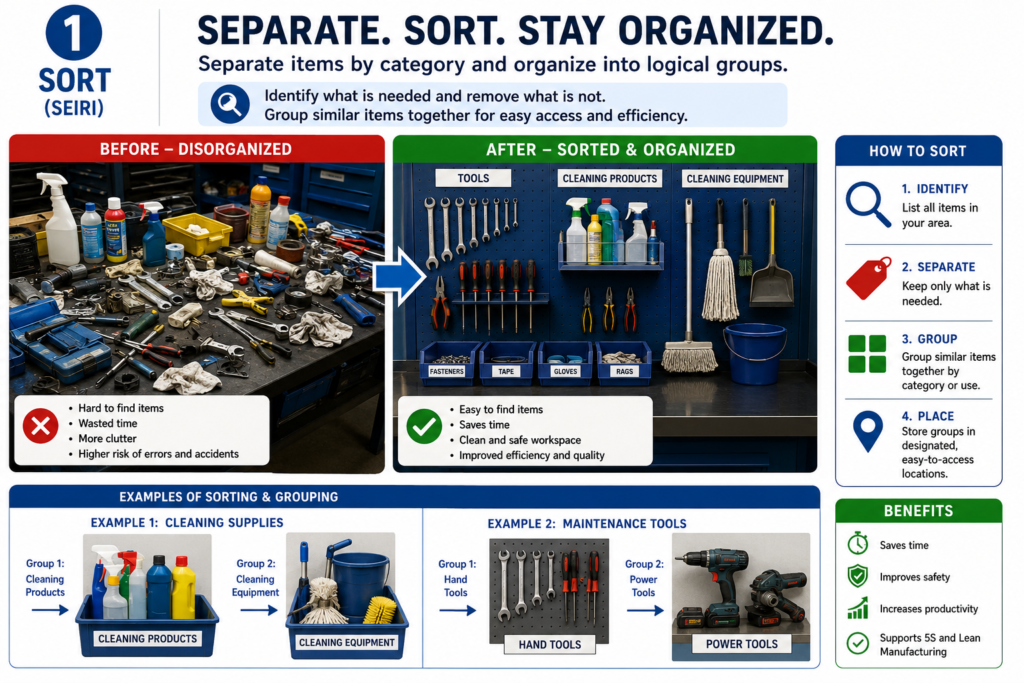
For example, all cleaning products such as sprays, disinfectants, and detergents can be stored in one clearly labelled location, while cleaning equipment like mops, brushes, buckets, and vacuum cleaners can be grouped together in another dedicated area. In a manufacturing environment, hand tools used for machine maintenance can be organized on shadow boards, while production materials for specific assembly tasks can be stored together near the workstation where they are used.
By organizing items in logical clusters, employees can quickly find what they need, improve productivity, maintain cleaner workspaces, and reduce unnecessary movement or downtime. This simple but effective step forms a key part of the 5S methodology and helps build a strong foundation for lean manufacturing and continuous improvement.
Seiton: Set in order.
All groups of items should be clearly and easily identified to ensure quick access, efficient storage, and consistent workplace organization. Using visual management techniques such as different colours, labels, drawers, racks, shadow boards, floor markings, and storage stands helps employees instantly recognize where items belong and where they should be returned after use.
Each category or group of items should have its own designated storage area with a clear visual identity. Colours can be assigned to different departments, tool categories, or work processes, while labels and signs make it easier to identify contents without wasting time searching. Drawers, bins, shelves, and stands should also be clearly marked to support standardization and reduce confusion in the workplace.
Inside racks or storage areas, visual cues such as silhouettes, outlines, photographs, labels, or colour-coded spaces should be used to show the exact location for every individual item. This approach makes missing items immediately visible and encourages employees to return tools and equipment to their correct place after use. A well-organized storage system improves workflow, reduces wasted motion, increases productivity, and supports safer working conditions.
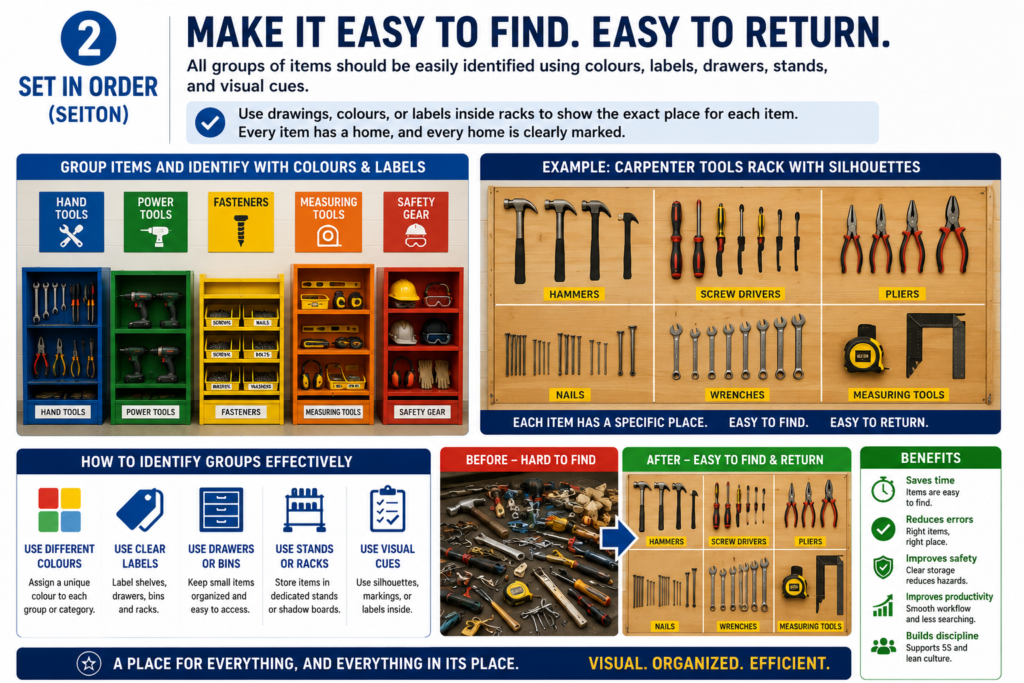
For example, carpenter tools can be stored on a dedicated shadow board where each tool has its own outlined silhouette. Hammers, screwdrivers, pliers, measuring tapes, and spanners are each assigned a specific marked position, making it easy to identify where every item belongs. Nails, screws, and smaller components can be stored in labelled drawers or colour-coded bins to prevent mixing and reduce time spent searching for materials.
Similarly, in a manufacturing or maintenance workshop, power tools may be stored in one colour-coded rack, hand tools in another, and safety equipment in a separate labelled area. Cleaning products and cleaning equipment can also be separated into dedicated zones with clear signage and floor markings. This level of visual organization creates a cleaner, safer, and more efficient workplace where employees can quickly find, use, and return items with minimal effort.
By making storage locations visually clear and standardized, organizations can reduce clutter, improve accountability, prevent lost tools, minimize downtime, and strengthen the foundation for successful 5S and lean manufacturing implementation.
Seiso: Cleaning (Shine).
Seiso, also known as Shine, focuses on thoroughly cleaning the workplace and maintaining a safe, organized, and efficient working environment. This step goes beyond simple housekeeping, it involves cleaning work areas, tools, machines, equipment, and storage locations while also inspecting them to identify abnormalities, wear, damage, or potential problems before they lead to breakdowns or safety risks.
The goal of Seiso is to create a workplace where everything is clean, functional, and ready for use at all times. Dirt, dust, oil leaks, waste materials, and unnecessary clutter should be removed regularly to maintain high standards of cleanliness and operational efficiency. A clean workplace not only improves appearance but also helps increase productivity, reduce accidents, extend equipment life, and improve overall product quality.
During the cleaning process, employees should inspect tools and equipment carefully to ensure they remain in good working condition. Regular inspection and preventive maintenance help identify issues such as loose components, leaks, cracks, overheating, worn parts, or abnormal machine behaviour before they become costly failures. Items should be maintained and conserved throughout their operational life cycle and replaced when they are no longer safe, reliable, or effective.
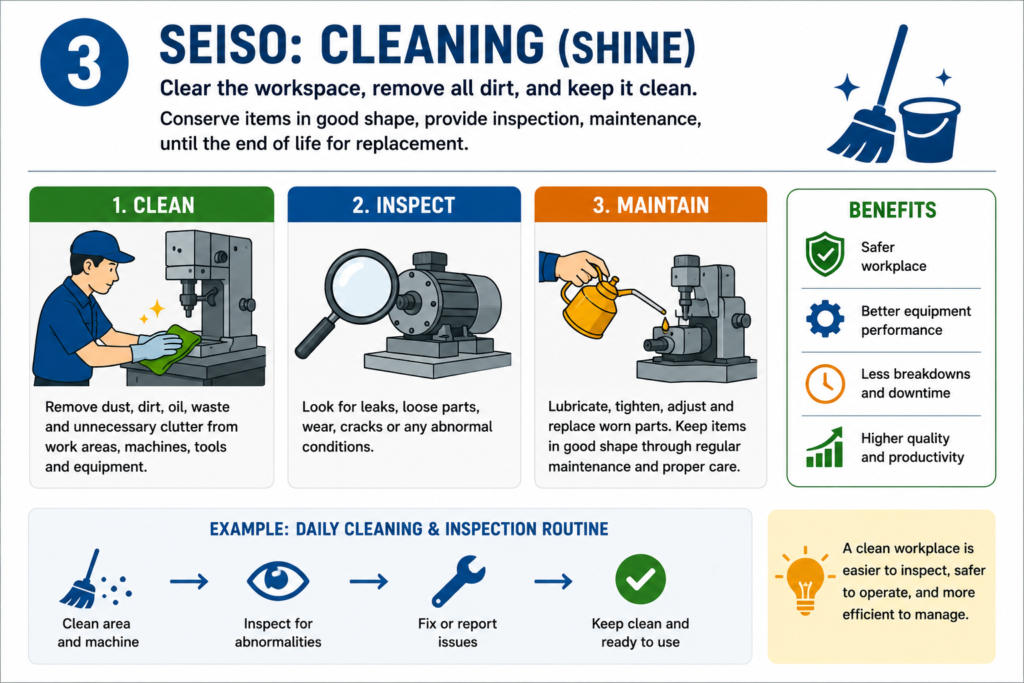
For example, in a manufacturing environment, machine operators may clean production equipment daily by removing dust, metal shavings, grease, and debris from machines and surrounding workstations. While cleaning, they may notice oil leaks, loose bolts, worn belts, or damaged components that require maintenance attention. By identifying these issues early, the company can prevent unexpected downtime, improve machine reliability, and reduce repair costs.
Similarly, in a warehouse or workshop, cleaning schedules can be established to ensure floors remain free from spills, tools are properly cleaned after use, and storage areas stay organized and hazard-free. Cleaning supplies, waste bins, and maintenance tools should also be clearly identified and easily accessible to support regular cleaning activities.
Seiso also helps build employee ownership and responsibility by encouraging everyone to take pride in maintaining their work environment. When cleanliness becomes part of the daily routine, organizations create a culture of discipline, safety, and continuous improvement that supports long-term lean manufacturing success.
A clean workplace is easier to inspect, safer to operate, and more efficient to manage. Through Seiso, businesses can improve equipment performance, extend asset life, reduce waste, and create a stronger foundation for operational excellence and continuous improvement.
Seiketsu: Standardize
Seiketsu, also known as Standardize, focuses on creating consistent procedures and routines that ensure the first three stages of 5S, Sort, Set in Order, and Shine, are maintained continuously. The purpose of this step is to establish clear standards so that workplace organization, cleanliness, and efficiency become part of everyday operations rather than one-time improvement activities.
To successfully standardize 5S, organizations should create clear procedures, responsibilities, schedules, and visual systems that help employees follow the same process consistently. Standardization reduces variation, improves accountability, and ensures that everyone understands how tasks should be performed and maintained across the workplace.
This can include setting up daily cleaning routines, inspection schedules, maintenance activities, visual checklists, audit forms, standard operating procedures (SOPs), colour-coded systems, and designated responsibilities for each work area. By creating repeatable routines, businesses can maintain workplace standards over time and prevent areas from returning to disorder or inefficiency.
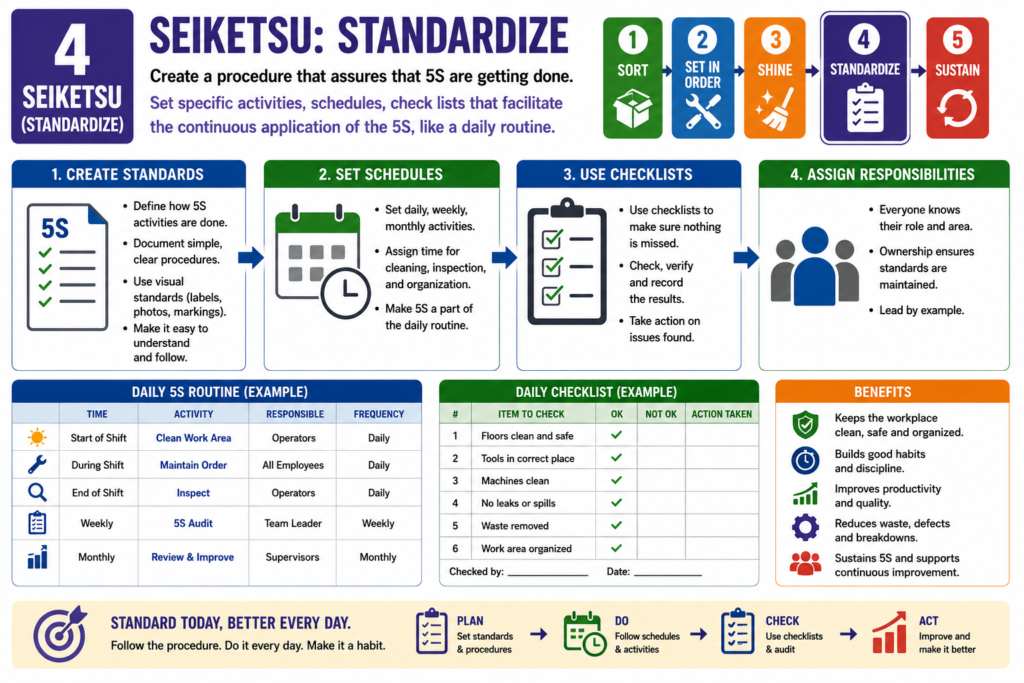
For example, a manufacturing company may introduce a daily 10-minute 5S routine at the beginning or end of each shift. Operators follow a checklist that includes cleaning machines, returning tools to shadow boards, checking safety equipment, inspecting workstations for abnormalities, and removing unnecessary materials from the area. Supervisors may also conduct weekly 5S audits using a standard scoring system to ensure procedures are being followed consistently.
Visual management tools can also support standardization. Labels, floor markings, cleaning schedules, machine inspection charts, and photographic “standard condition” displays help employees quickly identify whether a workspace meets the required standard. If something is missing, misplaced, or out of condition, it becomes immediately visible and easier to correct.
For instance, in a warehouse environment, forklift inspection checklists may be completed every morning before operation, while storage racks are checked weekly to ensure products remain correctly labelled and organized. In offices, employees may follow digital file organization standards and desk-cleaning procedures to maintain consistency across departments.
By standardizing 5S activities, organizations create a culture of discipline, consistency, and continuous improvement. Employees develop better habits, communication improves, and workplace expectations become clear to everyone. Standardization also helps new employees learn processes more quickly and ensures improvements are sustained long-term.
Ultimately, Seiketsu transforms 5S from a short-term initiative into a daily operational habit, supporting safer workplaces, higher productivity, reduced waste, and stronger lean manufacturing performance.
Shitsuke: Sustain
Shitsuke, also known as Sustain, is the final and most important step of the 5S methodology because it focuses on making 5S a permanent part of the organization’s culture and daily behaviour. The goal of Sustain is to ensure that the improvements achieved through Sort, Set in Order, Shine, and Standardize continue long-term and become a natural way of working for everyone in the workplace.
Sustaining 5S requires discipline, commitment, and active involvement from all employees, from operators and office staff to supervisors and management. It is about building positive habits, encouraging accountability, and creating a workplace culture where organization, cleanliness, safety, and continuous improvement are consistently maintained every day.
To successfully sustain 5S, organizations should regularly reinforce expectations and keep employees engaged through communication, training, visual reminders, and leadership support. Posters, floor markings, labels, performance boards, visual standards, and reminder signs can help employees remember procedures and maintain workplace standards. Regular audits, inspections, and team reviews also help ensure that 5S practices remain active and effective over time.
Recognition and motivation are equally important in sustaining improvements. Companies can encourage employee participation by introducing reward systems, team competitions, achievement certificates, or recognition programs for maintaining high 5S standards. Celebrating improvements and involving employees in continuous improvement activities helps build ownership and pride in the workplace.
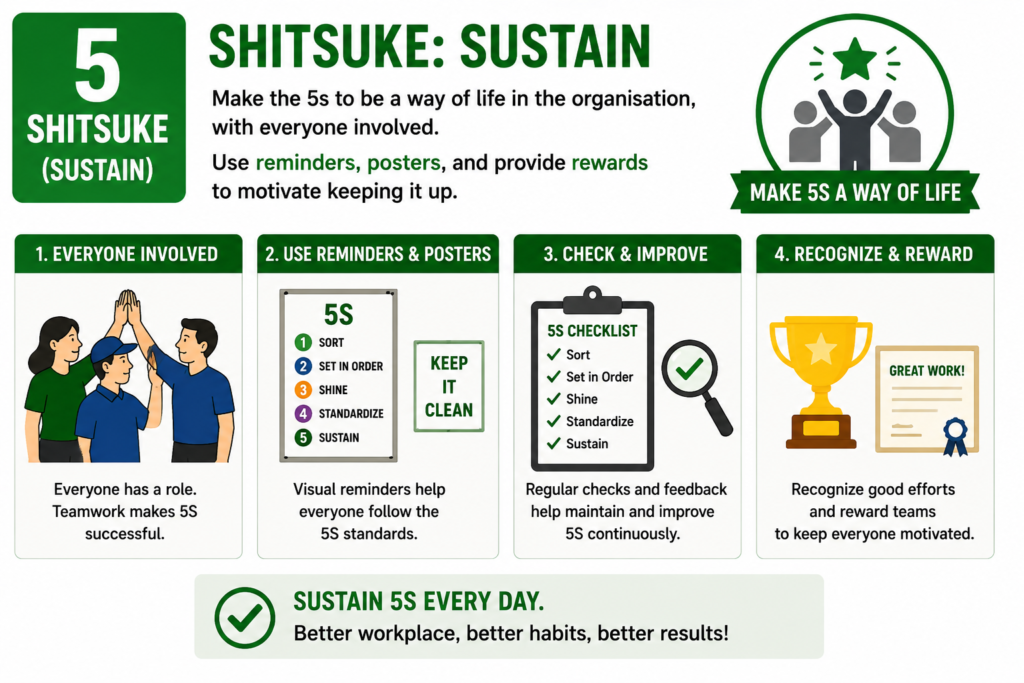
For example, a manufacturing company may conduct monthly 5S audits where departments are scored on cleanliness, organization, safety, and standardization. The best-performing team may receive a recognition award, while improvement areas are discussed during team meetings. Posters displaying 5S principles and “before-and-after” improvement examples can also be placed around the facility to reinforce good habits and maintain awareness.
Similarly, in an office environment, employees may follow desk organization standards, digital file management procedures, and regular workspace inspections to maintain consistency and efficiency. Managers can support sustainability by leading by example and encouraging teams to continuously identify improvement opportunities.
Sustain is what transforms 5S from a temporary project into a long-term organizational mindset. Without this step, workplaces can easily return to old habits, clutter, inefficiency, and inconsistent practices. By continuously reinforcing 5S principles and involving everyone in the process, organizations create a culture of discipline, teamwork, accountability, and continuous improvement.
Ultimately, Shitsuke ensures that 5S becomes a “way of life” within the organization, supporting safer workplaces, higher productivity, improved morale, better quality, and long-term lean manufacturing success.
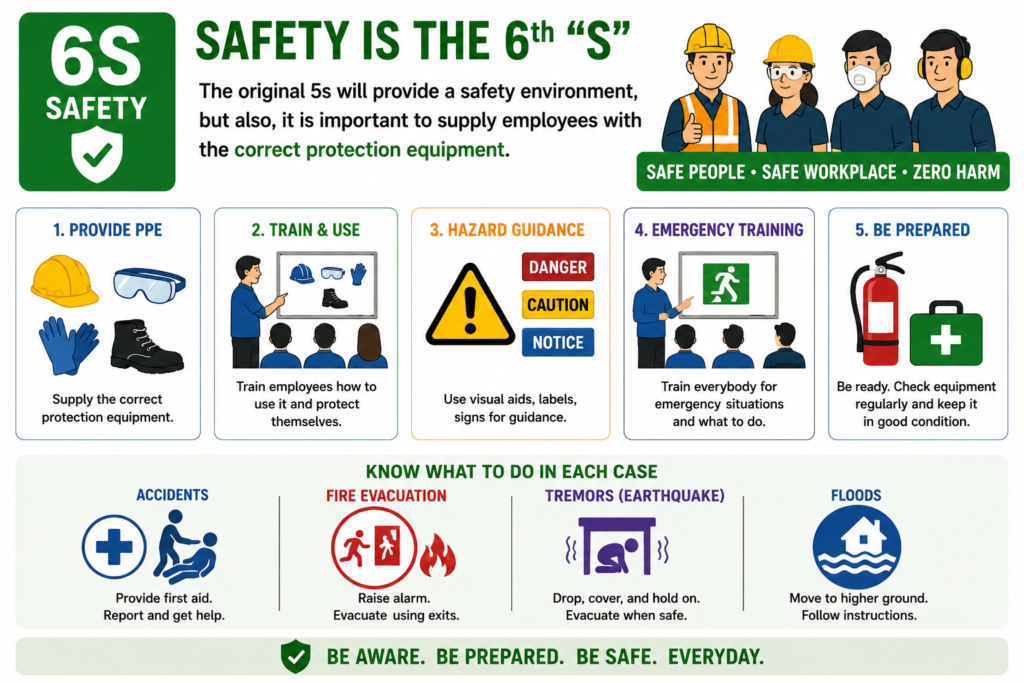
Safety is the 6 “S”.
The original 5s will provide a safety environment, but also, it is important to supply employees with the correct protection equipment. Train them how to use it and protect themselves from hazardous situations. Use visual aids, labels, signs for guidance. Train everybody for emergency situations and what to do in each case, like accidents, fire evacuation, tremors, floods.
Interested in our Industrial & Manufacturing Engineering Courses?
At iLearn Engineering®, we offer a diverse range of online accredited Industrial, Manufacturing and Mechanical Engineering courses and qualifications to cater to different academic and career goals. Our industrial courses are available in varying credit values and levels, ranging from 40 credit Engineering Diplomas to a Bachelor’s equivalent 360 credit International Graduate Diploma.
All Industrial / Manufacturing Engineering Courses
All Industrial / Manufacturing Engineering Diploma Courses can be seen here.
All Mechanical Engineering Diploma Courses can be seen here.
Short Courses for Industrial Engineering (40 Credits)
- Diploma in Manufacturing
- Diploma in Composites, Smart Materials & Nanotechnology
- Diploma in Lean Manufacturing
- Diploma in Mechanical Technology
- Diploma in Electrical Technology
- Diploma in Material Science
First Year of Undergraduate (Level 4 – 120 Credits)
Higher International Certificate in Industrial Engineering
Higher International Certificate in Mechanical Engineering
Years One and Two of Undergraduate (Level 5 – 240 Credits)
Higher International Diploma in Industrial Engineering
Higher International Diploma in Mechanical Engineering
Degree Equivalent International Graduate Diplomas in Engineering Management and Mechanical Engineering (Level 6 – 360 Credits)
International Graduate Diploma in Engineering Management (Level 6) [120 Credit Top Up]
International Graduate Diploma in Mechanical Engineering (Level 6) [120 Credit Top Up]
Complete Engineering Course Catalogue (all courses)
Alternatively, you can view all our online engineering courses here.
Get started today
Explore our range of Industrial and Manufacturing Engineering courses
Recent Posts
Types of Aircraft Drag Explained: Induced, Profile and Interference Drag
Types of Aircraft Drag Explained: Induced, Profile and Interference Drag An aircraft experiences several forms of aerodynamic drag at the same time. Some result from generating lift, some arise as air flows over the aircraft’s surfaces, and others are created when airflow around neighbouring components interacts. For a conventional aircraft in subsonic flight, total drag […]
Induced Drag Explained: Why Flying Slower Can Increase Drag
Induced Drag Explained: Why Flying Slower Can Increase Drag Why can an aircraft experience more drag when it flies more slowly? We usually associate greater speed with greater air resistance, but a wing must also generate enough lift to support the aircraft. Induced drag is the drag associated with producing lift on a finite-span wing. […]
Laminar vs Turbulent Boundary Layers: Why Airflow Separates from Aircraft Wings
Laminar vs Turbulent Boundary Layers: Why Airflow Separates from Aircraft Wings Airflow around an aircraft wing is often shown as smooth streamlines passing neatly over the aerofoil. In reality, the thin layer of air immediately next to the wing surface behaves very differently from the undisturbed airflow further away. This region is called the boundary […]