

Kaizen and Continuous Improvement: Benefits, Challenges, and Impact
Introduction
Continuous improvement is a management philosophy focused on making ongoing, incremental improvements to processes, products, and workplace culture. One of the most recognised approaches to continuous improvement is Kaizen, a Japanese philosophy meaning “change for the better.” Developed and popularised in Japanese manufacturing industries, particularly Toyota, Kaizen encourages all employees to contribute to improving efficiency, quality, and productivity.
This blog appraises the philosophy of continuous improvement by examining the principles of Kaizen, its advantages, limitations, and its impact on organisational performance.
“Kaizen is for everyday, for everybody in everywhere”
Masaaki Imai, Kaizen Institute Founder.
Every change, every improvement should be continuous.
As all manufacturing systems have some level of variation, it goes to reason that there is therefore always the opportunity for small, continuous improvements.
Successful strategies should be maintained, updated and improved according to the specific organisational needs. Monitoring and control of performance measures allow to identify indicators that are not met yet, or to recognize the procedures, methods that should be improved or controlled, and problems that need to be solved.
Continuous Improvement Using the Deming Cycle (PDCA)
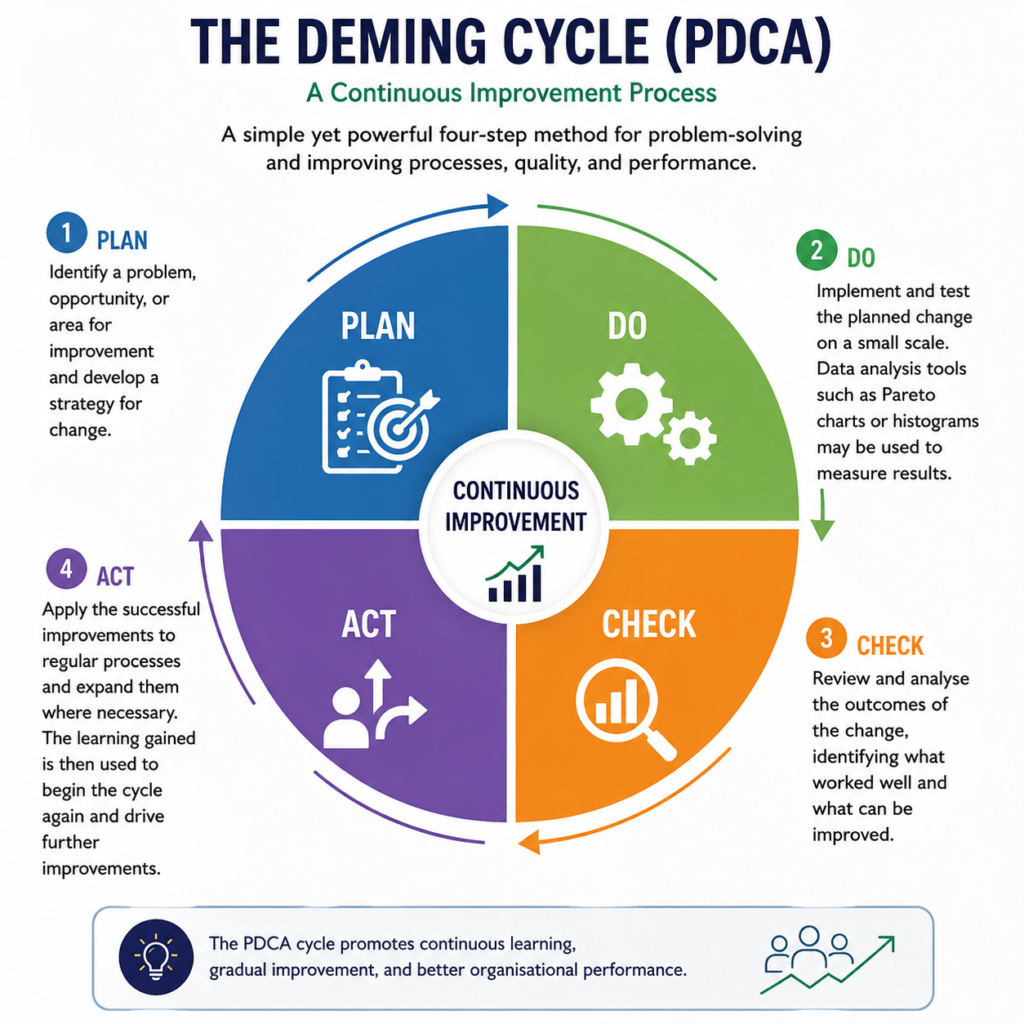
The Deming Cycle, also known as PDCA (Plan–Do–Check–Act), is a four-step method used for continuous improvement and problem-solving within organisations. It is an ongoing cycle that helps businesses improve processes, quality, and performance over time.
- Plan: Identify a problem, opportunity, or area for improvement and develop a strategy for change.
- Do: Implement and test the planned change on a small scale. Data analysis tools such as Pareto charts or histograms may be used to measure results.
- Check: Review and analyse the outcomes of the change, identifying what worked well and what can be improved.
- Act: Apply the successful improvements to regular processes and expand them where necessary. The learning gained is then used to begin the cycle again and drive further improvements.
The PDCA cycle promotes continuous learning, gradual improvement, and better organisational performance.
Understanding Kaizen and Continuous Improvement
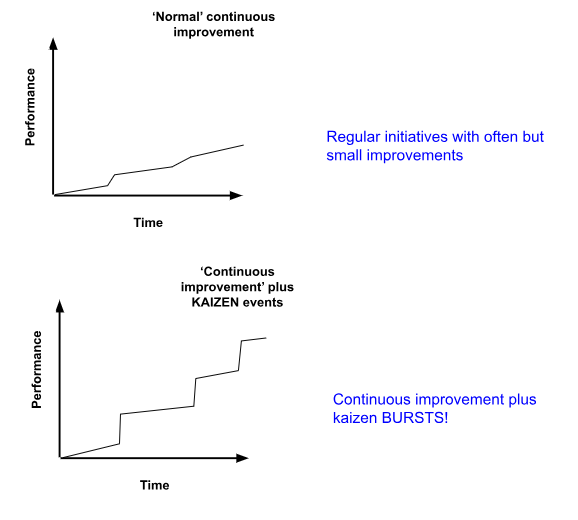
Kaizen translates to “Improvement for the better”. Kaizen is characterised by events, defined as “a structured project performed by a multidisciplinary group with the aim of improving a targeted work area or process in a given timeframe (Franken, et al., 2021, p. 966).”
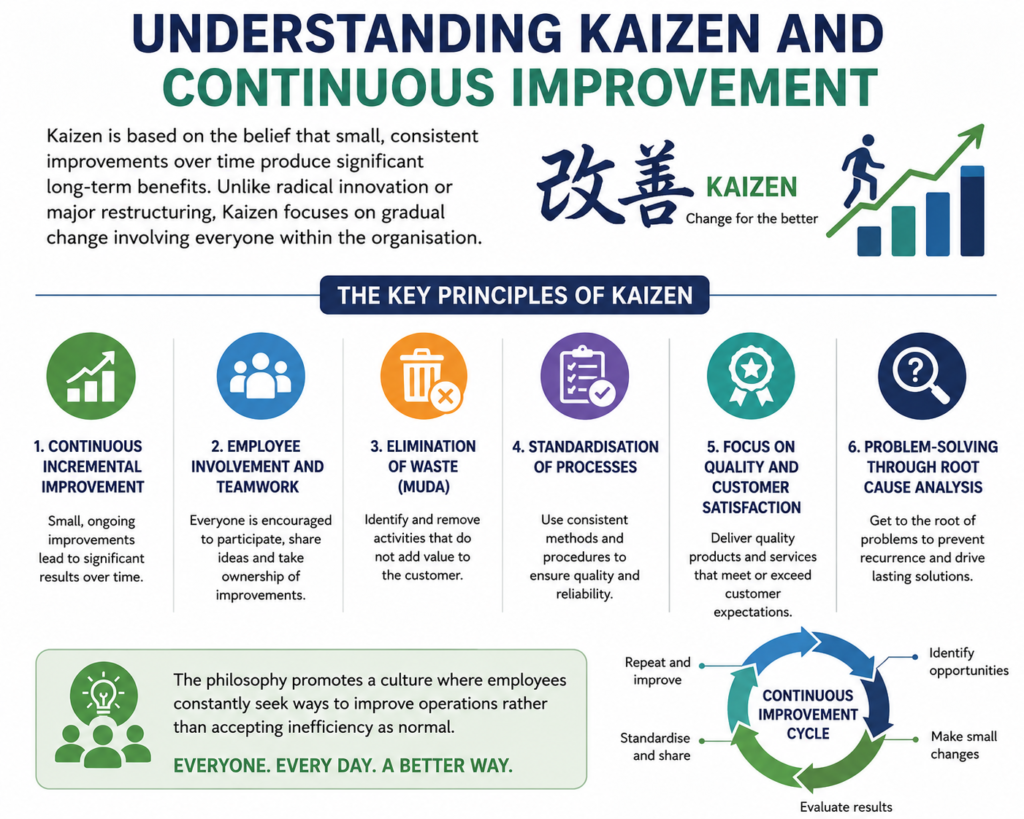
Kaizen is based on the belief that small, consistent improvements over time produce significant long-term benefits. Unlike radical innovation or major restructuring, Kaizen focuses on gradual change involving everyone within the organisation.
The key principles of Kaizen include:
- Continuous incremental improvement
- Employee involvement and teamwork
- Elimination of waste (muda)
- Standardisation of processes
- Focus on quality and customer satisfaction
- Problem-solving through root cause analysis
The philosophy promotes a culture where employees constantly seek ways to improve operations rather than accepting inefficiency as normal.
Within a manufacturing company, a kaizen event would be a short term blitz to hit a specific problem or issue with a rapid response team. A typical kaizen event should have a clear problem to solve, and last within the region of 1-6 days only.
Advantages of Kaizen and Continuous Improvement
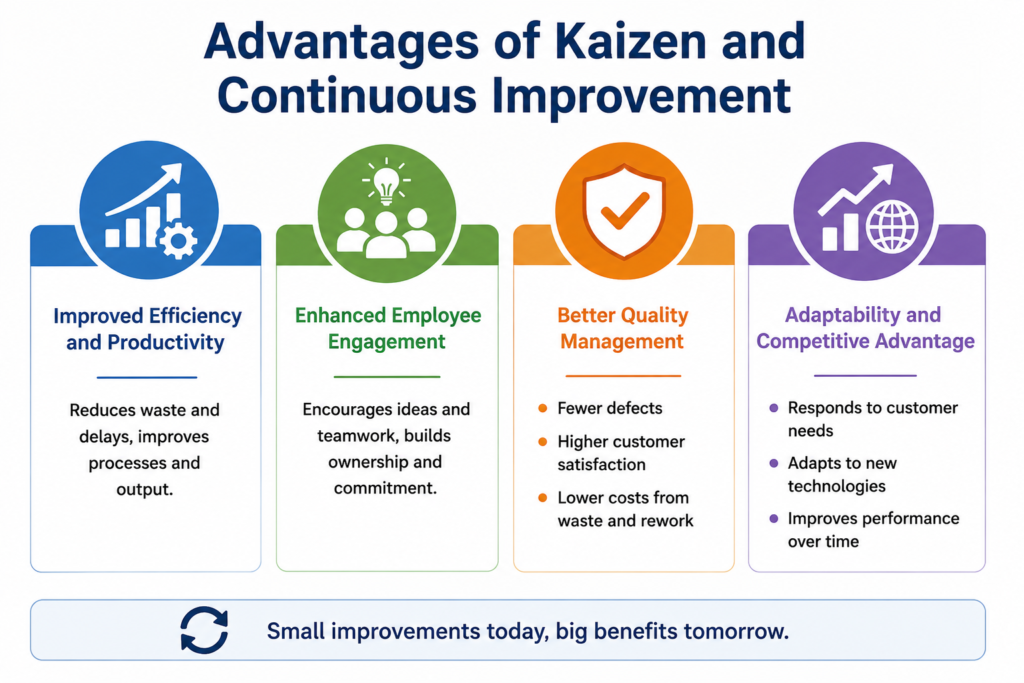
Improved Efficiency and Productivity: Kaizen helps organisations identify wasteful activities and inefficient processes. By continuously refining workflows, businesses can reduce delays, minimise errors, and improve productivity. For example, in manufacturing environments, continuous improvement can reduce production downtime and improve output quality.
Enhanced Employee Engagement: One of Kaizen’s greatest strengths is employee participation. Workers at all levels are encouraged to contribute ideas for improvement. This creates a sense of ownership, motivation, and teamwork. Employees who feel valued are often more committed to organisational goals and workplace success.
Better Quality Management: Continuous improvement encourages organisations to focus on preventing problems rather than correcting them after they occur. Quality control becomes part of everyday activities.
As a result:
- Defects are reduced
- Customer satisfaction improves
- Costs associated with rework and waste decrease
Adaptability and Competitive Advantage: Businesses operating in rapidly changing markets benefit from continuous improvement because it promotes flexibility and responsiveness.
Organisations using Kaizen are often better prepared to: Respond to customer demands, Introduce new technologies, Improve operational performance over time.
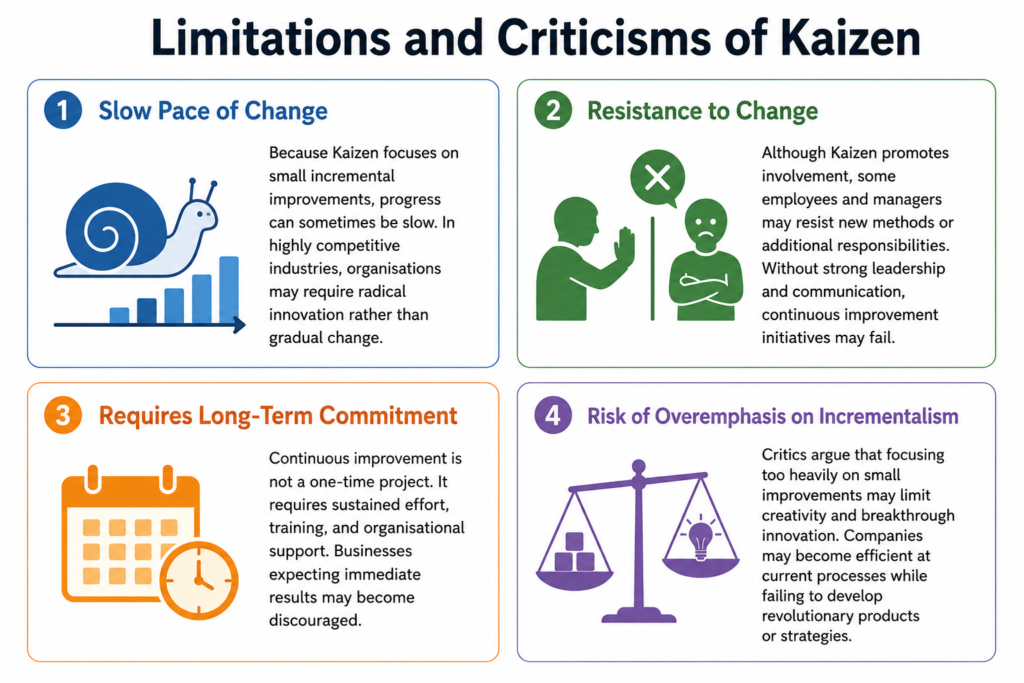
Limitations and Criticisms of Kaizen
Slow Pace of Change: Because Kaizen focuses on small incremental improvements, progress can sometimes be slow. In highly competitive industries, organisations may require radical innovation rather than gradual change.
Resistance to Change: Although Kaizen promotes involvement, some employees and managers may resist new methods or additional responsibilities. Without strong leadership and communication, continuous improvement initiatives may fail.
Requires Long-Term Commitment: Continuous improvement is not a one-time project. It requires sustained effort, training, and organisational support. Businesses expecting immediate results may become discouraged.
Risk of Overemphasis on Incrementalism: Critics argue that focusing too heavily on small improvements may limit creativity and breakthrough innovation. Companies may become efficient at current processes while failing to develop revolutionary products or strategies.
Sometimes Six Sigma phases are confused with Kaizen Events, but these are different. Six sigma attacks problems within processes variation, that required statistical analysis and more time to identify root causes. Kaizen is used in operational problems or improvement opportunities with no need of statistical analysis to identify root causes and possible solutions. These are quite “obvious” in the process. Six sigma requires at least 3 months with a “step or large change”; and Kaizen performs from 1 hour to 6 days with incremental changes.
Large changes take longer. They imply radical change or a transformation at once. Incremental improvements are small changes to improve the existing processes, products or services that have opportunities of improvement or better performance. There is no resistance to change and small improvements are taken better from people than large ones, due to doing a totally different process, activity. Also, small improvements are not perceived by the customers to avoid difficulties in using products or services. However, there are situations that need radical changes to stay in the market, to address a disruption or to solve a problem.
Imagine a person that never did exercise before and now wants to start weight lifting, and to grow body muscle. If this person try to lift 60 pounds of weight with both arms on the first day of training, she/he might get an injury or a severe accident. On the other hand, if this person starts lifting 5 to 10 pounds and increases weight weekly, it would be a healthier and safer way to increase body muscle.
It is the same in business. If participants are used to working with manual equipment in the assembly line, and in a day this line is changed to automatisation, this change will be harder to understand from users. If automatisation is introduced gradually, with training, sensibilization, participants will adopt the change with less resistance. However, every organisation has different needs. For example, hospitals required urgent radical changes in their procedures and lay outs to treat COVID-19 patients.
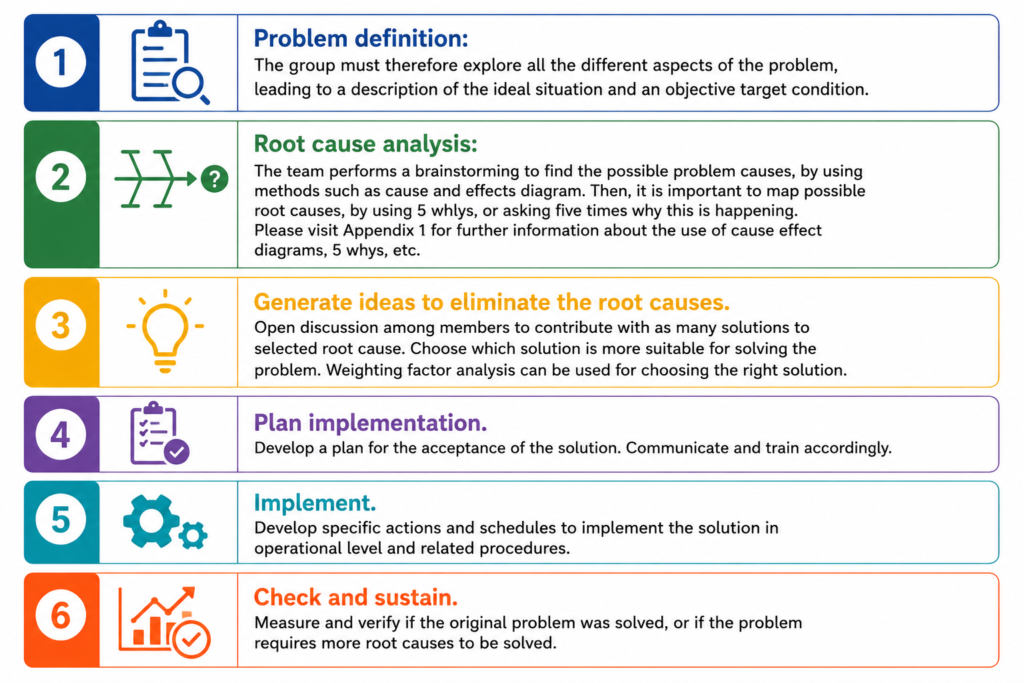
Kaizen follows 6 phases
Interested in our Industrial & Manufacturing Engineering Courses?
At iLearn Engineering®, we offer a diverse range of online accredited Industrial, Manufacturing and Mechanical Engineering courses and qualifications to cater to different academic and career goals. Our industrial courses are available in varying credit values and levels, ranging from 40 credit Engineering Diplomas to a Bachelor’s equivalent 360 credit International Graduate Diploma.
All Industrial / Manufacturing Engineering Courses
All Industrial / Manufacturing Engineering Diploma Courses can be seen here.
All Mechanical Engineering Diploma Courses can be seen here.
Short Courses for Industrial Engineering (40 Credits)
- Diploma in Manufacturing
- Diploma in Composites, Smart Materials & Nanotechnology
- Diploma in Lean Manufacturing
- Diploma in Mechanical Technology
- Diploma in Electrical Technology
- Diploma in Material Science
First Year of Undergraduate (Level 4 – 120 Credits)
Higher International Certificate in Industrial Engineering
Higher International Certificate in Mechanical Engineering
Years One and Two of Undergraduate (Level 5 – 240 Credits)
Higher International Diploma in Industrial Engineering
Higher International Diploma in Mechanical Engineering
Degree Equivalent International Graduate Diplomas in Engineering Management and Mechanical Engineering (Level 6 – 360 Credits)
International Graduate Diploma in Engineering Management (Level 6) [120 Credit Top Up]
International Graduate Diploma in Mechanical Engineering (Level 6) [120 Credit Top Up]
Complete Engineering Course Catalogue (all courses)
Alternatively, you can view all our online engineering courses here.
Get started today
Explore our range of Industrial and Manufacturing Engineering courses
Recent Posts
Types of Aircraft Drag Explained: Induced, Profile and Interference Drag
Types of Aircraft Drag Explained: Induced, Profile and Interference Drag An aircraft experiences several forms of aerodynamic drag at the same time. Some result from generating lift, some arise as air flows over the aircraft’s surfaces, and others are created when airflow around neighbouring components interacts. For a conventional aircraft in subsonic flight, total drag […]
Induced Drag Explained: Why Flying Slower Can Increase Drag
Induced Drag Explained: Why Flying Slower Can Increase Drag Why can an aircraft experience more drag when it flies more slowly? We usually associate greater speed with greater air resistance, but a wing must also generate enough lift to support the aircraft. Induced drag is the drag associated with producing lift on a finite-span wing. […]
Laminar vs Turbulent Boundary Layers: Why Airflow Separates from Aircraft Wings
Laminar vs Turbulent Boundary Layers: Why Airflow Separates from Aircraft Wings Airflow around an aircraft wing is often shown as smooth streamlines passing neatly over the aerofoil. In reality, the thin layer of air immediately next to the wing surface behaves very differently from the undisturbed airflow further away. This region is called the boundary […]