

Oil vs Grease vs Dry Lubricant: How to Choose
Introduction
Should a bearing use oil or grease? Would a dry lubricant perform better on an exposed slide? Choosing a lubricant by habit, colour or convenience can lead to excess heat, leakage, contamination or premature wear. A sound choice starts with the machine specification and the conditions at the contact point.
Oil is generally preferred where circulation, cooling, filtration or high-speed supply is important. Grease is useful when lubricant must remain in place, help exclude contamination or support longer relubrication intervals. Dry lubricants suit selected applications where liquid lubricants would attract contamination, escape or become unsuitable. The equipment manufacturer’s specification should always take priority.
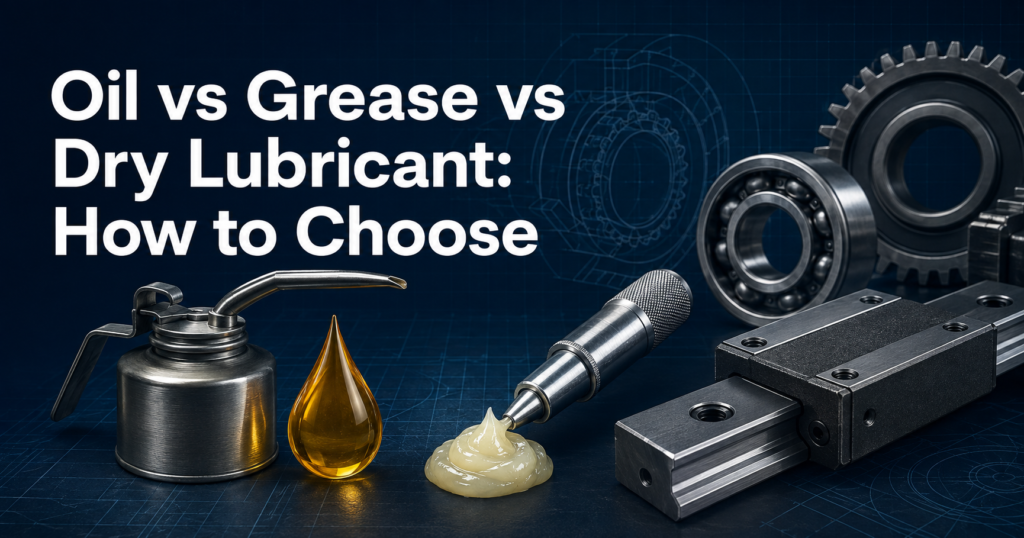
This guide compares oil, grease and dry lubricants and provides a practical framework for deciding which type is appropriate for a machine.
Why lubricant selection matters
A lubricant forms a film between surfaces in relative motion. That film reduces direct surface contact, controls friction and limits wear. Depending on the application, the lubricant may also remove heat, carry contaminants towards a filter, resist corrosion, support sealing or transmit power.
The wrong product can interfere with these functions. Oil that is too thin may not maintain an adequate film. Oil that is too viscous may circulate poorly or create excessive drag. Too much grease can churn and generate heat. A dry film may wear away too quickly or provide no useful cooling.
For a broader introduction to these functions, see iLearn Engineering’s guide to lubricants and lubrication systems in machinery.
When should oil be used?
Lubricating oil is a fluid made from a base oil and, in many applications, a package of performance additives. The base oil may be mineral, synthetic, vegetable-derived or a blend. Additives can improve properties such as oxidation resistance, corrosion protection, detergency, anti-wear performance or foam control.
Advantages of oil
Oil can flow into small clearances and be pumped around a machine. This makes it particularly useful when the application requires:
- continuous delivery to moving contacts;
- circulation through bearings, gears or an engine;
- heat removal;
- transport of wear particles towards a filter;
- high-speed operation with controlled viscous resistance; or
- monitoring through sampling and oil-condition analysis.
Typical applications include engines, gearboxes, turbines, hydraulic systems, compressors, circulating-oil bearings and some high-speed spindles.
Limitations of oil
Because oil flows, it normally requires an effective housing, reservoir, seal or recirculation system. Leakage can create housekeeping, environmental and safety problems. Oil can also run away from a contact during extended shutdowns or be displaced by water and other contamination.
Viscosity selection is essential. SKF’s bearing guidance relates the required oil viscosity to factors including bearing size, rotational speed and operating temperature.[1] An oil should therefore be selected from the machine or component specification rather than by assuming that a thicker product provides better protection.
Oil is often a strong candidate when:
- the lubricant must remove heat;
- the system already contains pumps, filters and pipework;
- the contact operates at high speed;
- contamination needs to be carried away and filtered;
- lubricant condition will be monitored; or
- several components require a continuous shared supply.
When should grease be used?
Grease is a semi-solid lubricant. The National Lubricating Grease Institute describes lubricating grease as a mixture of lubricating fluid, performance-enhancing additives and a thickener. The lubricating fluid is normally the largest component; the thickener gives the product its consistency.[2]
Grease works by retaining lubricating fluid close to the contact rather than behaving as a solid block between the moving surfaces.
Advantages of grease
Grease is easier to retain than oil and can reduce the need for a complex circulation system. It can also help restrict the entry of dust or water around a correctly designed bearing arrangement.
Grease is frequently used where:
- the lubricant must stay in place;
- relubrication points are difficult to access;
- leakage must be limited;
- the component operates intermittently;
- an oil reservoir would be impractical; or
- the grease can provide an additional contamination barrier.
Common examples include electric-motor bearings, rolling bearings, linkages, chassis points, slow or moderately moving gears and exposed mechanisms.
Limitations of grease
Grease does not remove heat as effectively as circulating oil. It can also create churning and resistance if the quantity, consistency or base-oil viscosity is unsuitable. This is particularly important in high-speed bearings.
A grease product is not defined only by its apparent thickness. Selection can involve base-oil viscosity, thickener type, consistency, additives, operating temperature, speed, load and resistance to water or other contamination. SKF’s lubricant-selection guidance incorporates several of these application factors.[3]
Grease is often a strong candidate when:
- the lubricant must remain close to the contact;
- leakage would be unacceptable;
- relubrication is relatively infrequent;
- cooling is not a primary lubricant function;
- the housing is simple or partly exposed; or
- a supplementary barrier against contamination is helpful.
When should a dry lubricant be used?
Dry lubricants use low-shear solid materials such as graphite, molybdenum disulphide or polytetrafluoroethylene (PTFE). They may be applied as powders, bonded coatings or sprays. In a spray product, a liquid carrier may evaporate and leave a dry lubricating film behind.
Advantages of dry lubricants
A dry film does not flow away in the same manner as oil and usually attracts less loose contamination once its carrier has evaporated. It can be useful on a small sliding or threaded component where oil or grease would create an unacceptable mess or collect dust.
Dry lubricants can be considered where:
- oil or grease would attract problematic dust or debris;
- surrounding surfaces must remain relatively clean;
- a small mechanism could be obstructed by grease;
- leakage cannot be tolerated;
- conventional fluids would evaporate or become unsuitable; or
- a bonded film is required for assembly, running-in or intermittent movement.
Possible applications include locks, threaded fasteners, selected sliding guides, hinges and specialist high-temperature, aerospace or vacuum mechanisms.
Limitations of dry lubricants
Dry films generally provide little or no cooling and cannot circulate contaminants towards a filter. Their useful life may be limited by abrasion, repeated movement, solvents, water or poor surface preparation.
“Dry lubricant” is also a broad commercial description. Not every dry spray has the same chemistry, film strength, temperature limit or material compatibility. Its current technical data should be checked before use.
A dry lubricant is often a strong candidate when:
- oil and grease would retain too much dirt;
- cleanliness is more important than cooling;
- movement is light, intermittent or limited;
- a thin, non-flowing film is required; or
- the manufacturer specifies a solid-film product.
Oil vs grease vs dry lubricant: comparison table
| Selection factor | Oil | Grease | Dry lubricant |
|---|---|---|---|
| Ability to flow into small clearances | High | Limited | Depends on the application method |
| Ability to remain in place | Lower unless contained | High | High after a bonded film cures |
| Cooling capability | Good when circulated | Limited | Very limited |
| Contaminant removal | Good in filtered circulation systems | Limited | Very limited |
| Leakage risk | Higher | Lower | Very low after application |
| Ability to help exclude contamination | Depends on sealing system | Often useful | Limited |
| Suitability for high speed | Often strong, subject to viscosity and system design | Possible with correct selection and quantity | Application-specific |
| Suitability for infrequent relubrication | Depends on the system | Often strong | Depends on film life |
| Dust attraction on exposed surfaces | Can be significant | Can retain contamination | Often lower after curing or carrier evaporation |
| Typical uses | Engines, gearboxes, hydraulics, turbines and circulation systems | Bearings, linkages and retained lubrication points | Locks, threads, slides and specialist conditions |
The table identifies general tendencies, not fixed rules. A sealed high-speed bearing may be designed for grease, while a slow heavily loaded gearbox may require oil. The component specification determines which general characteristics matter in the actual design.
The seven factors that should guide lubricant selection
1. Manufacturer’s specification
Begin with the equipment manual, bearing catalogue or approved lubricant list. Look for a required viscosity grade, grease consistency, performance classification, relubrication interval and any prohibited chemistries.
2. Speed
High-speed contacts can generate heat through viscous drag or grease churning. They also require a lubricant that reaches the contact quickly and forms a stable film. Oil is frequently advantageous, but correctly selected grease is used successfully in many high-speed bearing arrangements.
3. Load and motion
Heavy load can reduce the separation between surfaces. Oscillating, reciprocating and very slow movements also present different film-formation conditions from continuous rotation. Consider whether the contact requires anti-wear or extreme-pressure performance rather than relying on viscosity alone.
4. Temperature
Oil becomes less viscous as temperature rises and more viscous as it falls. Grease can soften, harden, oxidise or lose oil depending on its formulation and conditions. A dry film may tolerate some temperatures that would challenge conventional fluids, but its stated limits must still be observed.
Selection should consider cold start-up, normal running temperature, short-duration peaks and nearby heat sources.
5. Cooling and contamination control
If the lubricant must carry away heat or transport particles to a filter, circulating oil usually provides a clear advantage. Grease can help exclude contaminants but does not flush debris away. Dry lubricants provide neither significant cooling nor filtration.
6. Retention, sealing and orientation
Vertical shafts, exposed mechanisms and simple housings may struggle to retain oil. Grease or a bonded dry film may remain in place more effectively. This does not remove the need for correct seals, guards and lubricant quantity.
7. Maintenance access
Consider how the product will be applied, inspected, replenished and removed. A difficult-to-access bearing may favour long-life grease or an automatic lubrication system. A critical gearbox may favour circulating oil because it can be sampled, filtered and monitored.
A practical SELECT checklist
The following SELECT checklist is an iLearn Engineering editorial framework designed to organise a lubricant decision. It is not an industry standard and does not replace manufacturer guidance.
- S — Specification: What lubricant type, viscosity, consistency and performance level does the manufacturer require?
- E — Environment: Will the contact face dust, water, chemicals, washdown, vacuum conditions or potential food contact?
- L — Load and movement: What loads, speeds, starts, stops, oscillations or impacts will occur?
- E — Exposure to temperature: What are the start-up, continuous and peak temperatures?
- C — Cooling and cleanliness: Must the lubricant remove heat, carry debris to a filter or avoid attracting contamination?
- T — Time and access: How often can the point be inspected and relubricated, and how will the used product be removed?
If any answer is unknown, the decision is not ready to be made. Obtain the machine data and current lubricant technical information first.
Four illustrative selection examples
These examples show how the factors can be applied. They are illustrations rather than product recommendations.
Example 1: Enclosed gearbox with heat to remove
An enclosed gearbox operates continuously and its lubricant must reach several gear meshes and bearings. The system can contain a sump, and heat removal is important.
Likely direction: oil, because it can splash or circulate, distribute through the housing and contribute to heat removal. The required viscosity and additive performance would come from the gearbox manufacturer.
Example 2: Electric-motor bearing with limited maintenance access
A rolling bearing is enclosed, leakage must be limited and cooling through lubricant circulation is not required. Maintenance access is occasional.
Likely direction: grease, provided the bearing speed, temperature, fill quantity and relubrication interval are suitable. Overfilling must be avoided.
Example 3: Lightly loaded slide in a dusty location
An exposed slide moves intermittently. Oil or grease could retain abrasive dust, and there is no need for lubricant-based cooling.
Likely direction: a manufacturer-approved dry or solid-film lubricant, subject to material compatibility and film-life requirements.
Example 4: Bearing in food-processing equipment
The contact requires reliable lubrication and there is a possibility of incidental food contact.
Likely direction: the mechanical conditions still determine whether oil or grease is appropriate, but the selected product must also have the correct food-contact registration for its intended use. NSF identifies H1 lubricants as products intended for incidental food-contact applications and explains the role of ISO 21469 hygiene requirements.[4]
Common lubricant-selection mistakes
Assuming thicker is always better
A more viscous oil or stiffer grease can increase drag, reduce flow and raise operating temperature. The correct value depends on the contact and its operating temperature.
Filling a bearing completely with grease
Excess grease can churn, generate heat and increase pressure on seals. Use the specified initial fill and relubrication quantity.
Selecting by colour
Lubricant colour is not a reliable indication of chemistry, compatibility or performance. Products with similar colours can have very different base oils, thickeners and additives.
Mixing products without checking compatibility
Mixing oils or greases can change viscosity, consistency, oil separation, corrosion protection or load-carrying performance. A change may require cleaning or flushing.
Treating all spray lubricants as equivalent
Penetrating fluids, water-displacing sprays, wet lubricants and dry-film products perform different functions. Read the intended-use statement and technical data.
Ignoring the application method
Even the correct lubricant cannot protect a component if blocked lines, empty reservoirs, damaged fittings or unsuitable intervals prevent it reaching the contact.
Develop your understanding of machines and mechanical systems
Lubricant selection forms part of the wider study of bearings, gears, seals, power transmission and machine maintenance.
The Diploma in Mechanical Technology is a focused 40-credit Level 4 route covering engineering science and machines and systems.
For broader study, the Higher International Certificate in Mechanical Engineering provides a 120-credit Level 4 foundation.
The Higher International Diploma in Mechanical Engineering comprises 240 credits in total, incorporating Level 4, while the International Graduate Diploma in Mechanical Engineering provides the corresponding Level 6 route.
Compare these mechanical engineering pathways and select the depth of study that best supports your professional-development objectives.
Frequently asked questions
Is grease better than oil for bearings?
Not universally. Grease is easier to retain and may support longer relubrication intervals. Oil is advantageous where cooling, circulation, filtration or very low viscous resistance is required. Bearing design, speed, load and temperature determine the appropriate choice.
Can oil be used instead of grease?
Only if the component and lubrication system are designed for it. Oil may leak from a grease-lubricated housing, while its viscosity and additives may not satisfy the original requirements.
Does grease cause more resistance than oil?
Grease can produce more churning and drag, particularly if too much is applied or its consistency is unsuitable. Correctly selected grease in the correct quantity is nevertheless appropriate for many high-speed components.
What lubricant should be used in dusty conditions?
The choice depends on the machine. A correctly sealed grease arrangement may help exclude dust, while a dry film may suit an exposed, lightly loaded slide that would otherwise collect contamination. The manufacturer’s guidance should be followed.
When should dry lubricant be used?
Dry lubricant can suit selected applications where oil or grease would attract dirt, flow away or interfere with a small mechanism. It should not be chosen where lubricant-based cooling or contaminant removal is required.
Can different greases be mixed?
Not without confirming compatibility. Different thickeners, base oils and additives may interact and alter consistency or performance.
Is silicone spray a dry lubricant?
Some silicone sprays leave a low-residue lubricating film, but “dry lubricant” is not a precise description of every silicone product. Check the formulation, intended application and technical data rather than relying on the marketing name.
Can too much lubricant damage a machine?
Yes. Excess grease can churn and generate heat, while excess oil can foam, leak or overwhelm seals. Correct quantity is part of correct lubricant selection.
References
[1] SKF: Selecting a suitable oil
[2] National Lubricating Grease Institute: What is lubricating grease?
[3] SKF: Lubricant selection
[4] NSF: Food-grade lubricants and ISO 21469 certification
Interested in our engineering courses?
We have over 70 courses across all major engineering disciplines, including, mechanical, electrical and electronic, civil, aerospace, industrial, computer and general engineering. Visit our course catalogue for a complete list of fully accredited engineering programmes.
A small selection of short Engineering courses …
Diploma in Mechanical Technology
Diploma in Mechanical Engineering
Level 6 Engineering Courses
International Graduate Diploma in Mechanical Engineering
Level 5 Engineering Courses
Higher International Diploma in Industrial Engineering
Higher International Diploma in Mechanical Engineering
Level 4 Engineering Courses
Higher International Certificate in Industrial Engineering
Higher International Certificate in Mechanical Engineering
View Engineering Courses
Explore our UK-accredited engineering courses. 100% Online with no schedules, no deadlines and no exams.
Recent Posts
Types of Aircraft Drag Explained: Induced, Profile and Interference Drag
Types of Aircraft Drag Explained: Induced, Profile and Interference Drag An aircraft experiences several forms of aerodynamic drag at the same time. Some result from generating lift, some arise as air flows over the aircraft’s surfaces, and others are created when airflow around neighbouring components interacts. For a conventional aircraft in subsonic flight, total drag […]
Induced Drag Explained: Why Flying Slower Can Increase Drag
Induced Drag Explained: Why Flying Slower Can Increase Drag Why can an aircraft experience more drag when it flies more slowly? We usually associate greater speed with greater air resistance, but a wing must also generate enough lift to support the aircraft. Induced drag is the drag associated with producing lift on a finite-span wing. […]
Laminar vs Turbulent Boundary Layers: Why Airflow Separates from Aircraft Wings
Laminar vs Turbulent Boundary Layers: Why Airflow Separates from Aircraft Wings Airflow around an aircraft wing is often shown as smooth streamlines passing neatly over the aerofoil. In reality, the thin layer of air immediately next to the wing surface behaves very differently from the undisturbed airflow further away. This region is called the boundary […]