

Surface Tension Explained: Cohesion, Adhesion and Engineering Applications
Why does water form droplets instead of spreading into an infinitely thin layer? How can a liquid rise through a narrow tube against gravity? Why does adding detergent change the way water wets a surface?
All three questions involve surface tension.
Surface tension is the tendency of a liquid interface to resist an increase in area. It arises because molecules at the surface experience a different balance of intermolecular attractions from molecules inside the liquid. Surface tension influences the formation of droplets and bubbles, wetting, capillary flow and the movement of liquid interfaces. Engineers must account for it in applications ranging from inkjet printing and coatings to heat pipes, microfluidics and spacecraft fluid systems.
This guide explains where surface tension comes from, how it relates to cohesion and adhesion, how engineers measure it and why its effects become especially important at small scales.
What is surface tension?
A liquid has an interface wherever it meets another phase, such as air, another liquid or a solid surface. Creating more of that interface requires energy because molecules must be moved from the interior of the liquid into a different molecular environment at the boundary.
Surface tension describes the mechanical effect of this interfacial energy. It can be expressed as force per unit length, normally in newtons per metre (N/m). For a liquid interface, it may also be interpreted in terms of energy per unit area, measured in joules per square metre (J/m²). These units are dimensionally equivalent.[1][2]
Surface tension is sometimes described as an elastic “skin”. This analogy can help explain why a small, light object may be supported at a water surface, but the interface is not a separate membrane. Its behaviour is produced by molecular interactions within the liquid and across the interface.
What causes surface tension at the molecular level?
Molecules inside a liquid are surrounded by neighbouring molecules. Their attractions act in many directions and are approximately balanced.
A molecule at a liquid–air surface does not have the same liquid environment above it. Attractions from neighbouring liquid molecules act mainly sideways and inward. The interface consequently tends to contract towards a state with lower surface area and lower interfacial energy.[1][3]
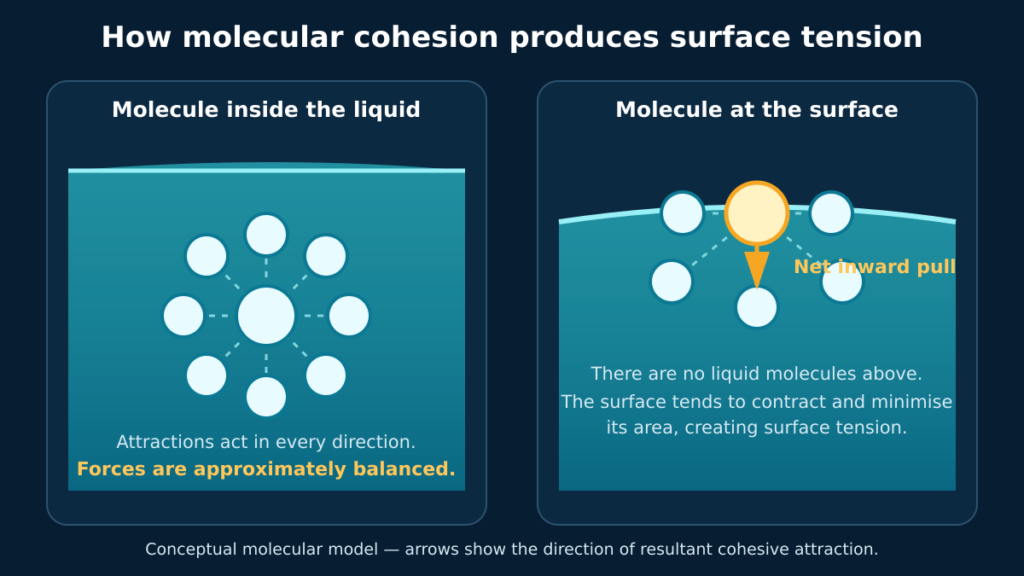
Water has relatively strong cohesion because its polar molecules form hydrogen bonds with one another. NASA uses this molecular explanation to demonstrate why the effects of water’s surface tension become especially visible in microgravity.[4]
Different liquids have different surface tensions because their molecular structures and intermolecular forces differ. The value also depends on temperature and on the other phase forming the interface.
Why do liquid droplets form rounded shapes?
For a given volume, a sphere has the smallest possible surface area. A liquid droplet therefore tends towards a spherical shape when surface tension is the dominant influence.
This does not mean that every droplet is a perfect sphere:
- Gravity flattens larger droplets resting on a surface.
- Air resistance deforms falling droplets.
- Impact and vibration can make a droplet oscillate.
- Contact with a solid introduces adhesion and wetting effects.
- Electric, thermal or pressure forces may alter the interface.
Small airborne droplets can be nearly spherical because surface forces are large relative to their weight. Larger falling water droplets are typically flattened or distorted rather than tear-shaped. The familiar tear shape is more appropriate to a drop hanging from an outlet before detachment.
What is the difference between cohesion and adhesion?
Cohesion is attraction between molecules of the same substance. In a water droplet, cohesion describes the attraction between water molecules.
Adhesion is attraction between different substances. For example, adhesion occurs between water molecules and a glass, metal or polymer surface.
The balance between cohesion and adhesion affects whether a liquid beads up or spreads:
- When cohesion is strong relative to adhesion, the liquid tends to form a compact bead.
- When adhesion to the solid is comparatively strong, the liquid spreads more readily.
- Real behaviour also depends on surface roughness, contamination, chemical treatment and temperature.
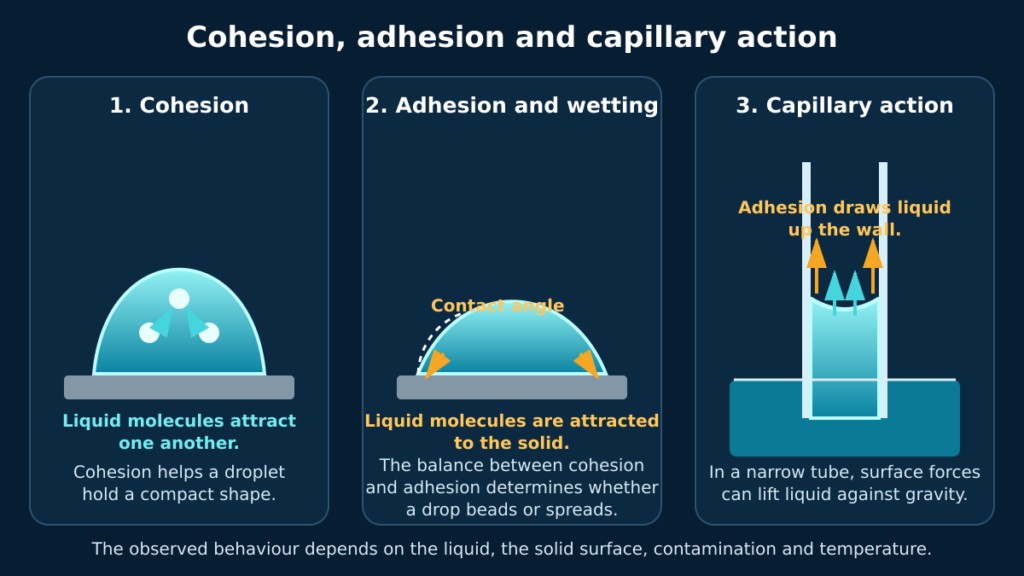
These concepts should not be treated as two isolated forces with a universal winner. Wetting depends on the energetic balance among the solid–liquid, solid–vapour and liquid–vapour interfaces.
What are contact angle and wettability?
Wettability describes how readily a liquid maintains contact with and spreads across a solid surface.
The contact angle is the angle formed where the liquid–vapour interface meets the solid, measured through the liquid. It provides a practical indication of wetting under defined conditions:
- A smaller contact angle generally indicates greater wetting.
- A larger contact angle indicates that the liquid beads more strongly.
- An angle alone does not completely describe a real moving or contaminated interface.
A surface described as hydrophilic has an affinity for water and tends to produce lower water contact angles. A hydrophobic surface tends to repel water and produce larger contact angles.
Real surfaces introduce complications. Roughness and chemical variation can pin the edge of a droplet. The angle observed as a drop advances may differ from the angle observed as it recedes. This difference is called contact-angle hysteresis and helps explain why a drop can remain attached to a tilted surface.
Why wettability matters to engineers
Engineers may want a liquid to:
- Spread evenly across a painted or coated surface
- Remain as a controlled droplet in a printing system
- Enter a porous material or microchannel
- Drain rapidly from a heat exchanger
- Avoid sticking to a protective surface
- Form a reliable joint during soldering or brazing
The “best” wettability therefore depends on the intended function.
What is capillary action?
Capillary action is the movement of a liquid within a narrow passage or porous material because of surface tension, wetting and the shape of the liquid interface.
When a liquid wets the wall of a narrow tube, adhesion pulls the liquid along the wall and the curved meniscus transmits a capillary pressure. The liquid may rise until the upward capillary effect is balanced by the weight of the liquid column.
In general:
- Narrower passages can produce greater capillary rise.
- Stronger wetting promotes liquid movement along the wall.
- Surface tension affects the magnitude of the capillary pressure.
- Density and gravity oppose the rise of the liquid column.
Capillary action is not limited to glass tubes. It occurs in wicks, textiles, paper, soil, porous metals, heat pipes and microfluidic channels.
NASA reports that capillary behaviour becomes critical in reduced gravity because buoyancy and gravity-driven drainage become weak. Spacecraft fluid systems must use container geometry, wetting and capillary forces to manage liquids, bubbles and phase separation.[5]
How do temperature and surfactants affect surface tension?
Surface tension is not a fixed value for a substance under every condition.
Temperature
For many liquids, surface tension decreases as temperature rises. Increased molecular motion reduces the cohesive effect at the interface. Surface tension approaches zero as the liquid and vapour phases become indistinguishable at the critical point. Engineering data should therefore be quoted at a stated temperature.[2][3]
A temperature difference along an interface can also create a surface-tension gradient. Liquid can be driven from a region of lower surface tension towards a region of higher surface tension. This behaviour is known as the Marangoni effect and can influence welding pools, coating flows, crystal growth and thermal-fluid systems.
Surfactants
Surfactants are substances that accumulate at an interface and can substantially reduce surface tension. Their molecules typically contain one part attracted to water and another part less compatible with it.
Soaps and detergents use surfactants to help water spread, enter small gaps and detach oily contamination. Surfactants are also used in paints, inks, emulsions, foams and process fluids.
More surfactant is not automatically better. Excessive foaming, residue, material compatibility and process requirements must also be considered.
How is surface tension measured?
The selected measurement method depends on the liquid, expected value, available sample, temperature range and whether the interface is static or changing.
Capillary-rise method
The height and meniscus of a liquid in a narrow tube are related to surface tension, density, gravity, tube radius and contact angle. Cleanliness and accurate tube dimensions are essential.
Wilhelmy-plate method
A thin plate is brought into contact with the liquid and the wetting force is measured. The result depends on the wetted perimeter and contact conditions.
Du Noüy-ring method
A ring is pulled through the interface while the required force is measured. Corrections are needed because the measured force depends on the shape of the liquid interface around the ring.
Pendant-drop method
The profile of a hanging droplet is analysed. The balance between gravity and surface tension determines its shape, allowing surface or interfacial tension to be calculated.
The UK National Physical Laboratory’s guidance discusses surface-tension measurement and the importance of appropriate test methods, reference materials and controlled conditions.[3]
Surface tension in engineering applications
Surface tension becomes particularly influential where dimensions are small or where two phases meet. As a system becomes smaller, surface effects can become large relative to volume-dependent forces such as weight.
Inkjet printing and additive manufacturing
Inkjet systems must form repeatable droplets, detach them from a nozzle and deposit them onto a surface without uncontrolled spreading or satellite drops. Surface tension, viscosity, nozzle geometry and wettability interact throughout the process.
Peer-reviewed research has demonstrated the importance of both wettability and surface tension in inkjet droplet formation.[6]
Similar principles apply when depositing electronic materials, biological samples or binders in additive-manufacturing processes.
Coatings, paints and adhesives
A coating must wet the substrate sufficiently to form a continuous layer. Poor wetting can contribute to beading, voids or incomplete coverage. Excessive spreading can also be undesirable where boundaries or deposit thickness must be controlled.
Surface preparation is therefore important. Oil, dust, oxidation and cleaning residue can change surface energy and contact angle even when the coating formulation remains unchanged.
Microfluidics and laboratory devices
Microfluidic systems manipulate small quantities of liquid through narrow channels. At these scales, capillary pressure and wetting can dominate gravity.
Engineers can use surface treatments and channel geometry to guide, stop, divide or combine droplets.
Heat pipes and thermal management
A heat pipe uses evaporation, condensation and capillary return to transfer thermal energy. A porous wick returns condensed working fluid towards the heated region. Surface tension, pore dimensions, wettability and fluid properties affect the available capillary pressure.
Boiling and condensation are also strongly affected by the way a surface wets, nucleates and sheds bubbles or droplets.
Welding, brazing and soldering
Molten material must wet the surfaces involved if it is to spread into a joint. Surface contamination, oxide layers and temperature can impede wetting. Fluxes are often used to remove or limit oxides and improve interfacial behaviour.
Surface-tension gradients may also drive flow within a molten weld pool, affecting its shape and heat transfer.
Fuel injection and sprays
Liquid jets break into droplets when disruptive aerodynamic and inertial forces overcome the stabilising effect of surface tension. Droplet size and distribution affect mixing, evaporation and combustion.
Surface tension is therefore one of several properties considered alongside viscosity, density, pressure difference and nozzle geometry.
Spacecraft fluid systems
On Earth, gravity helps separate gas and liquid and determines where liquid settles in a tank. In microgravity, surface tension, wetting and container geometry can dominate.
NASA identifies capillary-fluid behaviour as important to spacecraft reservoirs, thermal systems, life-support equipment and propellant management.[5]
A practical INTERFACE checklist
The INTERFACE checklist is an iLearn Engineering framework for considering surface-tension effects in an engineering system. It is not an industry standard.
- I — Identify every phase: Establish which liquids, gases and solids meet at each interface.
- N — Note the scale: Surface effects become increasingly important in small passages, droplets and films.
- T — Track temperature: Record operating temperatures and gradients across the interface.
- E — Examine surface condition: Consider roughness, cleanliness, coatings, oxidation and contamination.
- R — Review fluid properties: Check surface or interfacial tension, viscosity, density and composition.
- F — Follow the moving interface: Consider spreading, pinning, breakup, coalescence and evaporation.
- A — Assess wetting: Use relevant contact-angle or application testing rather than appearance alone.
- C — Control contamination: Small amounts of surfactant or residue can alter interfacial behaviour.
- E — Evaluate under real conditions: Validate the design at representative speed, pressure, temperature and geometry.
This framework helps connect a property measured in the laboratory with the way an actual interface behaves inside equipment.
How surface tension connects with other fluid-mechanics principles
Surface tension is only one influence on fluid behaviour. Engineers often need to consider it together with pressure, inertia, gravity and viscosity.
- Fluid pressure determines the forces acting across areas and can change the curvature of an interface.
- Bernoulli’s principle relates pressure, speed and elevation along an idealised flow.
- The continuity principle connects flow rate, area and velocity.
In a large pipe, bulk-flow effects may dominate. In a tiny channel, droplet or porous wick, the interface may control the entire system.
Develop your understanding of fluid and mechanical systems
Understanding surface tension supports the wider study of fluid mechanics, hydraulic equipment, thermal systems, manufacturing processes and engineering design.
The Diploma in Fluid Mechanics is a focused 40-credit Level 4 route covering engineering science and machines and systems.
For broader study, the Higher International Certificate in Mechanical Engineering provides a 120-credit Level 4 foundation.
The Higher International Diploma in Mechanical Engineering comprises 240 credits in total and incorporates Level 4.
The International Graduate Diploma in Mechanical Engineering comprises 360 credits in total and incorporates Level 5.
Compare these mechanical engineering pathways and select the depth of study that best supports your professional-development objectives.
Frequently asked questions
What causes surface tension?
Surface tension results from intermolecular interactions at a liquid interface. Molecules at the surface experience a different balance of attractions from molecules inside the liquid, so increasing the interfacial area requires energy.
What is the unit of surface tension?
The SI unit is the newton per metre (N/m). Surface tension may also be interpreted as interfacial energy per unit area in joules per square metre (J/m²).
Why do water droplets form spheres?
A sphere has the smallest surface area for a given volume. Small droplets therefore tend towards a spherical shape when surface tension dominates gravity and other forces.
What is the difference between cohesion and adhesion?
Cohesion is attraction between molecules of the same substance. Adhesion is attraction between different substances, such as water and glass. Their balance contributes to wetting behaviour.
Does higher surface tension mean better wetting?
Not necessarily. Wetting depends on the energetic relationship among the liquid, solid and surrounding phase. Surface condition and contamination also matter.
Why does soap reduce the surface tension of water?
Soap contains surfactant molecules that accumulate at the water interface and change its molecular environment. This reduces surface tension and helps water spread and enter small gaps.
Does surface tension increase or decrease with temperature?
For most liquids, surface tension decreases as temperature rises. Values should therefore be compared at the same stated temperature.
Is capillary action caused only by adhesion?
No. Capillary action involves adhesion, cohesion, surface tension, wetting, interface curvature, passage size, liquid density and gravity.
Why is surface tension important in microfluidics?
Microfluidic channels and droplets have a high interface-to-volume ratio. Surface tension and wetting can therefore dominate gravity and strongly influence movement, breakup and mixing.
References
[1] OpenStax: Cohesion and adhesion in liquids—surface tension and capillary action
[2] National Institute of Standards and Technology: Surface tension
[3] National Physical Laboratory: A guide to the measurement of surface tension
[4] NASA: STEMonstrations—Surface Tension
[5] NASA: Fundamental and Applied Microgravity Capillary Flows, Phenomena and Transport
Interested in our engineering courses?
We have over 70 courses across all major engineering disciplines, including, mechanical, electrical and electronic, civil, aerospace, industrial, computer and general engineering. Visit our course catalogue for a complete list of fully accredited engineering programmes.
A small selection of short Engineering courses …
Diploma in Mechanical Engineering
Diploma in Aerospace Engineering
Level 6 Engineering Courses
International Graduate Diploma in Mechanical Engineering
International Graduate Diploma in Aerospace Engineering
Level 5 Engineering Courses
Higher International Diploma in Mechanical Engineering
Higher International Diploma in Aerospace Engineering
Level 4 Engineering Courses
Higher International Certificate in Mechanical Engineering
Higher International Certificate in Aerospace Engineering
View Engineering Courses
Explore our UK-accredited engineering courses. 100% Online with no schedules, no deadlines and no exams.
Recent Posts
Types of Aircraft Drag Explained: Induced, Profile and Interference Drag
Types of Aircraft Drag Explained: Induced, Profile and Interference Drag An aircraft experiences several forms of aerodynamic drag at the same time. Some result from generating lift, some arise as air flows over the aircraft’s surfaces, and others are created when airflow around neighbouring components interacts. For a conventional aircraft in subsonic flight, total drag […]
Induced Drag Explained: Why Flying Slower Can Increase Drag
Induced Drag Explained: Why Flying Slower Can Increase Drag Why can an aircraft experience more drag when it flies more slowly? We usually associate greater speed with greater air resistance, but a wing must also generate enough lift to support the aircraft. Induced drag is the drag associated with producing lift on a finite-span wing. […]
Laminar vs Turbulent Boundary Layers: Why Airflow Separates from Aircraft Wings
Laminar vs Turbulent Boundary Layers: Why Airflow Separates from Aircraft Wings Airflow around an aircraft wing is often shown as smooth streamlines passing neatly over the aerofoil. In reality, the thin layer of air immediately next to the wing surface behaves very differently from the undisturbed airflow further away. This region is called the boundary […]