

What Is a Fluid? Liquids, Gases and Shear Stress Explained
Water clearly flows, and air moves around an aircraft or through a ventilation duct. But what about substances such as honey, grease or tar that move extremely slowly? Are they still fluids?
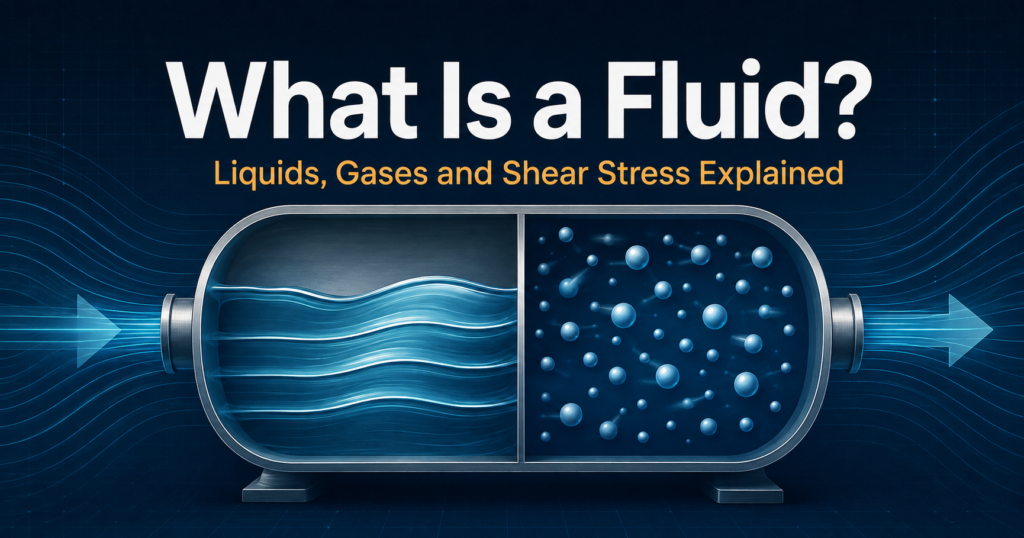
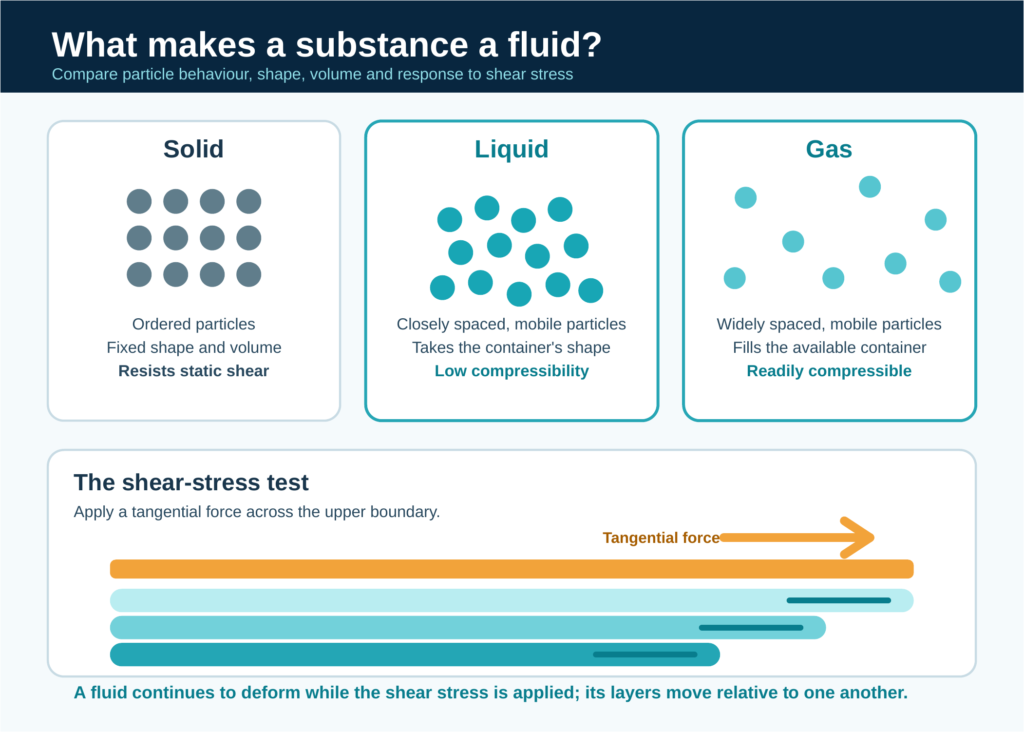
In engineering, a fluid is a substance that continuously deforms while subjected to shear stress. Both liquids and gases meet this definition because their particles can move relative to one another. A fluid may flow quickly or so slowly that its movement is difficult to observe, but it cannot remain permanently at rest while a sustained shear stress acts upon it.
Understanding this definition provides the foundation for studying pressure, viscosity, hydraulics, aerodynamics and almost every other area of fluid mechanics.
What is the engineering definition of a fluid?
A fluid is a substance that continuously changes shape when exposed to a tangential force.
A tangential force acts parallel to a surface. When this force is divided by the area over which it acts, it produces shear stress.
A solid can resist a moderate shear stress by deforming through a limited amount. If the force remains within the material’s elastic range, the solid can reach a new equilibrium without continuing to change shape.
A fluid behaves differently. Its layers continue moving relative to one another for as long as the shear stress is maintained. Massachusetts Institute of Technology fluid-mechanics notes make this distinction by comparing the limited deformation of a solid with the continuously increasing deformation of a fluid under shear stress.[1]
This does not mean that a fluid offers no resistance to motion. Real fluids resist relative movement through viscosity. The important distinction is that this resistance affects the rate of deformation; it does not allow a fluid to maintain a fixed shape under sustained shear stress.
Why is tar still a fluid?
Water pours easily, so its classification as a fluid seems obvious. Tar can appear almost solid because its viscosity is much higher.
However, if a quantity of tar is placed on a surface and exposed to gravity for long enough, it gradually spreads. Its particles change their relative positions, and the material adopts a new shape.
The speed of flow does not determine whether something is a fluid. Tar, honey and treacle are fluids because they continue to deform under sustained shear stress, even though they do so slowly.
This distinction is useful when examining lubricants, polymers, coatings and other industrial materials that may behave differently under changing temperatures and loading conditions.
Solids, liquids and gases compared
Solids, liquids and gases all consist of particles, but their particle arrangements and responses to force differ.
| Property | Solid | Liquid | Gas |
|---|---|---|---|
| Shape | Retains a defined shape | Takes the shape of its container | Expands to fill its container |
| Volume | Normally has a defined volume | Has an approximately defined volume | Has no fixed volume |
| Particle spacing | Closely packed and ordered | Closely packed but mobile | Much more widely separated |
| Movement | Particles vibrate around relatively fixed positions | Particles move past one another | Particles move freely throughout the available volume |
| Compressibility | Usually low | Usually low under ordinary conditions | Relatively high |
| Response to sustained shear | Can resist without continuously deforming | Continues to deform | Continues to deform |
Liquids and gases are therefore both fluids. Their shared ability to deform continuously is more important to the engineering definition than their visible differences.
How does a liquid behave?
The particles in a liquid are close together, but they are not held in the fixed arrangement associated with a solid. They can move and slide past neighbouring particles.
Consequently, a liquid normally:
- takes the shape of the part of its container that it occupies;
- retains an approximately fixed volume;
- forms an interface or free surface where it meets a gas;
- flows when an appropriate force or pressure difference is applied; and
- experiences relatively small volume changes under ordinary pressure variations.
Water in a bottle provides a simple example. The water adopts the shape of the lower part of the bottle, but it does not expand to fill the air space above it.
How does a gas behave?
Gas particles are much more widely separated than particles in a liquid. They move freely and collide with each other and with the boundaries of their container.
A gas therefore:
- has no fixed shape;
- has no fixed volume;
- expands to occupy its available container;
- changes density as it is compressed or expanded; and
- responds noticeably to changes in pressure and temperature.
Air is a fluid even though it cannot normally be seen. It flows through ducts, around vehicles, across turbine blades and over aircraft wings.
The relationship between pressure, temperature and gas volume is examined more closely in the guide to ideal gas laws and their engineering applications.
Are liquids really incompressible?
Liquids are commonly described as incompressible, but this is an engineering approximation rather than an absolute rule.
All real liquids can be compressed to some degree. Under ordinary engineering pressures, however, their changes in volume are often so small that treating density as constant produces a sufficiently accurate and much simpler analysis.
The United States Geological Survey describes water as essentially incompressible under normal conditions while explaining that sufficiently high pressures can still produce a small reduction in its volume.[2]
The incompressible-fluid assumption is particularly useful when analysing:
- hydraulic cylinders;
- water distribution systems;
- pumps and turbines;
- low-speed liquid flow;
- fire hoses; and
- many pipeline systems.
Engineers must reconsider the assumption where pressure changes are exceptionally large, where rapid transients cause water hammer, or where small density changes materially affect the result.
Gases are generally more compressible because their particles have considerably more space between them. Increasing the pressure can move those particles closer together and reduce the gas volume.
Why are fluids treated as continuous materials?
At the microscopic level, every liquid and gas consists of individual particles separated by spaces. Tracking every particle would be impractical in most engineering calculations.
Fluid mechanics therefore normally uses the continuum model. Under this model, the fluid is treated as a continuous material whose properties can be defined at every point.
The continuum approach allows engineers to describe properties such as:
- pressure;
- density;
- temperature;
- velocity; and
- viscosity.
Although these properties ultimately result from molecular behaviour, they can normally be measured and analysed without calculating the motion of every molecule. MIT’s introductory fluid-mechanics material illustrates this distinction by explaining when liquids and gases can be treated as continuous media at engineering scales.[1]
The approximation can become less reliable in specialised situations where molecular distances are no longer extremely small compared with the equipment or flow region. Examples can include very low-density gases and certain microscale systems.
What properties describe a fluid?
Identifying a material as a fluid is only the beginning. Engineers must also understand the properties that determine how it behaves.
Density
Density measures the amount of mass contained within a given volume.
A dense fluid contains more mass within the same volume than a less dense fluid. Density affects hydrostatic pressure, buoyancy, mass flow and the forces acting on engineering components.
Density must not be confused with viscosity. A fluid can be dense without being highly viscous, and it can be viscous without having an unusually high density.
Pressure
Pressure is the normal force exerted per unit area. In a stationary fluid, pressure acts perpendicular to any surface.
Atmospheric pressure, gauge pressure and absolute pressure provide different reference points for pressure measurements. These concepts and their calculations are covered in the existing guide to pressure in fluids and engineering problems.
Viscosity
Viscosity describes a fluid’s resistance to the relative motion of its layers.
A low-viscosity liquid such as water flows comparatively easily. Honey and tar have higher viscosities and flow more slowly under similar conditions.
Viscosity is sometimes called “thickness”, but this description can be misleading. It is a measurable transport property rather than simply a visual characteristic.
Temperature can also change viscosity significantly. The practical effects on machinery and oil selection are explained in Lubricant Viscosity Explained: How to Choose Machine Oil.
Compressibility
Compressibility describes how much a fluid’s volume changes when pressure changes.
Gases are normally much more compressible than liquids. This difference determines whether density can be treated as constant and influences the equations engineers select for a problem.
Surface tension
Molecules at a liquid surface experience a different balance of intermolecular forces from those within the liquid. This produces surface tension and helps explain droplets, bubbles, capillary action and wetting behaviour.
These mechanisms are examined in Surface Tension Explained: Cohesion, Adhesion and Engineering Applications.
The National Institute of Standards and Technology maintains thermophysical data for properties including density, viscosity, thermal conductivity and surface tension, demonstrating the range of fluid properties required in engineering analysis.[3]
Where do engineers work with fluids?
Fluids are involved in almost every engineering sector.
Hydraulic systems
Hydraulic equipment uses pressurised liquid to transmit force. The relatively low compressibility of hydraulic fluid helps produce controlled and predictable actuator movement.
Pumps and pipelines
Engineers must consider pressure, density, viscosity and flow rate when selecting pumps and designing pipelines. Ignoring one property can cause excessive energy consumption, poor performance or damaging pressure conditions.
Aerodynamics
Airflow around an aircraft, vehicle or turbine blade creates pressure distributions and aerodynamic forces. Gas density and compressibility become increasingly important as flow speed increases.
The relationship between fluid velocity, pressure and elevation is introduced in the guide to Bernoulli’s principle.
Lubrication
Oil and grease form fluid films that separate moving surfaces. Their viscosity must be appropriate for the operating temperature, speed and load.
Heating, ventilation and process engineering
Fans, compressors, refrigeration systems, heat exchangers and industrial processing equipment all depend on controlled liquid or gas flow.
A practical framework for describing any fluid
When approaching a fluid-mechanics problem, begin with five questions:
- Is the material a liquid or a gas?
This provides an initial indication of its likely compressibility and volume behaviour. - What causes the fluid to move?
Look for pressure differences, gravity, moving boundaries, pumps or buoyancy effects. - Can density be treated as constant?
This determines whether an incompressible approximation is reasonable. - How important is viscosity?
Viscosity influences internal resistance, velocity distribution and energy losses. - Are interfaces important?
Surface tension may be significant where droplets, bubbles, narrow tubes or wetting are involved.
These questions do not replace a detailed calculation, but they help identify the correct physical model before equations are selected.
Develop your understanding of fluid mechanics
For focused study of fluid properties, pressure, fluid statics and fluid dynamics, the Diploma in Fluid Mechanics provides the closest subject-specific route. It is a 40-credit EduQual Level 5 qualification.
Learners seeking a broader mechanical-engineering foundation can consider the Higher International Certificate in Mechanical Engineering, a Level 4 qualification worth 120 credits.
The Higher International Diploma in Mechanical Engineering provides 240 credits in total and incorporates Level 4 study. Its published Level 5 curriculum includes a specialist Fluid Mechanics unit.
For more advanced and extensive mechanical-engineering study, the International Graduate Diploma in Mechanical Engineering provides 360 credits in total and incorporates the Level 5 pathway.
Choose the Diploma in Fluid Mechanics for focused professional development, or compare the broader mechanical-engineering pathways if you want to develop knowledge across a wider range of engineering subjects.
Frequently asked questions
Is air a fluid?
Yes. Air is a gas, and gases are fluids because they continuously deform under shear stress and expand to fill their available space.
Is tar a solid or a fluid?
Tar is a highly viscous fluid. It may appear solid over a short observation period, but it gradually deforms and flows while subjected to sustained stress.
Can a fluid resist shear stress?
A moving real fluid develops viscous shear stresses that resist relative movement between its layers. However, it cannot remain at rest while sustaining a shear stress. Continued shear produces continued deformation.
Are liquids completely incompressible?
No. Real liquids can be compressed, but the volume change is often sufficiently small for engineers to treat them as incompressible under ordinary conditions.
What is the difference between density and viscosity?
Density is mass per unit volume. Viscosity measures resistance to relative motion within a fluid. They describe different properties and should not be used interchangeably.
Why does a gas fill its container while a liquid does not?
Gas particles are widely separated and move throughout the available space. Liquid particles remain much closer together, giving a liquid an approximately fixed volume even though it takes the shape of its container.
References
[1] Massachusetts Institute of Technology — Fluids: Lecture 1 Notes
[2] United States Geological Survey — Water Compressibility
[3] National Institute of Standards and Technology — Thermophysical Properties of Fluid Systems
Interested in our engineering courses?
We have over 70 courses across all major engineering disciplines, including, mechanical, electrical and electronic, civil, aerospace, industrial, computer and general engineering. Visit our course catalogue for a complete list of fully accredited engineering programmes.
A small selection of short Engineering courses …
Diploma in Mechanical Engineering
Diploma in Aerospace Engineering
Level 6 Engineering Courses
International Graduate Diploma in Mechanical Engineering
International Graduate Diploma in Aerospace Engineering
Level 5 Engineering Courses
Higher International Diploma in Mechanical Engineering
Higher International Diploma in Aerospace Engineering
Level 4 Engineering Courses
Higher International Certificate in Mechanical Engineering
Higher International Certificate in Aerospace Engineering
View Engineering Courses
Explore our UK-accredited engineering courses. 100% Online with no schedules, no deadlines and no exams.
Recent Posts
Types of Aircraft Drag Explained: Induced, Profile and Interference Drag
Types of Aircraft Drag Explained: Induced, Profile and Interference Drag An aircraft experiences several forms of aerodynamic drag at the same time. Some result from generating lift, some arise as air flows over the aircraft’s surfaces, and others are created when airflow around neighbouring components interacts. For a conventional aircraft in subsonic flight, total drag […]
Induced Drag Explained: Why Flying Slower Can Increase Drag
Induced Drag Explained: Why Flying Slower Can Increase Drag Why can an aircraft experience more drag when it flies more slowly? We usually associate greater speed with greater air resistance, but a wing must also generate enough lift to support the aircraft. Induced drag is the drag associated with producing lift on a finite-span wing. […]
Laminar vs Turbulent Boundary Layers: Why Airflow Separates from Aircraft Wings
Laminar vs Turbulent Boundary Layers: Why Airflow Separates from Aircraft Wings Airflow around an aircraft wing is often shown as smooth streamlines passing neatly over the aerofoil. In reality, the thin layer of air immediately next to the wing surface behaves very differently from the undisturbed airflow further away. This region is called the boundary […]