

How Aerospace Structures Are Built: Components and Structural Layout
Introduction
Aerospace structures are engineered to withstand extreme loads, pressure changes, and environmental conditions while remaining as lightweight as possible. The structural design of an aircraft or spacecraft relies on a carefully arranged system of components that work together to provide strength, stability, and aerodynamic efficiency. From the outer skin to internal frames, stringers, and spars, each structural element plays a crucial role in maintaining integrity during flight. This blog explores the typical components used in aerospace structures and how their layout contributes to the overall performance and safety of modern aircraft.
Function of the Structure
The primary functions of an aircraft’s structure can be basically broken down into the following:
· To transmit & resist applied loads.
· To provide and maintain aerodynamic shape.
· To protect its crew, passengers, payload, systems, etc.
For the vast majority of aircraft, this leads to the use of a semi-monocoque design (i.e. a thin, stressed outer shell with additional stiffening members) for the wing, fuselage & empennage.
Aircraft Structure
According to the current Title 14 of the Code of Federal Regulations (14 CFR) part 1, Definitions and Abbreviations, an aircraft is a device that is used, or intended to be used, for flight. Categories of aircraft for certification of airmen include airplane, rotorcraft, lighter-than-air, powered-lift, and glider. Part 1 also defines an airplane as an engine-driven, fixed-wing aircraft heavier than air that is supported in flight by the dynamic reaction of air against its wings.
Major components
Although aircraft are designed for a variety of purposes, most of them have the same major components. The overall characteristics are largely determined by the original design objectives. Most aircraft structures include a fuselage, wings, an empennage, landing gear, and a powerplant.
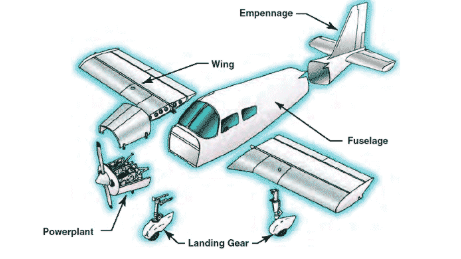
Fuselage
The fuselage includes the cabin and/or cockpit, which contains seats for the occupants and the controls for the aeroplane. In addition, the fuselage may also provide room for cargo and attachment points for the other major aeroplane components. Some aircraft utilise an open truss structure. The truss-type fuselage is constructed of steel or aluminium tubing. Strength and rigidity is achieved by welding the tubing together into a series of triangular shapes, called trusses.
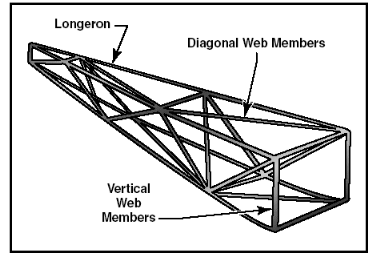
Construction of the Warren truss features longerons, as well as diagonal and vertical web members. To reduce weight, small aeroplanes generally utilise aluminium alloy tubing, which may be riveted or bolted into one piece with cross-bracing members.
As technology progressed, aircraft designers began to enclose the truss members to streamline the aeroplane and improve performance. This was originally accomplished with cloth fabric, which eventually gave way to lightweight metals such as aluminium. In some cases, the outside skin can support all or a major portion of the flight loads. Most modern aircraft use a form of this stressed skin structure known as monocoque or semi monocoque construction.
The monocoque design uses stressed skin to support almost all imposed loads. This structure can be very strong but cannot tolerate dents or deformation of the surface. This characteristic is easily demonstrated by a thin aluminium beverage can. You can exert considerable force to the ends of the can without causing any damage.
However, if the side of the can is dented only slightly, the can will collapse easily. The true monocoque construction mainly consists of the skin, formers, and bulkheads. The formers and bulkheads provide shape for the fuselage.
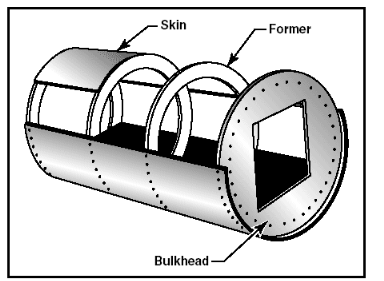
Since no bracing members are present, the skin must be strong enough to keep the fuselage rigid. Thus, a significant problem involved in monocoque construction is maintaining enough strength while keeping the weight within allowable limits. Due to the limitations of the monocoque design, a semi-monocoque structure is used on many of today’s aircraft.
The semi-monocoque system uses a substructure to which the aeroplane’s skin is attached. The substructure, which consists of bulkheads and/or formers of various sizes and stringers, reinforces the stressed skin by taking some of the bending stress from the fuselage.
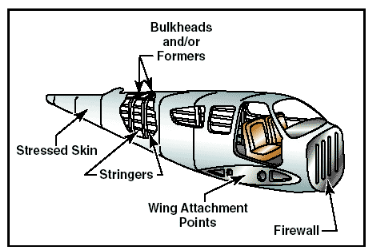
The main section of the fuselage also includes wing attachment points and a firewall.
On single-engine aeroplanes, the engine is usually attached to the front of the fuselage. There is a fireproof partition between the rear of the engine and the cockpit or cabin to protect the pilot and passengers from accidental engine fires. This partition is called a firewall and is usually made of heat-resistant material such as stainless steel.
Wings
The wings are airfoils attached to each side of the fuselage and are the main lifting surfaces that support the aeroplane in flight. There are numerous wing designs, sizes, and shapes used by the various manufacturers. Each fulfils a certain need with respect to the expected performance for the particular aeroplane.
Wings may be attached at the top, middle, or lower portion of the fuselage. These designs are referred to as high-, mid-, and low-wing, respectively. The number of wings can also vary. Aeroplanes with a single set of wings are referred to as monoplanes, while those with two sets are called biplanes.
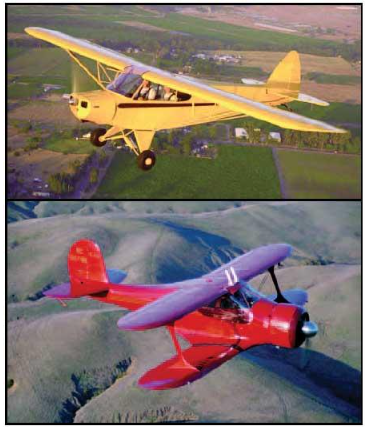
Many high-wing aeroplanes have external braces, or wing struts, which transmit the flight and landing loads through the struts to the main fuselage structure. Since the wing struts are usually attached approximately halfway out on the wing, this type of wing structure is called semi-cantilever. A few high-wing and most low-wing aeroplanes have a full cantilever wing designed to carry the loads without external struts.
The principal structural parts of the wing are spars, ribs, and stringers.
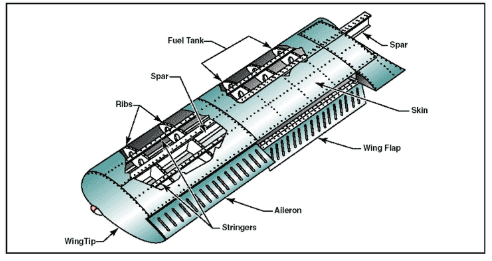
These are reinforced by trusses, I-beams, tubing, or other devices, including the skin. The wing ribs determine the shape and thickness of the wing (airfoil). In most modern aeroplanes, the fuel tanks either are an integral part of the wing´s structure, or consist of flexible containers mounted inside of the wing.
Attached to the rear, or trailing edges of the wings are two types of control surfaces referred to as ailerons and flaps.
Ailerons extend from about the midpoint of each wing outward toward the tip and move in opposite directions to create aerodynamic forces that cause the aeroplane to roll.
Flaps extend outward from the fuselage to near the midpoint of each wing. The flaps are normally flush with the wing´s surface during cruising flight. When extended, the flaps move simultaneously downward to increase the lifting force of the wing for takeoffs and landings.
Empennage
The correct name for the tail section of an aeroplane is empennage. The empennage includes the entire tail group, consisting of fixed surfaces such as the vertical stabilizer and the horizontal stabilizer. The movable surfaces include the rudder, the elevator, and one or more trim tabs.
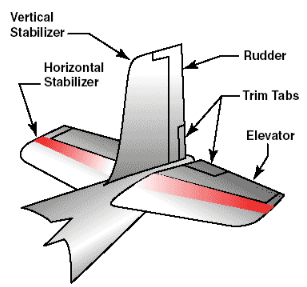
A second type of empennage design does not require an elevator. Instead, it incorporates a one-piece horizontal stabilizer that pivots from a central hinge point.
This type of design is called a stabilator, and is moved using the control wheel, just as you would the elevator.
For example, when you pull back on the control wheel, the stabilator pivots so the trailing edge moves up. This increases the aerodynamic tail load and causes the nose of the aeroplane to move up. Stabilators have an antiservo tab extending across their trailing edge.
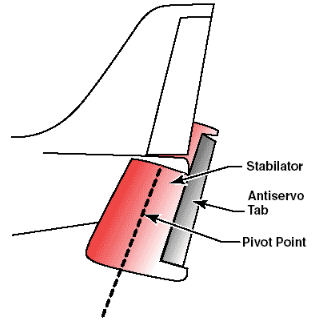
The antiservo tab moves in the same direction as the trailing edge of the stabilator. The antiservo tab also functions as a trim tab to relieve control pressures and helps maintain the stabilator in the desired position.
The rudder is attached to the back of the vertical stabilizer.
During flight, it is used to move the aeroplane’s nose left and right. The rudder is used in combination with the ailerons for turns during flight. The elevator, which is attached to the back of the horizontal stabilizer, is used to move the nose of the aeroplane up and down during flight.
Trim tabs are small, movable portions of the trailing edge of the control surface. These movable trim tabs, which are controlled from the cockpit, reduce control pressures. Trim tabs may be installed on the ailerons, the rudder, and/or the elevator.
Landing gear
The landing gear is the principle support of the aeroplane when parked, taxiing, taking off, or when landing. The most common type of landing gear consists of wheels, but aeroplanes can also be equipped with floats for water operations, or skis for landing on snow.
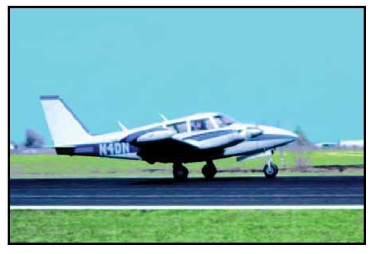
The landing gear consists of three sets of wheels, two main wheels and a third wheel positioned either at the front or rear of the aeroplane. Landing gear employing a rear mounted wheel is called conventional landing gear.
Aeroplanes with conventional landing gear are sometimes referred to as tailwheel aeroplanes. When the third wheel is located on the nose, it is called a nosewheel, and the design is referred to as a tricycle gear. A steerable nosewheel or tailwheel permits the aeroplane to be controlled throughout all operations while on the ground.
The powerplant
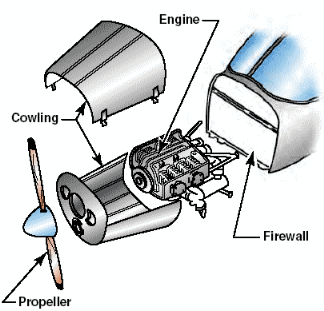
The powerplant usually includes both the engine and the propeller. The primary function of the engine is to provide the power to turn the propeller. It also generates electrical power, provides a vacuum source for some flight instruments, and in most single-engine aeroplanes, provides a source of heat for the pilot and passengers. The engine is covered by a cowling, or in the case of some aeroplanes, surrounded by a nacelle.
The purpose of the cowling or nacelle is to streamline the flow of air around the engine and to help cool the engine by ducting air around the cylinders. The propeller, mounted on the front of the engine, translates the rotating force of the engine into a forward acting force called thrust that helps move the aeroplane through the air.
Interested in our Aerospace Engineering Courses?
At iLearn Engineering®, we offer a diverse range of online accredited aerospace engineering courses and qualifications to cater to different academic and career goals. Our aerospace courses are available in varying credit values and levels, ranging from 40 credit Engineering Diplomas to a Bachelor’s equivalent 360 credit International Graduate Diploma.
All Aerospace Engineering Courses
All Aerospace Engineering Diploma Courses can be seen here.
Short Aerospace Courses (40 Credits)
- Diploma in Aerospace Engineering
- Diploma in Aircraft Design
- Diploma in Principles of Flight
- Diploma in Aerospace Structures
- Diploma in Aerodynamics
- Diploma in Aerodynamics, Propulsion and Space
First Year of Undergraduate (Level 4 – 120 Credits)
Higher International Certificate in Aerospace Engineering
Years One and Two of Undergraduate (Level 5 – 240 Credits)
Higher International Diploma in Aerospace Engineering
Degree Equivalent International Graduate Diploma (Level 6 – 360 Credits)
International Graduate Diploma in Aerospace Engineering
Complete Engineering Course Catalogue (all courses)
Alternatively, you can view all our online engineering courses here.
Recent Posts
Why a Headwind Reduces Take-Off Distance: The Airspeed–Groundspeed Derivation
Why a Headwind Reduces Take-Off Distance: The Airspeed–Groundspeed Derivation Aeroplanes normally take off into wind because the wing must reach a required airspeed to produce lift, whereas the runway distance is travelled at groundspeed. A headwind contributes to the airspeed before the aircraft has covered any runway. It therefore reduces the groundspeed required at lift-off […]
How to Calculate Aircraft Take-Off Ground Run: A Flight Mechanics Tutorial
How to Calculate Aircraft Take-Off Ground Run: A Flight Mechanics Tutorial An aircraft does not become airborne simply because its engines are producing thrust. During the take-off ground run, thrust must overcome aerodynamic drag and rolling resistance. On a sloping runway, it must also overcome a component of the aircraft’s weight. This tutorial derives a […]
Types of Aircraft Drag Explained: Induced, Profile and Interference Drag
Types of Aircraft Drag Explained: Induced, Profile and Interference Drag An aircraft experiences several forms of aerodynamic drag at the same time. Some result from generating lift, some arise as air flows over the aircraft’s surfaces, and others are created when airflow around neighbouring components interacts. For a conventional aircraft in subsonic flight, total drag […]