

How Aircraft Design Shapes Longitudinal Stability
Introduction
This blog will aim to link this to certain design features that aircraft use to improve their stability and mitigate the negative effects of disturbances.
Dynamic Stability
The dynamic stability of an aircraft simply describes how the aircraft behaves after the disturbance has taken place. The dynamic stability of an aeroplane involves the amount of time it takes for it to react to its static stability after it has been displaced from a condition of equilibrium. Dynamic stability involves the oscillations that typically occur as the aeroplane tries to return to its original position or attitude.
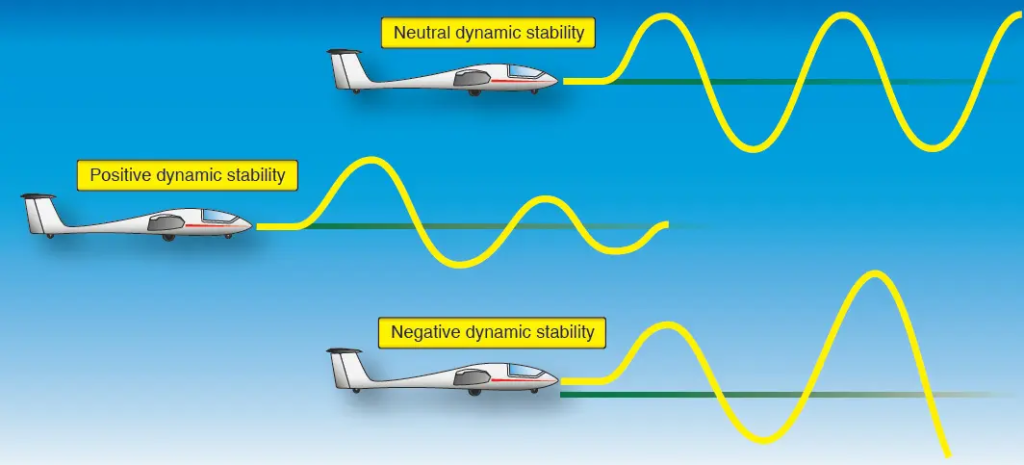
Even though an aeroplane may have positive static stability, it may have dynamic stability which is positive, neutral, or negative.
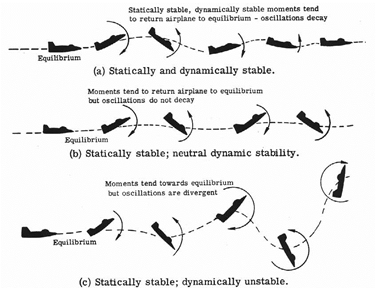
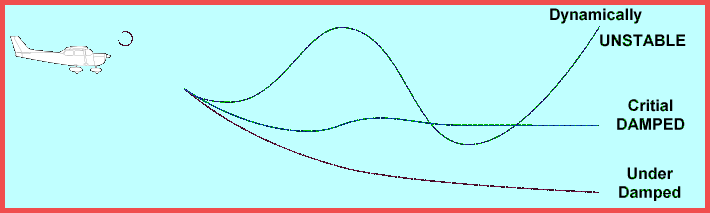
Consider the three scenarios depicted above, and imagine this is in relation to longitudinal stability. The aircraft has positive static and dynamic stability. The static portion refers to the fact that after a disturbance has taken place causing the aircraft to pitch nose up, the initial tendency of the aircraft is to go nose down (a statically unstable aircraft would continue to pitch up) The positive dynamic stability is referring to how the aircraft reacts over time and as the oscillations are getting smaller, it is positive.
In b the initial tendency is again to pitch nose down, however the aircraft is unable to reduce the amplitude of oscillations over time and they stay the same size and hence it has neutral dynamic stability.
The final case in c shows that over time the size of oscillations is increasing as the aircraft is initially trying to correct the disturbance, however, the negative dynamic stability is causing this to overshoot more and more each oscillation. In this case the restoring moments are tending towards equilibrium but the size of oscillations are diverging and becoming larger.
Design Features to Improve Longitudinal Static Stability
When an aircraft experiences a disturbance that pitches the nose up an aircraft with positive longitudinal stability will create a restoring moment to bring the aircraft back to level flight. It creates this restorative moment through the increased lift generated by the tail. It thereby follows that the angle of attack, surface area and position of the tail will all have an effect on the longitudinal stability of an aircraft.
The tail plane is usually set at an angle less than that of the main planes, the angle between the chord of the tail plane and the chord of the main planes is known as the longitudinal dihedral

This longitudinal dihedral is a practical characteristic of most types of aeroplane, but so many considerations enter into the problem that it cannot be said that an aeroplane which does not possess this feature is necessarily unstable longitudinally.
In any case, it is the actual angle at which the tail plane strikes the airflow, which matters; therefore we must not forget the downwash from the main planes. This downwash, if the tail plane is in the stream, will cause the actual angle of attack to be less than the angle at which the tail plane is set. For this reason, even if the tail plane is set at the same angle as the main planes, there will in effect be a longitudinal dihedral angle, and this may help the aeroplane to be longitudinally stable.
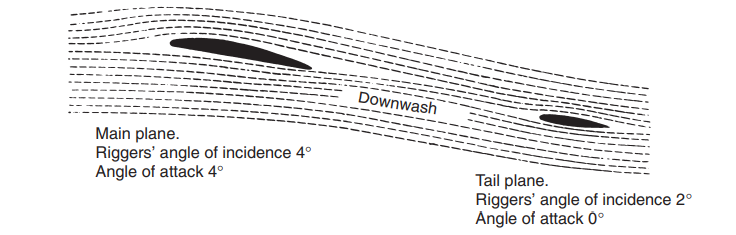
Suppose an aeroplane to be flying so that the angle of attack of the main planes is 4° and the angle of attack of the tail plane is 2°; a sudden gust causes the nose to rise, inclining the longitudinal axis of the aeroplane by 1°. What will happen? The momentum of the aeroplane will cause it temporarily to continue moving practically in its original direction and at its previous speed. Therefore the angle of attack of the main planes will become nearly 5° and of the tail plane nearly 3°.
The pitching moment about the centre of gravity of the main planes will probably have a nose-up, i.e. unstable tendency, but that of the tail plane, with its long leverage about the centre of gravity, will definitely have a nose-down tendency. If the restoring moment caused by the tail plane is greater than the upsetting moment caused by the main planes, and possibly the fuselage, then the aircraft will be stable.
The further forward the center of gravity of the aircraft the greater the moment arm for the tailplane, and therefore the greater the turning effect of the tailplane lift force. This has a very stabilising effect longitudinally. The position of the center of gravity can be marginally controlled by the Pilot by the disposition of payload and fuel, usually done prior to flight. A forward center of gravity leads to increased longitudinal stability and an aft movement of the center of gravity leads to reduced longitudinal stability.
Limits are laid down for the range within which the center of gravity must lie for safe flight and a prudent Pilot always loads his aeroplane and checks the trim sheet to ensure that this is so. If the center of gravity is behind the legally allowable aft limit, the restoring moment of the tailplane in pitch may be insufficient for longitudinal stability. A center of gravity further forward leads to more stability.
The more stable the aeroplane, the greater the control force the Pilot must exert to control or move the aeroplane in manoeuvres, which can become tiring. Also, if the center of gravity is too far forward, the elevator may not be sufficiently effective at low speeds to flare the nose-heavy aircraft for landing.
Longitudinal Dynamic Stability
The longitudinal dynamic stability specifically refers to the response of an aircraft over time to an initial nose up or nose down pitch. The diagram illustrates positive longitudinal dynamic stability: a series of damped oscillations of constant period, or frequency, and diminishing amplitude, that bring the aircraft back to the trimmed condition after a displacement. Period is time per cycle. Frequency, which is inversely proportional to period, is cycles per unit of time. Amplitude is the difference between the crest or the trough and the original equilibrium condition. Damping is the force that decreases the amplitude of the oscillation with each cycle. The damping ratio, ζ, is the time for one cycle divided by the total time it takes for the oscillation to subside. The higher the damping ratio, the more quickly the motion disappears.
Damping defines much about the character of an aircraft. If damping is too high, an aircraft may seem sluggish in response to control inputs. If damping is too low, turbulence or control inputs can excite the aircraft too readily; its behaviour appears skittish. There are two modes of pitch oscillation: the heavily damped short period mode (damping ratio about 0.3 or greater), followed by the lightly damped, and more familiar, long period, phugoid mode.
Drag effects, rather than tail movement, damp the phugoid. Raising parasite drag increases damping. With both the short period and the phugoid mode, an aft shift in center of gravity., close to the neutral point, will begin to produce an increase in period and a decrease in damping. Propellers add a damping factor absent with jets. If brake horsepower is constant, propeller thrust increases as airspeed decreases, and vice versa. This adds a forward force at the low-speed top of the phugoid and a restraining force at the highspeed bottom. This changing thrust/airspeed relationship helps reduce the speed variation from trim and thus helps damp the motion. The phugoid is sensitive to coefficient of lift, CL. At slow speeds, thus at high CL, both the period and the damping decrease. At high speeds, thus at low CL, both period and damping increase
Interested in our Aerospace Engineering Courses?
At iLearn Engineering®, we offer a diverse range of online accredited aerospace engineering courses and qualifications to cater to different academic and career goals. Our aerospace courses are available in varying credit values and levels, ranging from 40 credit Engineering Diplomas to a Bachelor’s equivalent 360 credit International Graduate Diploma.
All Aerospace Engineering Courses
All Aerospace Engineering Diploma Courses can be seen here.
Short Aerospace Courses (40 Credits)
- Diploma in Aerospace Engineering
- Diploma in Aircraft Design
- Diploma in Principles of Flight
- Diploma in Aerospace Structures
- Diploma in Aerodynamics
- Diploma in Aerodynamics, Propulsion and Space
First Year of Undergraduate (Level 4 – 120 Credits)
Higher International Certificate in Aerospace Engineering
Years One and Two of Undergraduate (Level 5 – 240 Credits)
Higher International Diploma in Aerospace Engineering
Degree Equivalent International Graduate Diploma (Level 6 – 360 Credits)
International Graduate Diploma in Aerospace Engineering
Complete Engineering Course Catalogue (all courses)
Alternatively, you can view all our online engineering courses here.
Recent Posts
Why a Headwind Reduces Take-Off Distance: The Airspeed–Groundspeed Derivation
Why a Headwind Reduces Take-Off Distance: The Airspeed–Groundspeed Derivation Aeroplanes normally take off into wind because the wing must reach a required airspeed to produce lift, whereas the runway distance is travelled at groundspeed. A headwind contributes to the airspeed before the aircraft has covered any runway. It therefore reduces the groundspeed required at lift-off […]
How to Calculate Aircraft Take-Off Ground Run: A Flight Mechanics Tutorial
How to Calculate Aircraft Take-Off Ground Run: A Flight Mechanics Tutorial An aircraft does not become airborne simply because its engines are producing thrust. During the take-off ground run, thrust must overcome aerodynamic drag and rolling resistance. On a sloping runway, it must also overcome a component of the aircraft’s weight. This tutorial derives a […]
Types of Aircraft Drag Explained: Induced, Profile and Interference Drag
Types of Aircraft Drag Explained: Induced, Profile and Interference Drag An aircraft experiences several forms of aerodynamic drag at the same time. Some result from generating lift, some arise as air flows over the aircraft’s surfaces, and others are created when airflow around neighbouring components interacts. For a conventional aircraft in subsonic flight, total drag […]