

How Aircraft Stay Balanced: Longitudinal Stability Made Simple
Introduction
In this blog we will examine and analyse the principles behind stability of aircraft, we will explore what is meant by the term stability and discuss ways in which the design of aircraft are influenced.
Generally speaking, the term stability refers to the ability of an aircraft to return to a specific flight condition after a disturbance. For example an aircraft that is in straight and level flight is disturbed (potentially by pilot control or an external disturbance) a stable aircraft will tend back to straight and level flight. An unstable aircraft under the same conditions would tend to move further away from the initial flight condition. The aircraft may tend to do neither of these and will simply remain in the new disturbed position, this would be neutrally stable aircraft.
Commercial aircraft are designed with an inherent stability, whilst this can lead to poorer manoeuvrability it is much safer. Some military aircraft on the other hand are designed with an inherent instability. This inherent instability gives increased manoeuvrability but does require more input of controls and is deemed unsafe for commercial use.
The diagram shows some of the ways in which an aircraft will behave when it is disturbed, it illustrates pitching motion of the aircraft, although the same principles can be applied to roll and yaw.
- The top line shows positive static stability and an ability to immediately return to initial pitch.
- The second is neutral stability, where the aircraft continues on its new pitch and does not correct.
- Finally the unstable case is where the aircraft will continue to pitch further nose down after the initial disturbance.
A longitudinally unstable aeroplane has a tendency to dive or climb progressively into a very steep dive or climb, or even a stall. Thus, an aeroplane with longitudinal instability becomes difficult and sometimes dangerous to fly.
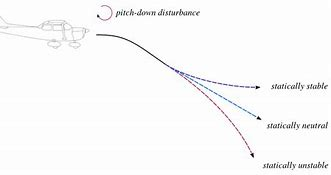
stable, neutrally stable and unstable aircraft
The terms stick free and stick fixed stability are conditions by which stick-fixed means that the elevators are held in their neutral position relative to the tail plane, whereas stick-free means that the pilot releases the control column and allows the elevators to take up their own positions. We use the term control to represent the power of the pilot to manoeuvre the aircraft into a desired position. We are considering longitudinal static stability which is concerned with how stable the aircraft is in terms of pitching around the lateral axis, in response to an initial disturbance.
Longitudinal static stability is dependent on the following factors:
1. Location of the wing with respect to the centre of gravity;
2. Location of the horizontal tail surfaces with respect to the centre of gravity; and
3. The area or size of the tail surfaces.
In order for the aircraft to be longitudinally stable the relation of the wing and tail moments must be such that, if the moments are initially balanced and the aeroplane is suddenly nosed up, the wing moments and tail moments will change so that the sum of their forces will provide an unbalanced but restoring moments which in turn, will bring the nose down again. Similarly, if the aeroplane is nosed down, the resulting change in moments will bring the nose back up.
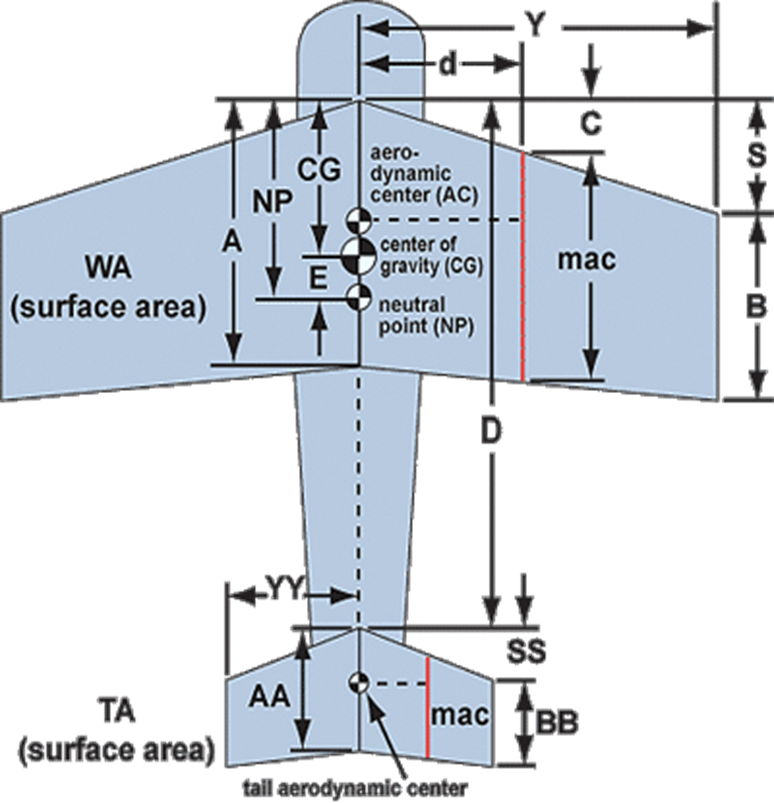
As noted above in the list the longitudinal stability of an aircraft is significantly affected by the distance between the centre of gravity and the aerodynamic centre. The centre of gravity is where the weight of the aircraft is considered to act and is influenced by design, loading, passengers and payload. The aerodynamic centre is the average position at which the forces are considered to act on a wing, such as lift. Similar in principle to centre of gravity being the average position of weight. In most common aircraft the aerodynamic centre is approximately one quarter of a chord length. Aircraft with the centre of gravity forward of the aerodynamic centre can be considered longitudinally stable. If the centre of gravity is aft of the aerodynamic centre it is considered unstable.
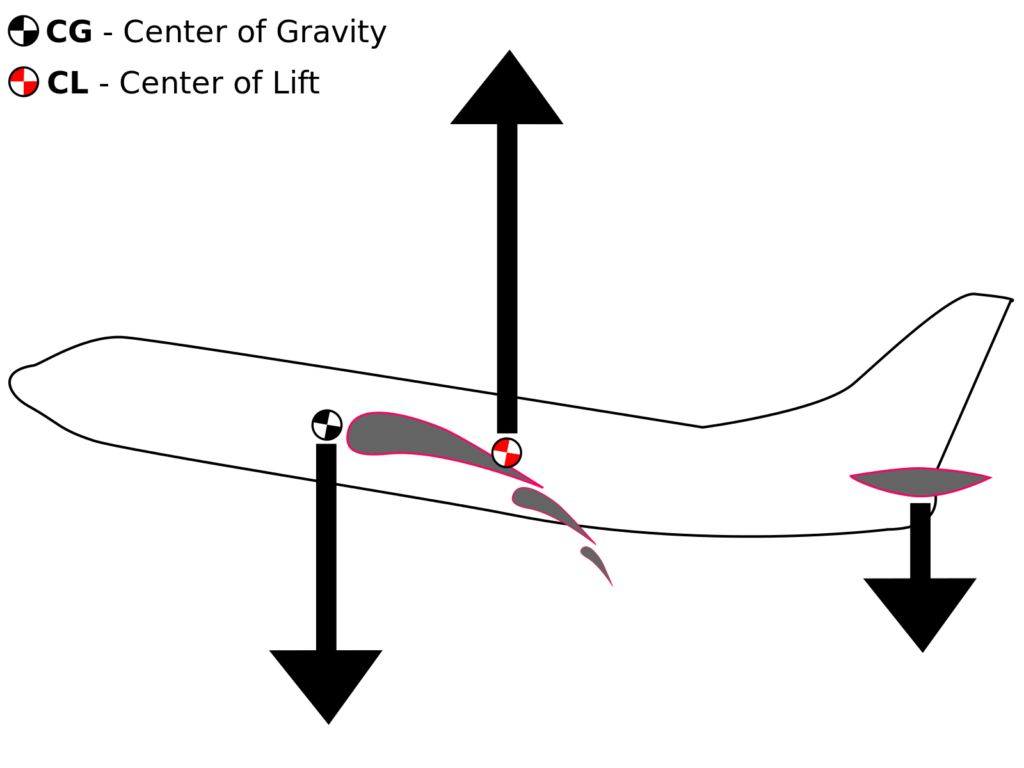
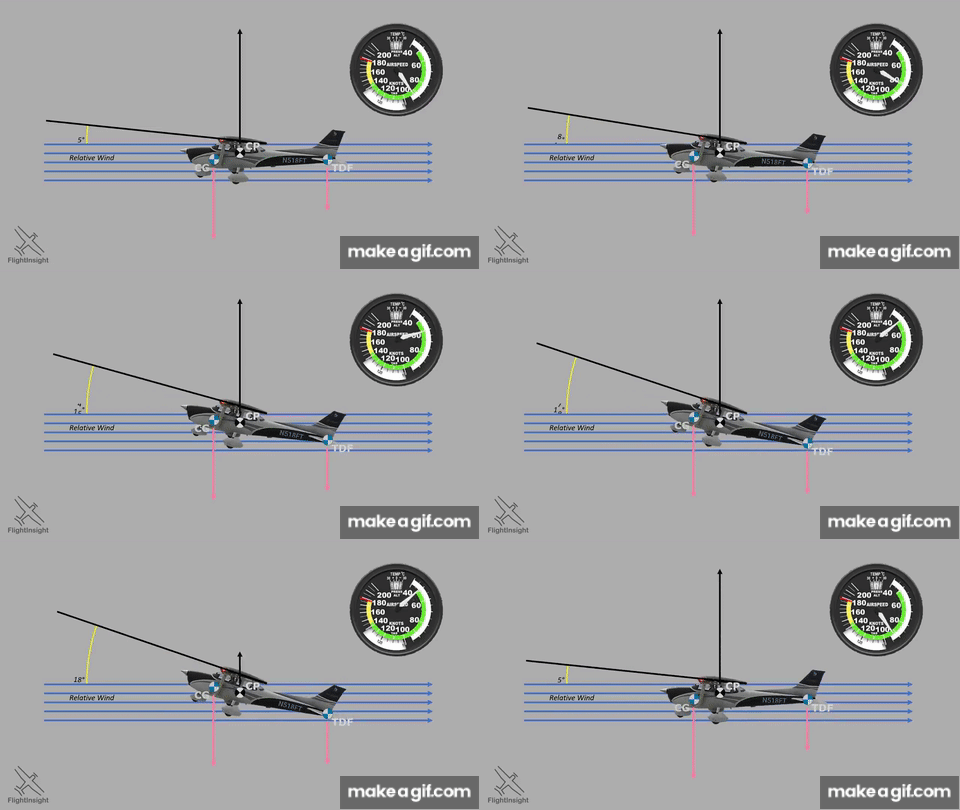
The centre of pressure in most unsymmetrical airfoils has a tendency to change its fore and aft position with a change in the angle of attack. The centre of pressure tends to move forward with an increase in angle of attack and to move aft with a decrease in angle of attack. This means that when the angle of attack of an airfoil is increased, the centre of pressure moves forward and tends to lift the leading edge of the wing more. This tendency gives the wing an inherent quality of instability. This instability must be counteracted by the moment created by the tail plane.
If we imagine a disturbance taking place which pitches the aircraft upwards in the diagram below – this also increases the relative angle of attack of the tail plane, which in turn increases the lift and so the downforce which would be generated in level flight now acts upwards. This causes an anticlockwise moment around the centre of gravity which leads to restoring the aircraft to level flight.
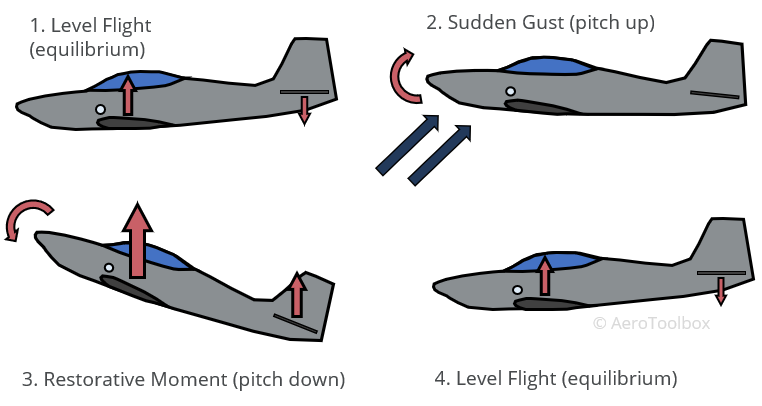
Stable aircraft reacting to disturbance
Because of the great length of the moment arm between the centre of gravity and the tailplane, the Lift force produced by the tailplane need not be large for its turning effect to be quite powerful. The further forward the center of gravity of the aircraft the greater the moment arm for the tailplane, and therefore the greater the turning effect of the tailplane lift force. As the tail is raised and the nose pitches back down, the original angle of attack is restored, the extra upwards lift force from the tailplane disappears and things are back to where they were prior to the disturbance. In this way the changes caused in the tailplane Lift force have led to longitudinal stability. The more stable the aeroplane, the greater the control force the Pilot must exert to control or move the aeroplane in manoeuvres, which can become tiring. Also, if the center of gravity is too far forward, the elevator may not be sufficiently effective at low speeds to flare the nose-heavy aircraft for landing.
A good example of the stabilising effect of a tailplane is the passage of a dart or an arrow through the air, in which the tail-fins act as a tailplane to maintain longitudinal stability.
When the angle of attack of an aircraft changes, the net change in lift generated by the wings, stabiliser, and fuselage acts at the neutral point. There is no moment change about the neutral point as angle of attack changes, only a change in lift force. In order for an aircraft to be longitudinally stable, the centre of gravity must be ahead of the neutral point. The diagram below shows the key points of interest relating to longitudinal stability. The Neutral point is the position of centre of gravity where stability would be neutral. is defined as the distance between the centre of gravity and the neutral point of the aircraft (E). There are actually two static stability neutral points: stick-fixed (elevator and trim tab held in the prevailing trim position), and stick-free (hands off, elevator allowed to float in streamline as the angle of attack at the tail changes).
In flight-testing, stick-fixed stability determines the amount of control and elevator movement needed to change airspeed (or center of lift, or α) from trim. Stick-free stability determines the required force.
Interested in our Aerospace Engineering Courses?
At iLearn Engineering®, we offer a diverse range of online accredited aerospace engineering courses and qualifications to cater to different academic and career goals. Our aerospace courses are available in varying credit values and levels, ranging from 40 credit Engineering Diplomas to a Bachelor’s equivalent 360 credit International Graduate Diploma.
All Aerospace Engineering Courses
All Aerospace Engineering Diploma Courses can be seen here.
Short Aerospace Courses (40 Credits)
- Diploma in Aerospace Engineering
- Diploma in Aircraft Design
- Diploma in Principles of Flight
- Diploma in Aerospace Structures
- Diploma in Aerodynamics
- Diploma in Aerodynamics, Propulsion and Space
First Year of Undergraduate (Level 4 – 120 Credits)
Higher International Certificate in Aerospace Engineering
Years One and Two of Undergraduate (Level 5 – 240 Credits)
Higher International Diploma in Aerospace Engineering
Degree Equivalent International Graduate Diploma (Level 6 – 360 Credits)
International Graduate Diploma in Aerospace Engineering
Complete Engineering Course Catalogue (all courses)
Alternatively, you can view all our online engineering courses here.
Recent Posts
Civil Engineering Courses and Diplomas: Topics, Skills and Career Routes
Civil Engineering Courses and Diplomas: Topics, Skills and Career Routes Introduction Civil engineering is the backbone of modern society. From roads and bridges to skyscrapers and water systems, civil engineers design, build, and maintain the infrastructure that keeps the world running. If you’re considering a civil engineering course or diploma, understanding what it covers is […]
What Is a Diploma in Engineering? Courses, Levels and Career Routes Explained
What Is a Diploma in Engineering? Courses, Levels and Career Routes Explained Introduction Engineering shapes the world around us, from the buildings we live in to the technology we use every day. But for many aspiring engineers, the biggest question is not whether to pursue engineering, but how to start. Traditional university degrees are not […]
Engineering Courses: How to Choose the Right Route for Your Career
Engineering Courses: How to Choose the Right Route for Your Career Introduction Choosing an engineering course can feel like standing at the beginning of several different roads, each leading towards a different kind of future. One route may lead into mechanical systems and manufacturing. Another may lead towards aircraft, infrastructure, electronics, computing, renewable energy or […]