

Inside Airspeed Measurement: What Really Tells an Aircraft How Fast It’s Flying
Introduction
Airspeed is one of the most critical parameters in aviation, influencing aircraft performance, safety, and control. From basic pitot-static systems to advanced electronic sensors, accurate airspeed measurement underpins everything from takeoff calculations to flight stability.
This blog explores the fundamental principles of airspeed measurement, the instruments used to obtain it, and the common sources of error that engineers and pilots must account for in real-world applications.
There are 4 types of airspeed often referred to, the following list will discuss those four airspeeds.
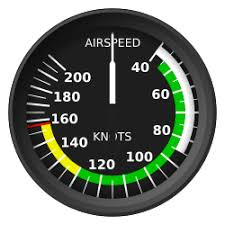
Indicated Airspeed (IAS)
This is the value that is read off the airspeed indicator, calculated from the pitot static system.
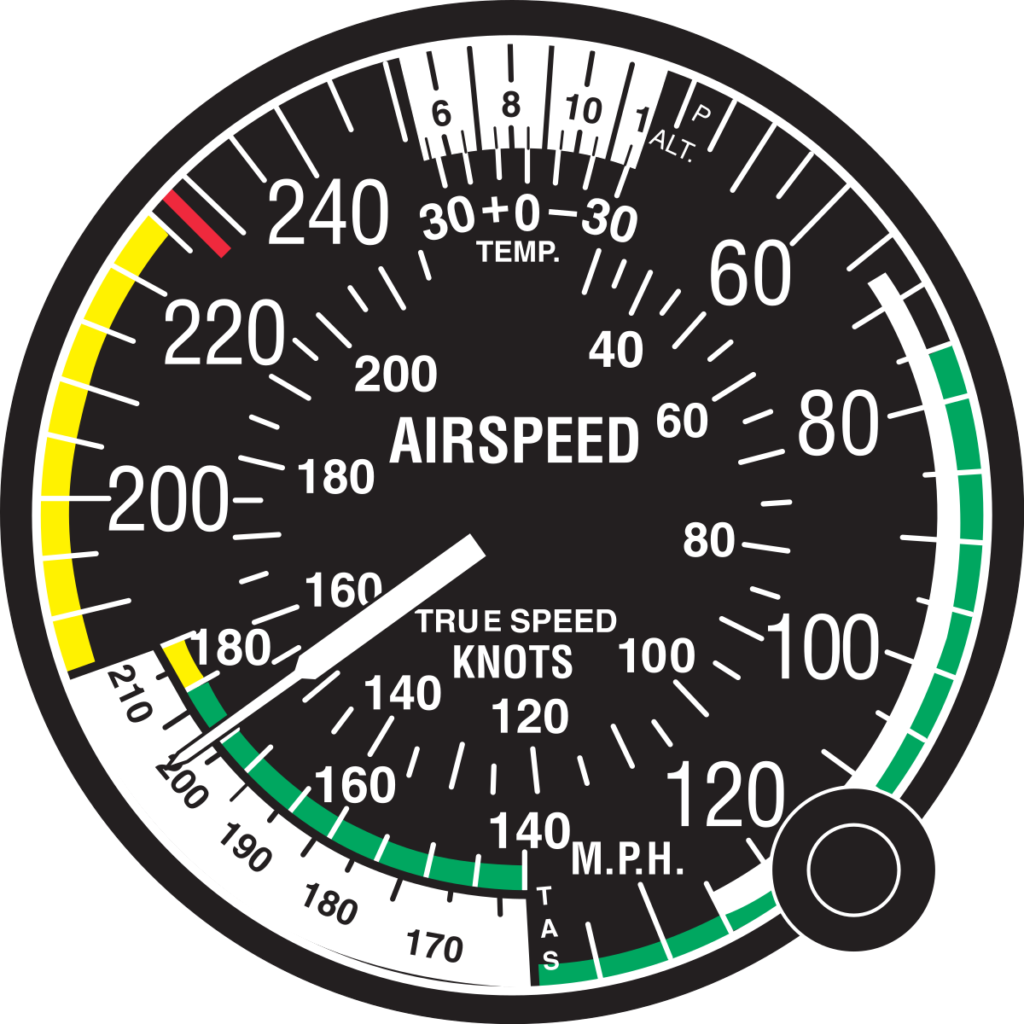
True Airspeed (TAS)
True airspeed is the speed of the aircraft relative to the air it’s flying through. At higher altitudes, true airspeed is higher than your indicated airspeed. Pressure decreases with higher altitudes, so for any given true airspeed, as you climb, fewer and fewer air molecules will enter the pitot tube. Because of that, indicated airspeed will be less than true airspeed. In fact, for every thousand feet above sea level, true airspeed is about 2% higher than indicated airspeed.
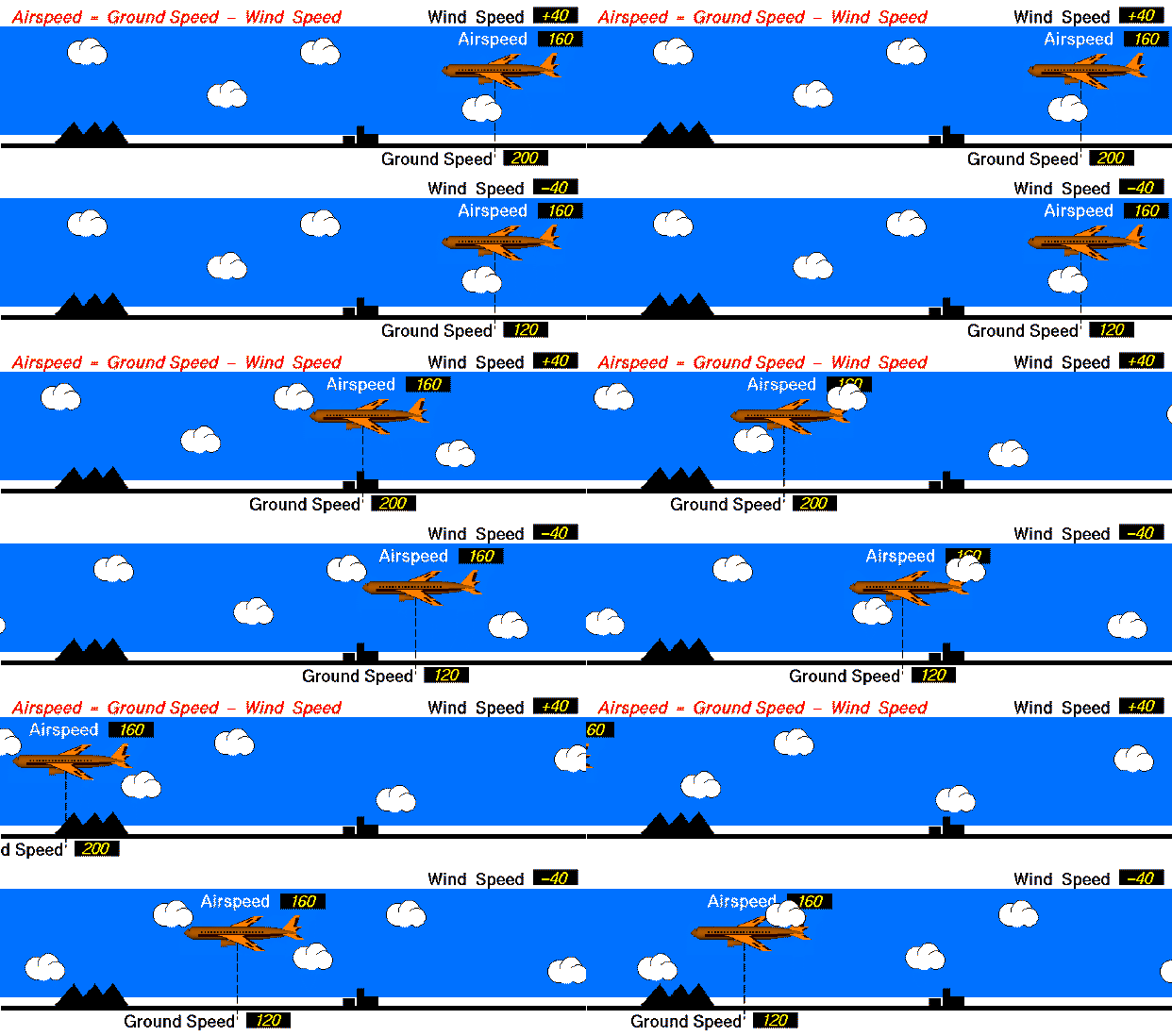
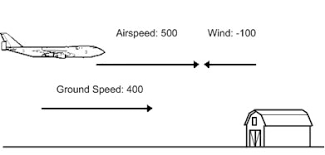
Groundspeed (GS)
This is the movement of the aircraft relative to the ground. It is the true airspeed with a correction for wind. With a true airspeed of 500 knots and a tailwind of 100 knots, you’d be flying a groundspeed of 400 knots and this would be the equivalent speed observed by a spectator on the ground.
Calibrated Airspeed (CAS)
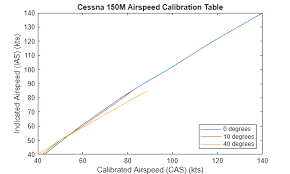
Calibrated airspeed is indicated airspeed corrected for instrument and positional errors. At certain airspeeds and with certain flap settings, the installation and instrument errors may total several knots. This error is generally greatest at low airspeeds, with nose high pitch attitudes. When flying at sea level under International Standard Atmosphere (ISA) conditions (15 degrees Celsius, 29.92 inches of mercury, 0% humidity), calibrated airspeed is the same as true airspeed. If there is no wind it is also the same as ground speed.
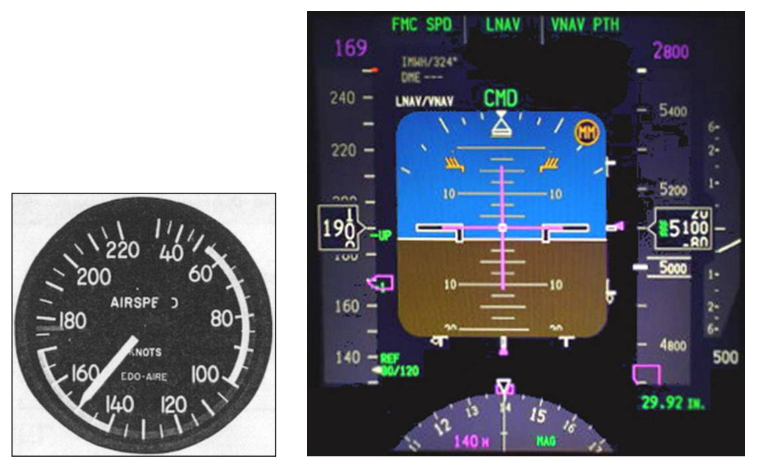
Located in the cockpit of an aircraft there will be an air speed indicator, which is a device for measuring forward speed of an aircraft.
Airspeed is usually measured (and indicated) in knots (nautical miles per hour) although other units of measurement are sometimes encountered, kilometres per hour is often used. On older aircraft, airspeed is usually indicated to the pilot on a graduated scale over which a pointer moves. In modern aircraft, it is usually indicated on a speed tape which forms part of the Electronic Flight Instrument System display.
The air speed indicators are fed information from a pitot-static system. This system is sometimes referred to as a differential pressure flowmeter. It involves deriving the airspeed from differences in stagnation and static pressures recorded via a pitot tube. Pitot tubes are used to measure air flow in pipes, ducts, and stacks, and liquid flow in pipes, and open channels. While accuracy and rangeability are relatively low, pitot tubes are simple, reliable, inexpensive, and suited for a variety of environmental conditions, including extremely high temperatures and a wide range of pressures.
Pitot Tubes
Pitot tubes were invented by Henri Pitot in 1732 to measure the flowing liquid or air velocity. They are a differential pressure flowmeter. A pitot tube measures two pressures: the static and the total impact pressure. The static pressure is the operating pressure in the pipe, duct, or the environment, upstream to the pitot tube. It is measured at right angles to the flow direction, preferably in a low turbulence location.
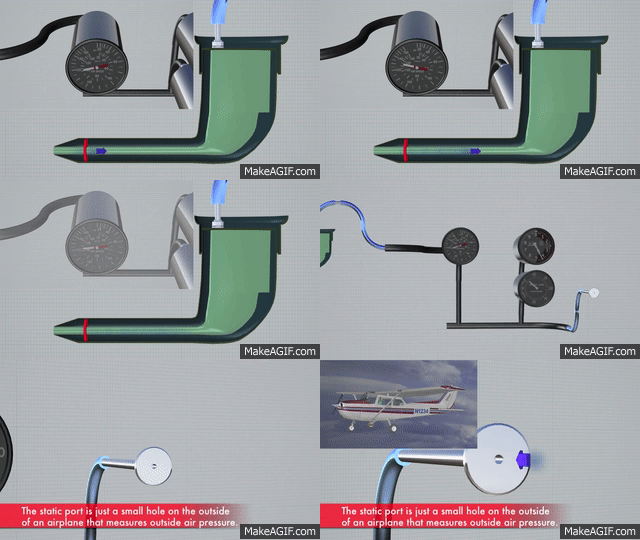
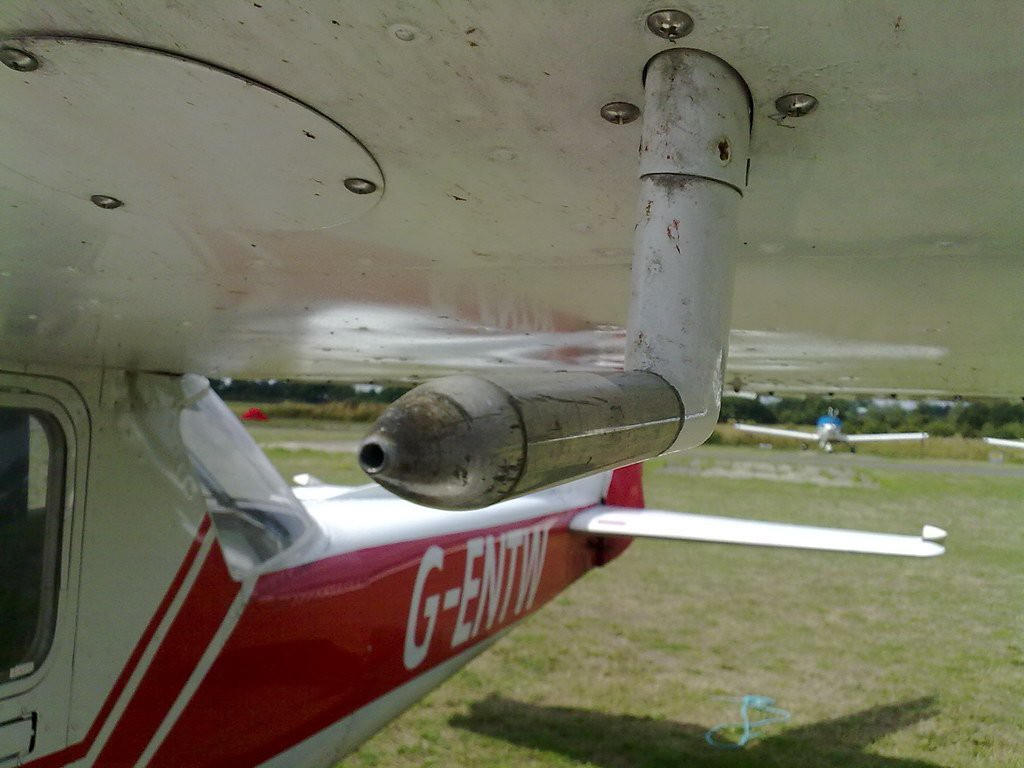
The total impact pressure is the sum of the static and dynamic pressures and is detected as the flowing stream impacts on the pitot opening. To measure impact pressure (from the forward motion of the aircraft), most pitot tubes use a small, sometimes L-shaped tube, with the opening directly facing the oncoming flow stream.
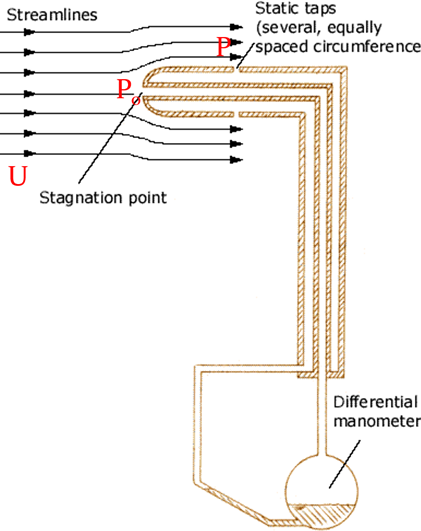
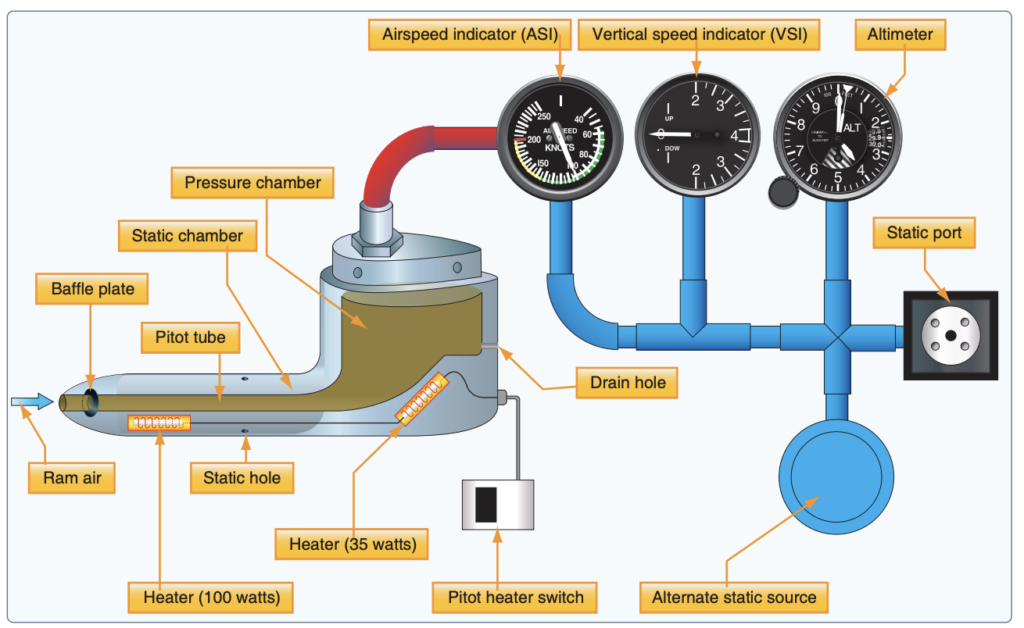
The diagram shows the static ports at right angles to the flow which measure the static pressure and the velocity inlet facing the flow which measures the dynamic pressure and can be found using Bernoulli’s principle. Bernoulli’s principle will state that the difference between stagnation and static pressure is the dynamic pressure, from which velocity can be found:
P0 – P1 = ½ ρV2
Example: A pitot tube measures a difference in static and total pressure as 15,000Pa. The tube is on an aircraft flying in air with density 1.2kgm-3
What velocity is the aircraft flying at?
As the pressure at the velocity inlet is the stagnation pressure we can use this form of Bernoulii’s equation:
P0 – P1 = ½ ρV2
2(P0 – P1 ) / ρ= V2
V = √2(P0 – P1 ) / ρ
V = √2x 15000 / 1.2 = 158m/s
Pitot tubes are carefully sited to reduce to a minimum error due to the flow of air over the aircraft. Commercial aircraft have at least two completely independent pitot systems to provide redundancy in the case of system failure. Pitot tubes are normally covered when the aircraft is parked for more than a short period of time to reduce the chance of blockage or contamination. They are invariably electrically heated to reduce contamination by moisture and prevent blockage by ice.
Blockages in pitot tubes can be caused by:
- In-Flight Icing
- Insects
- Volcanic Ash
- Heavy rain
- Crude Oil Smoke
- Failure to remove maintenance seals or protective covers from external vents prior to flight
- Failure to select pitot static heat on
- Damage to the radome/nose cone of an aircraft causing erroneous pitot and static information.
If the pitot probe is blocked but the pitot drain and static ports are free, then in straight and level (cruising) flight the displayed IAS will tend to reduce, eventually indicating zero. If the pitot probe and pitot drain are blocked but the static port is free then the IAS will increase during a steady climb and decrease during a steady descent. If the pitot probe, pitot drain, and static ports are all blocked then the IAS will remain constant despite changes in actual airspeed.
Interested in our Aerospace Engineering Courses?
At iLearn Engineering®, we offer a diverse range of online accredited aerospace engineering courses and qualifications to cater to different academic and career goals. Our aerospace courses are available in varying credit values and levels, ranging from 40 credit Engineering Diplomas to a Bachelor’s equivalent 360 credit International Graduate Diploma.
All Aerospace Engineering Courses
All Aerospace Engineering Diploma Courses can be seen here.
Short Aerospace Courses (40 Credits)
- Diploma in Aerospace Engineering
- Diploma in Aircraft Design
- Diploma in Principles of Flight
- Diploma in Aerospace Structures
- Diploma in Aerodynamics
- Diploma in Aerodynamics, Propulsion and Space
First Year of Undergraduate (Level 4 – 120 Credits)
Higher International Certificate in Aerospace Engineering
Years One and Two of Undergraduate (Level 5 – 240 Credits)
Higher International Diploma in Aerospace Engineering
Degree Equivalent International Graduate Diploma (Level 6 – 360 Credits)
International Graduate Diploma in Aerospace Engineering
Complete Engineering Course Catalogue (all courses)
Alternatively, you can view all our online engineering courses here.
Recent Posts
Why a Headwind Reduces Take-Off Distance: The Airspeed–Groundspeed Derivation
Why a Headwind Reduces Take-Off Distance: The Airspeed–Groundspeed Derivation Aeroplanes normally take off into wind because the wing must reach a required airspeed to produce lift, whereas the runway distance is travelled at groundspeed. A headwind contributes to the airspeed before the aircraft has covered any runway. It therefore reduces the groundspeed required at lift-off […]
How to Calculate Aircraft Take-Off Ground Run: A Flight Mechanics Tutorial
How to Calculate Aircraft Take-Off Ground Run: A Flight Mechanics Tutorial An aircraft does not become airborne simply because its engines are producing thrust. During the take-off ground run, thrust must overcome aerodynamic drag and rolling resistance. On a sloping runway, it must also overcome a component of the aircraft’s weight. This tutorial derives a […]
Types of Aircraft Drag Explained: Induced, Profile and Interference Drag
Types of Aircraft Drag Explained: Induced, Profile and Interference Drag An aircraft experiences several forms of aerodynamic drag at the same time. Some result from generating lift, some arise as air flows over the aircraft’s surfaces, and others are created when airflow around neighbouring components interacts. For a conventional aircraft in subsonic flight, total drag […]