

International Standard Atmosphere Model in Aviation and Aerospace
Introduction
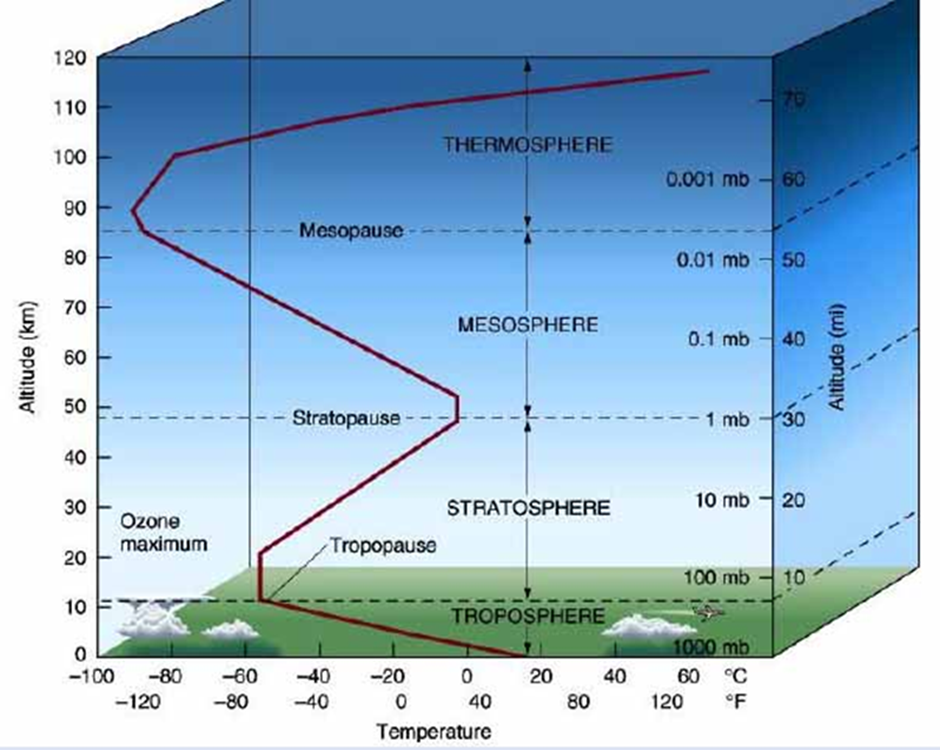
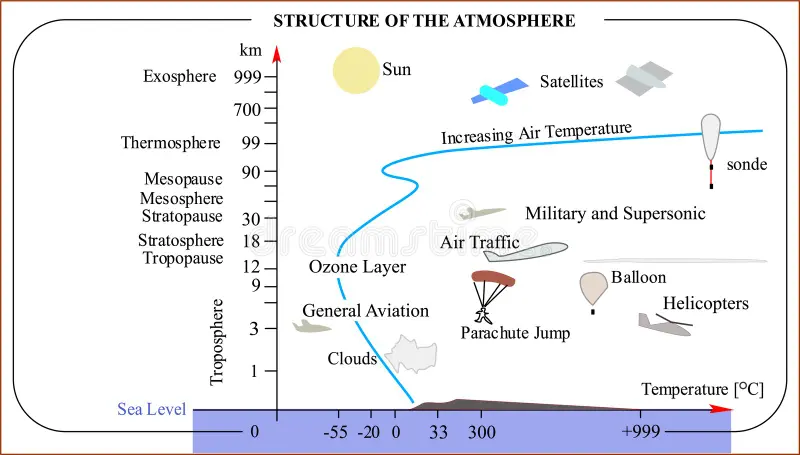
This blog takes a look into the structure of the atmosphere and how various parameters such as air density, temperature and pressure change with altitude. Air can be thought of as behaving like a fluid in the gas phase.
Troposphere
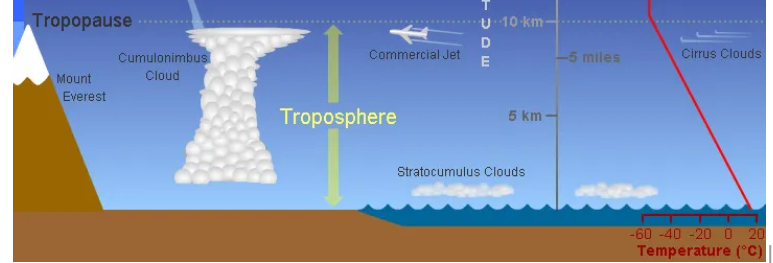
The Troposphere is the lowest part of the atmosphere from sea level up to 11 km, the part we live in. It contains most of our weather – clouds, rain, snow. In this part of the atmosphere the temperature gets colder as the distance above the earth increases, by about 6.5°C per kilometre. The actual change of temperature with height varies from day to day, depending on the weather.
The troposphere contains about 75% of all of the air in the atmosphere, and almost all of the water vapour (which forms clouds and rain). The decrease in temperature with height is a result of the decreasing pressure. If a parcel of air moves upwards it expands (because of the lower pressure). When air expands it cools. So air higher up is cooler than air lower down.
The lowest part of the troposphere is called the boundary layer. This is where the air motion is determined by the properties of the Earth’s surface. Turbulence is generated as the wind blows over the Earth’s surface, and by thermals rising from the land as it is heated by the sun. This turbulence redistributes heat and moisture within the boundary layer, as well as pollutants and other constituents of the atmosphere.
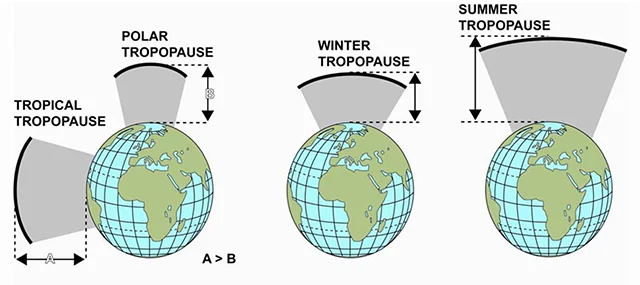
The top of the troposphere is called the tropopause. This is lowest at the poles, where it is about 7 – 10 km above the Earth’s surface. It is highest (about 17 – 18 km) near the equator.
Air density in the troposphere decreases with altitude, affecting:
- Lift generation
- Engine performance
- Take-off and landing distances
Reduced density at higher altitudes lowers lift and thrust for a given airspeed, requiring careful performance calculations, especially during take-off from high-elevation or hot airports.
Tropopause
The tropopause is the boundary layer that separates the troposphere from the stratosphere in Earth’s atmosphere from 11 km up to approx 16 km. It marks a fundamental change in atmospheric behaviour and is highly important in aviation, meteorology, and atmospheric physics. The temperature is approximately -6.5K/km. At the tropopause, this temperature decrease stops. Above it, in the stratosphere, temperature is approximately constant or begins to increase with altitude due to ozone absorption of ultraviolet radiation. This change in temperature gradient is the defining feature of the tropopause.
For aircraft operations, the tropopause is significant because:
- Jet streams are typically found close to the tropopause level
- Jet aircraft often cruise near or just below it for fuel efficiency
- Clear-air turbulence is common near the tropopause due to strong wind shear
Crossing the tropopause can involve noticeable changes in temperature gradients and atmospheric stability.
Stratosphere
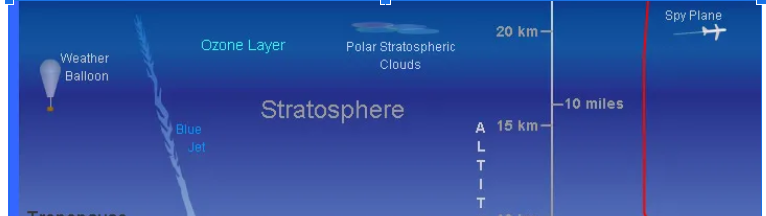
The Stratosphere extends upwards from the tropopause to about 50 km. It contains much of the ozone in the atmosphere. The increase in temperature with height occurs because of absorption of ultraviolet (UV) radiation from the sun by this ozone. Temperatures in the stratosphere are highest over the summer pole, and lowest over the winter pole.
By absorbing dangerous UV radiation, the ozone in the stratosphere protects us from skin cancer and other health damage. However chemicals (called CFCs or freons, and halons) which were once used in refrigerators, spray cans and fire extinguishers have reduced the amount of ozone in the stratosphere, particularly at polar latitudes, leading to the so-called “Antarctic ozone hole”

Now humans have stopped making most of the harmful CFCs. We expect the ozone hole will eventually recover over the 21st century, but this is a slow process.
Commercial jet aircraft often cruise near the lower stratosphere or just above the tropopause because:
- Air is less dense, reducing aerodynamic drag
- Fuel efficiency improves at higher altitudes
- Flights can operate above most weather systems
This makes the stratosphere important for optimising range, endurance, and fuel consumption.
Mesosphere
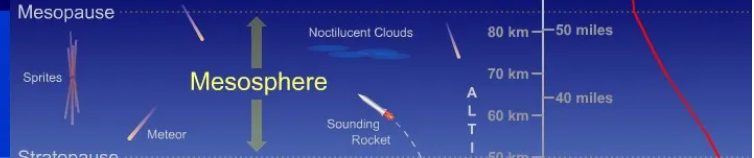
The region above the stratosphere is called the mesosphere, 50 km up to approx 100 km. Here the temperature again decreases with height, reaching a minimum of about -90°C at the “mesopause”.
The air in the mesosphere is extremely thin:
- Less than 1% of sea-level density
- Insufficient to generate aerodynamic lift for aircraft
As a result, traditional aircraft cannot operate in this region.
Although not used for normal flight, the mesosphere is important because:
- Re-entry vehicles and spacecraft pass through it, experiencing aerodynamic heating and deceleration
- Sounding rockets and experimental hypersonic vehicles may briefly operate in this layer
- It influences high-altitude ballistic trajectories
Understanding mesospheric properties is essential for thermal protection system design and re-entry dynamics.
Ionosphere
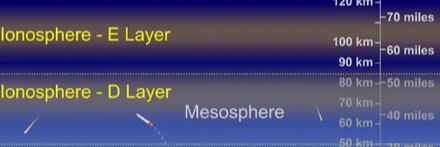
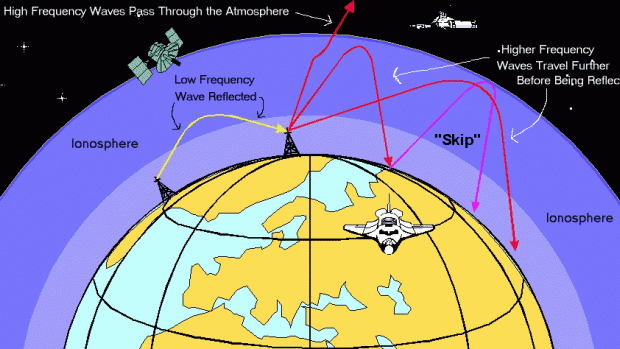
The region of the atmosphere above about 80 km to 300km is called the “ionosphere”, since the energetic solar radiation knocks electrons off molecules and atoms, turning them into “ions” with a positive charge. The temperature of the thermosphere varies between night and day and between the seasons, as do the numbers of ions and electrons which are present. The ionosphere reflects and absorbs radio waves, allowing us to receive shortwave radio broadcasts in New Zealand from other parts of the world.
In aviation, the ionosphere Enables and disrupts long-range radio communication
- Affects satellite navigation accuracy
- Influences polar and oceanic flight operations
- Is impacted by solar and geomagnetic activity
Although aircraft do not physically operate in the ionosphere, its behaviour directly impacts flight safety, communication reliability, and navigation precision.
Thermosphere
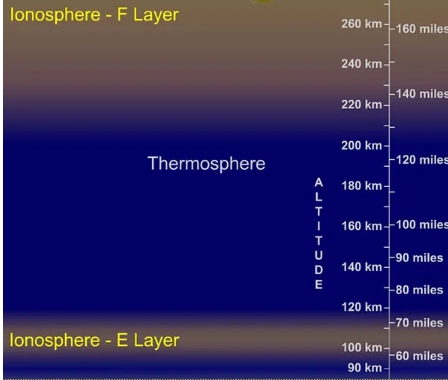
The Thermosphere lies above the mesopause, 300+ km, and is a region in which temperatures again increase with height. This temperature increase is caused by the absorption of energetic ultraviolet and X-Ray radiation from the sun.
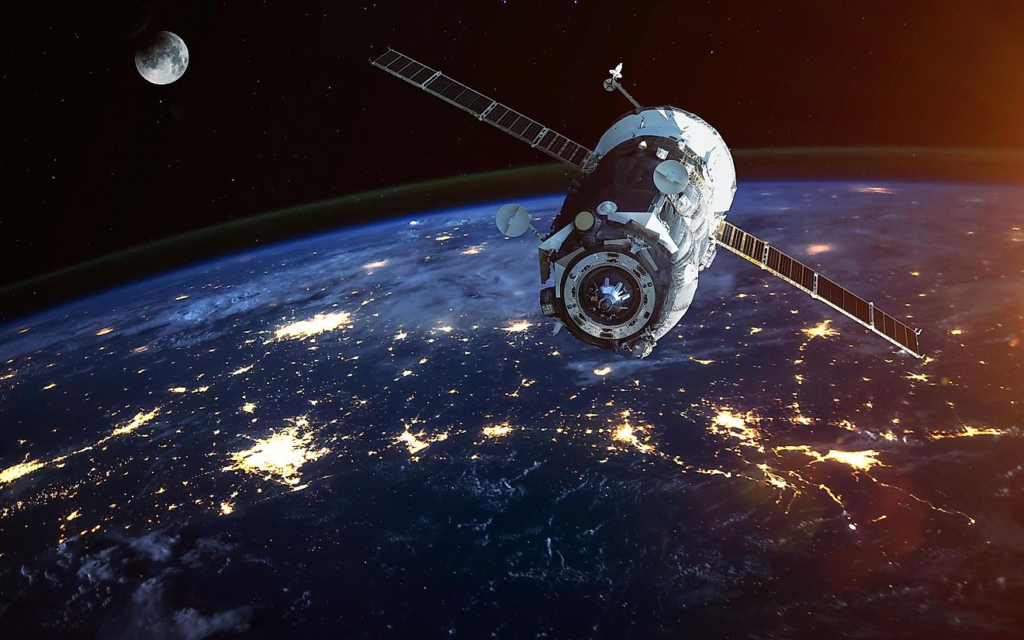
One definition of where space begins is at 100km level. International law states that outer space shall be free for exploration and use by all, but there is no definitive law stating where national air space actually ends and outer space begins. This leaves the door open for a variety of interpretations. A common definition of space is known as the Kármán Line, an imaginary boundary 100 kilometres (62 miles) above mean sea level. In theory, once this 100 km line is crossed, the atmosphere becomes too thin to provide enough lift for conventional aircraft to maintain flight. At this altitude, a conventional plane would need to reach orbital velocity or risk falling back to Earth.
Exosphere
The region above about 500 km is called the exosphere. It contains mainly oxygen and hydrogen atoms, but there are so few of them that they rarely collide – they follow “ballistic” trajectories under the influence of gravity, and some of them escape right out into space.
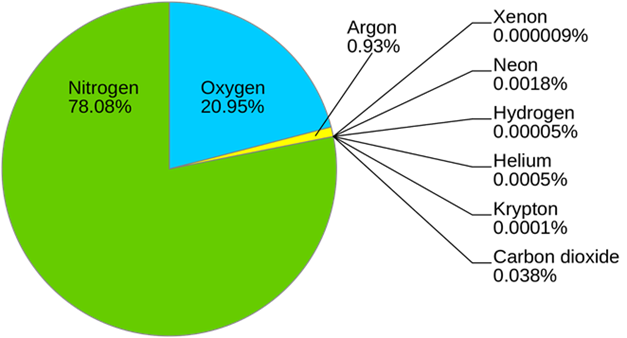
The atmosphere is an invisible envelope that surrounds the planet, it is made up of a mixture of gases, Oxygen and Nitrogen being the 2 major constituents. Oxygen is often incorrectly assumed to make up the largest portion of gases in the atmosphere, this is not the case and nitrogen is the primary constituent.
Air Density
Density (ρ) is an expression of the weight of an object per unit volume, with units of kg/m3. A typical value for the density of air is 1.225 kg/m3 at sea level. The density of air decreases with an increase in altitude. The decrease in density will have the effect in decreasing both the lift and drag forces experienced by an aircraft flying at altitude.
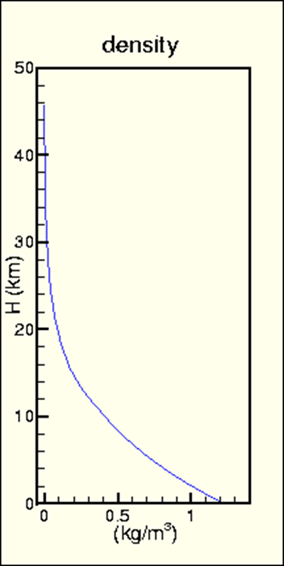
The graph above demonstrates how quickly air density changes with altitude. Even at an altitude of only 10km the air density compared to sea level has already more than halved. Given that the height of Mount Everest is close to 9km, care must be taken when ascending to this height. Reduced air density means less oxygen intake per breath which is drastically needed whilst exerting yourself. This is one of the main reasons aircraft are pressurised at high altitudes as being exposed to the atmosphere at 10km can be fatal. You would suffer from hypoxia, which is a shortage of oxygen. The effects are massively decreased cognitive function and eventually unconsciousness and death. It is the main reason you are required to put your mask on straight away in the event of a cabin breach.
Air Pressure
The weight of air above any point can be felt as a pressure measured in Newtons per square metre (N/m2) or Pascals (Pa). A common unit for expressing pressure is the bar: 1 bar = 1 × 10⁵ Pa. The average pressure at sea level due to the weight of the atmosphere is 101,000 N/m2 or 101 kN/ m2. The higher above the earth’s surface you travel (within the atmosphere), the less the weight of air above you so the pressure decreases.
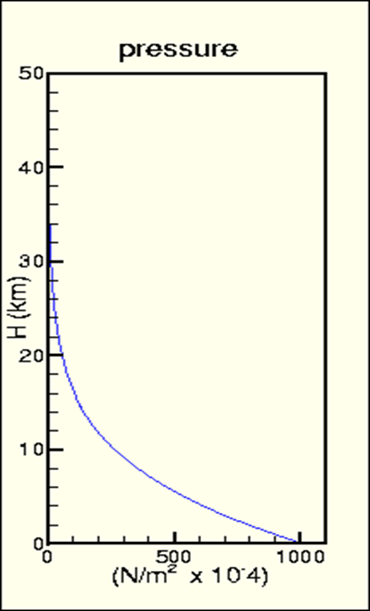
The air pressure shows a similar variation with altitude compared to density. It decreases fairly rapidly up until 10km then after this point gradually tends towards zero. The air pressure can roughly be calculated using the formula:
P = ρgh
Where ρ = density in kgm-3, g = acceleration due to gravity ( 9.81ms-2), h = height in m.
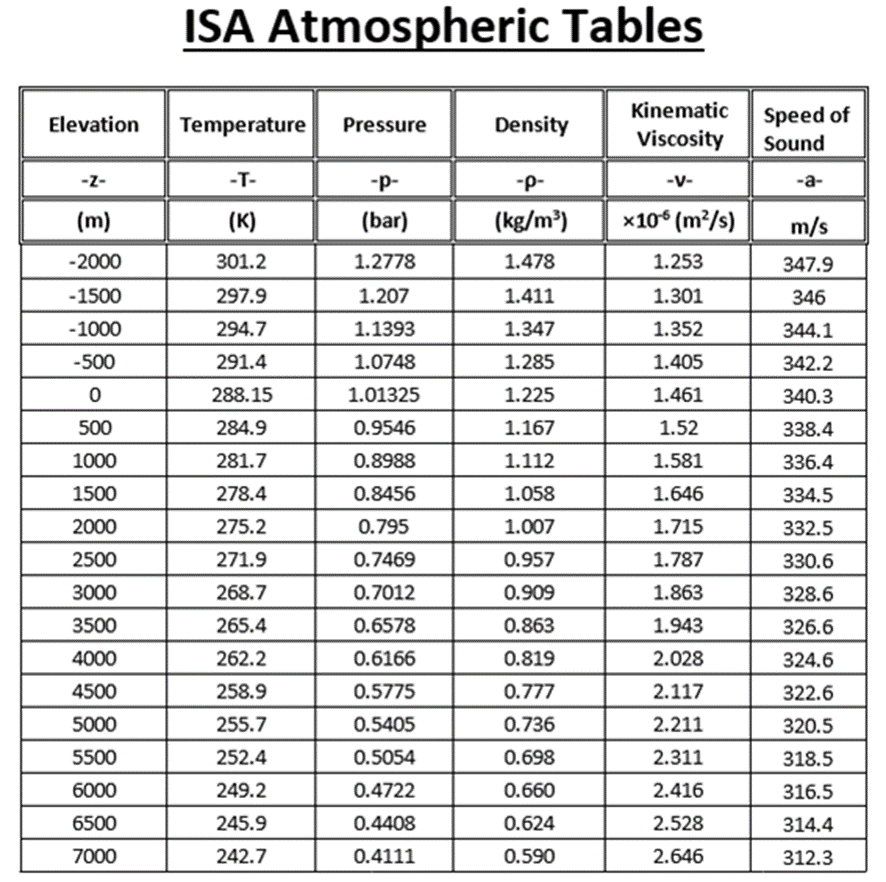
However, in this case as the altitude increases so does the density, which makes things a little more complicated. However the pressure at sea level is due to there being up to 50km of air above us. The properties of the atmosphere are presented on the international standard atmosphere, which is a table indicating temperature, pressure and density at certain altitudes.
Gas Law and Speed of Sound
One important feature for any gas is the speed of sound through the gas. The speed of sound actually represents the speed of any disturbance through the medium and hence is vitally important in terms of the aerodynamic repercussions this has, such as in transonic and supersonic flight. Disturbances are transmitted through a gas as a result of collisions between the randomly moving molecules in the gas. The transmission of a small disturbance through a gas is an isentropic process, which means conditions in the gas are the same before and after the disturbance passes through. Because the speed of transmission depends on molecular collisions, the speed of sound depends on the state of the gas. The speed of sound is a constant within a given gas and the value of the constant depends on the type of gas (air, pure oxygen, carbon dioxide, etc.) and the temperature of the gas. An analysis based on conservation of mass and momentum shows that the speed of sound, a, is given by the following:
a = √γRT
Where,γ = ratio of specific heats ( 1.4 for air), R = gas constant ( 287Jkg-1K-1), T = temperature in K
The formula above shows that for our model the speed of sound is decreasing with temperature and hence decreases with altitude. The ratio of specific heats (also known as the adiabatic index), usually denoted by gamma, is the ratio of specific heat at constant pressure to the specific heat at constant volume. For monatomic gas γ= 1.666, and for diatomic gases γ = 1.4 , at ordinary temperatures. For air, it is not simply one gas, its value is close to that of a diatomic gas (1.4). We must also note the units of the gas constant and temperature. The gas constant relates the pressure, volume and temperature of a gas. The temperature must be measured on an absolute scale, in this case it is the Kelvin scale. To convert from the often used degrees Celsius we must add 273 to get the value in Kelvin. Whilst air is not a perfect gas, for the sake of our analysis we can consider it to be so and assume it obeys the ideal gas equation given below:
PV = mRT
Or in terms of density:
P = ρRT
Example: At an altitude of 4000m the temperature in the atmosphere is -11 degrees Celsius. The air density is 0.819 kgm-3 . Show by calculation what the speed of sound and pressure is at this altitude.
Solution:
-11 degrees Celsius must first be converted to kelvin:
T = -11 + 273 = 262K
We can now use:
a = √γRT
a = √1.4 x 287 x 262 = 324ms-1
For the air pressure:
P = ρRT
P = 0.819 x 287 x 262 = 61.6kPa or 0.616 bar.
We can verify these results by looking at the ISA in the chart above at the 4000m altitude row.
Interested in our Aerospace Engineering Courses?
At iLearn Engineering®, we offer a diverse range of online accredited aerospace engineering courses and qualifications to cater to different academic and career goals. Our aerospace courses are available in varying credit values and levels, ranging from 40 credit Engineering Diplomas to a Bachelor’s equivalent 360 credit International Graduate Diploma.
All Aerospace Engineering Courses
All Aerospace Engineering Diploma Courses can be seen here.
Short Aerospace Courses (40 Credits)
- Diploma in Aerospace Engineering
- Diploma in Aircraft Design
- Diploma in Principles of Flight
- Diploma in Aerospace Structures
- Diploma in Aerodynamics
- Diploma in Aerodynamics, Propulsion and Space
First Year of Undergraduate (Level 4 – 120 Credits)
Higher International Certificate in Aerospace Engineering
Years One and Two of Undergraduate (Level 5 – 240 Credits)
Higher International Diploma in Aerospace Engineering
Degree Equivalent International Graduate Diploma (Level 6 – 360 Credits)
International Graduate Diploma in Aerospace Engineering
Complete Engineering Course Catalogue (all courses)
Alternatively, you can view all our online engineering courses here.
Recent Posts
Why a Headwind Reduces Take-Off Distance: The Airspeed–Groundspeed Derivation
Why a Headwind Reduces Take-Off Distance: The Airspeed–Groundspeed Derivation Aeroplanes normally take off into wind because the wing must reach a required airspeed to produce lift, whereas the runway distance is travelled at groundspeed. A headwind contributes to the airspeed before the aircraft has covered any runway. It therefore reduces the groundspeed required at lift-off […]
How to Calculate Aircraft Take-Off Ground Run: A Flight Mechanics Tutorial
How to Calculate Aircraft Take-Off Ground Run: A Flight Mechanics Tutorial An aircraft does not become airborne simply because its engines are producing thrust. During the take-off ground run, thrust must overcome aerodynamic drag and rolling resistance. On a sloping runway, it must also overcome a component of the aircraft’s weight. This tutorial derives a […]
Types of Aircraft Drag Explained: Induced, Profile and Interference Drag
Types of Aircraft Drag Explained: Induced, Profile and Interference Drag An aircraft experiences several forms of aerodynamic drag at the same time. Some result from generating lift, some arise as air flows over the aircraft’s surfaces, and others are created when airflow around neighbouring components interacts. For a conventional aircraft in subsonic flight, total drag […]