

Taking Off Anywhere: STOL and VTOL Solutions Explained
Introduction
Aircraft require a large distance in order to successfully take off. Similarly aircraft require large distances to be able to land safely. Removing these distances from the flight plan can be of great benefit, depending on the required mission of the aircraft. In order to reduce the distance required for take off and landing VTOL (vertical take off and landing) and STOL (short take off and landing) aircraft designs were considered.
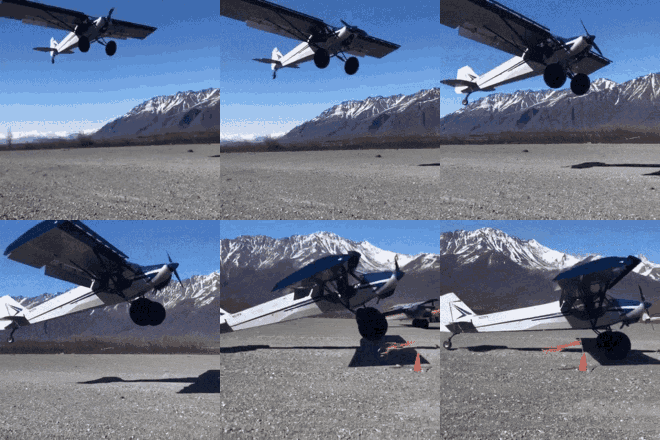
The need for design of such aircraft was perhaps triggered by military needs. The need to transport troops to and from the battlefront under stringent take off and landing conditions necessitated the need for VTOL capabilities in transport aircraft.
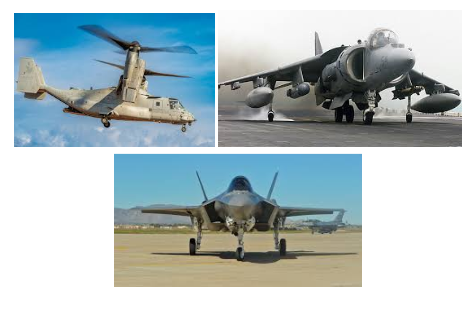
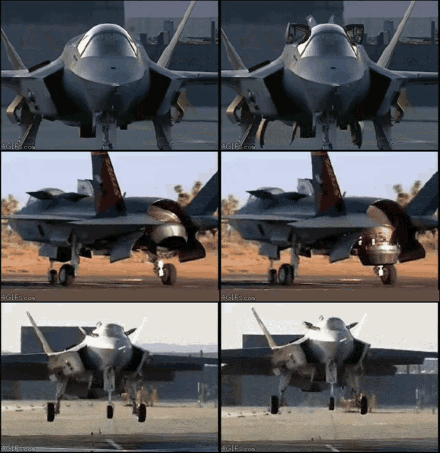
The design principles and the features of VTOL aircraft were then extrapolated to modern turbojet engines with thrust vectoring capabilities to produce the V22 Osprey, Harrier jump jet and the F35 Lightning II.
There is also the need for emergency vehicles such as helicopters, for rapid transport of patients to a hospital, minimum take off and landing distances are required. For aircraft based in locations such as forest or difficult terrain the need for shorter runways is also important as it would be impractical to have vast lengths of runway running through these locations.
The design and development of VTOL aircraft began with the application of turbo shaft engines on a helicopter, which is the oldest and most reliable form of rotorcraft. The sole purpose of helicopters was quick and easy transport of troops to the battlefront either from the base location or aircraft carriers. The helicopters were limited by speed, range and transport capabilities in the past. These constraints led to the development of turbofan engine powered supersonic VTOL aircraft with extensive attack capabilities to provide air support.
The VTOL technology is mainly classified based on the nature of requirements such as transport and air strike. The transport class aircraft with VTOL technology are mostly rotorcraft like Helicopters, Gyrodynes, tilt rotors and tilt wings, which use advanced turbo shaft engines.
Design Considerations
Helicopters
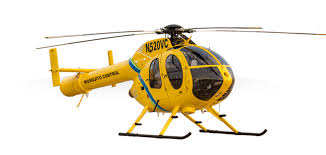
Perhaps the most popular type of VTOL aircraft are helicopters. Whilst they benefit from the minimal take off and landing distances, they are also highly manoeuvrable and capable of hovering. They are widely used for both military and transport applications.
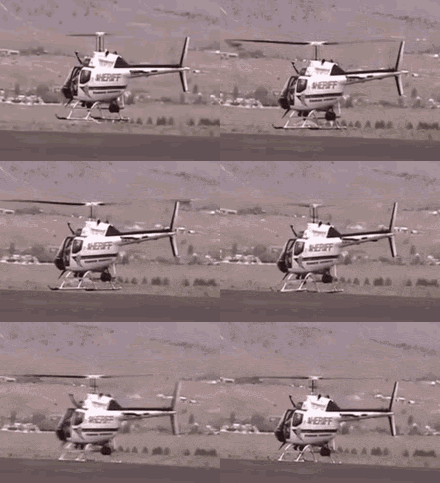
Helicopters generate their lift from revolving blades. In accordance with Newton’s third law, the helicopter fuselage tends to rotate in the direction opposite to the rotor blades. This effect is called torque. Torque must be counteracted and or controlled before flight is possible. In tandem rotor and coaxial helicopter designs, the rotors turn in opposite directions to neutralise or eliminate torque effects.
In tip-jet helicopters, power originates at the blade tip and equal and opposite reaction is against the air; there is no torque between the rotor and the fuselage. Power varies with the flight manoeuvre and results in a variable torque effect that must be continually corrected. Compensation for torque in the single main rotor helicopter is accomplished by means of a variable pitch anti torque rotor (tail rotor) located on the end of a tail boom extension at the rear of the fuselage.
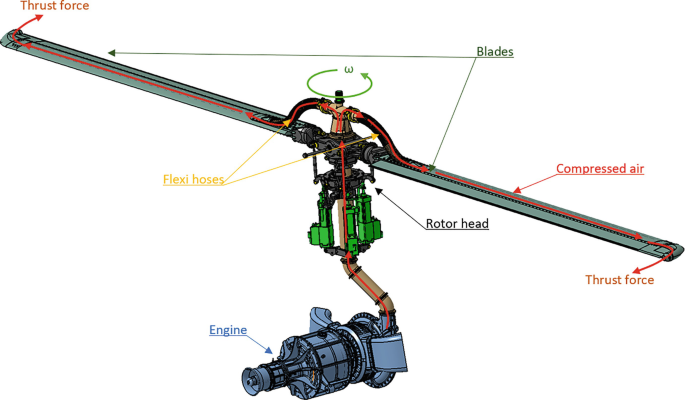
The most common challenge in designing a helicopter is that of vibrations and noise. The vibrations and noise are reduced through several active and passive techniques like harmonic control, structure control response, and blade control.
As the blades on the helicopter rotate, the blade going into the wind (the wind produced by the motion of the aircraft) gets more lift, and drag, than the blade going down wind. This happens whenever the machine moves in any direction, forwards, backwards or sideways; but it becomes an even more serious problem when moving at high speeds because the tip portions of the blade going into the wind meet compressibility problems before the aircraft itself is moving anywhere near the speed of sound; this fact has so far limited the speed of helicopters to something like 200 knots (370km/h).
Some designs to combat these issues include hinges on blades to give them variable dihedral, they also allow the blades to bend backwards. Replacing the tail rotor with an air jet to perform the same function is a relatively recent development, these designs are called NOTAR (no tail rotor)
Tiltrotor aircraft
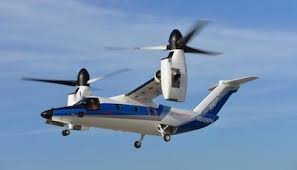
The tilt rotor technology combines the advantages of the vertical take-off mechanism of a helicopter mounted on wings with a tilting mount for the rotors.
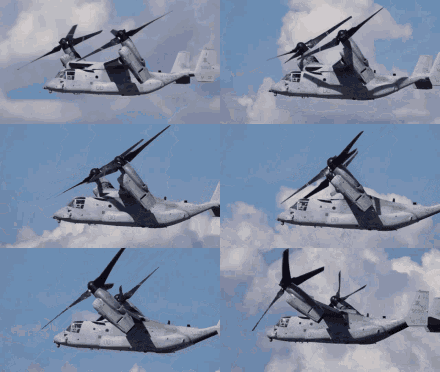
This allows the rotor to be tilted beyond 90 degrees. The introduction of this surpasses the limitations of helicopter design.
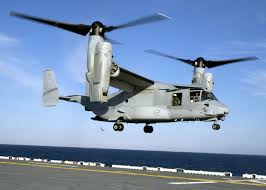
The design of a tilt rotor engine requires that the engines be tilted vertically for take-off and landing conditions. This calls for the engine assembly to be functioning in a vertical configuration. This is one of the major constraints on the engine. The thrust to weight ratio is extremely demanding of the engine. The gyroscopic precession at very high rotor speeds imparts tremendous loads on the engine shaft. These aircraft are mostly used for military transport applications requiring very high payload capacities. These are some of the main constraints on such aircraft.
Powered lift aircraft
As the name suggests, a powered lift aircraft is mounted with an engine and a power lift fan to generate the thrust required for a stable take-off and landing.
The inflight thrust requirements are met by an efficient turbofan engine with an afterburner design. The power lift fan with equal thrust capability is driven by bleeding power from the turbine. Auxiliary roll thrust mechanisms are used to stabilise the down forces.
A STOL aircraft must be able to fly at low controlled speeds, yet it must also offer acceptable cruise performance. The challenge is to design a wing with a high lift coefficient so that the wing area is as small as possible, while allowing for take-off and landing speeds that are as low as possible. Short wings make the aircraft easier to taxi, especially when operating in an off-airport environment with obstructions. They also allow for better visibility, and require less space for hangaring, while also being easier to build and stronger as there is less weight and wingspan to support.
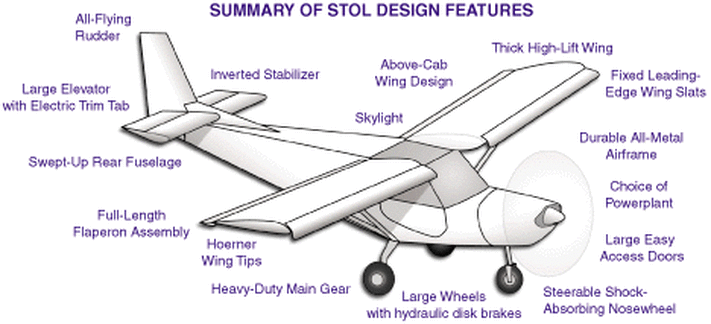
Specialised aerofoils allow aircraft to achieve STOL. Some specialised features include: A thick wing, full-length leading edge slats and trailing edge flaps give a maximum wing lift coefficient of 3.10, while maintaining a short wing-span – for maximum strength and ground manoeuvrability.
The stall of the wing occurs at the highest lift coefficient on an airfoil. Conventional trailing edge wing flaps help delay the stall to a higher lift coefficient, but only with limited effectiveness. However, by combining the use of trailing edge flaps with leading edge slats, the wing’s lift coefficient can be effectively doubled if used on the full span of the wing.
Interested in our Aerospace Engineering Courses?
At iLearn Engineering®, we offer a diverse range of online accredited aerospace engineering courses and qualifications to cater to different academic and career goals. Our aerospace courses are available in varying credit values and levels, ranging from 40 credit Engineering Diplomas to a Bachelor’s equivalent 360 credit International Graduate Diploma.
All Aerospace Engineering Courses
All Aerospace Engineering Diploma Courses can be seen here.
Short Aerospace Courses (40 Credits)
- Diploma in Aerospace Engineering
- Diploma in Aircraft Design
- Diploma in Principles of Flight
- Diploma in Aerospace Structures
- Diploma in Aerodynamics
- Diploma in Aerodynamics, Propulsion and Space
First Year of Undergraduate (Level 4 – 120 Credits)
Higher International Certificate in Aerospace Engineering
Years One and Two of Undergraduate (Level 5 – 240 Credits)
Higher International Diploma in Aerospace Engineering
Degree Equivalent International Graduate Diploma (Level 6 – 360 Credits)
International Graduate Diploma in Aerospace Engineering
Complete Engineering Course Catalogue (all courses)
Alternatively, you can view all our online engineering courses here.
Recent Posts
Why a Headwind Reduces Take-Off Distance: The Airspeed–Groundspeed Derivation
Why a Headwind Reduces Take-Off Distance: The Airspeed–Groundspeed Derivation Aeroplanes normally take off into wind because the wing must reach a required airspeed to produce lift, whereas the runway distance is travelled at groundspeed. A headwind contributes to the airspeed before the aircraft has covered any runway. It therefore reduces the groundspeed required at lift-off […]
How to Calculate Aircraft Take-Off Ground Run: A Flight Mechanics Tutorial
How to Calculate Aircraft Take-Off Ground Run: A Flight Mechanics Tutorial An aircraft does not become airborne simply because its engines are producing thrust. During the take-off ground run, thrust must overcome aerodynamic drag and rolling resistance. On a sloping runway, it must also overcome a component of the aircraft’s weight. This tutorial derives a […]
Types of Aircraft Drag Explained: Induced, Profile and Interference Drag
Types of Aircraft Drag Explained: Induced, Profile and Interference Drag An aircraft experiences several forms of aerodynamic drag at the same time. Some result from generating lift, some arise as air flows over the aircraft’s surfaces, and others are created when airflow around neighbouring components interacts. For a conventional aircraft in subsonic flight, total drag […]