

What Really Happens in a Turn? Principles and Issues of Turning Flight
Introduction
At first glance, a turn in an aircraft looks simple, just bank the wings and change direction. But beneath that smooth arc across the sky lies a carefully balanced interplay of aerodynamics, forces, and pilot control inputs. Turning flight is far more than “tilt and steer.” It reshapes how lift works, redistributes load across the wings, increases stall speed, and demands precise coordination to keep the aircraft stable and efficient.
In this blog, we’ll break down the core principles of turning flight, how lift is redirected, why load factor increases, what coordinated flight truly means, and explore the common issues pilots must manage, from adverse yaw to accelerated stalls. By the end, you’ll see that every turn is a dynamic balancing act between physics and precision.
Incorrect Bank Angle
We assume that when the pilot makes a turn he is banking at the correct angle for a required turn. There are a few physical indicators that can be used to tell if the pilot is at the correct bank. A good indicator is the wind itself, or a vane, like a weather cock, mounted in some exposed position. In normal flight and in a correct bank the wind will come from straight ahead (neglecting any local effects from the slipstream); if the bank is too much, the aeroplane will sideslip inwards and the aeroplane, and pilot if he is in an open cockpit, will feel the wind coming from the inside of the turn, whereas if the bank is too small, the wind will come from the outside of the turn, due to an outward skid on the part of the aeroplane.
Another indication would be a plumb-bob hung in the cockpit out of contact with the wind. In normal flight this would, of course, hang vertically; during a correct bank it would not hang vertically, but in exactly the same position relative to the aeroplane as it would in normal flight, i.e. it would bank with the aeroplane. If over-banked the plumb-line would be inclined inwards; if under-banked, outwards from the above position.
This plumb-bob idea, in the form of a pendulum, forms the basis of the sideslip indicator which is provided by the top pointer of the so-called turn and bank indicator. The pointer is geared so as to move in such a way that the pilot must move the control column away from the direction of the pointer, this being the instinctive reaction. Sometimes a curved transparent tube containing a metal ball is used, and again the control column must be moved away from the indication given on the instrument.
It is interesting to note that in early aeroplanes the slip indicator was, in effect, a spirit level, the tube being curved the opposite way and with a bubble (in liquid) instead of the ball; the pilot was then told to ‘follow the bubble’, not the instinctive reaction. Nowadays such simple mechanical devices are being replaced by electronic or digital displays which nevertheless often mimic the appearance of the older instruments.
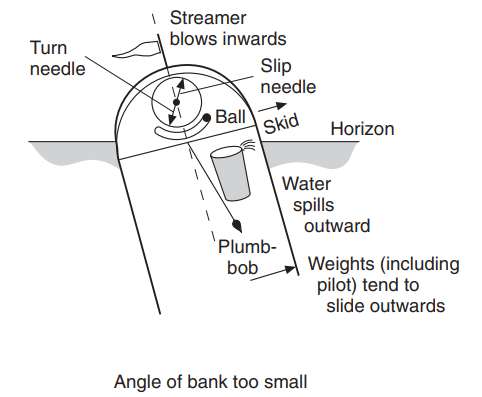
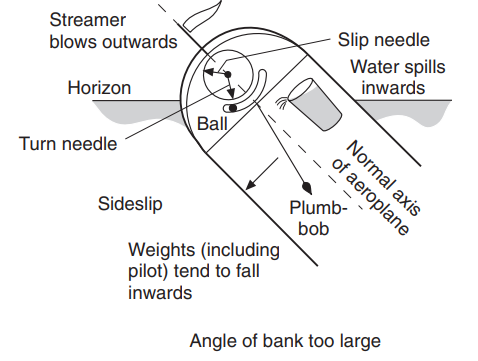
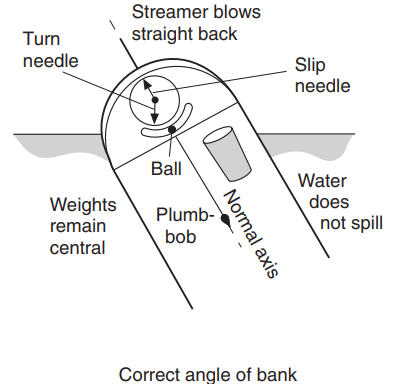
The diagrams above is interesting as it demonstrates the physical effects of a bank angle in an aircraft. The inclusion of the glass of water demonstrates how all the forces in an aircraft are correctly balanced. The forces that are balanced are those discussed at the beginning of the workbook, they are gravity, centrifugal force from the turn and lift generated from wings.
Modern aircraft use a turn and bank indicator, an aircraft instrument containing one indicator to show turning, or rotation about the vertical axis, and another to show banking, or rotation about the longitudinal axis. The two indicators are essentially separate instruments, but they are customarily placed together. The bank indicator is the simpler of the two and consists of a curved glass tube filled with a damping liquid in which a small steel ball rolls. When the craft is horizontal, the ball is located in the lowest part of the tube; as the craft banks, gravity holds the ball at the lowest point as the tube rotates from side to side. The tube can be calibrated to show the angle of banking. The turn indicator contains a gyroscope that develops a torque when the craft rotates. This torque controls a pointer that indicates to the pilot in degrees per unit of time the rate at which the craft is turning.
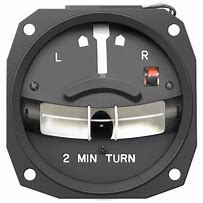
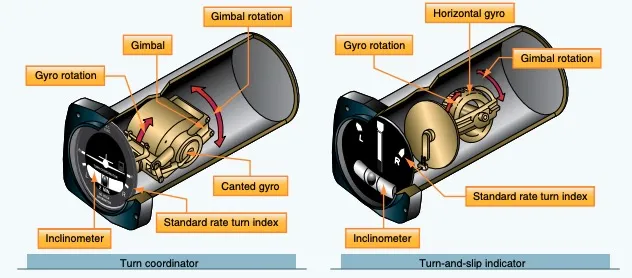
Turn and bank indicator
Issues During Turn
In order for the pilot to initiate a banked turn they must make use of the ailerons. If the aircraft is required to bank to the right hand side then the pilot must lower the left aileron and raise the right aileron. This sequence is depicted below. As the lift is increased over the left wing and slightly decreased over the right wing, this has the effect of causing the aircraft to roll to the right, or lowering of the right wing.
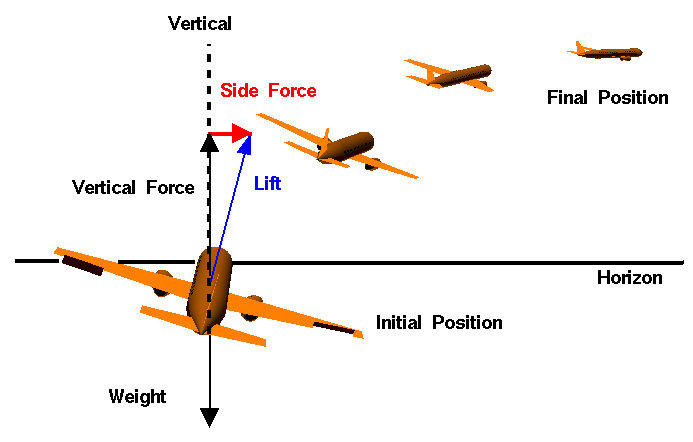
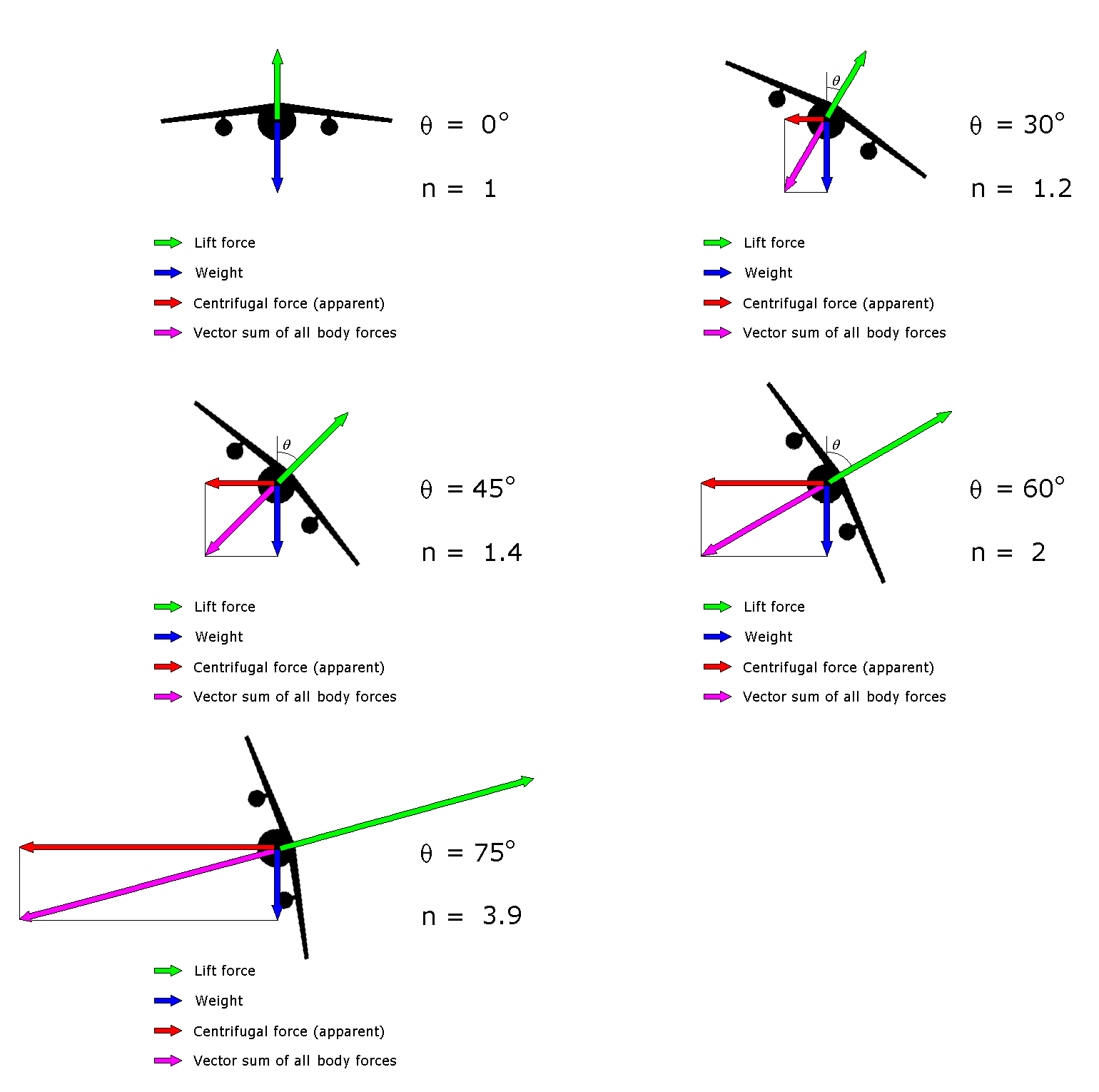
As the aircraft is banking, the lift force which acts perpendicular to the wings, now has a sideways force component. As long as the aircraft is banked, the side force is a constant, unopposed force on the aircraft. The resulting motion of the centre of gravity of the aircraft is a circular arc. Rudders are not used to turn the aircraft but are used to coordinate the turn, i.e. to keep the nose of the aircraft pointed along the flight path. If the rudder is not used, one can encounter an adverse yaw in which the drag on the outer wing pulls the aircraft nose away from the flight path. Slipping turns occur when the nose is yawed outside of the turn. This is caused by either too little rudder in the direction of the turn, or even the use of opposite rudder (adverse yaw). Skidding turns occur when the nose is yawed inside the turn. This is caused by either too much rudder in the direction of the turn.
Once the aircraft is banking the outer wing in the turn, in this case the left hand wing, will be travelling faster than the inner wing. This causes more lift to be produced over this wing. Not only is it necessary to take off the aileron control but actually to apply opposite aileron by moving the control column against the direction of the bank, this is called holding off bank.
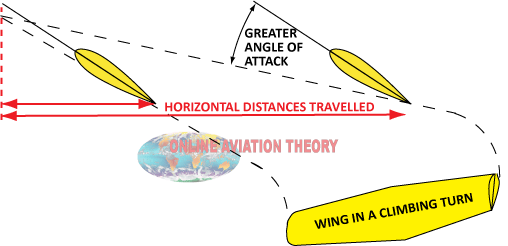
If we were to consider the wings of an aircraft during a gliding turn or descending the whole aircraft will move the same distance downwards during one complete turn, but the inner wing, because it is turning on a smaller radius, will have descended on a steeper spiral than the outer wing; therefore the air will have come up to meet it at a steeper angle. This means that the inner wing will have a larger angle of attack and so obtain more lift than the outer wing. The extra lift obtained in this way may compensate, or more than compensate, the lift obtained by the outer wing due to increase in velocity. Thus in a gliding turn there may be little or no need to hold off bank. In a climbing turn, on the other hand, the inner wing still describes a steeper spiral, but this time it is an upward spiral, so the air comes down to meet the inner wing more than the outer wing, thus reducing the angle of attack on the inner wing. So, in this case, the outer wing has more lift both because of velocity and because of increased angle, and there is even more necessity for holding off bank than during a normal turn. This means the pilot must use less aileron control than would be required in a level turn at the same angle of bank.
Steep Banks
In this final section we consider the aircraft performing steep banking manoeuvres from a control point of view as well as the forces involved. As the banking angle of an aircraft approaches 90º the rudder gradually takes the place of the elevators and the elevators take the place of the rudder (as they both become rotated by 90º) The effectiveness of these components each performing their counterparts function is drastically reduced.
A manoeuvre at 90º, or vertical bank, without sideslip, is theoretically impossible, since in such a bank the lift will be horizontal and will provide no contribution towards lifting the weight. If it is claimed that such a bank can, in practice, be executed, the explanation must be that a slight upward inclination of the fuselage together with the propeller thrust provides sufficient lift. This statement however only applies to a continuous vertical bank in which no altitude is lost. It is perfectly possible, both theoretically and practically, to execute a turn in which, for a few moments, the bank is vertical, or even over the vertical. In the latter case the manoeuvre is really a combination of a loop and a turn.
The radius of turn can be reduced as the angle of bank is increased, but even with a vertical bank there is a limit to how small the radius can become due to the lift on the wings having
to provide the entirety of the sideways. We can analyse the radius of the turn at this vertical case below:
L = ½ ρV2ScL
L = WV2/rg
L = ½ ρV2ScL = WV2/rg
rearranging for r:
r = 2W / ρgScL
In level flight the stalling speed VS can be given by:
W = L = CLmax ½ ρVS2ScL
If we substitute this value of W into our formula for the radius we get
r = 2W / ρgScL = 2CLmax ½ ρVS2ScL / (ρgScL )
Simplifying gives:
r = CLmax VS2CL / CLg
Or
r = VS2 / g x CLmax /CL
This equation shows that the radius of turn will be minimum when CL is equal to CLmax i.e. when the angle of attack is the stalling angle, and also when the radius of turn,
r = VS2 / g
At this point we can see that the radius of the turn in vertical banking condition is entirely independent of the actual speed. The only factor affecting the radius of turn in this condition is the stalling speed of the aircraft. Thus, to turn at minimum radius, one must fly at the stalling angle, but any speed may be employed provided the engine power is sufficient to maintain it. In actual practice, the engine power is the deciding factor in settling the minimum radius of turn whether in a vertical bank or any other bank, and it must be admitted that it is not usually possible to turn on such a small radius as the above formula would indicate. This formula applies to some extent to all steep turns and shows that the aeroplane with the lower stalling speed can make a tighter turn than one with a higher stalling speed. (We are referring, as explained above, to the stalling speed in straight and level flight.) But in order to take advantage of this we must be able to stand the g’s involved in the steep banks, and we must have engine power sufficient to maintain turns at such angles of bank.
Interested in our Aerospace Engineering Courses?
At iLearn Engineering®, we offer a diverse range of online accredited aerospace engineering courses and qualifications to cater to different academic and career goals. Our aerospace courses are available in varying credit values and levels, ranging from 40 credit Engineering Diplomas to a Bachelor’s equivalent 360 credit International Graduate Diploma.
All Aerospace Engineering Courses
All Aerospace Engineering Diploma Courses can be seen here.
Short Aerospace Courses (40 Credits)
- Diploma in Aerospace Engineering
- Diploma in Aircraft Design
- Diploma in Principles of Flight
- Diploma in Aerospace Structures
- Diploma in Aerodynamics
- Diploma in Aerodynamics, Propulsion and Space
First Year of Undergraduate (Level 4 – 120 Credits)
Higher International Certificate in Aerospace Engineering
Years One and Two of Undergraduate (Level 5 – 240 Credits)
Higher International Diploma in Aerospace Engineering
Degree Equivalent International Graduate Diploma (Level 6 – 360 Credits)
International Graduate Diploma in Aerospace Engineering
Complete Engineering Course Catalogue (all courses)
Alternatively, you can view all our online engineering courses here.
Recent Posts
Why a Headwind Reduces Take-Off Distance: The Airspeed–Groundspeed Derivation
Why a Headwind Reduces Take-Off Distance: The Airspeed–Groundspeed Derivation Aeroplanes normally take off into wind because the wing must reach a required airspeed to produce lift, whereas the runway distance is travelled at groundspeed. A headwind contributes to the airspeed before the aircraft has covered any runway. It therefore reduces the groundspeed required at lift-off […]
How to Calculate Aircraft Take-Off Ground Run: A Flight Mechanics Tutorial
How to Calculate Aircraft Take-Off Ground Run: A Flight Mechanics Tutorial An aircraft does not become airborne simply because its engines are producing thrust. During the take-off ground run, thrust must overcome aerodynamic drag and rolling resistance. On a sloping runway, it must also overcome a component of the aircraft’s weight. This tutorial derives a […]
Types of Aircraft Drag Explained: Induced, Profile and Interference Drag
Types of Aircraft Drag Explained: Induced, Profile and Interference Drag An aircraft experiences several forms of aerodynamic drag at the same time. Some result from generating lift, some arise as air flows over the aircraft’s surfaces, and others are created when airflow around neighbouring components interacts. For a conventional aircraft in subsonic flight, total drag […]