

Exploring Continuous Flow and Batch Production Methods
Introduction
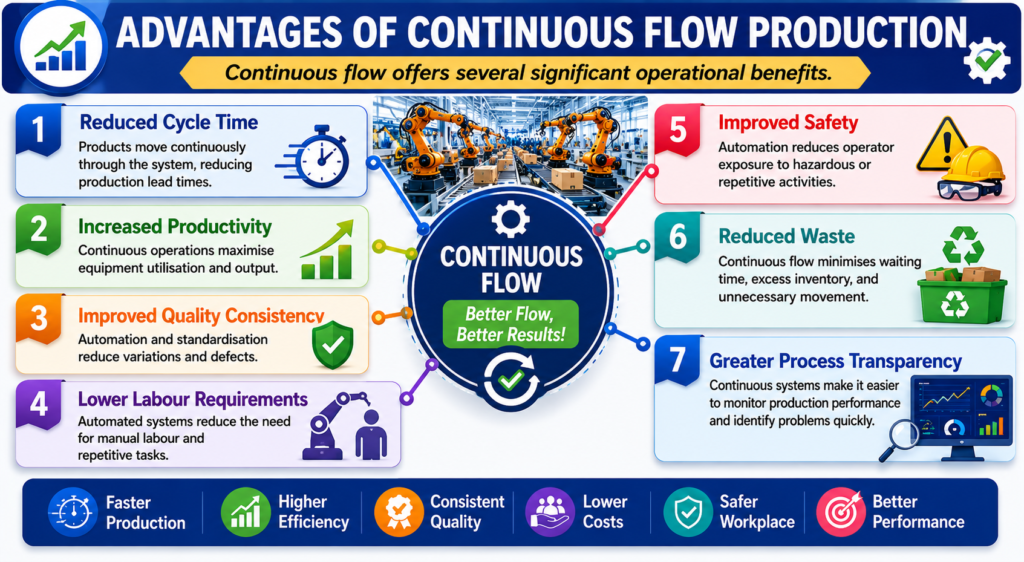
Manufacturing organisations continually seek methods to improve efficiency, reduce waste, increase productivity, and deliver products faster to customers. One of the most important concepts in modern production systems is continuous flow production. Continuous flow focuses on creating a smooth, uninterrupted movement of materials, components, and products through the manufacturing process.
Traditionally, many industries used batch production systems, where products are manufactured in groups or lots before moving to the next stage of production. However, modern industries increasingly adopt continuous flow systems because they improve speed, consistency, quality, and operational efficiency.
Understanding the differences between continuous flow and batch production systems helps organisations determine the most suitable production method for their operations.
Understanding Production Systems
A production system refers to the method used to manufacture products or deliver services. Two common production systems are:
- Continuous Flow Production
- Batch Production
Each system has different operational characteristics, advantages, and limitations.
What is Continuous Flow Production?
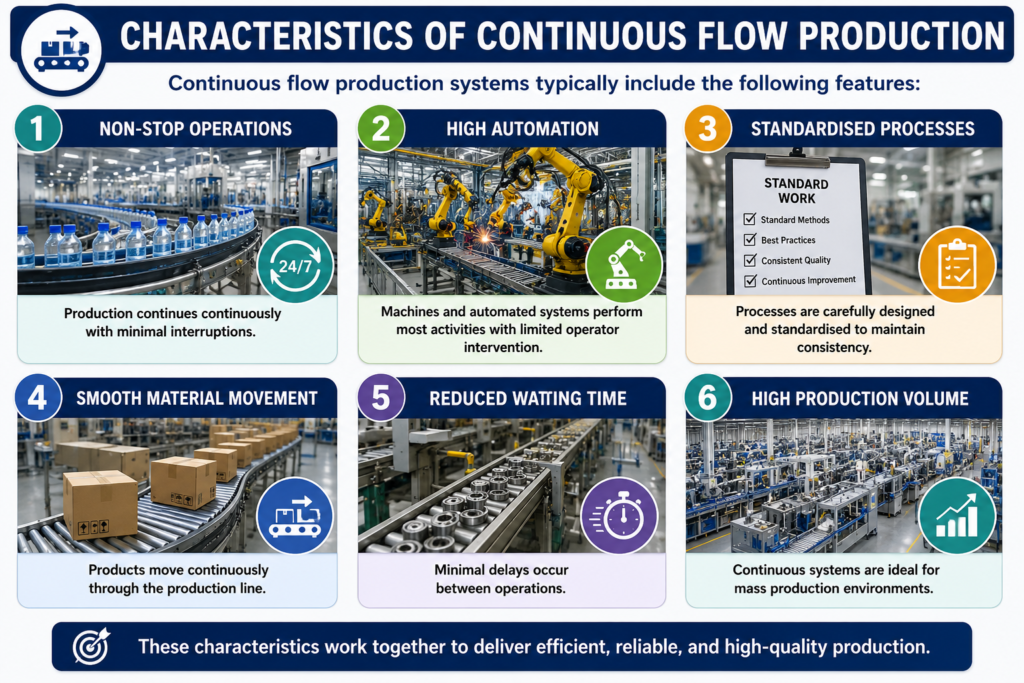
Continuous flow production is a non-stop manufacturing process where materials or products move continuously through production stages without interruption. Products are processed in a steady stream, reducing waiting time and delays between operations.
This production system is commonly used in industries requiring large-scale production and consistent output.
In continuous flow systems:
- Materials continuously enter the process
- Production activities occur simultaneously
- Products move continuously between workstations
- Minimal waiting or storage occurs between stages
Continuous flow is strongly associated with lean manufacturing principles, as it reduces waste and improves efficiency.
Examples of Continuous Flow Production
Continuous flow systems are widely used across manufacturing industries.
Liquid Production Systems: Industries such as paint, oil, chemicals, and beverages use continuous flow processes where liquids move constantly through pipes, tanks, and processing equipment.
Automotive Manufacturing: Toyota’s vehicle assembly lines are a classic example of continuous flow production. Cars move continuously along the assembly line while workers and automated systems perform assembly tasks simultaneously.
Pharmaceutical Industry: Tablet and capsule manufacturing often use continuous production systems to ensure consistent quality and high production rates.
Food Processing: Milk, bottled drinks, bread production, and snack manufacturing commonly use continuous flow systems.
What is Batch Production?
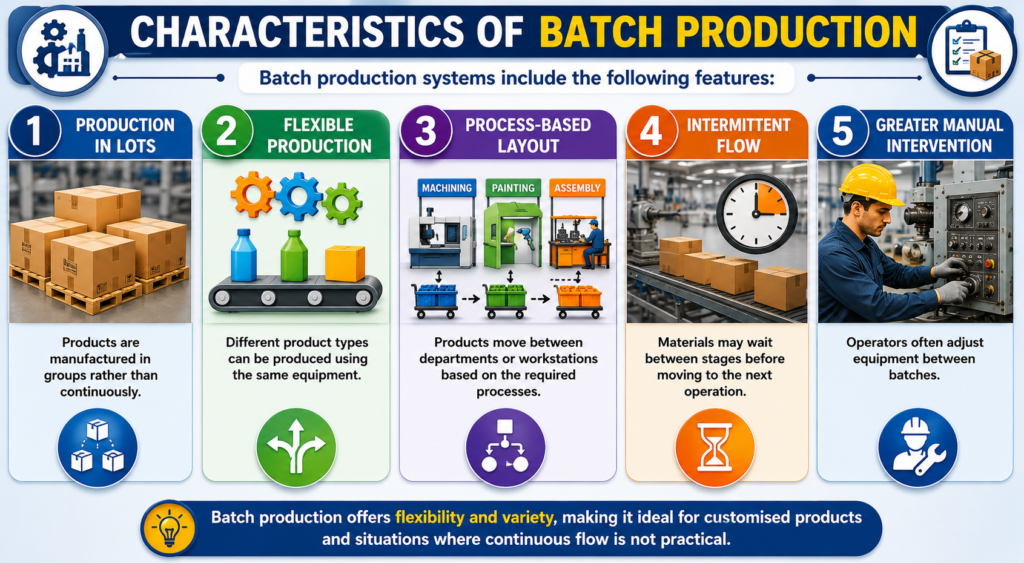
Batch production is a manufacturing method where products are produced in groups or quantities called batches. Each batch moves through a sequence of production stages before the next batch begins.
Unlike continuous flow systems, batch production has a clear beginning and end for each production cycle.
According to Barker and Rawtani (2005), batch production refers to the material produced during a single execution of a production process or the quantity produced at one time.
Example of Batch Production
Donut Manufacturing
Donuts are commonly produced in batches. Although different donut types may vary in flavour, colour, or toppings, they follow similar production stages:
- Mixing ingredients
- Forming dough
- Baking or frying
- Applying toppings
- Packaging
Each batch completes the full process before another batch begins.
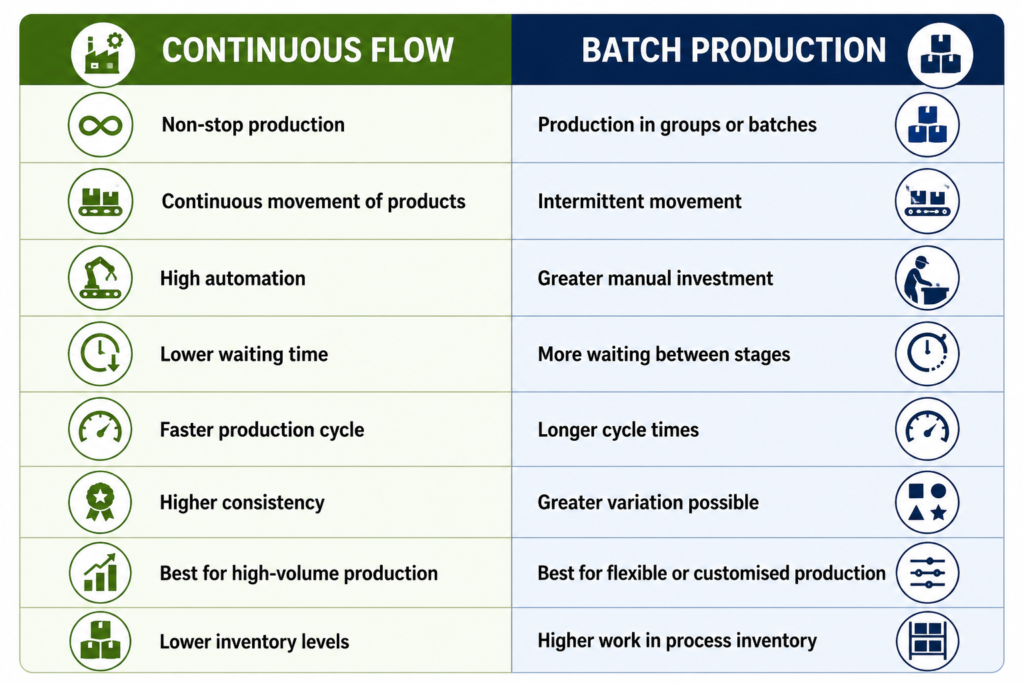
Continuous Flow vs Traditional Batch Production
When Batch Production is Necessary
Although continuous flow provides many advantages, some manufacturing processes cannot operate continuously.
Painting Operations: In automotive manufacturing, painting is often completed in batches for safety, ventilation, and quality control reasons.
Welding Operations: Certain welding processes require isolated work areas and controlled conditions, making batch processing more practical.
Heat Treatment Processes: Metal treatment and curing operations may require grouped processing in specialised equipment.
In these cases, batch production may increase cycle time but improve safety and quality.
The Shift from Batch to Continuous Flow
Many industries originally relied on batch production systems but later transitioned to continuous flow manufacturing.
The main reasons for this shift include:
- Reducing labour-intensive activities
- Improving production speed
- Increasing quality consistency
- Lowering production costs
- Enhancing automation
- Reducing human error
According to Barker and Rawtani (2005), batch production often required highly skilled and experienced operators to maintain consistent quality. Continuous flow systems reduced this dependency through automation and process standardisation.
Continuous Flow and Lean Manufacturing
Continuous flow is a fundamental principle of lean manufacturing. Lean production aims to eliminate waste and improve value creation.
Continuous flow supports lean principles by reducing:
- Waiting time
- Excess inventory
- Overproduction
- Unnecessary movement
- Defects
- Transportation waste
Lean tools such as:
- Kanban
- SMED
- 5S
- Value Stream Mapping
- Total Productive Maintenance (TPM)
are often used alongside continuous flow systems to improve operational performance.
Challenges of Continuous Flow Production
Despite its advantages, continuous flow systems also present challenges.
High Initial Investment. Automation equipment and production line setup can be expensive.
Limited Product Flexibility: Continuous systems may struggle with highly customised products.
Equipment Failure Impact: A single machine breakdown can stop the entire production line.
Complex Process Design: Continuous systems require careful planning and coordination.
Conclusion
Continuous flow production is one of the most effective manufacturing systems for achieving high productivity, consistent quality, and reduced operational waste. By maintaining uninterrupted product movement and minimising delays between operations, organisations can significantly improve efficiency and customer responsiveness.
Although batch production remains important for certain processes and flexible manufacturing environments, many industries continue shifting toward continuous flow systems due to advances in automation and lean manufacturing practices.
Understanding the advantages, limitations, and applications of continuous flow enables organisations to select the most suitable production strategy for their operational goals and customer demands.
Interested in our Industrial & Manufacturing Engineering Courses?
At iLearn Engineering®, we offer a diverse range of online accredited Industrial, Manufacturing and Mechanical Engineering courses and qualifications to cater to different academic and career goals. Our industrial courses are available in varying credit values and levels, ranging from 40 credit Engineering Diplomas to a Bachelor’s equivalent 360 credit International Graduate Diploma.
All Industrial / Manufacturing Engineering Courses
All Industrial / Manufacturing Engineering Diploma Courses can be seen here.
All Mechanical Engineering Diploma Courses can be seen here.
Short Courses for Industrial Engineering (40 Credits)
- Diploma in Manufacturing
- Diploma in Composites, Smart Materials & Nanotechnology
- Diploma in Lean Manufacturing
- Diploma in Mechanical Technology
- Diploma in Electrical Technology
- Diploma in Material Science
First Year of Undergraduate (Level 4 – 120 Credits)
Higher International Certificate in Industrial Engineering
Higher International Certificate in Mechanical Engineering
Years One and Two of Undergraduate (Level 5 – 240 Credits)
Higher International Diploma in Industrial Engineering
Higher International Diploma in Mechanical Engineering
Degree Equivalent International Graduate Diplomas in Engineering Management and Mechanical Engineering (Level 6 – 360 Credits)
International Graduate Diploma in Engineering Management (Level 6) [120 Credit Top Up]
International Graduate Diploma in Mechanical Engineering (Level 6) [120 Credit Top Up]
Complete Engineering Course Catalogue (all courses)
Alternatively, you can view all our online engineering courses here.
Get started today
Explore our range of Industrial and Manufacturing Engineering courses
Recent Posts
Types of Aircraft Drag Explained: Induced, Profile and Interference Drag
Types of Aircraft Drag Explained: Induced, Profile and Interference Drag An aircraft experiences several forms of aerodynamic drag at the same time. Some result from generating lift, some arise as air flows over the aircraft’s surfaces, and others are created when airflow around neighbouring components interacts. For a conventional aircraft in subsonic flight, total drag […]
Induced Drag Explained: Why Flying Slower Can Increase Drag
Induced Drag Explained: Why Flying Slower Can Increase Drag Why can an aircraft experience more drag when it flies more slowly? We usually associate greater speed with greater air resistance, but a wing must also generate enough lift to support the aircraft. Induced drag is the drag associated with producing lift on a finite-span wing. […]
Laminar vs Turbulent Boundary Layers: Why Airflow Separates from Aircraft Wings
Laminar vs Turbulent Boundary Layers: Why Airflow Separates from Aircraft Wings Airflow around an aircraft wing is often shown as smooth streamlines passing neatly over the aerofoil. In reality, the thin layer of air immediately next to the wing surface behaves very differently from the undisturbed airflow further away. This region is called the boundary […]