

Exploring Kanban Systems for Efficient Manufacturing Operations
Introduction
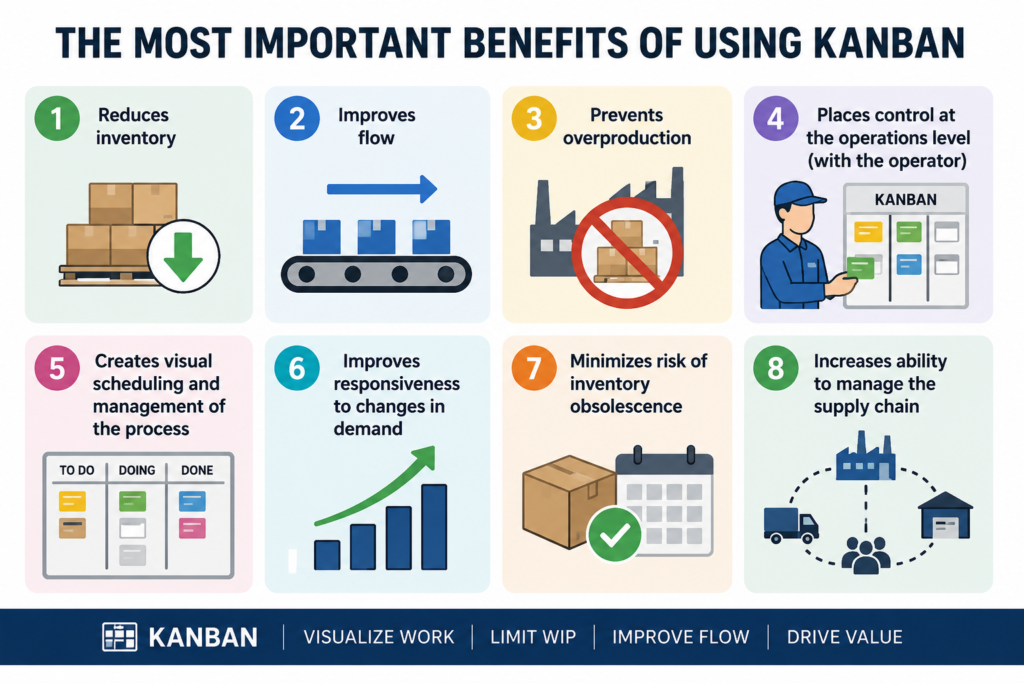
Kanban is a visual system part of the Toyota Management System to support the “pull inventory” system, Just in Time.
The Kanban is a Japanese word that means “Visual System”. It is used to understand the level of inventories available for raw material, work in process or any other item needed in the shopfloor. Labels are attached to storage bins with the specific information of the item, amount of inventory to keep and replenishment point. Therefore, the person responsible for the inventories can maintain items available all time, when the production orders are placed.
Kanban can be used not only in manufacturing companies, but it has also reached popularity in the information systems sector, to facilitate a visual system of work to do, work in progress and work to be done or done.
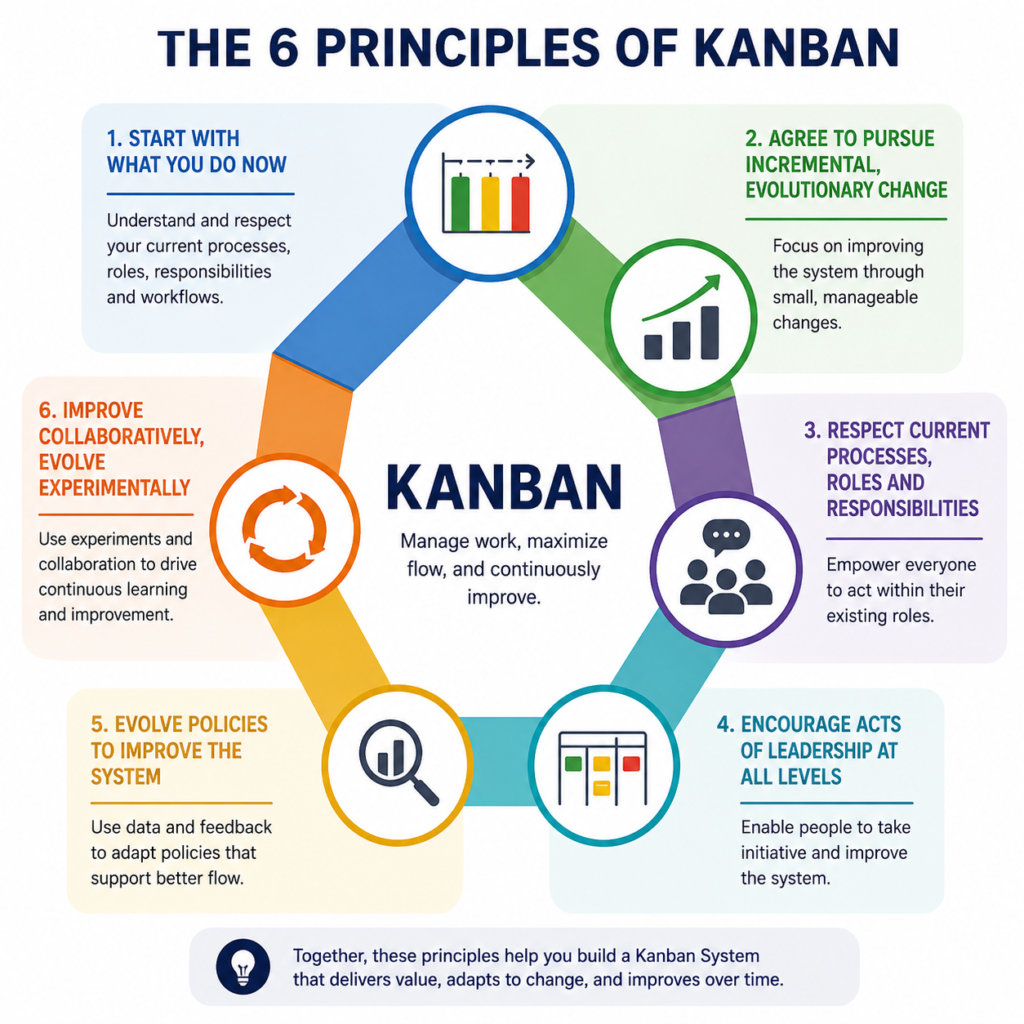
The 6 principles of Kanban
1. Start with What You Do Now
Kanban encourages organizations to begin by working with their existing processes, workflows, and systems rather than introducing major changes immediately. This approach makes implementation smoother because teams can gradually improve operations without disrupting daily work. Instead of replacing current methods, Kanban focuses on understanding how work is currently completed and identifying opportunities for improvement over time. This principle helps reduce resistance to change and allows organizations to adopt Lean practices at a comfortable pace.
2. Agree to Pursue Incremental, Evolutionary Change
Kanban promotes small, continuous improvements instead of large-scale transformations. Rather than attempting a complete operational overhaul, organizations make gradual adjustments that improve efficiency step by step. This evolutionary approach reduces risk because changes are tested, measured, and refined over time. Small improvements are often easier for teams to accept and sustain, leading to long-term operational success.
3. Respect Current Processes, Roles, and Responsibilities
Kanban recognizes that existing roles, responsibilities, and workflows already provide value to the organization. Instead of forcing immediate restructuring, Kanban encourages teams to improve collaboration within the current organizational structure. This principle helps maintain stability while improvements are introduced gradually. Employees feel valued because their knowledge and expertise remain important during the transition.
4. Encourage Leadership at All Levels
Kanban promotes leadership throughout the organization, not only among managers or senior executives. Every team member is encouraged to identify problems, suggest improvements, and contribute to process optimization. This creates a culture of accountability and continuous improvement where employees feel empowered to take ownership of their work and help improve the system. In Kanban, leadership is viewed as a shared responsibility that can come from anyone involved in the process.
5. Make Policies and Processes Explicit
Kanban emphasizes the importance of clearly defining workflows, rules, responsibilities, and process expectations. Visual boards, work limits, and transparent procedures help everyone understand how work moves through the system. When processes are clearly documented and visible, teams can identify bottlenecks, reduce confusion, and improve consistency across operations. This transparency also improves communication and decision-making within the organization.
6. Improve Collaboratively and Evolve Experimentally
Kanban encourages teams to work together to solve problems and continuously improve processes using data and experimentation. Improvements are tested through small experiments, measured, and refined based on results. This scientific and collaborative approach allows organizations to make informed decisions while encouraging innovation and teamwork. Continuous feedback and performance measurement help organizations adapt quickly to changing business demands.
The steps to implement Kanban
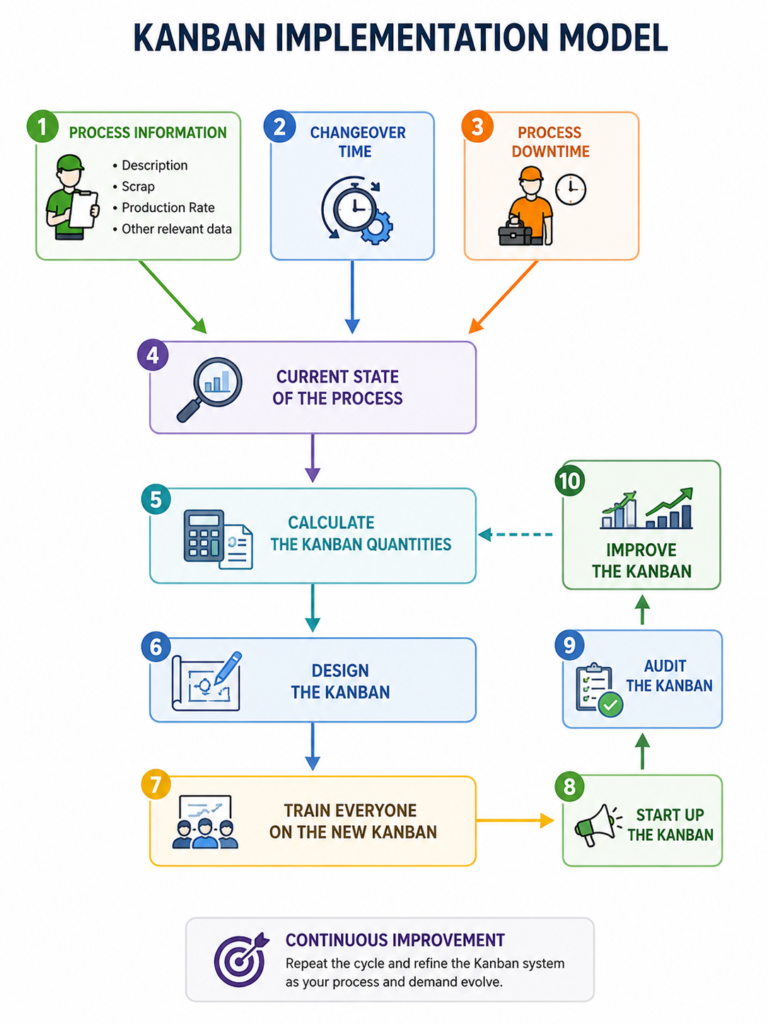
1. Analyze the Current Process: Review the existing workflow, inventory levels, production rates, downtime, and material movement to understand how the process currently operates.
2. Identify Demand and Production Requirements: Determine customer demand, replenishment frequency, cycle times, and required inventory levels to support smooth production flow.
3. Calculate Kanban Quantities: Calculate the number of containers, cards, and replenishment quantities needed to maintain production without overstocking.
4. Design the Kanban System: Create the Kanban cards, boards, container labels, and visual controls that will be used to manage workflow and inventory.
5. Establish Replenishment Rules: Define how and when materials will be replenished, including withdrawal methods, production triggers, and delivery schedules.
6. Train Employees: Train operators, supervisors, and support staff on how the Kanban system works and how to follow the rules consistently.
7. Launch the Kanban System: Implement the system in the production area and begin managing workflow using Kanban signals and visual controls.
8. Monitor and Audit Performance: Track inventory levels, flow efficiency, lead times, and card usage to ensure the system operates correctly.
9. Continuously Improve the System: Use audits, feedback, and performance data to refine Kanban quantities, workflows, and replenishment methods for ongoing improvement.
Kanban Implementation Process
Conduct data collection: The use of value stream mapping allows you to identify the state of the process and the production processes that need Kanban.
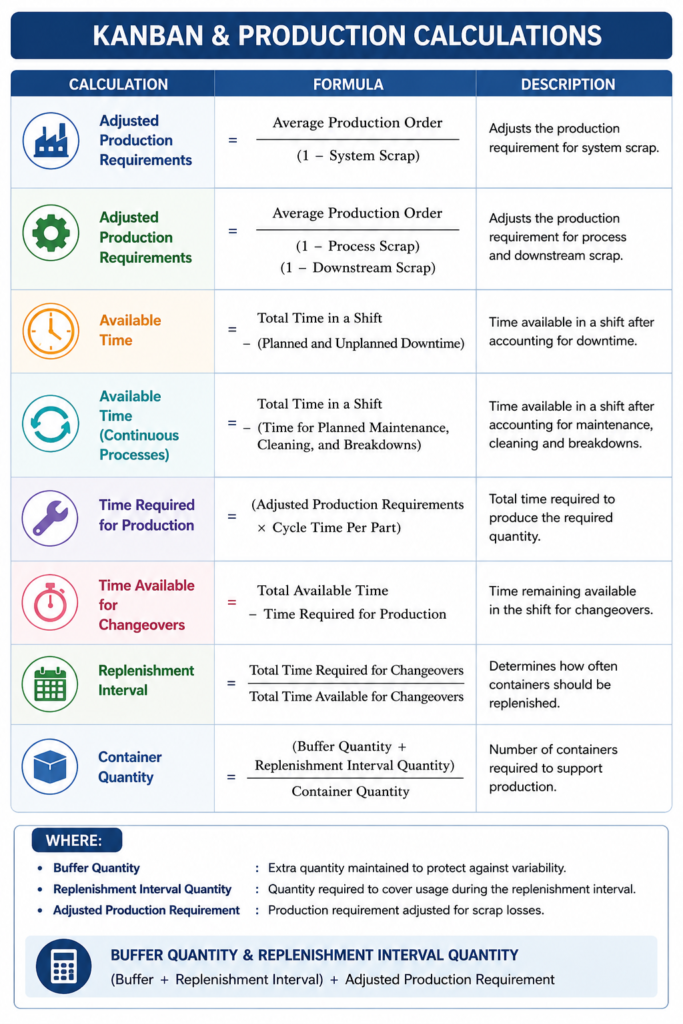
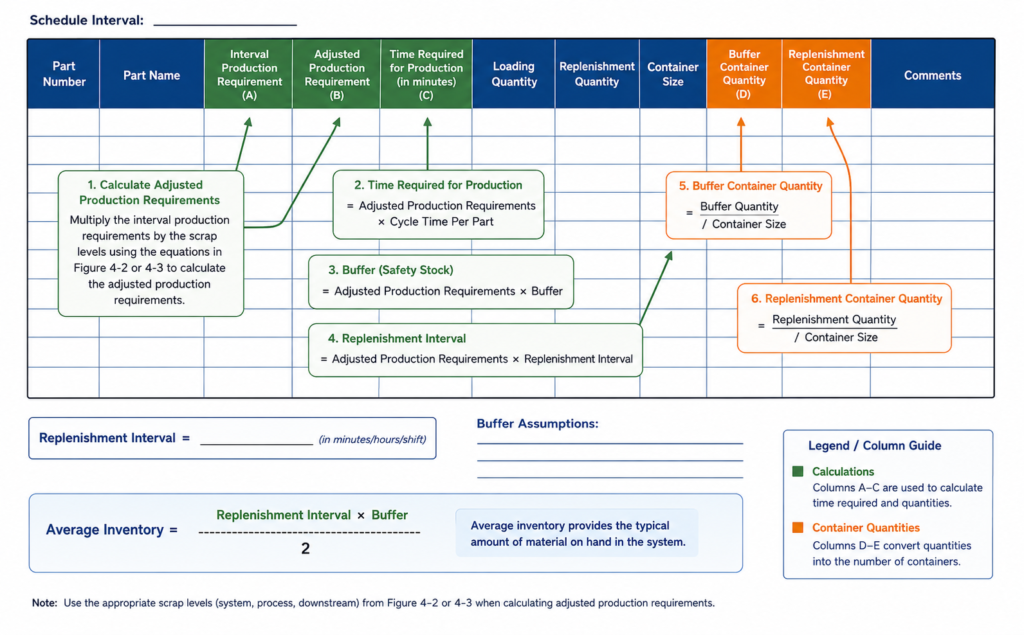
Calculate the Kanban size: There are a set of formulas to calculate the number of containers, replenishment time or quantities. The following images express the formulas needed, and an example of a template to visualise these quantities. Formulas to calculate Kanban Size.
Design the Kanban: At this phase it is important to select the signalling mechanism (manual visual boards, electronic visual boards, etc), to develop the rules for operation of the Kanban, as well as creating the visual management plans
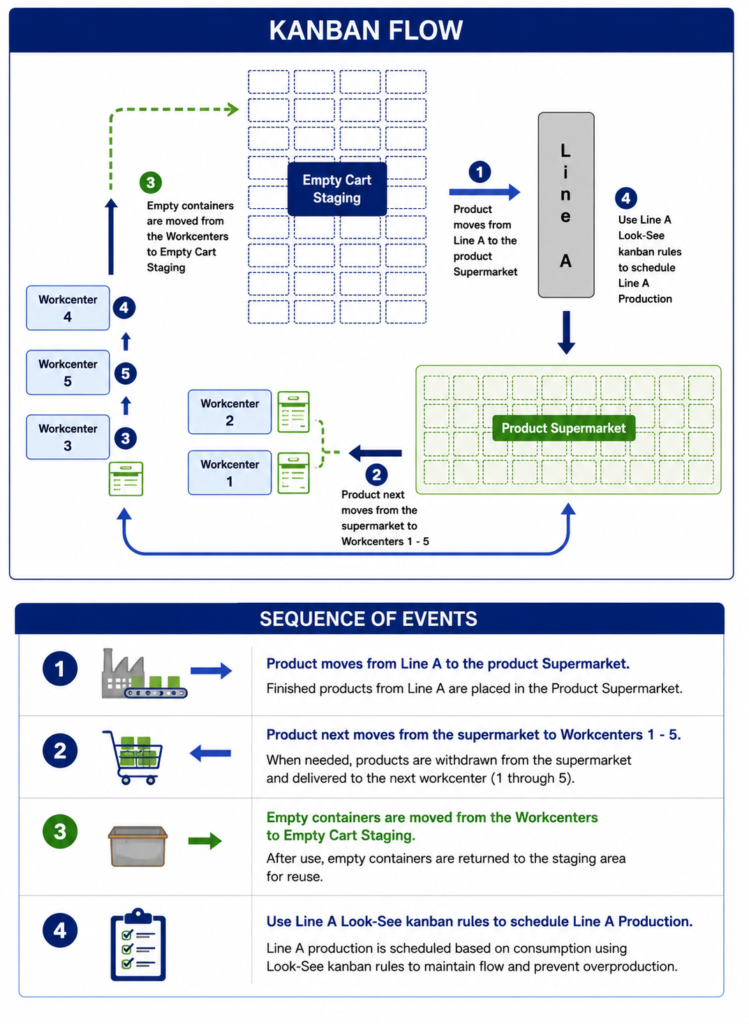
Train everyone: Start from the basic concepts, establish and communicate how Kanban will be operated, explain the flow and rules. Try to come up with what if scenarios and establish the specific rules to follow.
Start the Kanban: After completing the training process the next step is to start. Then, you have to verify inventories to assure the process was understood correctly. Some of the common issues that come up in the start up process are related to operator misunderstanding in the use of cards, rules, etc.
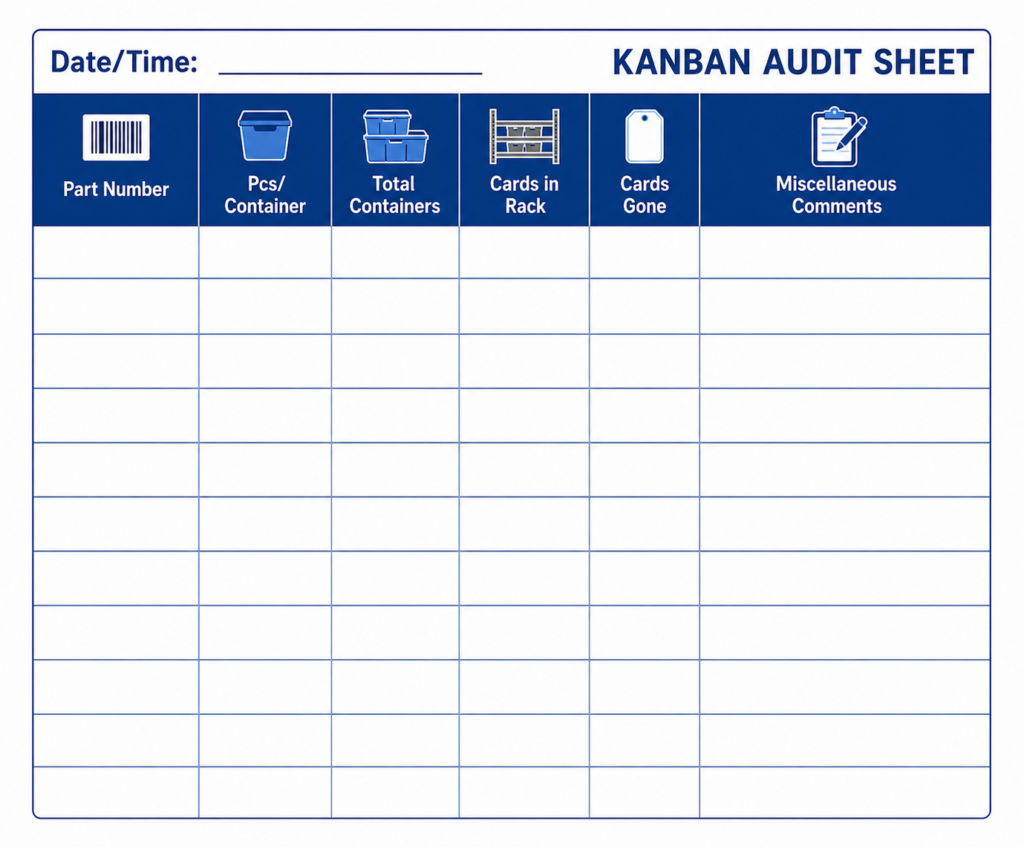
Audit and maintain the Kanban: Assess if all requirements were met. You can use a checklist to verify if all requirements were met, as well to identify problems and how to solve them.
Improve the Kanban: Among the actions to improve the Kanban are:
- Coordinate the activities of the changeover participants
- Eliminate wasted motion
- Eliminate travel
- Eliminate waiting
- Improve the startup activities
Types of Kanban Systems
There are different types of Kanban systems depending on the needs of the organisation, if it is used in the production process, inventory management, or work in progress.
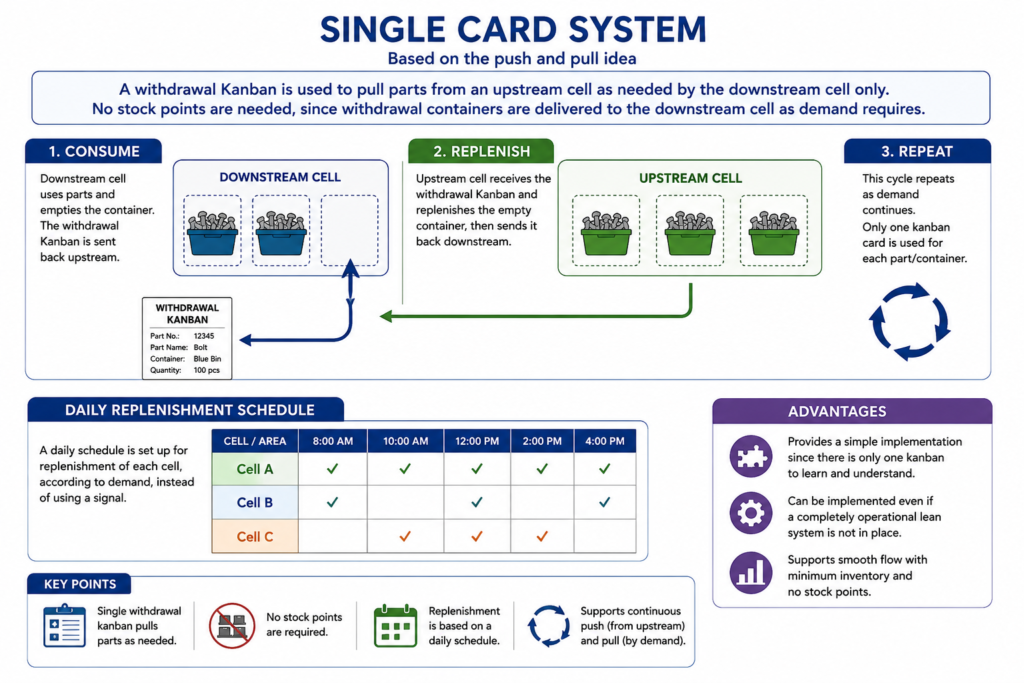
Single card system.
It is based on the push and pull idea. When the containers are empty in the cell, then this is replenished. Also, a daily schedule is set up for replenishment of each cell, according to demand, instead of using a signal. For example, a withdrawal Kanban can be used to pull parts of an upstream cell as needed by the downstream cell only. No stock points are needed, since withdrawal containers are delivered to the downstream cell as demand requires. One advantage is that this provides a simple implementation since there is only one Kanban to learn and understand. Also, it can be implemented even if a completely operational lean system is not in place.
Dual card system.
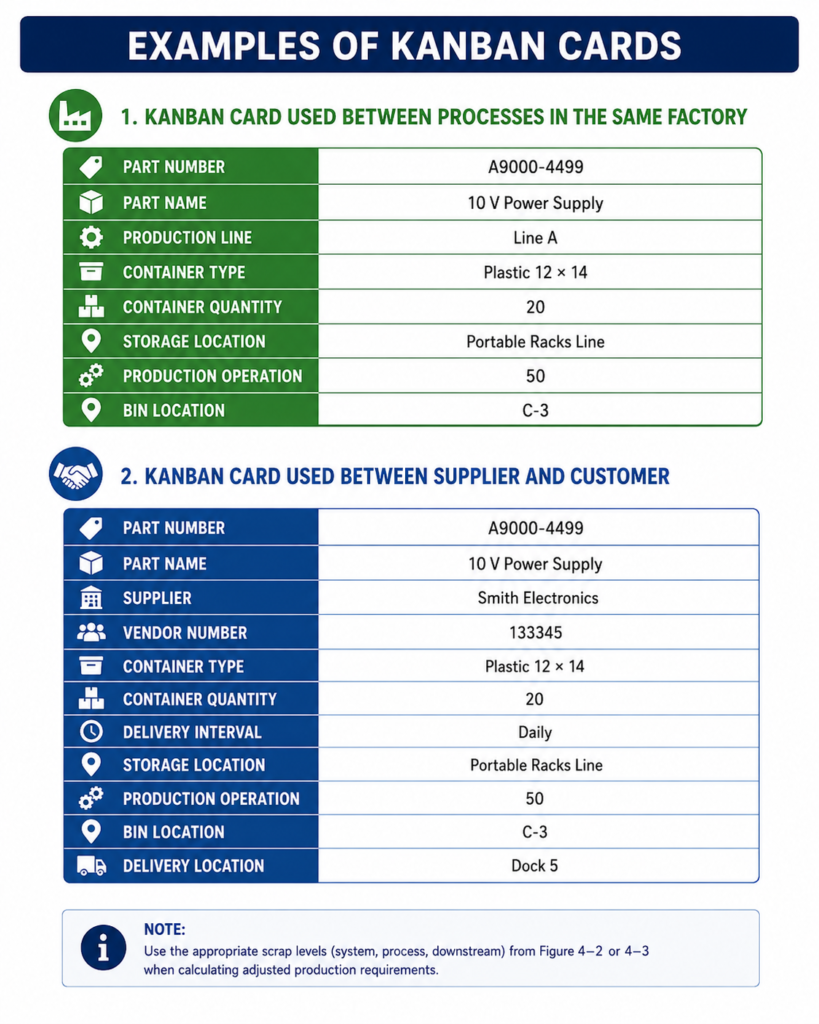
Usually, cards are plastic rectangular shaped and enclosed in a vinyl packet to be reusable. The cards are attached to containers which are designed for each component. The dual card system is used in production order that signals an upstream cell or process to produce a certain part; and a withdrawal Kanban that serves to link two cells or processes. The cards specify part number, container capacity, previous and next cell or process, and other information such as part quantity that a downstream process can withdraw from the upstream process, or the part type and quantity that the next cell or process must produce (production-ordering Kanban). The beauty of this system is simplicity, easy to visualise and to understand from users.
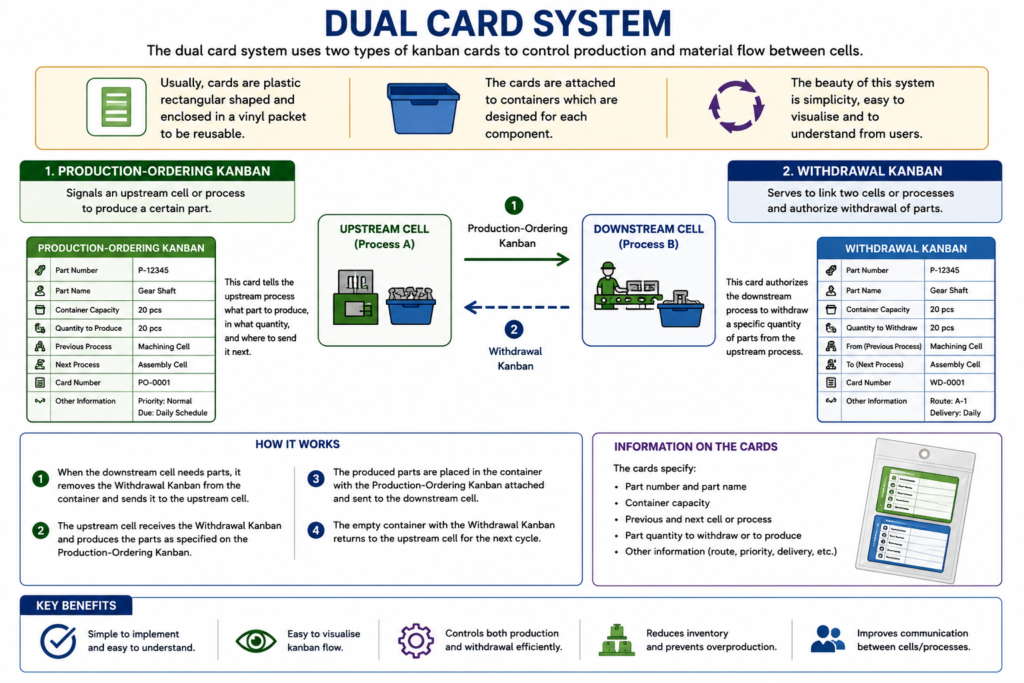
Kanban has many benefits and it is relatively simple to implement and use with a manual information system.
limitations:
Goods must be produced in whole discrete units. Kanban is not applicable for continuous processes such as breweries.
Kanban should be a subsystem of a linked-cell manufacturing system, using Just in time philosophy. It makes no sense without lean production, in which only necessary parts are manufactured and withdrawn in the right quantity at the right time.
Standardisation, cell design and manufacturing system, and operations within cells, smoothing of production must be implemented before an effective pull system can take place.
The parts included in the Kanban system should be used every day (high use of parts). Kanban provides that at least one full container of a given part number is available.
Special types of Kanban
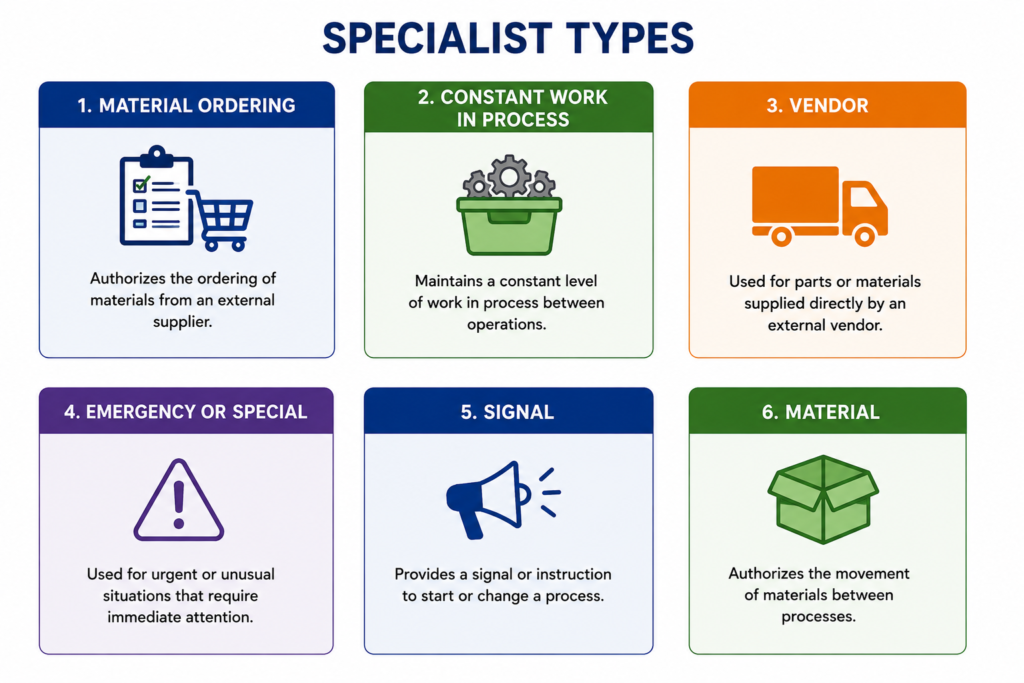
Material ordering Kanban are a special kind of withdrawal card. These are used to get material from vendors. The cards are similar, but in this case, cards are detachable to go to the users accounts receivable department.
Constant work in the process system focuses on maintaining a constant level of work in process over the entire manufacturing system. Work in process at any point within the system is allowed to fluctuate freely. The constant work in the process system tries to control work in process like kanban but fails to make use of the demand prompted pulling of material between cells.
It has some advantages: There is no blocking. The station only stops producing if the raw materials upstream are disrupted. It is simple to control because the only variable is the total work in process in the systems. Works with a large variety of parts. Unbalanced lines can be handled well. A true kanban system has difficulty functioning in a facility that has not balanced the process with the final assembly. Bottlenecks near the end of the line are not devastating. The process continues receiving raw materials, so production can continue.
Limitations of Constant work in process: It is inferior to Kanban if the lines are balanced. Performance is poor if bottlenecks occur near the beginning. It can experience routing problems since the parts are pushed through the factory, a routing sequence must be set. This is not a problem if the parts travel to the same cell.
Vendor Kanban. It is a type of withdrawal kanban. It is used to request delivery of parts from a subcontracted supplier.
Emergency or special Kanban: It is issued temporarily for defective work, extra insertions, or spurts in demand. These are issued for extraordinary reasons and collected immediately.
Signal Kanban: It is used for lot manufacturing in job order-oriented production. It is a triangular form that is attached to a pallet or stock of containers at the reorder point. This kanban is removed and placed at the dispatching post to signal the need for the manufacture of additional parts.
Material Kanban. It is used in conjunction with the signal kanban. This material Kanban is set higher than that of the signal kanban, so that the material requirements will be fulfilled before manufacture of the parts begin.
Interested in our Industrial & Manufacturing Engineering Courses?
At iLearn Engineering®, we offer a diverse range of online accredited Industrial, Manufacturing and Mechanical Engineering courses and qualifications to cater to different academic and career goals. Our industrial courses are available in varying credit values and levels, ranging from 40 credit Engineering Diplomas to a Bachelor’s equivalent 360 credit International Graduate Diploma.
All Industrial / Manufacturing Engineering Courses
All Industrial / Manufacturing Engineering Diploma Courses can be seen here.
All Mechanical Engineering Diploma Courses can be seen here.
Short Courses for Industrial Engineering (40 Credits)
- Diploma in Manufacturing
- Diploma in Composites, Smart Materials & Nanotechnology
- Diploma in Lean Manufacturing
- Diploma in Mechanical Technology
- Diploma in Electrical Technology
- Diploma in Material Science
First Year of Undergraduate (Level 4 – 120 Credits)
Higher International Certificate in Industrial Engineering
Higher International Certificate in Mechanical Engineering
Years One and Two of Undergraduate (Level 5 – 240 Credits)
Higher International Diploma in Industrial Engineering
Higher International Diploma in Mechanical Engineering
Degree Equivalent International Graduate Diplomas in Engineering Management and Mechanical Engineering (Level 6 – 360 Credits)
International Graduate Diploma in Engineering Management (Level 6) [120 Credit Top Up]
International Graduate Diploma in Mechanical Engineering (Level 6) [120 Credit Top Up]
Complete Engineering Course Catalogue (all courses)
Alternatively, you can view all our online engineering courses here.
Get started today
Explore our range of Industrial and Manufacturing Engineering courses
Recent Posts
Types of Aircraft Drag Explained: Induced, Profile and Interference Drag
Types of Aircraft Drag Explained: Induced, Profile and Interference Drag An aircraft experiences several forms of aerodynamic drag at the same time. Some result from generating lift, some arise as air flows over the aircraft’s surfaces, and others are created when airflow around neighbouring components interacts. For a conventional aircraft in subsonic flight, total drag […]
Induced Drag Explained: Why Flying Slower Can Increase Drag
Induced Drag Explained: Why Flying Slower Can Increase Drag Why can an aircraft experience more drag when it flies more slowly? We usually associate greater speed with greater air resistance, but a wing must also generate enough lift to support the aircraft. Induced drag is the drag associated with producing lift on a finite-span wing. […]
Laminar vs Turbulent Boundary Layers: Why Airflow Separates from Aircraft Wings
Laminar vs Turbulent Boundary Layers: Why Airflow Separates from Aircraft Wings Airflow around an aircraft wing is often shown as smooth streamlines passing neatly over the aerofoil. In reality, the thin layer of air immediately next to the wing surface behaves very differently from the undisturbed airflow further away. This region is called the boundary […]