

Introduction to Just-in-Time Manufacturing
Introduction
Just-in-Time (JIT) manufacturing is a key lean manufacturing philosophy and one of the pillars of the Toyota Production System. JIT focuses on producing and delivering materials only when they are needed, reducing excess inventory and waste.
In a JIT system, raw materials, components, and finished products move through production exactly at the required time. This helps organisations reduce storage costs, improve efficiency, increase productivity, and minimise waste.
JIT also supports continuous improvement and better quality. However, successful implementation requires reliable suppliers, accurate scheduling, standardised processes, and strong communication. Although JIT reduces costs and inventory, it can also make organisations more vulnerable to supply chain disruptions.
The elements of a JIT process typically include the following
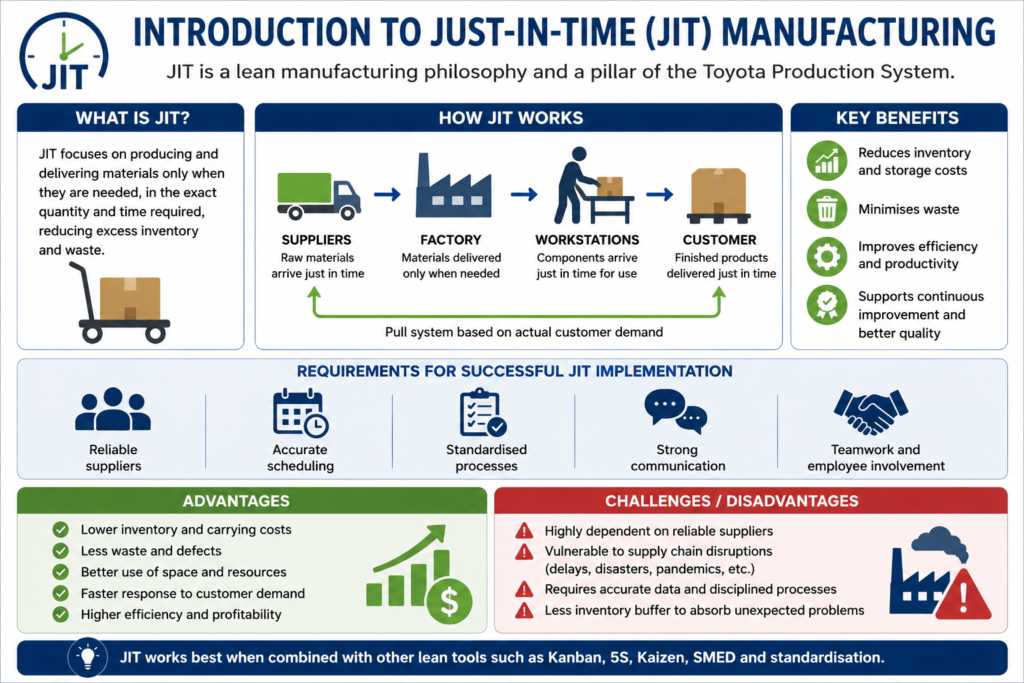
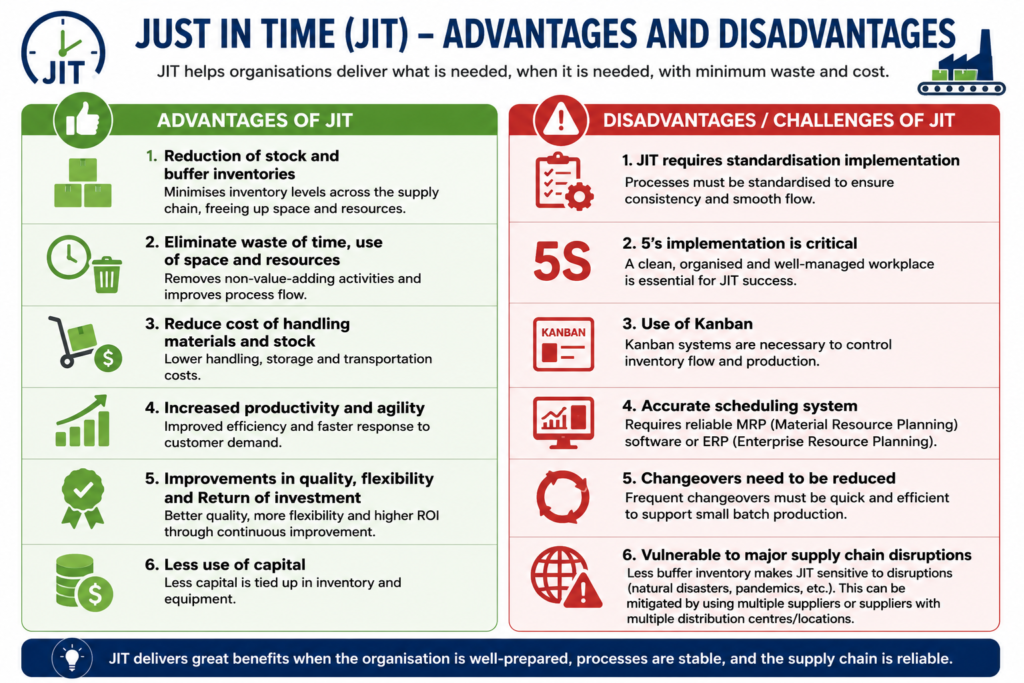
As you can see, every lean manufacturing tool is related to each one, then an organisation should apply these tools together, as a system, to accomplish real lean production. That is why Toyota Production is a system and it has its principals, pillars, supports and elements that will lead to a total lean production system. In other words, Kanban cannot work without standardisation; standardisation needs 5’s to be in place before establishing standards. Just in Time needs the Kanban and visual cards, etc.
Lean production systems require the analysis of the organisational context and needs, and the design of the implementation process, step by step, of each of the tools and philosophies.
Lean Production System Elements
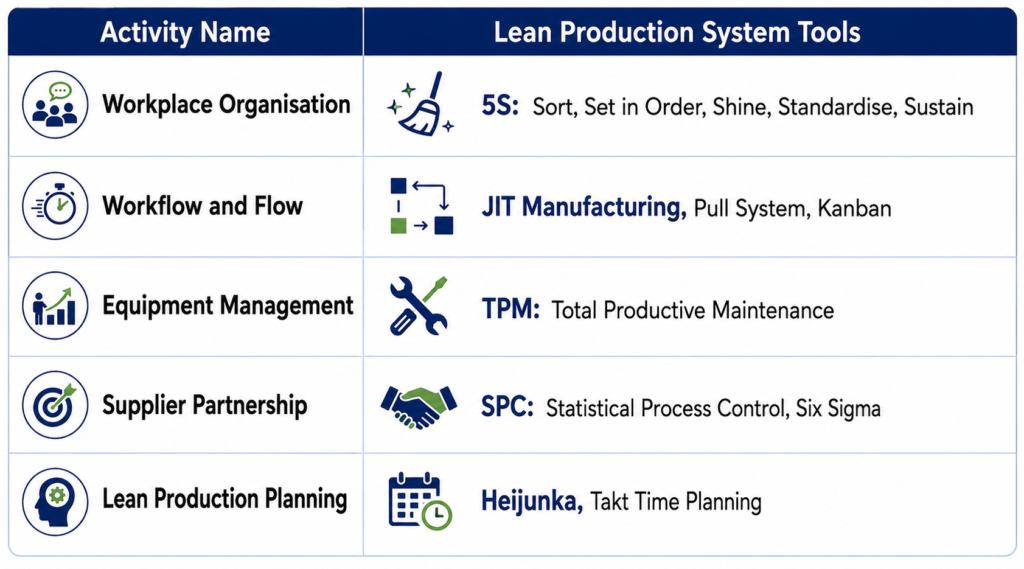
Lean Implementation Step Chart
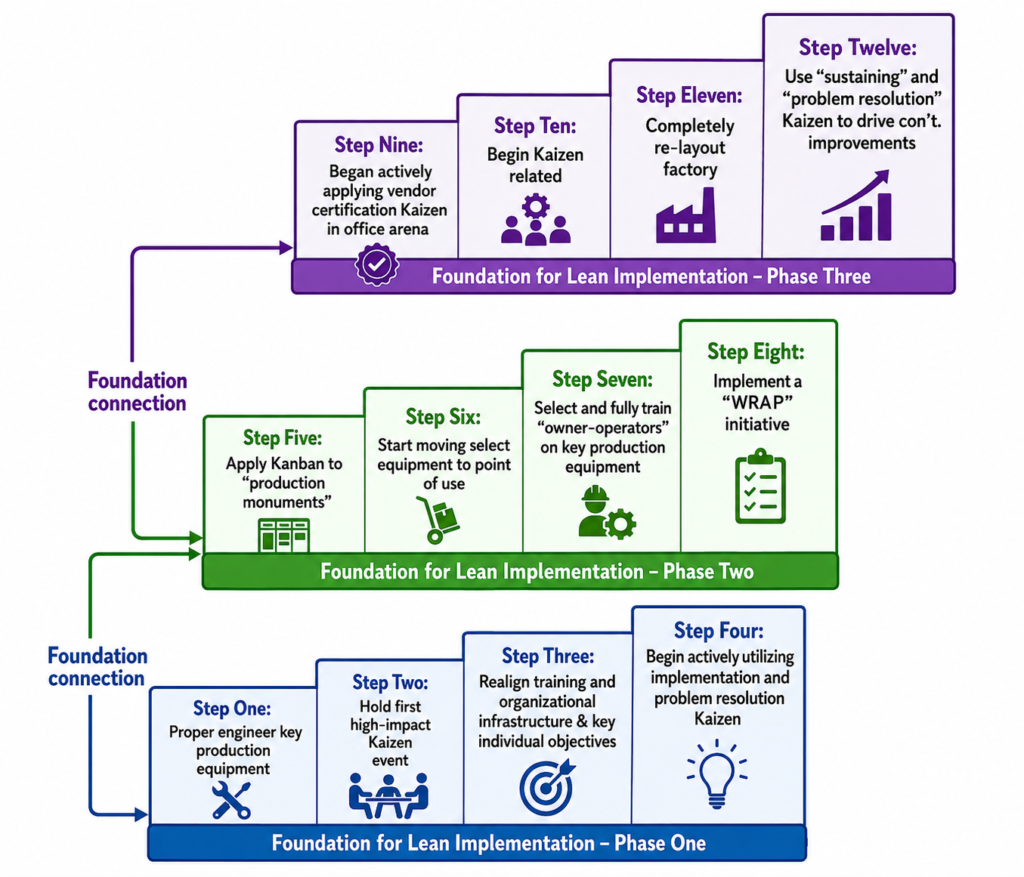
Lean Implementation Step Chart Breakdown
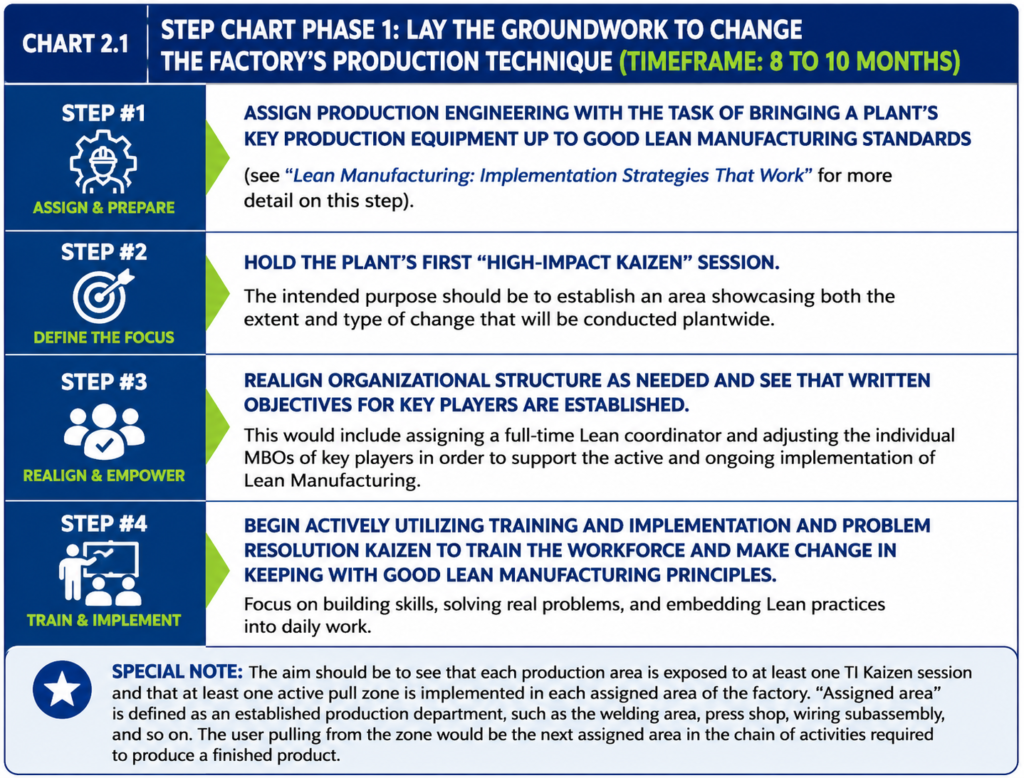
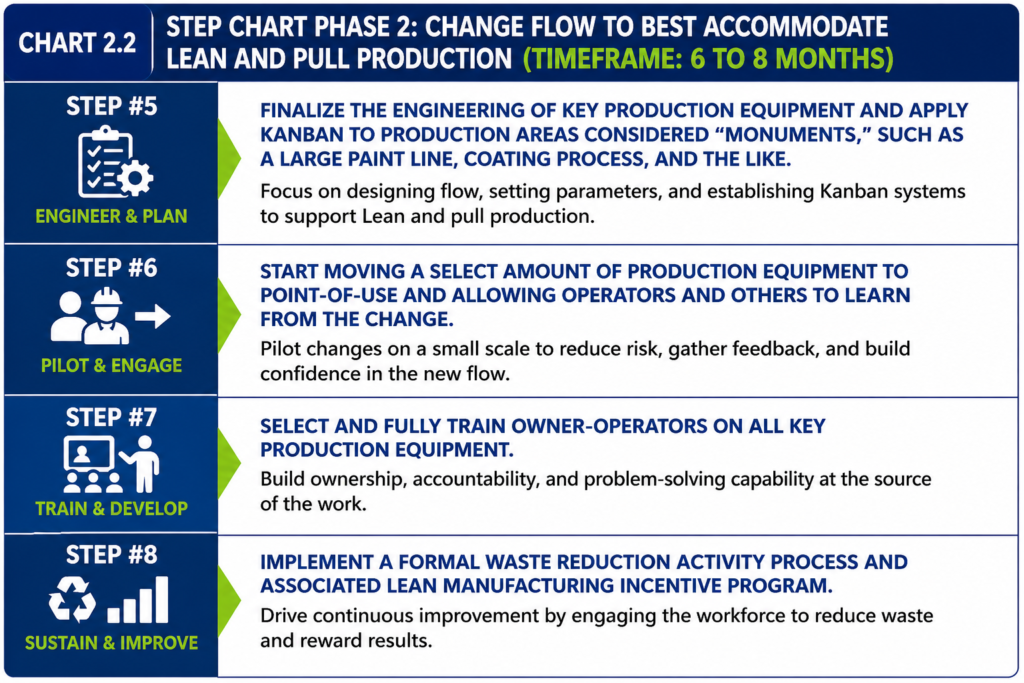
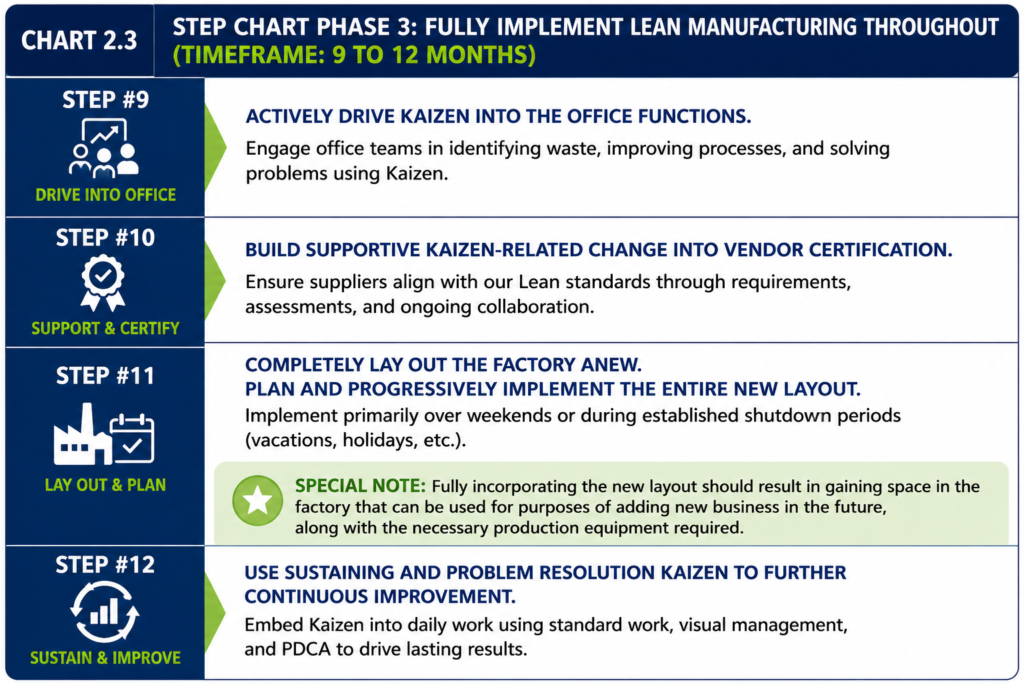
Just in time (JIT) has a huge impact in cost reductions and waste because of the use of only the inventory that is needed, as well as the efficiency that just in time requires to avoid any disruption in the supply chain. Therefore, it forces the organisation to be more productive and avoid any type of waste in the process that affects the flow of products from the supplier to the customer, such as, errors in orders, improper material handling and storage, wrong orders, mistakes in processes, etc.
Interested in our Industrial & Manufacturing Engineering Courses?
At iLearn Engineering®, we offer a diverse range of online accredited Industrial, Manufacturing and Mechanical Engineering courses and qualifications to cater to different academic and career goals. Our industrial courses are available in varying credit values and levels, ranging from 40 credit Engineering Diplomas to a Bachelor’s equivalent 360 credit International Graduate Diploma.
All Industrial / Manufacturing Engineering Courses
All Industrial / Manufacturing Engineering Diploma Courses can be seen here.
All Mechanical Engineering Diploma Courses can be seen here.
Short Courses for Industrial Engineering (40 Credits)
- Diploma in Manufacturing
- Diploma in Composites, Smart Materials & Nanotechnology
- Diploma in Lean Manufacturing
- Diploma in Mechanical Technology
- Diploma in Electrical Technology
- Diploma in Material Science
First Year of Undergraduate (Level 4 – 120 Credits)
Higher International Certificate in Industrial Engineering
Higher International Certificate in Mechanical Engineering
Years One and Two of Undergraduate (Level 5 – 240 Credits)
Higher International Diploma in Industrial Engineering
Higher International Diploma in Mechanical Engineering
Degree Equivalent International Graduate Diplomas in Engineering Management and Mechanical Engineering (Level 6 – 360 Credits)
International Graduate Diploma in Engineering Management (Level 6) [120 Credit Top Up]
International Graduate Diploma in Mechanical Engineering (Level 6) [120 Credit Top Up]
Complete Engineering Course Catalogue (all courses)
Alternatively, you can view all our online engineering courses here.
Get started today
Explore our range of Industrial and Manufacturing Engineering courses
Recent Posts
Types of Aircraft Drag Explained: Induced, Profile and Interference Drag
Types of Aircraft Drag Explained: Induced, Profile and Interference Drag An aircraft experiences several forms of aerodynamic drag at the same time. Some result from generating lift, some arise as air flows over the aircraft’s surfaces, and others are created when airflow around neighbouring components interacts. For a conventional aircraft in subsonic flight, total drag […]
Induced Drag Explained: Why Flying Slower Can Increase Drag
Induced Drag Explained: Why Flying Slower Can Increase Drag Why can an aircraft experience more drag when it flies more slowly? We usually associate greater speed with greater air resistance, but a wing must also generate enough lift to support the aircraft. Induced drag is the drag associated with producing lift on a finite-span wing. […]
Laminar vs Turbulent Boundary Layers: Why Airflow Separates from Aircraft Wings
Laminar vs Turbulent Boundary Layers: Why Airflow Separates from Aircraft Wings Airflow around an aircraft wing is often shown as smooth streamlines passing neatly over the aerofoil. In reality, the thin layer of air immediately next to the wing surface behaves very differently from the undisturbed airflow further away. This region is called the boundary […]