

Poka-Yoke: Building Error-Proofing into Manufacturing Systems
Introduction
In every manufacturing environment, mistakes can lead to defects, delays, rework, safety incidents, and unnecessary costs. One of the most effective Lean Manufacturing tools for preventing these issues is Poka-Yoke, also known as error-proofing or mistake-proofing.
Poka-Yoke is a simple yet powerful concept that helps prevent errors from occurring, detect them immediately when they happen, or stop them from progressing through the process. The best part? Most Poka-Yoke solutions are inexpensive and often require nothing more than creativity and practical thinking.
Everyday Examples of Poka-Yoke
Many of us interact with error-proofing devices every day without even realizing it.
Consider these examples:
- An ATM emits a warning sound if you forget to remove your bank card.
- Modern vehicles prevent drivers from starting the journey until seat belts are fastened.
- USB connectors are designed to fit only in the correct orientation.
- Online forms automatically validate data and prevent incorrect entries.
These systems are designed to either prevent mistakes or alert users before a problem occurs.
The same principles can be applied throughout manufacturing operations.
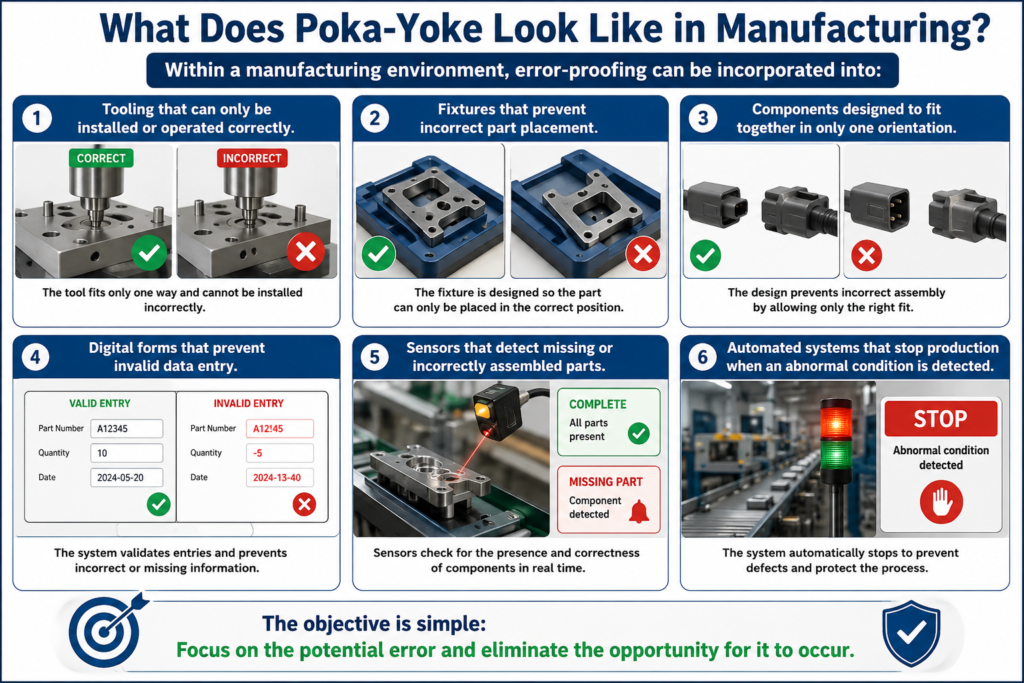
The objective is simple: focus on the potential error and eliminate the opportunity for it to occur.
The Three Levels of Error-Proofing
Not all error-proofing solutions provide the same level of protection. Poka-Yoke methods are generally categorized into three levels.
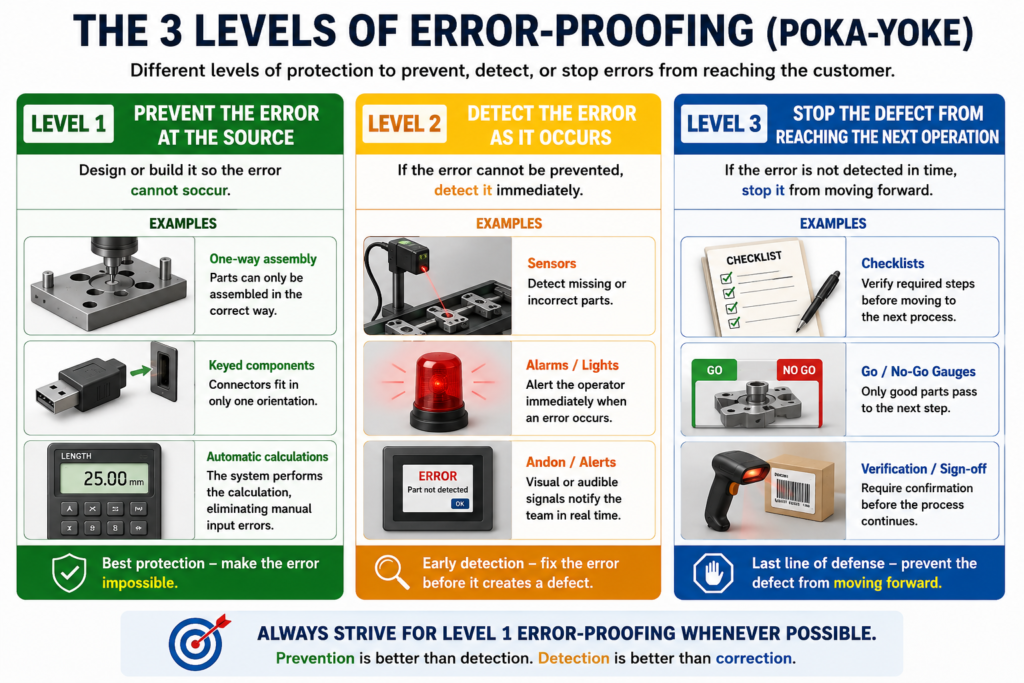
Level 1: Prevent the Error at the Source
This is the most effective level because it eliminates the possibility of making the mistake.
Examples include:
- One-way assemblies that cannot be installed incorrectly.
- Fixtures that only accept the correct part orientation.
- Software systems that automatically calculate values instead of relying on manual input.
Level 2: Detect the Error as It Occurs
When prevention is not possible, the next best option is immediate detection.
Examples include:
- Audible alarms.
- Warning lights.
- Sensors that identify missing components during assembly.
Level 3: Prevent the Defect from Moving Forward
These solutions stop errors from reaching the next process step or the customer.
Examples include:
- Checklists.
- Quality verification steps.
- Sign-off procedures.
While Level 3 solutions provide protection, organizations should always strive to achieve Level 1 error-proofing whenever possible, as prevention is more effective than detection or correction.
The Origins of Poka-Yoke
The concept of Poka-Yoke was developed by Shigeo Shingo, one of the pioneers of the Toyota Production System.
Shingo believed that defects are not inevitable. Instead, they result from human errors that can be anticipated and prevented. His philosophy was based on a simple principle:
Preventing mistakes is far less costly than correcting defects after they occur.
Rather than focusing on finding defects after production, Shingo encouraged managers and engineers to identify the root causes of errors and eliminate them before they could happen.
His approach transformed quality management by shifting attention from inspection to prevention.
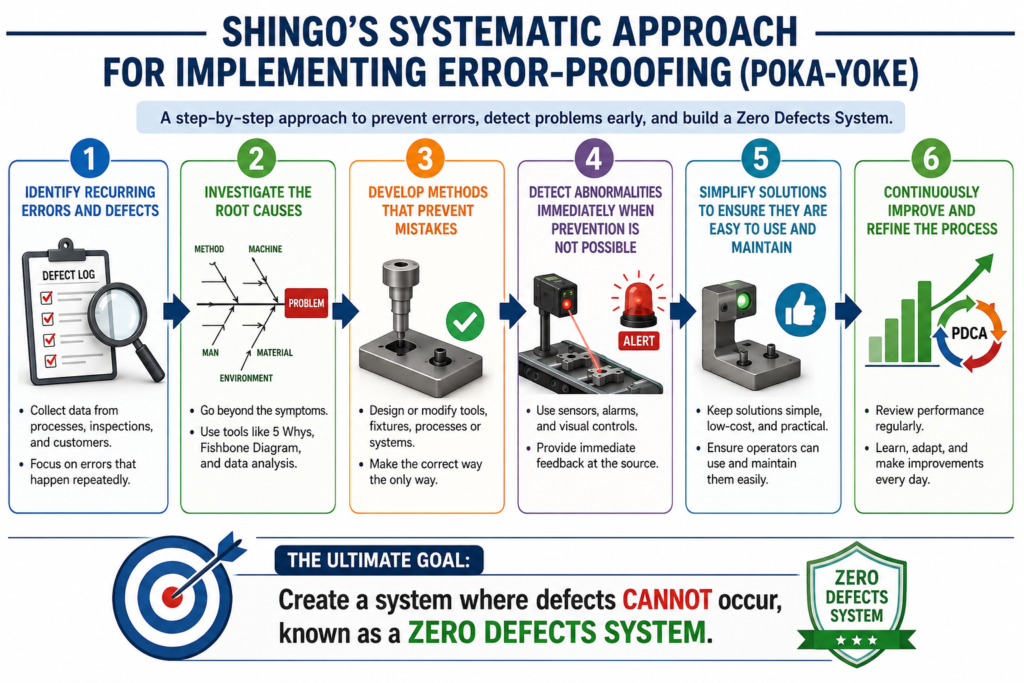
The ultimate goal is to create a system where defects cannot occur, often referred to as a Zero Defects System.
The Three Essential Components of Poka-Yoke
According to Lean practitioners, effective Poka-Yoke systems are built upon three key components.
1. 100% Inspection
Every part or product is checked against the required standard every time it is produced.
Unlike traditional inspection methods that rely on sampling, Poka-Yoke verifies each operation at the point where the error could occur.
This ensures that problems are identified immediately rather than after large quantities of defective products have been produced.
2. Rapid Feedback
Feedback must be immediate.
When an error occurs, operators need real-time information so they can:
- Stop the process.
- Correct the issue.
- Request assistance if necessary.
- Prevent defects from progressing further.
The closer the detection method is to the source of the error, the more effective it becomes.
3. Low Cost and Simplicity
One of the greatest strengths of Poka-Yoke is that it does not require expensive technology.
Many successful error-proofing devices are:
- Simple.
- Low-cost.
- Easy to implement.
- Easy to maintain.
Often, the most effective solutions come from operators who understand the process best and can identify practical improvements using everyday materials and creative thinking.
Conclusion
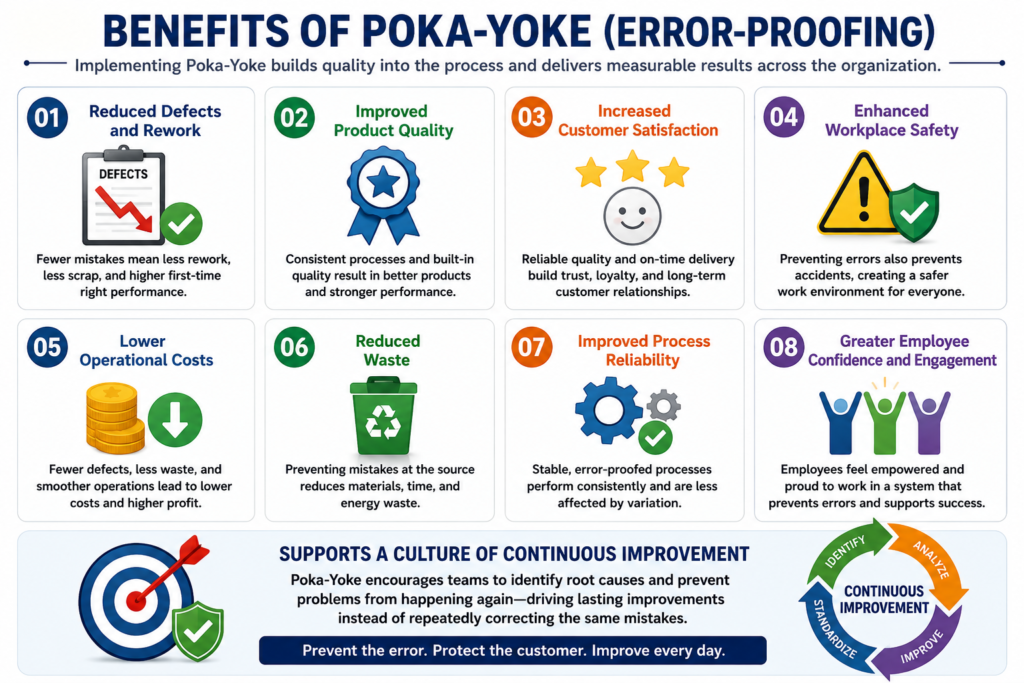
Poka-Yoke is one of the most valuable tools within Lean Manufacturing because it focuses on preventing problems before they occur. By designing processes, products, and systems that make errors impossible, or immediately visible, organizations can dramatically improve quality, safety, and efficiency.
Whether it is a sophisticated sensor system or a simple fixture that prevents incorrect assembly, every error-proofing solution contributes to the same objective: building quality into the process rather than inspecting it in afterward.
As Shigeo Shingo taught, the best defect is the one that never happens.
Interested in our Industrial & Manufacturing Engineering Courses?
At iLearn Engineering®, we offer a diverse range of online accredited Industrial, Manufacturing and Mechanical Engineering courses and qualifications to cater to different academic and career goals. Our industrial courses are available in varying credit values and levels, ranging from 40 credit Engineering Diplomas to a Bachelor’s equivalent 360 credit International Graduate Diploma.
All Industrial / Manufacturing Engineering Courses
All Industrial / Manufacturing Engineering Diploma Courses can be seen here.
All Mechanical Engineering Diploma Courses can be seen here.
Short Courses for Industrial Engineering (40 Credits)
- Diploma in Manufacturing
- Diploma in Composites, Smart Materials & Nanotechnology
- Diploma in Lean Manufacturing
- Diploma in Mechanical Technology
- Diploma in Electrical Technology
- Diploma in Material Science
First Year of Undergraduate (Level 4 – 120 Credits)
Higher International Certificate in Industrial Engineering
Higher International Certificate in Mechanical Engineering
Years One and Two of Undergraduate (Level 5 – 240 Credits)
Higher International Diploma in Industrial Engineering
Higher International Diploma in Mechanical Engineering
Degree Equivalent International Graduate Diplomas in Engineering Management and Mechanical Engineering (Level 6 – 360 Credits)
International Graduate Diploma in Engineering Management (Level 6) [120 Credit Top Up]
International Graduate Diploma in Mechanical Engineering (Level 6) [120 Credit Top Up]
Complete Engineering Course Catalogue (all courses)
Alternatively, you can view all our online engineering courses here.
Get started today
Explore our range of Industrial and Manufacturing Engineering courses
Recent Posts
Types of Aircraft Drag Explained: Induced, Profile and Interference Drag
Types of Aircraft Drag Explained: Induced, Profile and Interference Drag An aircraft experiences several forms of aerodynamic drag at the same time. Some result from generating lift, some arise as air flows over the aircraft’s surfaces, and others are created when airflow around neighbouring components interacts. For a conventional aircraft in subsonic flight, total drag […]
Induced Drag Explained: Why Flying Slower Can Increase Drag
Induced Drag Explained: Why Flying Slower Can Increase Drag Why can an aircraft experience more drag when it flies more slowly? We usually associate greater speed with greater air resistance, but a wing must also generate enough lift to support the aircraft. Induced drag is the drag associated with producing lift on a finite-span wing. […]
Laminar vs Turbulent Boundary Layers: Why Airflow Separates from Aircraft Wings
Laminar vs Turbulent Boundary Layers: Why Airflow Separates from Aircraft Wings Airflow around an aircraft wing is often shown as smooth streamlines passing neatly over the aerofoil. In reality, the thin layer of air immediately next to the wing surface behaves very differently from the undisturbed airflow further away. This region is called the boundary […]