

The Toyota Way and the Foundations of Lean Manufacturing
Introduction
Lean manufacturing is a living system, which interconnects every entity and person from the organisation to deliver value to the customer. Lean manufacturing is based on the Toyota Production System.
Toyota started as a small automobile manufacturing company of the Toyoda family, during World War II in Japan.
At the end of the war, the company had not enough financial resources and space; also, the market demand of vehicles was very low due to war impact. The Toyoda family asked one of the engineers of the plant, Taiichi Ohno, to solve this problem. Ohno came up with the Toyoda Production Systems (TPS), based on the philosophies of their founders, Sakichi Toyoda and his son Kiichiro Toyoda
1. Always be faithful to your duties, thereby contributing to the company and to the overall good.
2. Always be studious and creative, striving to stay ahead of the times.
3. Always be practical and avoid frivolousness.
4. Always strive to build a homelike atmosphere at work that is warm and friendly.
5. Always have respect for spiritual matters and remember to be grateful at all times.
Ohno created a production system with near zero waste to reduce costs; he kept low inventories to avoid tying up cash in parts and finished products. He created a production line with small quantities of multiple models in the same production line, in less time than United States manufacturing companies. This allowed the cars to get faster into the market, and therefore improving cash return to pay suppliers. Ohno illustrated the system as in the following figure:
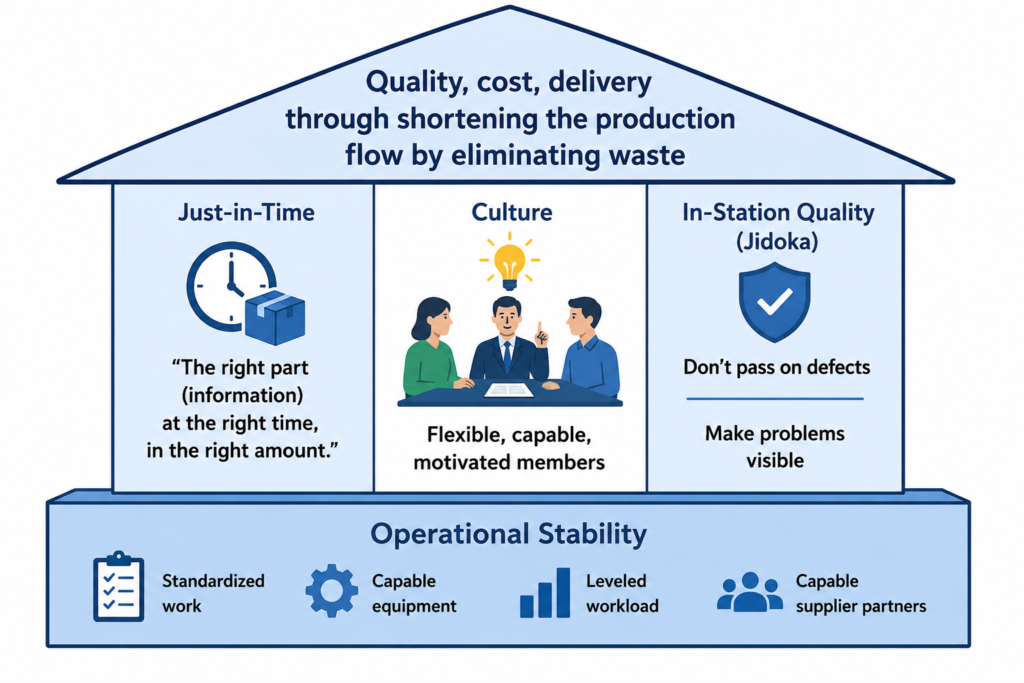
Toyota Production System
The Toyota Production System is built on two main pillars: Jidoka and Just in Time (JIT).
- Jidoka, developed from Sakichi Toyoda’s ideas, focuses on preventing defects by stopping machines automatically when problems occur. This allows errors to be fixed immediately and prevents faulty products from moving to the next stage.
- Just in Time (JIT), introduced by Kiichiro Toyoda, aims to remove waste and improve efficiency by producing the right items at the right time and in the right amount.
The system is supported by a stable and levelled workflow foundation, while flexible, skilled, and motivated employees are placed at the centre to achieve quality production, efficient delivery, and continuous improvement.
The house became the basis of today Toyota’s 14 Principles :
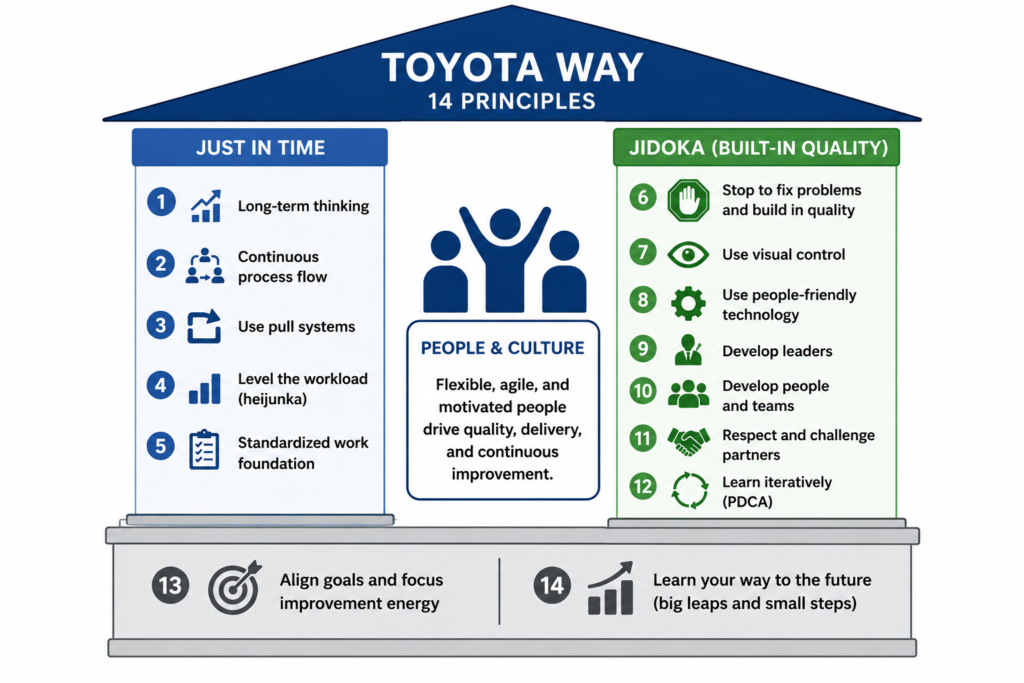
Principle 1. Base your management decisions on long-term systems thinking, even at the expense of short-term financial goals.
Principle 2. Connect people and processes through continuous process flow to bring problems to the surface.
Principle 3. Use “pull” systems to avoid overproduction.
Principle 4. Level out the workload, like the tortoise, not the hare (heijunka).
Principle 5. Work to establish standardized processes as the foundation for continuous improvement.
Principle 6. Build a culture of stopping to identify out-of-standard conditions and build in quality.
Principle 7. Use visual control to support people in decision-making and problem solving.
Principle 8. Adopt and adapt technology that supports your people and processes.
Principle 9. Grow leaders who thoroughly understand the work, live the philosophy, and teach it to others.
Principle 10. Develop exceptional people and teams who follow your company’s philosophy.
Principle 11. Respect your value chain partners by challenging them and helping them improve.
Principle 12. Observe deeply and learn iteratively (PDCA) to meet each challenge.
Principle 13. Focus the improvement energy of your people through aligned goals at all levels.
Principle 14. Learn your way to the future through bold strategy, some large leaps, and many small steps.
These fourteen principles are the key to implement the Toyota Way, which is not only a set of isolated tools to implement lean manufacturing in the shopfloor; it is the philosophy to live every day in the whole organisation. Moreover, they are a set of guidelines to keep growing and improving so that a company can continue to reach higher maturity levels. It is recommended to focus on those principals that are in a critical situation or need more attention than the others.
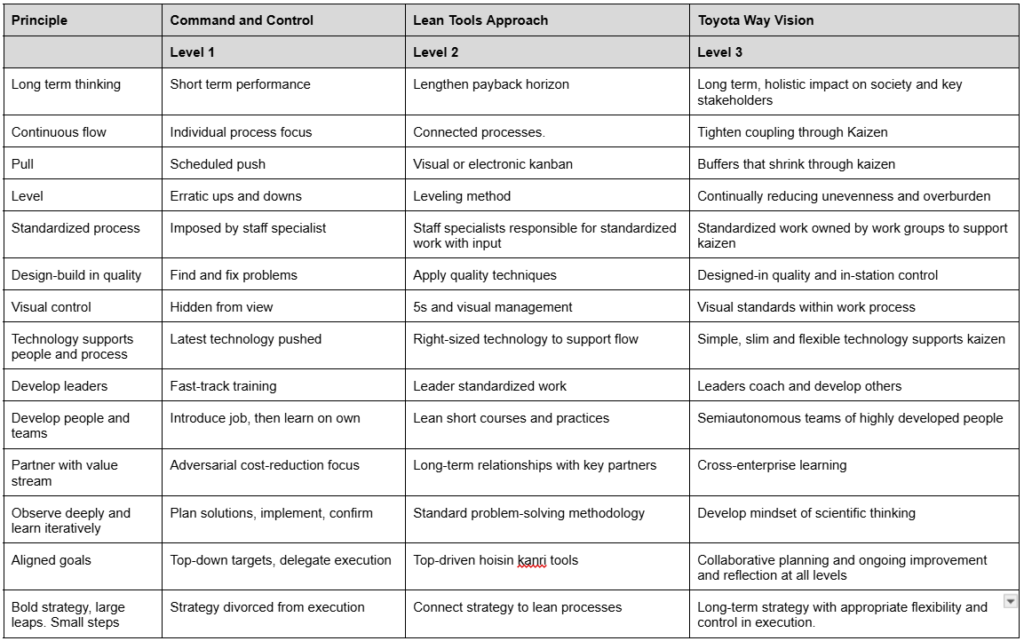
The following table can help you in developing a critical analysis of the maturity level of each principle according to the context and situation of an organisation, as well as to set the strategies and goals to achieve or to be integrated into a strategic plan.
Instructions: circle maturity level for each principle that best fits. If between two levels put an X on the border. Then mark your desired future state, where you would prefer to be.
Meanwhile, other scholars started to analyse the Toyota Production System and they came up with the name of “lean”. They analysed how Toyota established a way to work with less, and how Toyota managed to reduce everything that is a waste for the organisation (resources, time), they called it “lean production”
James Womack, Dan Jones, and Dan Roos called the Toyota Production System as “lean production” in their book The Machine That Changed the World. The authors give the name “lean production” based on a five-year study of the worldwide automobile industry, specially in Toyota´s Japanese and United State plants.
Interested in our Industrial & Manufacturing Engineering Courses?
At iLearn Engineering®, we offer a diverse range of online accredited Industrial, Manufacturing and Mechanical Engineering courses and qualifications to cater to different academic and career goals. Our industrial courses are available in varying credit values and levels, ranging from 40 credit Engineering Diplomas to a Bachelor’s equivalent 360 credit International Graduate Diploma.
All Industrial / Manufacturing Engineering Courses
All Industrial / Manufacturing Engineering Diploma Courses can be seen here.
All Mechanical Engineering Diploma Courses can be seen here.
Short Courses for Industrial Engineering (40 Credits)
- Diploma in Manufacturing
- Diploma in Composites, Smart Materials & Nanotechnology
- Diploma in Lean Manufacturing
- Diploma in Mechanical Technology
- Diploma in Electrical Technology
- Diploma in Material Science
First Year of Undergraduate (Level 4 – 120 Credits)
Higher International Certificate in Industrial Engineering
Higher International Certificate in Mechanical Engineering
Years One and Two of Undergraduate (Level 5 – 240 Credits)
Higher International Diploma in Industrial Engineering
Higher International Diploma in Mechanical Engineering
Degree Equivalent International Graduate Diplomas in Engineering Management and Mechanical Engineering (Level 6 – 360 Credits)
International Graduate Diploma in Engineering Management (Level 6) [120 Credit Top Up]
International Graduate Diploma in Mechanical Engineering (Level 6) [120 Credit Top Up]
Complete Engineering Course Catalogue (all courses)
Alternatively, you can view all our online engineering courses here.
Get started today
Explore our range of Industrial and Manufacturing Engineering courses
Recent Posts
Types of Aircraft Drag Explained: Induced, Profile and Interference Drag
Types of Aircraft Drag Explained: Induced, Profile and Interference Drag An aircraft experiences several forms of aerodynamic drag at the same time. Some result from generating lift, some arise as air flows over the aircraft’s surfaces, and others are created when airflow around neighbouring components interacts. For a conventional aircraft in subsonic flight, total drag […]
Induced Drag Explained: Why Flying Slower Can Increase Drag
Induced Drag Explained: Why Flying Slower Can Increase Drag Why can an aircraft experience more drag when it flies more slowly? We usually associate greater speed with greater air resistance, but a wing must also generate enough lift to support the aircraft. Induced drag is the drag associated with producing lift on a finite-span wing. […]
Laminar vs Turbulent Boundary Layers: Why Airflow Separates from Aircraft Wings
Laminar vs Turbulent Boundary Layers: Why Airflow Separates from Aircraft Wings Airflow around an aircraft wing is often shown as smooth streamlines passing neatly over the aerofoil. In reality, the thin layer of air immediately next to the wing surface behaves very differently from the undisturbed airflow further away. This region is called the boundary […]