

Three Engineers, One Goal: How Manufacturing, Production, and Industrial Roles Differ
Introduction
Walk into any manufacturing environment and you’ll find a complex system in motion, machines operating, materials flowing, products taking shape. But behind that system is something far more important than the equipment itself:
People designing, running, and improving it.
Among them are three key roles that often get grouped together, confused, or even used interchangeably: Manufacturing Engineers, Production Engineers, and Industrial Engineers.
At a glance, they may seem to do similar work. After all, they all contribute to making products efficiently, safely, and at the right quality. But look a little closer, and clear differences begin to emerge.
- One focuses on designing the system
- One focuses on running and delivering results from the system
- One focuses on optimising how people interact with the system
Each role brings a unique perspective, a different set of priorities, and a critical piece of the overall puzzle.
Yet despite these differences, they all share a common objective:
To create efficient, reliable, and high-performing manufacturing operations that deliver value to customers.
Understanding how these roles differ, and how they complement each other, is essential for anyone entering manufacturing, managing operations, or looking to improve performance.
Because in reality, no single role can achieve excellence alone.
It’s the collaboration between these engineers that turns a production system from functional… into exceptional.
What is a Manufacturing Engineer?
A Manufacturing Engineer designs and operates the manufacturing systems for a product. They choose the best technologies and processes to manufacture it, plan and design the factory that will produce the product, and manage the running, maintenance, and continuous improvement of the manufacturing process.
They may also be responsible for inventory control, quality management, quality control, material flow, cost analysis, procurement and supply chain management.
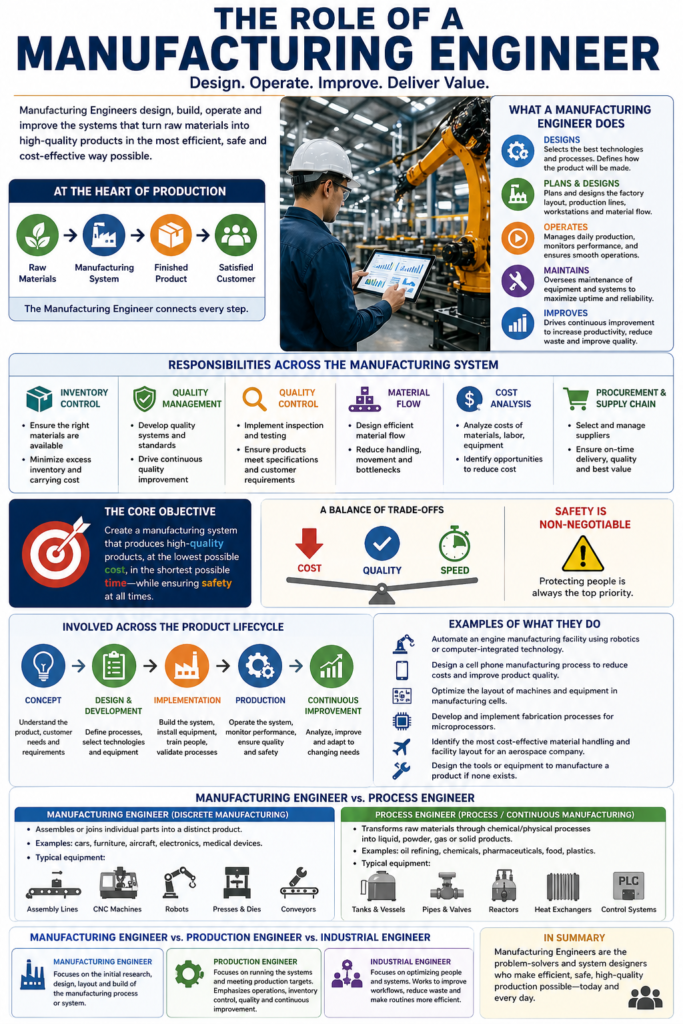
Their main goal is to create the stages of a manufacturing system that produce a product in the most time-efficient and cost-effective way possible, while always maintaining staff safety and product quality.
A Manufacturing Engineer is responsible for ensuring that manufacturing is carried out (and the end product is produced) in the most time-efficient and cost-effective way while still maintaining overall product quality.
For a new facility or product, they would figure out the optimal manufacturing process, break out the individual process steps, design and layout the production line, choose the machinery, design, and layout the individual workstations and develop an operational plan to ramp up production.
Within existing manufacturing set-ups, they are more likely to work in the monitoring of equipment and identifying opportunities for improvements to increase productivity while maintaining product quality.
For example, a Manufacturing Engineer might be hired to:
- Automate an engine manufacturing facility through the use of robotics or computer integrated technology.
- Design a cell phone manufacturing process to reduce costs and improve product quality.
- Figure out the most optimal layout of machines and equipment for manufacturing cells in discrete parts manufacturing.
- Develop and implement fabrication processes for microprocessors.
- Identify the most cost-effective material handling and facility layout alternative for an aerospace manufacturing company.
- Design the tools or equipment to manufacture a product if none exists.
Production Engineer vs Process Engineer
Imagine two very different factories.
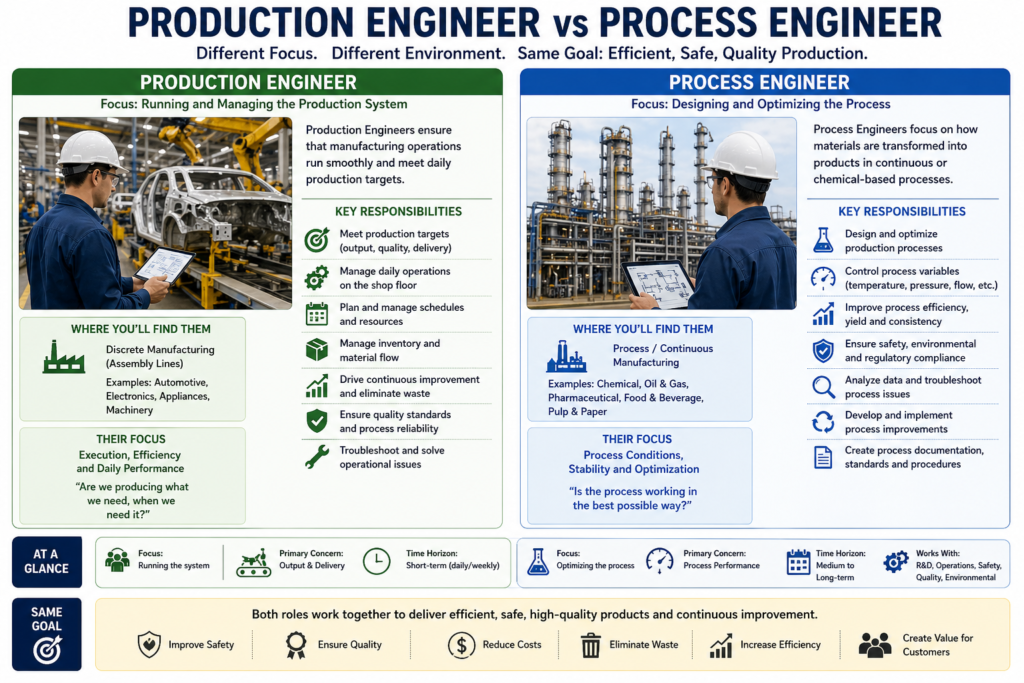
In the first, a car is being assembled. Metal parts arrive, robots weld frames, workers install components, and the vehicle slowly takes shape as it moves along an assembly line.
In the second, crude oil flows through pipes, heated and separated in towers, transformed through chemical processes into fuels and materials.
Both are manufacturing environments. Both require engineering expertise.
But the engineers at the heart of each system are thinking about very different problems.
The Production Engineer: Keeping the System Moving
Back in the car factory, the Production Engineer walks the floor. They are not designing the car. They are not inventing new materials.
Instead, they are asking:
- Are we hitting today’s production target?
- Why is that station slowing down?
- Why is inventory building up over there?
Their world is fast-paced and operational.
They focus on:
- Keeping machines running
- Ensuring materials arrive when needed
- Balancing workloads across the line
- Solving problems as they happen
If a machine stops, they act., if output drops, they investigate., if a delay appears, they remove it.
Their job is to make sure the system delivers, today, tomorrow, and every day. They live in the reality of deadlines, targets, and performance metrics.
If the factory is a heartbeat, the Production Engineer makes sure it never skips.
The Process Engineer: Understanding Transformation
Now step into the refinery. There is no assembly line. No individual parts moving step by step. Instead, materials flow continuously, through pipes, tanks, and reactors.
Here, the Process Engineer is not watching output in units per hour.
They are watching: temperature, pressure, flow rates, chemical reactions
They ask different questions:
- Is the reaction stable?
- Are we operating at optimal conditions?
- Can we improve yield or reduce energy use?
Their focus is on how materials are transformed.
A small change in temperature or pressure can:
- Improve efficiency
- Reduce waste
- Or cause serious safety risks
So their work is precise, analytical, and deeply technical.
If the system is a recipe, the Process Engineer ensures it is followed, and improved.
Two Roles, Two Perspectives
Both engineers are solving problems, but at different levels.
The Production Engineer sees: flow of parts, performance of operations, daily output
The Process Engineer sees: flow of materials, behaviour of systems, conditions of transformation
One is focused on execution. The other is focused on process behaviour.
Where They Overlap
Despite their differences, the two roles share a common goal:
Efficient, safe, and reliable production.
They both:
- Improve performance
- Reduce waste
- Solve problems
- Support continuous improvement
And in some industries, their work overlaps, especially where systems involve both assembly and transformation.
A Production Engineer asks: “Are we producing what we need, when we need it?”
A Process Engineer asks: “Is the process working in the best possible way?”
The Role of an Industrial Engineer
Imagine standing on a busy factory floor.
Machines are running, operators are moving between stations, materials are being lifted, assembled, inspected, and passed along. On the surface, everything looks productive, people are working hard, and products are being made.
But an Industrial Engineer sees something different. They don’t just see activity. They see flow… or the lack of it.
They notice the operator who has to take three extra steps every cycle. They see the queue of parts building up between two stations. They spot the moment where someone pauses, waiting, searching, adjusting.
And they start asking questions:
- Why does this step take so long?
- Why does this person need to move so much?
- Where is time being lost?
While other engineers might focus on the machine itself, its speed, its capability, its output, the Industrial Engineer focuses on how work happens around it.
They are concerned with: How tasks are performed, how people interact with tools and systems, how work flows from one step to the next
Because they understand something fundamental: Even the most advanced machine cannot compensate for an inefficient system.
An Industrial Engineer spends time observing, measuring, and analysing.
They might watch a process repeatedly, breaking it down into small steps:
- Reach
- Pick
- Move
- Assemble
- Inspect
They measure how long each action takes. They look for variation. They compare how different operators perform the same task. Not to criticise, but to understand.
Because within those small details lie opportunities: A movement that can be eliminated, a tool that can be repositioned, a sequence that can be simplified
Small changes, repeated thousands of times, create significant improvements.
What sets Industrial Engineers apart is their focus on the human side of production.
They ask:Is this task physically demanding? Does this layout cause unnecessary strain? Are workers forced to adapt to the system, or is the system designed for them?
They redesign workstations so that: tools are within easy reach, movements are natural and efficient, fatigue is reduced
Because when work is easier and safer:
- Errors decrease
- Productivity increases
Manufacturing Engineer Vs. Production Engineer Vs. Industrial Engineer
For some people, they are broadly synonyms with far more similarities than differences. But for what it’s worth, here is a very high-level take on the differences.
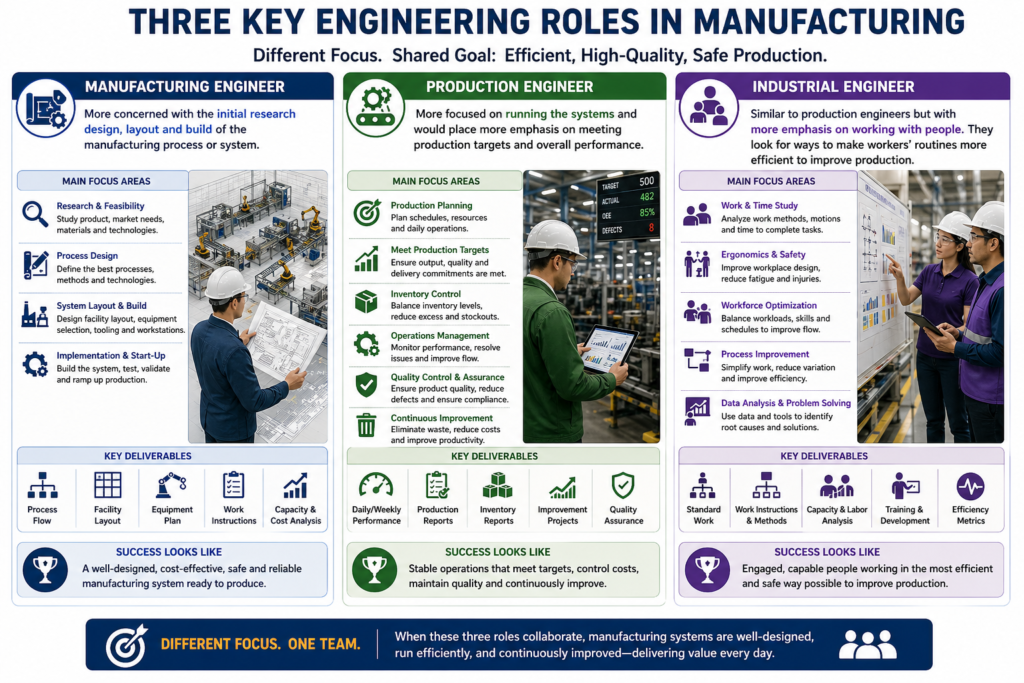
Manufacturing Engineers are more concerned with the initial research design, layout and build of the manufacturing process or system.
Production Engineers are more focused on running the systems and would place more emphasis on meeting production targets, inventory control, operations management, continuous improvement and elimination of waste, quality control, and quality assurance.
Industrial Engineers are similar to production engineers but put much more emphasis on working with people. They look for ways to make the workers’ routines more efficient to improve production.
Interested in our Industrial & Manufacturing Engineering Courses?
At iLearn Engineering®, we offer a diverse range of online accredited Industrial, Manufacturing and Mechanical Engineering courses and qualifications to cater to different academic and career goals. Our industrial courses are available in varying credit values and levels, ranging from 40 credit Engineering Diplomas to a Bachelor’s equivalent 360 credit International Graduate Diploma.
All Industrial / Manufacturing Engineering Courses
All Industrial / Manufacturing Engineering Diploma Courses can be seen here.
All Mechanical Engineering Diploma Courses can be seen here.
Short Courses for Industrial Engineering (40 Credits)
- Diploma in Manufacturing
- Diploma in Composites, Smart Materials & Nanotechnology
- Diploma in Lean Manufacturing
- Diploma in Mechanical Technology
- Diploma in Electrical Technology
- Diploma in Material Science
First Year of Undergraduate (Level 4 – 120 Credits)
Higher International Certificate in Industrial Engineering
Higher International Certificate in Mechanical Engineering
Years One and Two of Undergraduate (Level 5 – 240 Credits)
Higher International Diploma in Industrial Engineering
Higher International Diploma in Mechanical Engineering
Degree Equivalent International Graduate Diplomas in Engineering Management and Mechanical Engineering (Level 6 – 360 Credits)
International Graduate Diploma in Engineering Management (Level 6) [120 Credit Top Up]
International Graduate Diploma in Mechanical Engineering (Level 6) [120 Credit Top Up]
Complete Engineering Course Catalogue (all courses)
Alternatively, you can view all our online engineering courses here.
Get started today
Explore our range of Industrial and Manufacturing Engineering courses
Recent Posts
Types of Aircraft Drag Explained: Induced, Profile and Interference Drag
Types of Aircraft Drag Explained: Induced, Profile and Interference Drag An aircraft experiences several forms of aerodynamic drag at the same time. Some result from generating lift, some arise as air flows over the aircraft’s surfaces, and others are created when airflow around neighbouring components interacts. For a conventional aircraft in subsonic flight, total drag […]
Induced Drag Explained: Why Flying Slower Can Increase Drag
Induced Drag Explained: Why Flying Slower Can Increase Drag Why can an aircraft experience more drag when it flies more slowly? We usually associate greater speed with greater air resistance, but a wing must also generate enough lift to support the aircraft. Induced drag is the drag associated with producing lift on a finite-span wing. […]
Laminar vs Turbulent Boundary Layers: Why Airflow Separates from Aircraft Wings
Laminar vs Turbulent Boundary Layers: Why Airflow Separates from Aircraft Wings Airflow around an aircraft wing is often shown as smooth streamlines passing neatly over the aerofoil. In reality, the thin layer of air immediately next to the wing surface behaves very differently from the undisturbed airflow further away. This region is called the boundary […]