

Total Productive Maintenance Explained: Principles, Pillars, and Benefits
Introduction
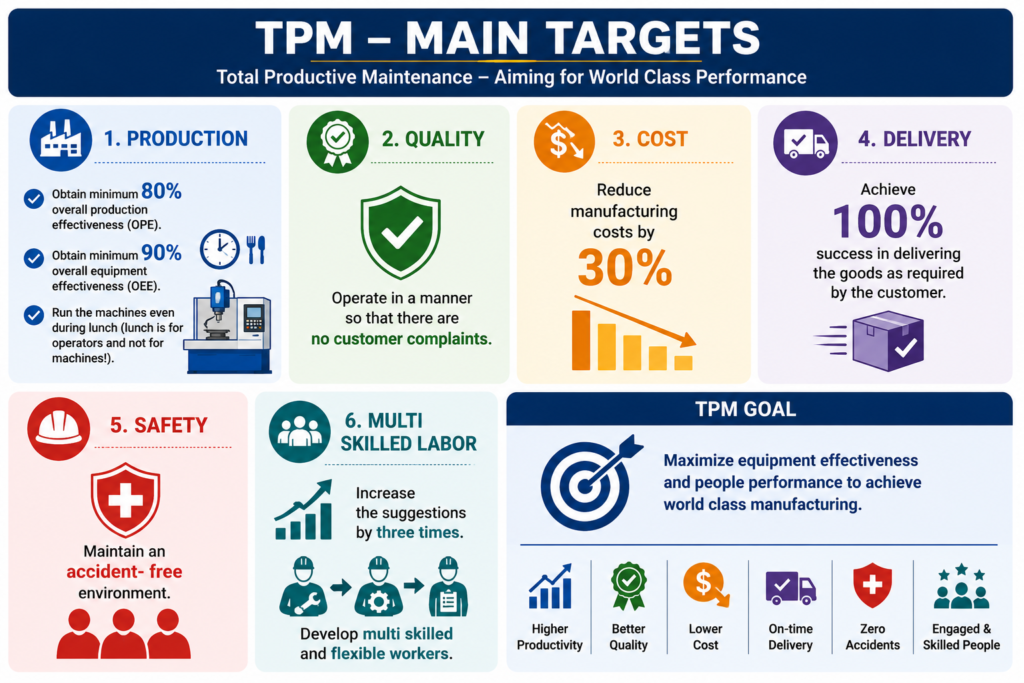
TPM combines preventive maintenance with total quality control. It creates a culture whereby operators develop ownership of the equipment and become ‘partners’ with maintenance engineering.
The result is to increase Overall Equipment Effectiveness (OEE) and improve existing planned maintenance systems.
Total Productive Maintenance was born with the idea of preventing equipment shut downs and repairs. In other words, maintenance is given before any failure comes out, instead of waiting for the equipment to break down. The word Total was introduced to involve everyone in the system to keep equipment working properly, and not waiting for scheduled maintenance provided by the operations management department or by the technical support team; the operators are trained and empowered to freely apply maintenance in their equipment as they observe it is needed.
.
Recommendation to follow four stages to roll out TPM in an organisation:
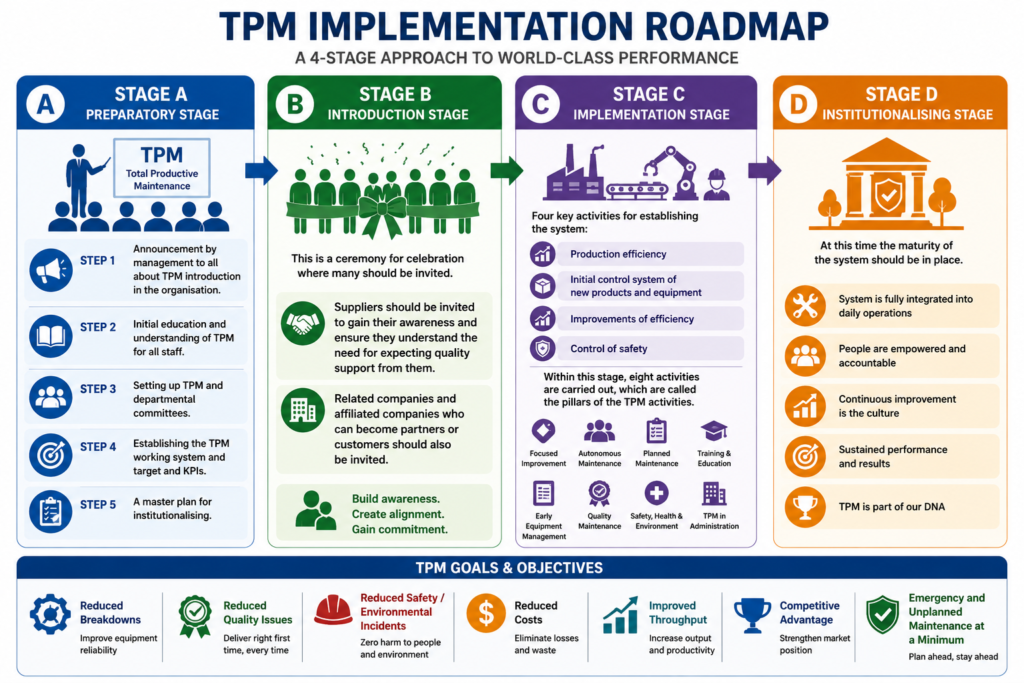
Pillars of TPM
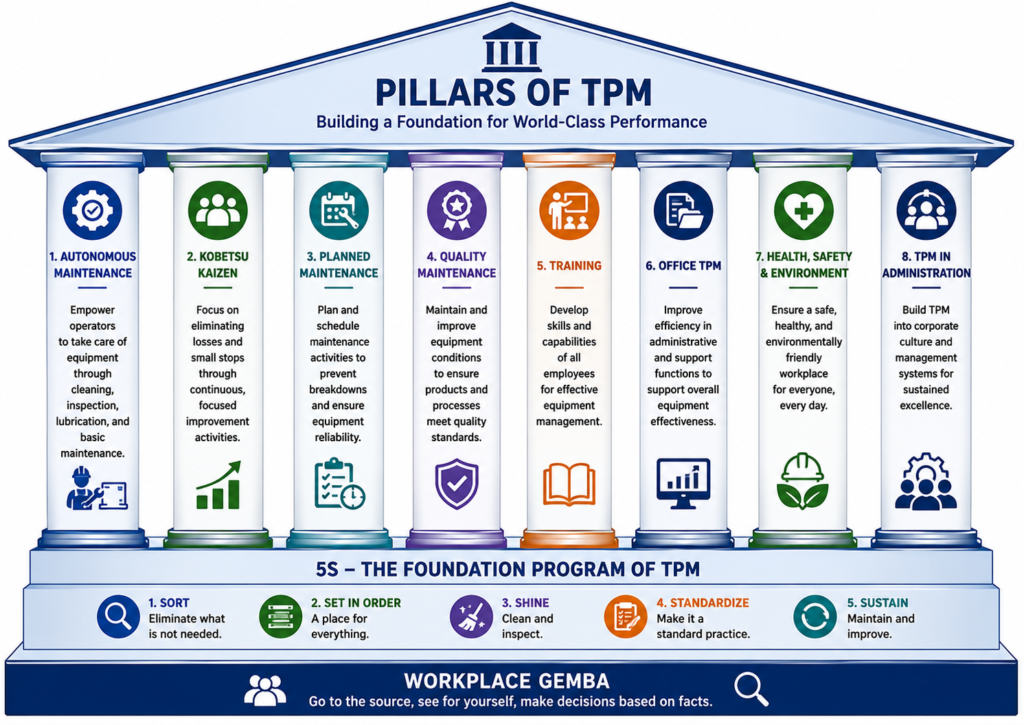
TPM is also known for having pillars as shown in the following image:
Pillar 0 :
(OK – this isn’t actually shown as a ‘pillar’ above – it is so fundamental to the whole process that it is actually shown as the foundation to all TPM activities.
TPM starts with 5S (sort, straighten, shine/ sweep, standardise, sustain), issues cannot be seen clearly in an unorganised place. Cleaning and organising will uncover problems. Making problems visible is the 1st step of improvement.
Pillar 1: Autonomous maintenance (Jishu Hozen (JH)):
Empowers and develops operators to be able to take care of small maintenance tasks. Frees up skilled maintenance people to spend time on more value- added activities and technical repairs. The operators are responsible for the upkeep of their equipment to prevent it from deteriorating.
Pillar 2: Kobetsu kaizen (to make better):
Kai means “change.” Zen means “for the better.” Kaizen means “continuous improvement.
Concept: Small incremental improvements. Improvements add up over time.
Pillar 3: Planned maintenance
Aimed to have trouble- free machinery and equipment with zero defects for 100% customer satisfaction. Become proactive versus reactive while utilising trained maintenance staff to help train operators to better maintain their equipment
Pillar 4: Quality maintenance
Aimed toward customer delight through highest quality through defect- free manufacturing. Focus is on eliminating nonconformances in a systematic manner. We gain understanding of what parts of the equipment affect product quality and begin to eliminate current quality concerns, and then move to potential quality concerns. Transition is from reactive to proactive
Pillar 5: Training
Aims to have multiskilled and energised employees who have high morale and are eager to come to work to perform all their required functions independently and effectively. Education is given to operators to upgrade their skills
Pillar 6: Office TPM
Office TPM should be started after activating from other pillars of TPM (Jishu Hozen, Kobetsu Kaizen, Planned maintenance, and Quality maintenance). Office TPM must improve productivity, efficiency, and flow in the administrative functions while identifying losses. Analysis of processes and procedures toward office automation is sought after.
Pillar 7: Safety, health, and environment
Focus to create a safe workplace and a surrounding area that is not damaged by process or procedures. This pillar will play an active role in each of the other pillars on a regular basis
More benefits of TPM are:
• Increase in productivity
• Reduction in manufacturing costs
• Reduction in customer complaints
• Increase in satisfying the customer’s needs by 100% by:
• Delivering the right quantity
• At the right time
• With best, required quality
• Reduction in safety incidents and environmental concerns.
In addition, TPM creates a positive work culture and environment to achieve the following:
• Build a higher level of confidence among the employees.
• Keep the workplace clean, neat, and attractive.
• Build and maintain a favourable positive attitude of the operators and maintainers.
• Deploy a new concept in all areas of the organisation.
• Share knowledge and experience.
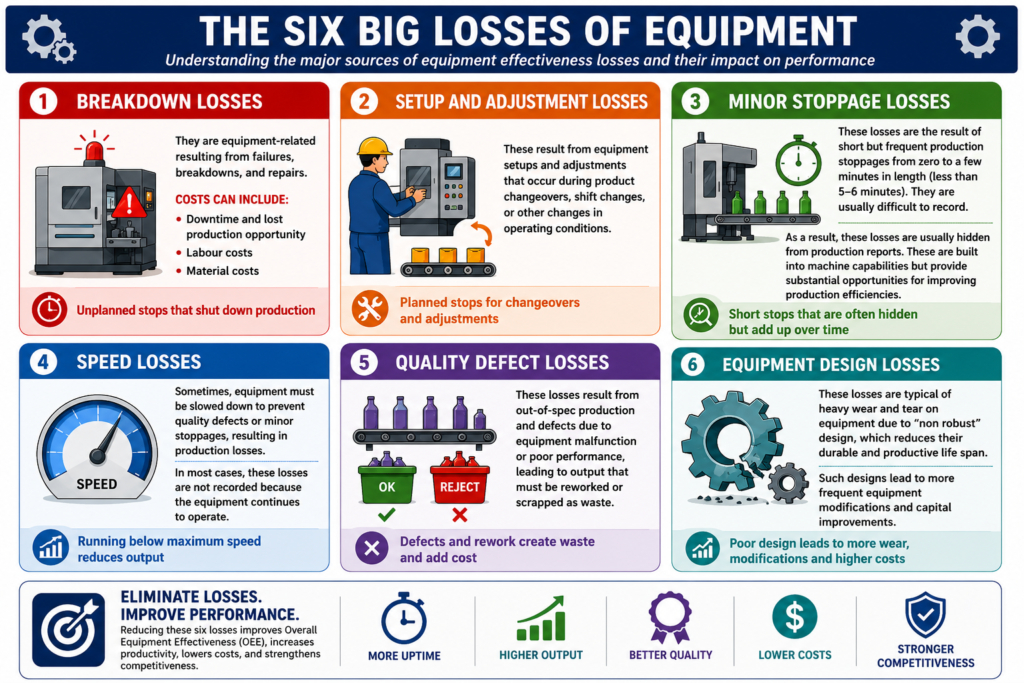
Gulati highlights another major topic in which TPM teams can focus their work, as well as for continuous improvement (Kaizen), these are the big six losses. These six losses are related to:
Interested in our Industrial & Manufacturing Engineering Courses?
At iLearn Engineering®, we offer a diverse range of online accredited Industrial, Manufacturing and Mechanical Engineering courses and qualifications to cater to different academic and career goals. Our industrial courses are available in varying credit values and levels, ranging from 40 credit Engineering Diplomas to a Bachelor’s equivalent 360 credit International Graduate Diploma.
All Industrial / Manufacturing Engineering Courses
All Industrial / Manufacturing Engineering Diploma Courses can be seen here.
All Mechanical Engineering Diploma Courses can be seen here.
Short Courses for Industrial Engineering (40 Credits)
- Diploma in Manufacturing
- Diploma in Composites, Smart Materials & Nanotechnology
- Diploma in Lean Manufacturing
- Diploma in Mechanical Technology
- Diploma in Electrical Technology
- Diploma in Material Science
First Year of Undergraduate (Level 4 – 120 Credits)
Higher International Certificate in Industrial Engineering
Higher International Certificate in Mechanical Engineering
Years One and Two of Undergraduate (Level 5 – 240 Credits)
Higher International Diploma in Industrial Engineering
Higher International Diploma in Mechanical Engineering
Degree Equivalent International Graduate Diplomas in Engineering Management and Mechanical Engineering (Level 6 – 360 Credits)
International Graduate Diploma in Engineering Management (Level 6) [120 Credit Top Up]
International Graduate Diploma in Mechanical Engineering (Level 6) [120 Credit Top Up]
Complete Engineering Course Catalogue (all courses)
Alternatively, you can view all our online engineering courses here.
Get started today
Explore our range of Industrial and Manufacturing Engineering courses
Recent Posts
Types of Aircraft Drag Explained: Induced, Profile and Interference Drag
Types of Aircraft Drag Explained: Induced, Profile and Interference Drag An aircraft experiences several forms of aerodynamic drag at the same time. Some result from generating lift, some arise as air flows over the aircraft’s surfaces, and others are created when airflow around neighbouring components interacts. For a conventional aircraft in subsonic flight, total drag […]
Induced Drag Explained: Why Flying Slower Can Increase Drag
Induced Drag Explained: Why Flying Slower Can Increase Drag Why can an aircraft experience more drag when it flies more slowly? We usually associate greater speed with greater air resistance, but a wing must also generate enough lift to support the aircraft. Induced drag is the drag associated with producing lift on a finite-span wing. […]
Laminar vs Turbulent Boundary Layers: Why Airflow Separates from Aircraft Wings
Laminar vs Turbulent Boundary Layers: Why Airflow Separates from Aircraft Wings Airflow around an aircraft wing is often shown as smooth streamlines passing neatly over the aerofoil. In reality, the thin layer of air immediately next to the wing surface behaves very differently from the undisturbed airflow further away. This region is called the boundary […]