

Pascal’s Law Explained: How Hydraulic Systems Multiply Force
How can a relatively small force applied to a brake pedal, jack handle or hydraulic control move a much heavier load?
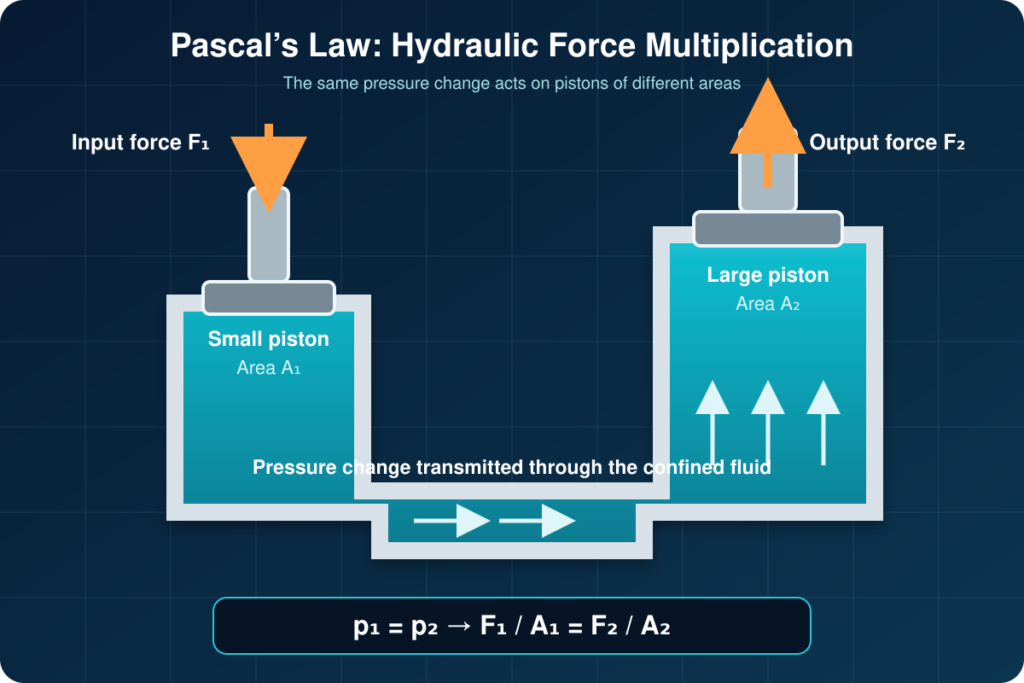
The answer is Pascal’s law. When pressure is applied to a confined fluid, the resulting pressure change is transmitted throughout the fluid. If that pressure acts on a piston with a larger surface area, it produces a larger force.
This principle allows hydraulic systems to multiply force. However, the increased force is balanced by a reduction in movement: the larger output piston travels a shorter distance than the smaller input piston.
What is Pascal’s law?
Pascal’s law, also called Pascal’s principle, states that a change in pressure applied to a confined fluid is transmitted throughout the fluid and to the walls of its container.
The law is normally applied to liquids because they undergo only very small changes in volume under ordinary engineering pressures. This makes them suitable for transmitting pressure between different parts of a hydraulic system.
A gas can also transmit pressure, but gases are much more compressible. Compression stores energy and produces greater changes in volume, making pneumatic systems behave differently from hydraulic systems.
The distinction between liquids, gases and incompressibility is explained further in What Is a Fluid? Liquids, Gases and Shear Stress Explained.
Pressure change versus total pressure
Pascal’s law applies specifically to a change in pressure.
If an additional pressure of 200 kPa is applied to a confined fluid, that pressure increase is transmitted throughout the fluid. It does not necessarily mean that the total pressure is identical at every point.
Where points are at different elevations, their total pressures may differ because hydrostatic pressure varies with depth. Points at the same elevation in a stationary, connected fluid will have the same pressure, provided other conditions are equal.
The relationship between pressure, depth and fluid density is covered in What Is Pressure in Fluids, and How Does It Affect Engineering Problems?.
How does a hydraulic system multiply force?
Consider a simplified hydraulic system containing:
- a small input piston with area A₁;
- a large output piston with area A₂;
- an enclosed volume of hydraulic fluid;
- an input force F₁; and
- an output force F₂.
Pressure is force divided by the area over which the force acts:
p = F / A
Where:
- p = pressure in pascals (Pa)
- F = force in newtons (N)
- A = area in square metres (m²)
The pressure produced by the input piston is:
p₁ = F₁ / A₁
Pascal’s law means that the pressure change is transmitted to the output piston. For a simplified system in which the pistons are at the same elevation:
p₁ = p₂
Therefore:
F₁ / A₁ = F₂ / A₂
Rearranging for the output force gives:
F₂ = F₁ × A₂ / A₁
This equation shows that output force increases in proportion to the ratio between the piston areas. OpenStax describes the same relationship when explaining how an undiminished pressure change can produce a larger force on a larger piston.[1]
Why piston diameter must be squared
A common mistake is to use the ratio of piston diameters directly. Pascal’s law uses piston area, not diameter.
The area of a circular piston is:
A = πd² / 4
Where:
- A = piston area
- d = piston diameter
- π ≈ 3.142
Because diameter is squared, doubling the piston diameter produces four times the area.
For two circular pistons:
A₂ / A₁ = d₂² / d₁²
Therefore:
F₂ / F₁ = d₂² / d₁²
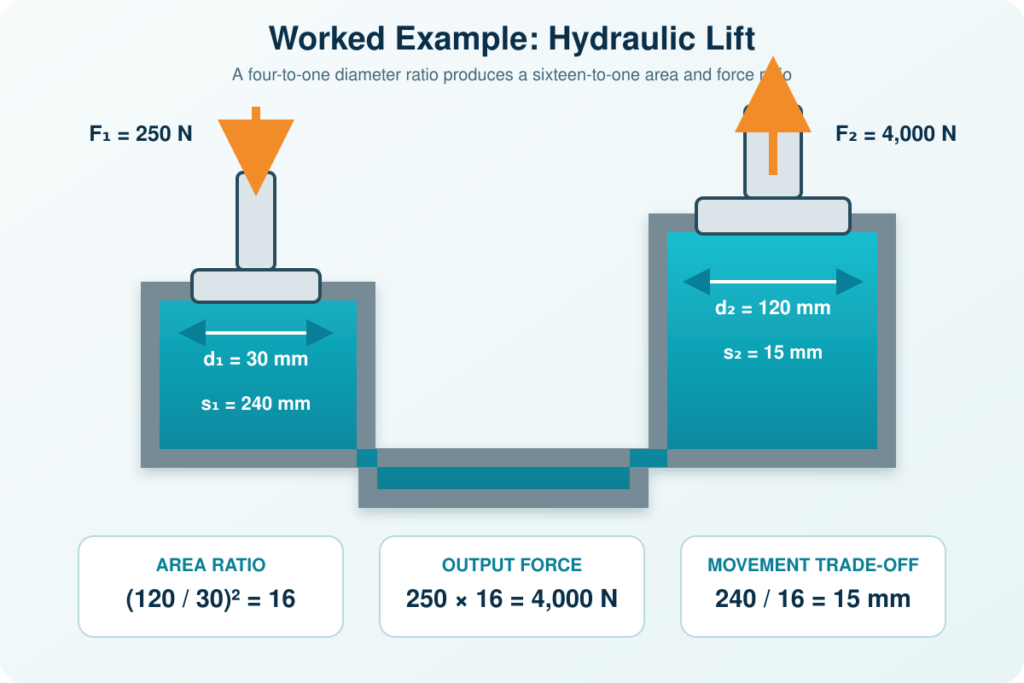
If the output piston has four times the diameter of the input piston, its area—and the ideal output force—is 16 times greater.
Worked example: hydraulic force multiplication
A hydraulic lift has:
- input-piston diameter = 30 mm
- output-piston diameter = 120 mm
- input force = 250 N
Calculate:
- the ideal output force;
- the mechanical advantage; and
- the output-piston movement if the input piston moves 240 mm.
Step 1: Calculate the area ratio
The diameter ratio is:
d₂ / d₁ = 120 / 30 = 4
The area ratio is therefore:
A₂ / A₁ = 4² = 16
Step 2: Calculate the output force
F₂ = F₁ × A₂ / A₁
F₂ = 250 × 16
F₂ = 4,000 N
Under ideal conditions, the lift produces an output force of 4,000 N.
Step 3: Calculate the mechanical advantage
Mechanical advantage is the ratio between output force and input force:
MA = F₂ / F₁
MA = 4,000 / 250
MA = 16
The ideal mechanical advantage is 16.
Step 4: Calculate the output movement
For an incompressible fluid with no leakage, the volume displaced by the input piston must equal the volume received by the output cylinder:
A₁s₁ = A₂s₂
Where:
- s₁ = input-piston movement
- s₂ = output-piston movement
Rearranging gives:
s₂ = s₁ × A₁ / A₂
s₂ = 240 / 16
s₂ = 15 mm
The output piston produces 16 times the force but moves only one-sixteenth of the distance.
Does a hydraulic system create extra energy?
A hydraulic system can multiply force, but it cannot create energy.
Work is calculated using:
W = F × s
Where:
- W = work in joules (J)
- F = force in newtons (N)
- s = distance moved in metres (m)
For the worked example, the input work is:
W₁ = 250 × 0.240
W₁ = 60 J
The ideal output work is:
W₂ = 4,000 × 0.015
W₂ = 60 J
The force increases, but the distance decreases by the same ratio. OpenStax similarly notes that a hydraulic system can increase force but cannot produce more work than is supplied to it.[1]
In a real system, output work will be slightly lower because energy is lost through friction, fluid resistance, leakage and deformation.
How pressure produces force
The force available from a hydraulic actuator depends on both pressure and piston area:
F = pA
Increasing system pressure increases the force produced by a given piston. Increasing piston area also increases force without requiring a higher pressure.
This creates an important design relationship:
- higher pressure can provide more force from a compact actuator;
- a larger piston can provide more force at the same pressure;
- a larger piston requires more fluid volume to travel the same distance; and
- component strength must be suitable for the system’s operating and transient pressures.
NASA’s educational explanation of Pascal’s principle also demonstrates how pressure applied to a smaller piston can produce a larger force at a larger piston.[2]
Where is Pascal’s law used?
Hydraulic jacks and vehicle lifts
A hydraulic jack uses a small pump piston to move fluid into a larger lifting cylinder. Repeated movement of the pump handle transfers additional fluid and gradually raises the load.
The increased output force makes it possible to lift a vehicle using a manageable input force. The trade-off is that several pump strokes may be required to move the larger piston through a relatively short distance.
Hydraulic brakes
When a driver presses a brake pedal, the master cylinder increases the pressure in the brake fluid. This pressure change is transmitted through the brake lines to pistons at the wheels.
The wheel pistons then press the brake pads against the discs. The complete system may also use pedal leverage and power assistance, but hydraulic pressure transmission remains a central operating principle.
Hydraulic presses
A hydraulic press applies a controlled compressive force to a component or material. Applications include forming, stamping, bending, assembly and material testing.
The required force can be produced by selecting a suitable combination of operating pressure and ram area.
Construction and agricultural machinery
Excavators, loaders, tractors and similar machines use hydraulic cylinders to move booms, buckets, blades and attachments.
Hydraulics are useful in these applications because they can provide large, controllable forces through comparatively compact actuators.
Aircraft systems
Aircraft may use hydraulics to operate landing gear, brakes, flight controls and other heavily loaded mechanisms. These systems require careful consideration of operating pressures, pressure transients, temperature, fatigue, leakage and failure conditions. The US Federal Aviation Administration addresses these factors in its hydraulic-system certification guidance.[3]
Why real hydraulic systems produce less force
The basic Pascal’s law calculation describes an ideal system. Several practical effects can reduce the available output force or change the movement of the actuator.
Friction
Seals, piston surfaces, bearings and mechanical linkages create friction. Part of the input force must overcome this resistance before useful output force is produced.
Pressure losses
Fluid moving through pipes, valves, bends and restrictions experiences resistance. Consequently, the pressure reaching an actuator may be lower than the pressure generated by the pump.
Internal and external leakage
Internal leakage allows fluid to pass between high- and low-pressure regions without performing useful work. External leakage removes fluid from the system and may create environmental and safety hazards.
Trapped air
Air is considerably more compressible than hydraulic fluid. Trapped air can make actuator movement feel soft, delayed or difficult to control because some input energy compresses the air instead of immediately moving the output piston.
Fluid compressibility and component deformation
Hydraulic fluids are not perfectly incompressible. Hoses, pipes and cylinder bodies can also expand slightly under pressure. These effects become more important where high stiffness, accurate positioning or rapid response is required.
Temperature and viscosity
Temperature changes fluid viscosity. Fluid that is too viscous can increase resistance and slow system response, while insufficient viscosity can increase leakage and reduce lubrication.
A practical hydraulic calculation checklist
Before calculating hydraulic force, check the following:
- Are all dimensions expressed in consistent units?
- Have piston diameters been converted into areas?
- Are the pistons at approximately the same elevation?
- Is the stated pressure gauge pressure or absolute pressure?
- Does the calculation assume ideal or actual efficiency?
- Have friction and pressure losses been considered?
- Is the required piston movement or fluid volume also important?
- Are the components rated for the expected pressure and transient loads?
This checklist helps prevent a mathematically correct force calculation from becoming an unsuitable engineering design decision.
Hydraulic-system safety
Hydraulic systems can contain substantial stored energy even after machinery has stopped. A small high-pressure leak can penetrate skin and cause a serious injection injury. The UK Health and Safety Executive advises that suspected hydraulic injection injuries require immediate specialist medical attention.[4]
Hydraulic equipment should be isolated, depressurised and secured using the manufacturer’s approved procedure before inspection or maintenance. Never search for a suspected high-pressure leak using a hand or another part of the body.
Develop your understanding of fluid mechanics
The Diploma in Fluid Mechanics is the closest subject-specific pathway for studying fluid properties, pressure, fluid statics, fluid dynamics and their engineering applications. It is a 40-credit EduQual Level 5 qualification.
For a broader foundation, the Higher International Certificate in Mechanical Engineering is a 120-credit Level 4 qualification.
The Higher International Diploma in Mechanical Engineering provides 240 credits in total and includes a specialist Fluid Mechanics unit at Level 5.
The International Graduate Diploma in Mechanical Engineering provides a 360-credit Level 6 pathway incorporating the preceding Level 4 and Level 5 study.
Choose the Diploma in Fluid Mechanics for focused professional development, or explore the broader mechanical-engineering pathways for study across several connected engineering subjects.
Frequently asked questions
What does Pascal’s law state?
Pascal’s law states that a change in pressure applied to a confined fluid is transmitted throughout the fluid and to the walls of its container.
Why do hydraulic systems multiply force?
The same pressure acts on pistons of different areas. When the pressure acts on the larger output piston, it produces a proportionally larger force.
Does Pascal’s law create free energy?
No. The output force increases, but the output piston moves through a shorter distance. An ideal hydraulic system conserves work, while a real system also experiences energy losses.
Is hydraulic mechanical advantage based on piston diameter or area?
It is based on piston area. For circular pistons, area is proportional to diameter squared, so the ratio of the diameters must be squared.
Why is trapped air a problem in hydraulic systems?
Air compresses much more readily than hydraulic fluid. Trapped air can therefore cause delayed, soft or unpredictable actuator movement.
Is hydraulic fluid completely incompressible?
No. All real fluids compress to some extent, but the volume change of hydraulic liquids is often small enough to use the incompressible-fluid approximation in introductory calculations.
References
[1] OpenStax — Pascal’s Principle
[2] NASA Glenn Research Center — Pascal’s Principle and Hydraulics
[3] Federal Aviation Administration — Hydraulic System Certification Tests and Analysis
[4] Health and Safety Executive — Hydraulic Injection Injury
Interested in our engineering courses?
We have over 70 courses across all major engineering disciplines, including, mechanical, electrical and electronic, civil, aerospace, industrial, computer and general engineering. Visit our course catalogue for a complete list of fully accredited engineering programmes.
A small selection of short Engineering courses …
Diploma in Mechanical Engineering
Diploma in Aerospace Engineering
Level 6 Engineering Courses
International Graduate Diploma in Mechanical Engineering
International Graduate Diploma in Aerospace Engineering
Level 5 Engineering Courses
Higher International Diploma in Mechanical Engineering
Higher International Diploma in Aerospace Engineering
Level 4 Engineering Courses
Higher International Certificate in Mechanical Engineering
Higher International Certificate in Aerospace Engineering
View Engineering Courses
Explore our UK-accredited engineering courses. 100% Online with no schedules, no deadlines and no exams.
Recent Posts
Types of Aircraft Drag Explained: Induced, Profile and Interference Drag
Types of Aircraft Drag Explained: Induced, Profile and Interference Drag An aircraft experiences several forms of aerodynamic drag at the same time. Some result from generating lift, some arise as air flows over the aircraft’s surfaces, and others are created when airflow around neighbouring components interacts. For a conventional aircraft in subsonic flight, total drag […]
Induced Drag Explained: Why Flying Slower Can Increase Drag
Induced Drag Explained: Why Flying Slower Can Increase Drag Why can an aircraft experience more drag when it flies more slowly? We usually associate greater speed with greater air resistance, but a wing must also generate enough lift to support the aircraft. Induced drag is the drag associated with producing lift on a finite-span wing. […]
Laminar vs Turbulent Boundary Layers: Why Airflow Separates from Aircraft Wings
Laminar vs Turbulent Boundary Layers: Why Airflow Separates from Aircraft Wings Airflow around an aircraft wing is often shown as smooth streamlines passing neatly over the aerofoil. In reality, the thin layer of air immediately next to the wing surface behaves very differently from the undisturbed airflow further away. This region is called the boundary […]