

How to Analyse Force as a Function of Time
In the previous post ( Dynamic Effects of Linear Motion) we considered the motion of a body (such as a vehicle or component in a machine) moving in a straight line when the acceleration was changing during the motion.
We shall now consider the case where the force is changing with time.
In engineering, understanding how forces act on objects is fundamental to designing safe and efficient systems. While many problems involve constant forces, real-world applications often require analysing situations where force varies with time. This is known as force as a function of time, or F(t).
Time-dependent forces appear in many engineering systems. For example, during a car crash, the impact force rapidly increases and then decreases over a short time. In machinery, motors and actuators apply forces that ramp up or fluctuate based on programmed input or load conditions. In structural engineering, dynamic loads like wind, waves, or earthquakes also produce forces that change with time.
When force is a function of time, engineers must use tools from calculus and differential equations to predict the resulting motion of objects. Newton’s Second Law, F(t) = m⋅a(t) connects force to acceleration, and by integrating over time, engineers can determine how velocity and position change under varying forces.
Consider a body of mass, m, moving under the influence of a force, F, which is a function of time, t.
F = F(t)
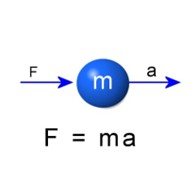
Using Newton’s second law, F = ma, gives:
ma = F(t)
Where
a = dv⁄dt
Therefore
m dv⁄dt = F(t)
Let us know integrate with respect to time:
m ∫ dv⁄dt dt = ∫ F(t) dt
∫ dv⁄dt dt = v
mv = ∫ F(t) dt + c
where c is an arbitrary constant of integration.
Example 1
An engineering component, P, of mass 2kg is moving in a straight line within the machine it is part of. P is initially at rest at a point O on the line of motion. The force acting on P has magnitude (3t2 + et) N at time t seconds and acts in the direction OP. Calculate:
The speed of P at time t = 2 seconds
The distance travelled at time t = 4 seconds
Using Newton’s second law, F = ma, with F = (3t2 + et) N and m = 2 kg gives:
F = ma
3t2 + et = 2a
Using
a = dv⁄dt
Gives
2 dv⁄dt = 3t2 + et
If we now integrate this with respect to t:
2 ∫ dv⁄dt = ∫ (3t2+et) dt
2v = 3⁄3 (t3) + et +c
2v = t3 + et + c
Now, we know from the information given in the question that v = 0 when t = 0 (initially at rest) and so we can substitute these values into this equation to find the value of c:
2(0) = (0)3+ e0 + c
0 = 0 +1 + c
c = -1
Hence:
2v = t3 + et -1
Finally, if we substitute the value for t = 2:
2v = 23 + e2 -1
v = 14.4⁄2 = 7.2 m/s
Now, we turn attention to the distance, x. From above, we know that:
2v = t3 + et -1
And we also know that
v = dx⁄dt
Therefore:
2 dx⁄dt = t3 + et -1
As before, let us integrate this with respect to time, t:
2 ∫ dx⁄dt dt = t3 + et -1
2x = 1⁄4 (t4)+ et – t + k
where k is some arbitrary constant of integration.
As x = 0 when t = 0, we can substitute this into the above equation to give:
0 = 0 + e0 + k
Where
e0 = 1
k = -1
So the equation for displacement, x, becomes:
2x = 1⁄4 t4 + et – t -1
We are interested in the value of displacement, x, when t = 4:
2x = 1⁄4 (4)4 + e4 – 4 -1
2x = 64 + e4 – 5 = 113.6
x = 56.8 m
Example 2
This example explores the motion of an engineering component subject to a time-dependent force. The component, denoted P, has a mass of 3 kg and moves in a straight line within the machine it is part of. At time t = 0, the component is initially at rest at point O, which we take as the origin of its motion.
The force acting on the component varies with time and is given by:
F(t) = 2t2 + et (in newtons)
Since this force acts along the direction of motion, it causes the component to accelerate. We will apply Newton’s Second Law to determine how this force affects the component’s velocity and displacement over time.
Mass m = 3 kg
Initial condition: at rest at point O, so v(0) = 0
Force: F(t) = 2t2 + et (Newtons)
We are to find:
Velocity as a function of time v(t)
Velocity at a specific time, e.g. t = 2
Displacement after a given time, e.g. t = 2
F(t) = m dv⁄dt
Substitute in the known values:
2t2 + et = 3 dv⁄dt
dv⁄dt = (2t2 + et ) ⁄3
Now integrate both sides:
∫dv = ∫(2t2⁄3 +et⁄3)dt
∫ dv = 2⁄3 ∫ (t2dt + 1⁄3 ∫ et )dt
v(t) =(2⁄3).t3 ⁄3 + 1⁄3et + c
At t = 0, v(0) = 0
0 = (2⁄3).03 ⁄3 + 1⁄3.(e0) + c
0 = 0 + 1⁄3 + c
c = -1⁄3
So the expression becomes
v(t) = (2⁄9) t3 + 1⁄3 et -1⁄3
When t = 2
v(2) = (2⁄9 )23 + 1⁄3e2 -1⁄3
v(2) = 3.907 m/s
To find the displacement , we need to integrate v(t)
x(t) = ∫ v(t) dt = ∫ (2⁄9) t3 + 1⁄3 et -1⁄3 )dt
x(t) = 2⁄9 ∫ t3.dt +1⁄3 ∫ et.dt – 1⁄3 ∫ 1.dt
x(t) = 1⁄18t4 + 1⁄3et –1⁄3t + c
Since x(0) = 0 when t = 0
0 = 0 + 1⁄3 – 0 +c
c = -1⁄3
x(t) = 1⁄18t4 + 1⁄3et –1⁄3t – 1⁄3
Now substitute t = 2
x(2) = 16⁄18 + 1⁄3 (3.907) – 2⁄3 – 1⁄3 = 1.1912m
Interested in our engineering courses?
We have over 70 courses across all major engineering disciplines, including, mechanical, electrical and electronic, civil, aerospace, industrial, computer and general engineering. Visit our course catalogue for a complete list of fully accredited engineering programmes.
A small selection of short courses …
Diploma in Mechanical Engineering
Diploma in Structural Engineering
Level 6 Courses
International Graduate Diploma in Mechanical Engineering
International Graduate Diploma in Civil Engineering
International Graduate Diploma in Aerospace Engineering
Level 5 Courses
Higher International Diploma in Mechanical Engineering
Higher International Diploma in Civil Engineering
Higher International Diploma in Aerospace Engineering
Level 4 Courses
Higher International Certificate in Mechanical Engineering
Higher International Certificate in Civil Engineering
Higher International Certificate in Aerospace Engineering
Alternatively, you can view all our online engineering courses here.
<
Recent Posts
Why a Headwind Reduces Take-Off Distance: The Airspeed–Groundspeed Derivation
Why a Headwind Reduces Take-Off Distance: The Airspeed–Groundspeed Derivation Aeroplanes normally take off into wind because the wing must reach a required airspeed to produce lift, whereas the runway distance is travelled at groundspeed. A headwind contributes to the airspeed before the aircraft has covered any runway. It therefore reduces the groundspeed required at lift-off […]
How to Calculate Aircraft Take-Off Ground Run: A Flight Mechanics Tutorial
How to Calculate Aircraft Take-Off Ground Run: A Flight Mechanics Tutorial An aircraft does not become airborne simply because its engines are producing thrust. During the take-off ground run, thrust must overcome aerodynamic drag and rolling resistance. On a sloping runway, it must also overcome a component of the aircraft’s weight. This tutorial derives a […]
Types of Aircraft Drag Explained: Induced, Profile and Interference Drag
Types of Aircraft Drag Explained: Induced, Profile and Interference Drag An aircraft experiences several forms of aerodynamic drag at the same time. Some result from generating lift, some arise as air flows over the aircraft’s surfaces, and others are created when airflow around neighbouring components interacts. For a conventional aircraft in subsonic flight, total drag […]