

What is Inertia and how to Calculate it ?
Inertia is the property of matter that causes it to resist changes in its velocity. This includes changes to the object’s speed or direction of motion. Inertia is directly related to mass, the greater the mass, the greater the inertia.
In simple terms: “An object in motion stays in motion, and an object at rest stays at rest unless acted upon by an external force.” (Newton’s First Law of Motion)
Understanding inertia is essential in many areas of engineering such as mechanical, structural, aerospace, and robotic engineering, influencing the design of systems for stability, efficiency, energy storage, and dynamic control. Engineers use inertia principles to optimize performance, minimize vibration, and ensure safety in moving systems.
Types of Inertia
Inertia of Rest: Resistance to starting motion.
Inertia of Motion: Resistance to stopping or changing motion.
Inertia of Direction: Resistance to changing direction.
How to Calculate Inertia
There are two key contexts:
Linear Inertia (Mass)
For linear motion, inertia is simply the mass of the object.
Inertia linear = M
Where: M = mass of the object (in kilograms)
Example

You have a cart with a mass of 10 kg. What is its inertia?
For linear motion, inertia is equal to mass.
Inertia = M = 10 kg
So, the cart has 10 kg of inertia—this means it resists changes to its motion with the same “effort” as a 10 kg object.
Rotational Inertia (Moment of Inertia)
In rotational motion, inertia is quantified as the moment of inertia I, which depends on the mass distribution relative to the axis of rotation.
I = ∑MiRi2
Or for continuous bodies:
I = ∫ R2 dm
Where:
I = moment of inertia
Mi = mass of each particle
Ri = distance from the axis of rotation
Example
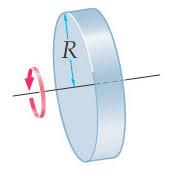
A solid disc of mass 5 kg and radius 0.4 meters is rotating about its central axis. What is its moment of inertia?
Use the formula for a solid disc:
I = ½ MR2
Where:
M = 5 kg
R = 0.4 m
I = ½ × 5 × 0.16
I = 12 × 0.8 = 0.4 kg⋅m2
So, the moment of inertia is 0.4 kg·m².
Interested in our engineering courses?
We have over 70 courses across all major engineering disciplines, including, mechanical, electrical and electronic, civil, aerospace, industrial, computer and general engineering. Visit our course catalogue for a complete list of fully accredited engineering programmes.
A small selection of short courses …
Diploma in Mechanical Engineering
Diploma in Structural Engineering
Level 6 Courses
International Graduate Diploma in Mechanical Engineering
International Graduate Diploma in Civil Engineering
International Graduate Diploma in Aerospace Engineering
Level 5 Courses
Higher International Diploma in Mechanical Engineering
Higher International Diploma in Civil Engineering
Higher International Diploma in Aerospace Engineering
Level 4 Courses
Higher International Certificate in Mechanical Engineering
Higher International Certificate in Civil Engineering
Higher International Certificate in Aerospace Engineering
Alternatively, you can view all our online engineering courses here.
Recent Posts
Why a Headwind Reduces Take-Off Distance: The Airspeed–Groundspeed Derivation
Why a Headwind Reduces Take-Off Distance: The Airspeed–Groundspeed Derivation Aeroplanes normally take off into wind because the wing must reach a required airspeed to produce lift, whereas the runway distance is travelled at groundspeed. A headwind contributes to the airspeed before the aircraft has covered any runway. It therefore reduces the groundspeed required at lift-off […]
How to Calculate Aircraft Take-Off Ground Run: A Flight Mechanics Tutorial
How to Calculate Aircraft Take-Off Ground Run: A Flight Mechanics Tutorial An aircraft does not become airborne simply because its engines are producing thrust. During the take-off ground run, thrust must overcome aerodynamic drag and rolling resistance. On a sloping runway, it must also overcome a component of the aircraft’s weight. This tutorial derives a […]
Types of Aircraft Drag Explained: Induced, Profile and Interference Drag
Types of Aircraft Drag Explained: Induced, Profile and Interference Drag An aircraft experiences several forms of aerodynamic drag at the same time. Some result from generating lift, some arise as air flows over the aircraft’s surfaces, and others are created when airflow around neighbouring components interacts. For a conventional aircraft in subsonic flight, total drag […]