

Analysis of Simple Machines
A machine can be described as an assembly of rigid bodies for transmitting force, motion or work
A machine is usually designed so that a desired load output from the machine is greater than the effort put in, for example a lever can lift a high load with a reasonably small force applied. The ratio of the load to effort is known as the mechanical advantage.
Mechanical Advantage (M.A) = load ( W) / effort (E)
As the load and the effort are forces and have the same units (N) the mechanical advantage has no units and is simply a ratio of these two values. In practice this mechanical advantage is obtained by allowing the effort to move a greater distance than the load.
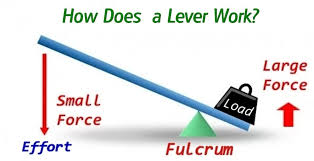
The diagram above shows how a simple lever operates with the effort applied and resulting load.
It is clear from this diagram that the effort must travel a greater distance than the load to raise it so that the weight is lifted. The greater the length of this level the smaller the effort that needs to be applied as the resulting moment will be greater.
Since the distance that the effort and load moves takes place over the same period of time, the ratio of these distances is also equal to the ratio of the velocities.
The velocity ratio of a machine is defined as:
Velocity Ratio (V.R) = distance moved by effort / distance moved by load
Just as the mechanical advantage, velocity ratio has no units.
For an ideal machine where no losses are present, such as friction, the velocity ratio is equal to the mechanical advantage. This statement leads us to the principle that the work input into a machine is the same as the work output by the machine.
Work input = effort x distance moved by effort
Work output = load x distance moved by load
Work input = work output
Effort x distance moved by effort = load x distance moved by load
Which leads to:
Distance moved by effort / distance moved by load = load / effort
For an ideal machine:
V.R = M.A
In practice, the work output is always less than the work input because of friction and other losses. This leads to examining the efficiency of a machine. The efficiency of a machine can be described by the useful work done by the machine divided by the work put into the machine.
Efficiency = work output/work input
Efficiency = load x distance moved by the load / actual effort x distance moved by the effort
Which leads to:
Efficiency ( η) = M.A / V.R
Example
The load on a lever is 2 kN and acts 20 mm from the fulcrum. The effort is 200 mm from the fulcrum. Assuming 80% efficiency, calculate the effort applied.
The velocity ratio.
V.R = distance moved by effort / distance moved by load = 200 / 20 = 10
Efficiency η = M.A / V.R
Rearranging gives:
M.A = η x V.R = 0.8 x 10 = 8
The mechanical advantage given by the lever is 8.
M.A = load / effort
Effort = load / M.A = 2000 / 8 = 250N
Example
A simple pulley system is shown opposite. A 50N effort is used to move an 80N load. The final effort moves 2 metres and at the same time the load moves 1 metre.
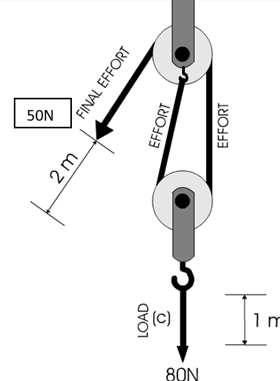
What is the Mechanical advantage, velocity ratio and efficiency of the pulley?
M.A = load / effort = 80 / 50 = 1.6
V.R = distance moved by effort / distance moved by load = 2 / 1 = 2
η = M.A / V.R = 1.6 / 2 = 0.8 or 80%
Interested in our engineering courses?
We have over 70 courses across all major engineering disciplines, including, mechanical, electrical and electronic, civil, aerospace, industrial, computer and general engineering. Visit our course catalogue for a complete list of fully accredited engineering programmes.
A small selection of short courses …
Diploma in Mechanical Engineering
Diploma in Structural Engineering
Level 6 Courses
International Graduate Diploma in Mechanical Engineering
International Graduate Diploma in Civil Engineering
International Graduate Diploma in Aerospace Engineering
Level 5 Courses
Higher International Diploma in Mechanical Engineering
Higher International Diploma in Civil Engineering
Higher International Diploma in Aerospace Engineering
Level 4 Courses
Higher International Certificate in Mechanical Engineering
Higher International Certificate in Civil Engineering
Higher International Certificate in Aerospace Engineering
Alternatively, you can view all our online engineering courses here.
<
Recent Posts
Why a Headwind Reduces Take-Off Distance: The Airspeed–Groundspeed Derivation
Why a Headwind Reduces Take-Off Distance: The Airspeed–Groundspeed Derivation Aeroplanes normally take off into wind because the wing must reach a required airspeed to produce lift, whereas the runway distance is travelled at groundspeed. A headwind contributes to the airspeed before the aircraft has covered any runway. It therefore reduces the groundspeed required at lift-off […]
How to Calculate Aircraft Take-Off Ground Run: A Flight Mechanics Tutorial
How to Calculate Aircraft Take-Off Ground Run: A Flight Mechanics Tutorial An aircraft does not become airborne simply because its engines are producing thrust. During the take-off ground run, thrust must overcome aerodynamic drag and rolling resistance. On a sloping runway, it must also overcome a component of the aircraft’s weight. This tutorial derives a […]
Types of Aircraft Drag Explained: Induced, Profile and Interference Drag
Types of Aircraft Drag Explained: Induced, Profile and Interference Drag An aircraft experiences several forms of aerodynamic drag at the same time. Some result from generating lift, some arise as air flows over the aircraft’s surfaces, and others are created when airflow around neighbouring components interacts. For a conventional aircraft in subsonic flight, total drag […]