

Critical Path Analysis: The Key to Efficient Engineering Project Planning
Introduction
Effective engineering projects rely on careful planning, clear priorities, and efficient use of time. Critical Path Analysis (CPA) is a powerful project management technique that helps engineers identify the most important tasks, the ones that directly determine the project’s completion date. By mapping task dependencies and highlighting the longest chain of activities, CPA allows teams to allocate resources more effectively, anticipate delays, and keep projects on track. Understanding how to apply Critical Path Analysis is essential for ensuring engineering projects are delivered efficiently and with confidence.
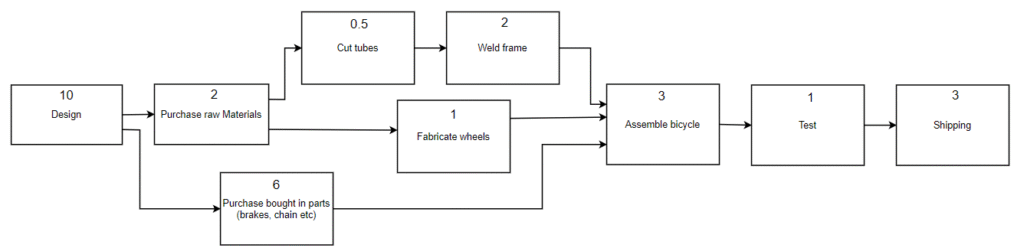
Let’s take a simplified project for designing and manufacturing a bicycle. Some of the main project activities can be shown in a network diagram as per below.

Notice how the project runs from left to right, and some activities can be done in parallel (e.g. making the frames, and fabricating the wheels) whilst some activities cannot start until the previous ones have finished (e.g. purchase of parts cannot start until the Design activity has finished).
The role as the project manager is to understand which activity must start first, how much slack or ‘float’ each activity has, and ultimately determine the critical path for this project.
So, the first job to do is to add how long each activity will take (the task duration), this has been added in as the number of days in the top centre of each box:
Earliest Start Time (EST) – The next piece of information we will add to the diagram is something called the Earliest Start Time. This details the earliest possible time that each task can start, given the duration of the tasks that must have already been completed. This is shown on the top left of each box in our diagram below.
Earliest Finish Time (EFT) – Similarly, the Earliest Finish Time is simply the earliest time each task can be finished given its start time and the duration to complete the task.
It can be written as EFT = EST + Task Duration. This number is written in the top right corner of each box.
Assuming we start the project on ‘day 0’, our network diagram would now look like this:
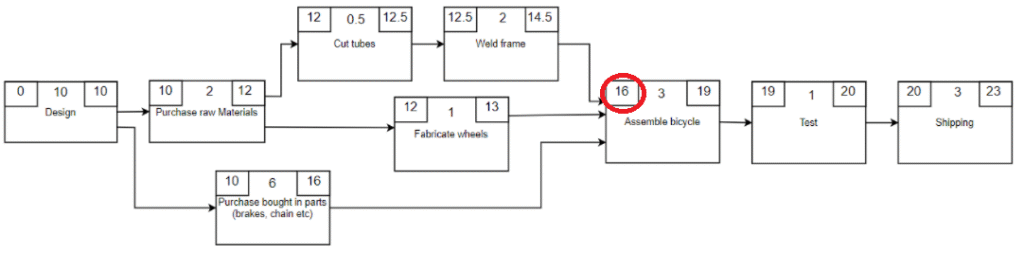
Notice how the earliest start time for each activity is the same as the highest finish time for the previous activities. E.g. The bicycle assembly cannot start until day 16 as this is the latest finish time of the 3 tasks that feed into it.
Doing this ‘forward’ pass of working left to right we have determined our earliest possible project finish time, 23 days.
Backwards Pass
Now, let’s consider we work backwards from our earliest project finish time. The purpose for doing this is to identify any slack within the activities, i.e. some of these activities could start later than the earliest start time without affecting the overall project.
Latest Finish Time (LFT) – The latest finish time is the latest that each task could finish without affecting the overall project.
We know the project should finish in 23 days, so we start by putting that as the latest finish time for the final (shipping) task.
The latest finish time is written in the bottom right of each box:
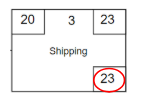
Latest Start Time (LST) – If we now start to work right-to-left (i.e. backwards) through our network, we can easily find the latest start time for each task. I.e. the latest time that any task can start without affecting the overall project. This is simply found by working backwards, i.e. LST = LFT – task duration.
The latest start time is written in the bottom left of each task box, so for ‘shipping’, the latest start time is day 20.

Working backwards through the diagram we can start to calculate the latest finish and therefore the latest start time for each activity, see the diagram below:

Let’s take a look at the activity ‘Purchase raw materials’. The two tasks following this are ‘cut tubes’ and ‘fabricate wheels’, but these both have different latest start times. In these instances you need to take the lowest of the latest start times. That’s because we need to finish the task ‘purchase raw materials’ to ensure we can start the task ‘cut tubes’ before the latest possible start time
Slack
Now that we have all this information, what can we do with it?
Well for each task we can now easily calculate the slack or float available in that task. We can do this simply by looking at the difference between the earliest and latest start times for each task. That is Slack = LST – EST. We can write this number in the bottom centre of the box for each task.

If we do that for our full process, we get:

What we have now identified in red is the Critical Path (that is, activities which have zero slack). In other words, all those tasks that have zero slack must be started on time in order for our project to keep to the schedule. If any of these items overrun, we know it will have a knock-on effect on the whole project.
Conversely, for the tasks not on the critical path, we have identified how much slack or float there is to start that task. E.g. Let’s look at the task ‘fabricate wheels’ in our project. This task has 3 days of slack, so we can start that task anytime between day 12 (EST) and day 15 (LST) and it won’t affect the overall project plan.
By identifying the critical path we now know which tasks we must prioritise and ensure they stick to schedule. In a real world example, let’s say we have some staff sickness, and we only have 1 Purchasing staff. It’s clear that in this example, they should concentrate on purchasing the bought in parts (brakes, chain etc) before they purchase the raw material because the ‘bought in parts’ are on the critical path.
Interested in our Mechanical and Aerospace Engineering Courses?
At iLearn Engineering®, we offer a diverse range of online accredited engineering courses and qualifications to cater to different academic and career goals. Our engineering courses are available in varying credit values and levels, ranging from 40 credit Engineering Diplomas to a 360 credit International Graduate Diploma.
All Mechanical and Aerospace Engineering Courses
All Mechanical Engineering Diploma Courses are here.
All Aerospace Engineering Diploma Courses are here.
Short Courses (40 Credits)
A selection of our more popular 40 credit mechanical and aerospace engineering diplomas…
Diploma in Mechanical Engineering
Diploma in Aerospace Engineering
First Year of Undergraduate (Level 4 – 120 Credits)
Higher International Certificate in Engineering
Higher International Certificate in Mechanical Engineering
Higher International Certificate in Aerospace Engineering
First Two Years of Undergraduate (Level 5 – 240 Credits)
Higher International Diploma in Engineering
Higher International Diploma in Mechanical Engineering
Higher International Diploma in Aerospace Engineering
Degree Equivalent International Graduate Diploma (Level 6 – 360 Credits)
International Graduate Diploma in Engineering
International Graduate Diploma in Mechanical Engineering
International Graduate Diploma in Aerospace Engineering
Complete Engineering Course Catalogue (all courses)
Alternatively, you can view all our online engineering courses here.
Recent Posts
Why a Headwind Reduces Take-Off Distance: The Airspeed–Groundspeed Derivation
Why a Headwind Reduces Take-Off Distance: The Airspeed–Groundspeed Derivation Aeroplanes normally take off into wind because the wing must reach a required airspeed to produce lift, whereas the runway distance is travelled at groundspeed. A headwind contributes to the airspeed before the aircraft has covered any runway. It therefore reduces the groundspeed required at lift-off […]
How to Calculate Aircraft Take-Off Ground Run: A Flight Mechanics Tutorial
How to Calculate Aircraft Take-Off Ground Run: A Flight Mechanics Tutorial An aircraft does not become airborne simply because its engines are producing thrust. During the take-off ground run, thrust must overcome aerodynamic drag and rolling resistance. On a sloping runway, it must also overcome a component of the aircraft’s weight. This tutorial derives a […]
Types of Aircraft Drag Explained: Induced, Profile and Interference Drag
Types of Aircraft Drag Explained: Induced, Profile and Interference Drag An aircraft experiences several forms of aerodynamic drag at the same time. Some result from generating lift, some arise as air flows over the aircraft’s surfaces, and others are created when airflow around neighbouring components interacts. For a conventional aircraft in subsonic flight, total drag […]