

Mechanical Engineering Courses and Diplomas: Topics, Skills and Career Routes
Introduction
Every mechanical engineer starts with curiosity. For some, it begins by taking apart a bicycle to see how the gears work. For others, it might be wondering how an aircraft engine can generate enough thrust to lift hundreds of passengers into the sky, or how a Formula One car can remain glued to the track while travelling at extraordinary speeds. Some are fascinated by robotics, renewable energy, or advanced manufacturing, while others simply enjoy solving practical problems and understanding how things work.
Whatever sparks that initial interest, the journey into mechanical engineering quickly reveals an important truth: mechanical engineering is far more than machines.
It is the science of motion, energy and forces. It is the study of how materials behave under load, how heat can be converted into useful work, how fluids move through complex systems, and how thousands of individual components come together to create reliable, efficient and safe engineering solutions. It is a discipline built upon mathematics, physics, creativity and analytical thinking, where every decision influences another.
Because of this complexity, becoming a mechanical engineer is not something that happens after completing a single course. It is a gradual process of building knowledge layer upon layer, developing not only technical understanding but also the judgement needed to solve increasingly complex engineering problems.
Choosing what to study, therefore, is not simply a decision about enrolling on a course. It is a decision about how far you want to develop your understanding, what responsibilities you hope to take on throughout your career, and the type of engineer you ultimately want to become.
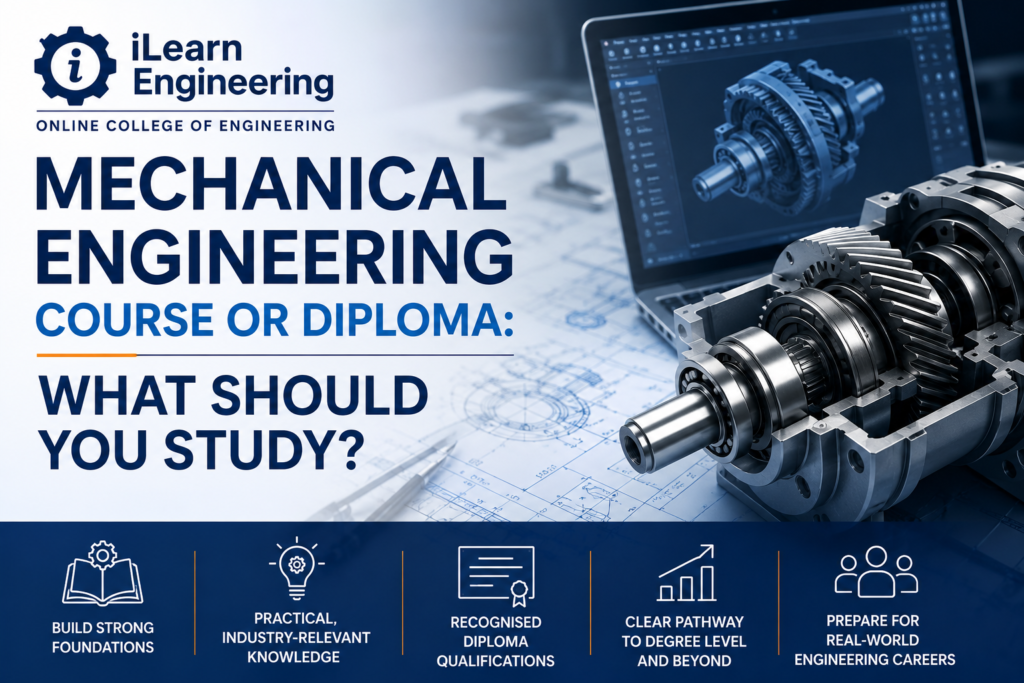
Because of this breadth, your study pathway is not just about gaining knowledge, it’s about defining the level at which you want to operate within the engineering profession. Whether your goal is to build a strong technical foundation, develop advanced analytical and design capabilities, or progress to professional-level engineering practice, each stage of study represents a deliberate step forward in both depth and responsibility.
As you advance, the focus shifts from understanding how systems work to questioning, improving, and ultimately innovating within them. Your chosen pathway should therefore reflect not only your current abilities, but your long-term ambitions, whether that is entering industry, progressing to degree-level study, or positioning yourself as a future engineering specialist or leader.
Mechanical engineering is a broad and technically demanding discipline, covering everything from fundamental physics to complex system design, and your study pathway should reflect how far you intend to progress within that space.
For many learners, the journey begins with short courses. These provide a focused introduction to specific areas such as CAD design, thermodynamics basics, or manufacturing processes. They are practical, accessible, and often immediately useful in the workplace. However, they tend to operate in isolation. You might learn how to use a tool or understand a concept, but you are not necessarily building a cohesive engineering framework. This is the key limitation, short courses develop skills, but they rarely develop engineers.
EduQual Level 4
Diploma-level study changes that dynamic completely. At Level 4, the emphasis is on establishing the intellectual foundation of mechanical engineering.
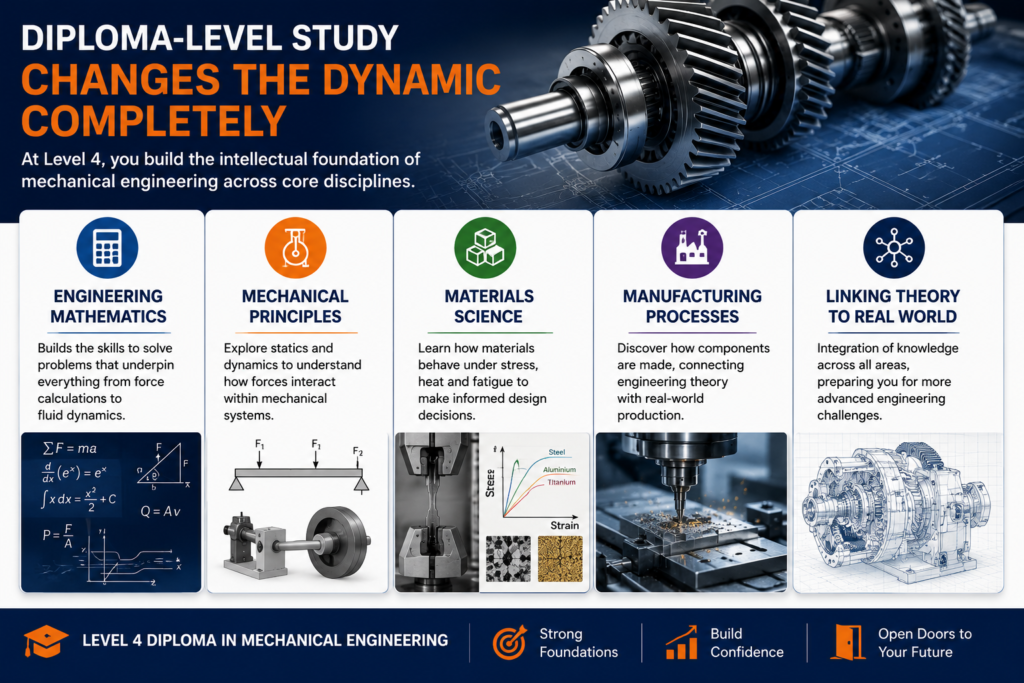
At this stage, students are introduced to the subjects that underpin every area of mechanical engineering.
Engineering Mathematics develops confidence with algebra, trigonometry, calculus and statistical techniques that later become essential when analysing engineering systems.
Engineering Science introduces the scientific principles that govern force, motion, energy, electricity and materials.
Engineering Design & Ethics begins to shift the focus towards professional engineering practice, encouraging learners to think not only about how something works, but whether it should be designed in a particular way and what responsibilities engineers have to society.
Alongside these core subjects, Mechanical Engineering students begin studying Structural Mechanics & Dynamics and Machines and Systems. These units introduce the behaviour of engineering structures, mechanical components and machine elements, allowing students to connect scientific theory with practical engineering applications.
At this point something important begins to happen. Engineering stops feeling like a collection of school subjects. Instead, students begin recognising that mathematics, physics and engineering design all describe different aspects of the same engineering problem.
EduQual Level 5
Progressing to Level 5, the learning becomes more analytical and applied.
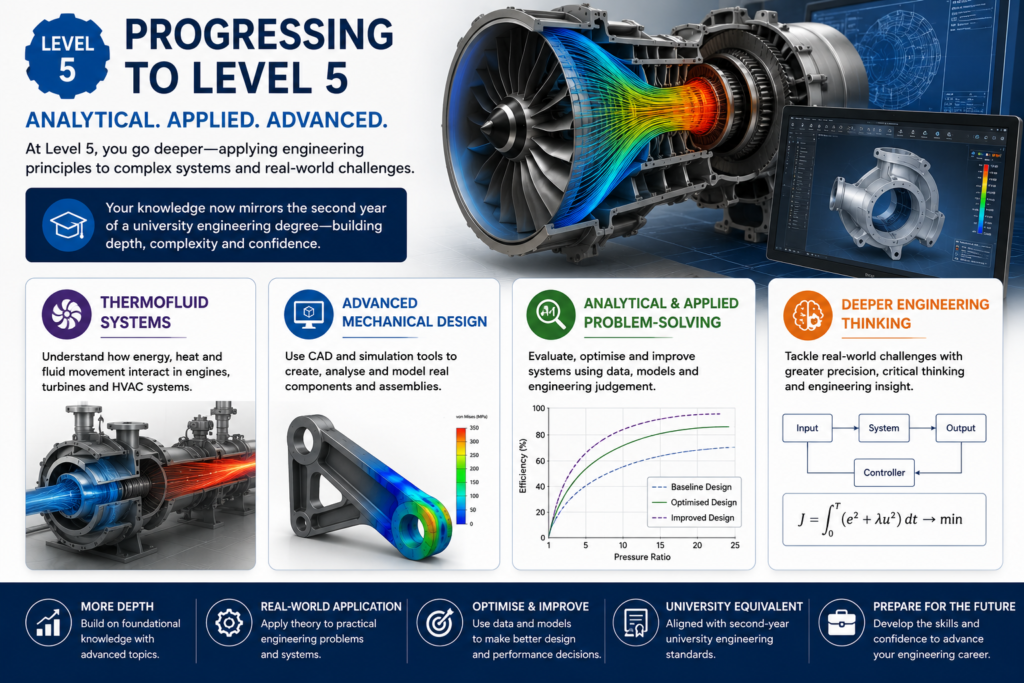
Students begin to engage with thermofluid systems, understanding how energy, heat, and fluid movement interact in engines, turbines, and HVAC systems. Mechanical design becomes more advanced, often incorporating CAD and simulation tools to model real components. There is also a stronger emphasis on problem-solving, students are expected not just to understand systems, but to evaluate, optimise, and improve them. At this stage, the knowledge base closely mirrors the second year of a university engineering degree, both in complexity and expectation.
This is reflected in subjects such as Research Skills and Project Management, which introduce structured investigation, planning and technical communication, alongside Engineering Management, where engineering decisions are considered within organisational and commercial contexts.
These diploma qualifications are typically awarded by recognised bodies such as EduQual, which ensures that the learning is externally quality-assured and aligned with international academic standards. This recognition is crucial. It means that what you are studying is not only structured and rigorous, but also transferable and respected globally, whether you choose to continue your education or enter the workforce.
Thinking Like a Professional Engineer
Ask an experienced engineer what makes someone an engineer, and the answer is rarely “they know lots of equations.”
Professional engineers are distinguished by the way they approach problems. They rarely begin with a solution.
Instead, they begin by asking questions.
What is the problem?
What are the constraints?
What information is available?
What assumptions are reasonable?
What are the risks?
Which solution offers the best balance between performance, safety, cost and sustainability?
This style of thinking develops gradually.
By EduQaul Level 5, students begin moving beyond finding correct answers towards identifying appropriate solutions.
That subtle difference represents one of the biggest transitions within engineering education.
Level 6
By the time a learner reaches Level 6, the transformation is significant. The focus now shifts towards innovation, integration and professional judgement., Engineering systems are no longer viewed as collections of individual components. Instead, they are analysed as complete, interconnected systems where decisions in one area influence performance elsewhere
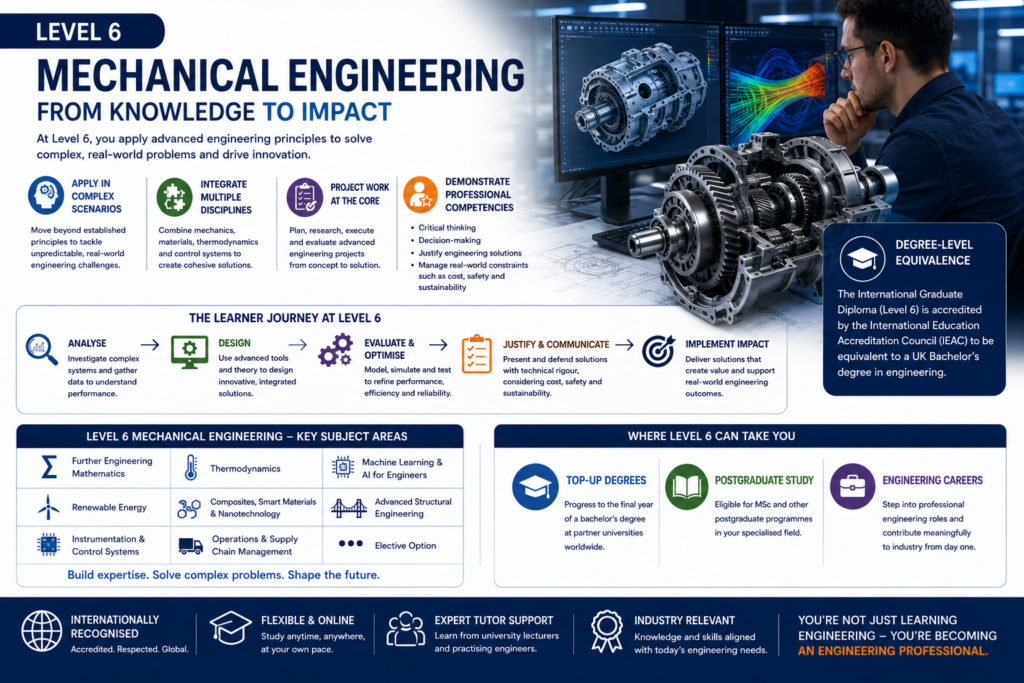
Project work becomes central, requiring planning, research, execution, and evaluation. This is where learners begin to demonstrate professional competencies: critical thinking, decision-making, and the ability to justify engineering solutions within real-world constraints such as cost, safety, and sustainability.
Importantly, Level 6 represents degree-level equivalence. It is not just another qualification, it is a culmination of the engineering learning journey, opening doors to top-up degrees, postgraduate study, or direct entry into engineering roles. At this point, learners are no longer just students; they are emerging professionals capable of contributing meaningfully to industry.
What makes this structured pathway particularly powerful is its flexibility. Unlike traditional routes that require a full commitment from the outset, this approach allows learners to progress step by step. You can begin with a short course to build confidence, move into a diploma to gain depth, and ultimately reach degree-level achievement. Each stage has standalone value, but together they form a coherent and strategic progression.
In practical terms, this means your decision should be guided by your long-term intent. If your goal is to gain a specific skill quickly, a short course is entirely appropriate. But if you are aiming to build a career in mechanical engineering, one that involves design responsibility, problem-solving, and progression into higher-level roles, then a diploma pathway is not just beneficial, it is essential.
Ultimately, mechanical engineering is about more than understanding machines. It is about applying scientific principles to solve real-world problems, improving systems, and driving innovation. To do that effectively, you need more than fragmented knowledge, you need a structured, recognised, and comprehensive education. Choosing the right study path is the first step in becoming the kind of engineer who can not only understand the world, but help shape it.
Engineering Never Really Stops
One of the unique characteristics of engineering is that education never truly ends.
Every generation of engineers encounters new materials, new software, new manufacturing methods and new technological challenges.
The mechanical engineer who graduated twenty years ago has witnessed the rise of additive manufacturing, digital twins, artificial intelligence, electric vehicles and advanced composite materials.
Tomorrow’s engineers will encounter technologies that have not yet been invented. This is why structured engineering education focuses less on memorising information and more on developing analytical thinking. Specific technologies may change. The principles of engineering remain remarkably constant.
A strong understanding of mathematics, mechanics, materials, energy and design enables engineers to adapt throughout their careers, regardless of how technology evolves.
Choosing the Path That Matches Your Ambition
Ultimately, choosing a mechanical engineering qualification is not simply about selecting the next course.
It is about deciding where you want your engineering journey to lead.
A short course may provide valuable knowledge in one specialist area and be exactly what a professional needs to update an existing skill.
A EduQual Level 4 qualification establishes the scientific and mathematical foundations upon which future engineering understanding depends.
EduQual Level 5 develops the analytical and technical capability expected of engineers working on increasingly complex projects.
Level 6 brings everything together, transforming accumulated knowledge into professional engineering judgement and preparing learners for degree-level practice.
Each stage has value in its own right.
Together, they represent something much more significant.
They represent the gradual transformation from someone who is interested in engineering into someone capable of contributing to it.
Mechanical engineering has always been about solving problems that matter. Whether designing cleaner energy systems, creating safer transport, improving manufacturing or developing technologies that have yet to be imagined, the profession depends on engineers who understand not only how things work, but why they work, and how they can be made better.
Choosing the right study pathway is therefore about much more than earning a qualification. It is the first step towards developing the knowledge, confidence and professional judgement needed to help shape the engineered world of tomorrow.

Interested in our Mechanical Engineering Courses?
At iLearn Engineering®, we offer a diverse range of online accredited Industrial, Manufacturing and Mechanical Engineering courses and qualifications to cater to different academic and career goals. Our industrial courses are available in varying credit values and levels, ranging from 40 credit Engineering Diplomas to a Bachelor’s equivalent 360 credit International Graduate Diploma.
All Mechanical and Manufacturing Engineering Courses
All Industrial / Manufacturing Engineering Diploma Courses can be seen here.
All Mechanical Engineering Diploma Courses can be seen here.
Short Courses for Mechanical Engineering (40 Credits)
A selection of short 40-credit diplomas in mechanical engineering are shown below:
- Diploma in Mechanical Engineering
- Diploma in Manufacturing
- Diploma in Lean Manufacturing
- Diploma in Mechanical Technology
- Diploma in Material Science
First Year of Undergraduate (Level 4 – 120 Credits)
Higher International Certificate in Industrial Engineering
Higher International Certificate in Mechanical Engineering
Years One and Two of Undergraduate (Level 5 – 240 Credits)
Higher International Diploma in Industrial Engineering
Higher International Diploma in Mechanical Engineering
Degree Equivalent International Graduate Diplomas in Engineering Management and Mechanical Engineering (Level 6 – 360 Credits)
International Graduate Diploma in Engineering Management (Level 6) [120 Credit Top Up]
International Graduate Diploma in Mechanical Engineering (Level 6) [120 Credit Top Up]
Complete Engineering Course Catalogue (all courses)
Alternatively, you can view all our online engineering courses here.
Get started today
Explore our range of Mechanical Engineering courses
Recent Posts
Why There Is No Perfect Aerofoil: The Design Trade-Offs Behind Every Aircraft Wing
Why There Is No Perfect Aerofoil: The Design Trade-Offs Behind Every Aircraft Wing If a designer could create a perfect aerofoil, it would produce very high lift with almost no drag, remain stable at every angle of attack, fit a lightweight structure inside the wing and work equally well at low and high speed. No […]
How Aerofoils Generate Lift: A Beginner’s Guide to Angle of Attack, Camber and Pressure Distribution
How Aerofoils Generate Lift: A Beginner’s Guide to Angle of Attack, Camber and Pressure Distribution An aerofoil does not create lift simply because its upper surface is curved. Lift is produced because the aerofoil meets the airflow at a suitable angle and shape, causing a pressure distribution that results in an aerodynamic force. For aircraft […]
Why Aircraft Engine Intakes Use Diffusers: Slowing Air to Recover Pressure
Why Aircraft Engine Intakes Use Diffusers: Slowing Air to Recover Pressure An aircraft engine needs a large, steady supply of air at its compressor face. That may sound simple, but the air approaching an aircraft is moving quickly, often with changes in direction, velocity and pressure caused by the aircraft’s shape and flight condition. An […]